
Medical Note: This article is for educational purposes only and should not replace professional medical advice. If your baby’s neck rash becomes painful, develops blisters, pus, fever, or does not improve within a few days, consult your pediatrician.
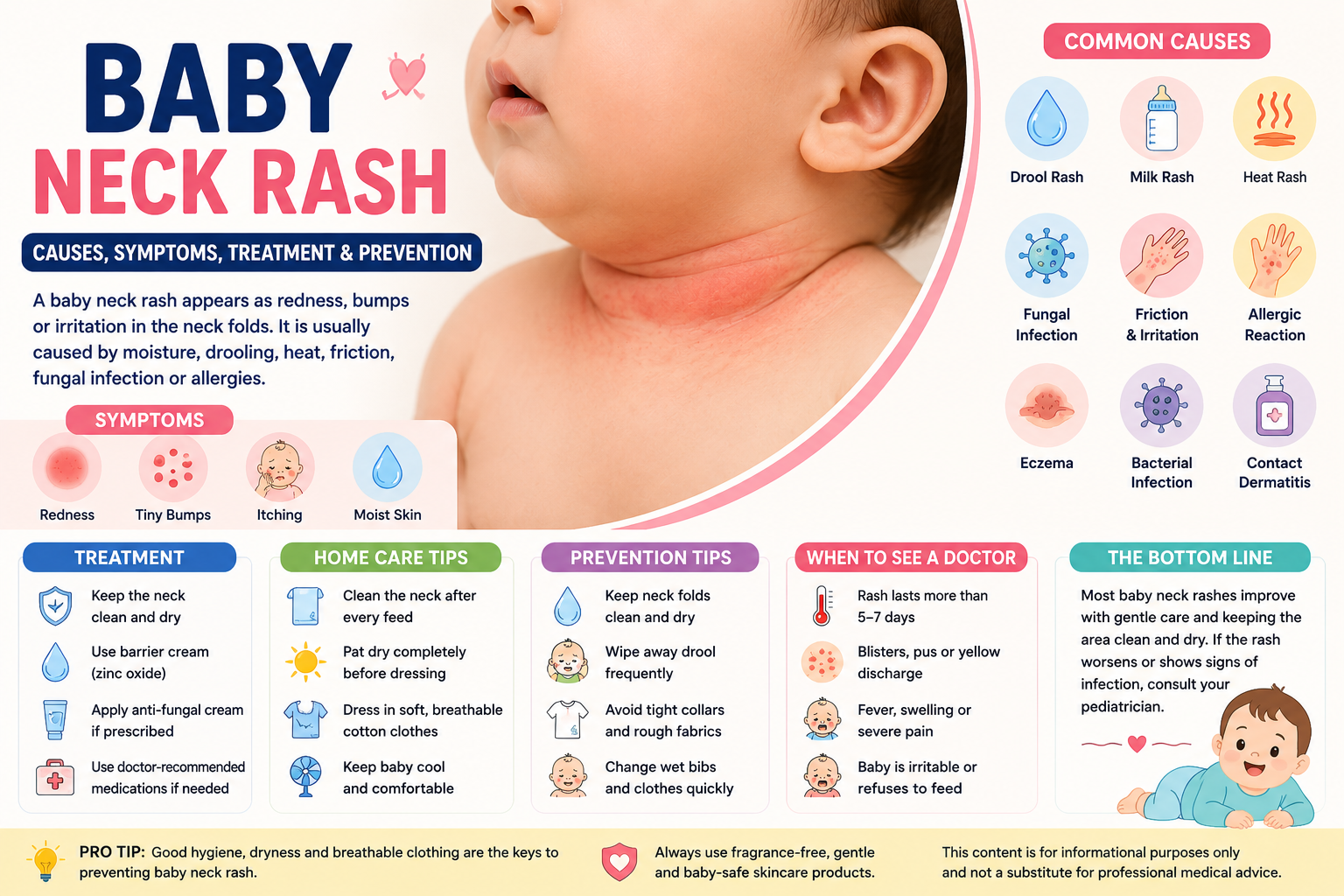
A baby neck rash is a common skin problem that appears as redness, irritation, bumps, or patches in the folds of a baby’s neck. Since babies have short necks with deep skin folds, moisture from milk, drool, sweat, and trapped heat can easily accumulate, making this area prone to irritation and infection.
Most neck rashes are mild and improve with proper hygiene, keeping the area dry, and using gentle skincare products. However, some rashes may be caused by fungal infections, eczema, bacterial infections, or allergies that require medical treatment.
This guide explains the causes, symptoms, treatment, home care, prevention tips, and when parents should seek medical attention.
What Is a Baby Neck Rash?
A baby neck rash is skin irritation or inflammation affecting the neck folds or surrounding skin. It may appear as:
- Red patches
- Tiny bumps
- Moist or shiny skin
- Dry flaky skin
- White patches
- Cracked skin
- Small blisters
The rash may affect one side of the neck or both sides, depending on the underlying cause.
Why Is the Neck Area So Prone to Rashes?
Babies often develop neck rashes because:
- Their neck folds trap moisture.
- Milk and formula can collect after feeding.
- Drool constantly wets the skin.
- Sweat builds up in warm weather.
- Air circulation is limited.
- Friction between skin folds causes irritation.
These factors make the neck one of the most common sites for skin irritation during infancy.
Common Causes of Baby Neck Rash
1. Heat Rash (Miliaria)
The most common cause.
Blocked sweat glands cause:
- Tiny red bumps
- Itching
- Prickly sensation
- Red patches
Read our Baby Heat Rash guide:
2. Drool Rash
Excess saliva may irritate the delicate neck skin, especially during:
- Teething
- Frequent spit-up
- Heavy drooling
The rash usually appears as:
- Bright redness
- Small bumps
- Moist irritated skin
3. Milk Rash
Milk that remains trapped inside neck folds after feeding may cause skin irritation.
Cleaning and drying the neck after every feed usually helps.
4. Fungal Infection (Yeast Infection)
Warm, moist neck folds create an ideal environment for yeast (Candida).
Symptoms include:
- Bright red rash
- Well-defined edges
- Small satellite bumps
- Moist skin
Read our Baby Fungal Infection guide:
5. Baby Eczema
Eczema can affect the neck and cause:
- Dry skin
- Red itchy patches
- Cracked skin
- Chronic irritation
Learn more in our Baby Eczema article:
6. Contact Dermatitis
Some babies develop a rash after contact with:
- Detergents
- Perfumes
- Lotions
- Baby wipes
- Fabric dyes
7. Friction Rash
Skin rubbing against skin may cause:
- Mild redness
- Irritation
- Soreness
This is especially common in chubby babies.
8. Bacterial Infection
Sometimes bacteria infect broken skin.
Symptoms include:
- Swelling
- Warm skin
- Yellow crust
- Pus
- Pain
Medical treatment is usually required.
Symptoms of Baby Neck Rash
Symptoms vary depending on the cause but commonly include:
- Redness
- Tiny bumps
- Moist skin
- Dry patches
- Flaky skin
- Itching
- Burning sensation
- Cracked skin
- Peeling
- Mild swelling
- White patches
- Foul smell (sometimes with yeast infection)
Baby Neck Rash vs Heat Rash
| Condition | Key Features |
|---|---|
| Baby Neck Rash | Localized to neck folds with multiple possible causes |
| Baby Heat Rash | Tiny red bumps caused by blocked sweat glands |
| Baby Eczema | Dry itchy inflamed patches |
| Baby Fungal Infection | Bright red moist rash with satellite lesions |
| Baby Dry Skin | Dry flaky skin without significant redness |
Is Baby Neck Rash Contagious?
Most neck rashes are not contagious.
However, rashes caused by bacterial or fungal infections may spread to nearby skin if left untreated.
How Is Baby Neck Rash Diagnosed?
Doctors usually diagnose a neck rash through:
- Physical examination
- Medical history
- Feeding habits
- Skin appearance
Occasionally, skin swabs or fungal tests may be recommended if an infection is suspected.
According to the American Academy of Dermatology (AAD), many infant skin conditions can be diagnosed by examining the appearance and location of the rash.
Risk Factors
Your baby is more likely to develop a neck rash if they:
- Drool excessively.
- Sweat frequently.
- Have deep neck folds.
- Live in a hot, humid climate.
- Have eczema.
- Wear tight clothing.
- Have sensitive skin.
- Experience frequent spit-up.
Can Baby Neck Rash Go Away on Its Own?
Yes.
Many mild neck rashes improve within 2–5 days after:
- Keeping the area dry
- Improving hygiene
- Reducing friction
- Using gentle moisturizers
If the rash worsens or spreads, medical evaluation is recommended.
Treatment for Baby Neck Rash
Treatment for a baby neck rash depends on its underlying cause. Most mild rashes caused by moisture, friction, drooling, or heat improve with gentle skincare and by keeping the neck folds clean and dry. If the rash is caused by a fungal, bacterial, or allergic condition, your pediatrician may recommend specific medications.
According to the American Academy of Dermatology (AAD), identifying the cause of a rash helps ensure the most effective treatment.
How Is Baby Neck Rash Treated?
1. Keep the Neck Clean
Clean your baby’s neck folds gently using:
- Lukewarm water
- A soft washcloth
- Mild fragrance-free baby cleanser (if needed)
Always clean the neck after:
- Feeding
- Spit-ups
- Excessive drooling
2. Dry the Neck Thoroughly
Moisture trapped in skin folds is one of the biggest causes of neck rashes.
After cleaning:
- Pat the skin dry.
- Avoid rubbing.
- Ensure all neck folds are completely dry before dressing your baby.
3. Apply a Barrier Cream
If irritation is caused by drool or friction, your pediatrician may recommend a protective barrier such as:
- Zinc oxide cream
- Petroleum-based ointment
- Baby-safe barrier cream
These products reduce skin irritation from saliva and moisture.
4. Moisturize Dry Skin
If dry skin or eczema is contributing to the rash:
- Apply a fragrance-free baby moisturizer.
- Use moisturizing creams immediately after bathing.
Read our Baby Dry Skin guide:
5. Treat Heat Rash
If heat rash is the cause:
- Dress your baby in lightweight cotton clothing.
- Keep the room cool.
- Avoid overheating.
Learn more in our Baby Heat Rash article:
6. Antifungal Treatment
For yeast (Candida) infections, doctors may prescribe:
- Antifungal cream
- Antifungal powder (when appropriate)
Read our Baby Fungal Infection article:
7. Treat Eczema
If eczema is causing the rash, treatment may include:
- Daily moisturizers
- Gentle skincare
- Prescription creams if required
Parents can learn more in our Baby Eczema guide:
8. Antibiotics (If Needed)
If a bacterial infection develops, your doctor may prescribe:
- Antibiotic cream
- Oral antibiotics for more severe infections
Never use antibiotics without medical advice.
Home Care Tips
Simple home care often helps mild neck rashes heal faster.
Keep the Neck Dry
Gently wipe away:
- Drool
- Milk
- Sweat
throughout the day.
Clean After Every Feeding
Milk trapped in skin folds is a common trigger for irritation.
Use a soft cloth to clean the neck after each feed.
Choose Breathable Clothing
Dress your baby in:
- Loose cotton clothes
- Lightweight fabrics
Avoid synthetic materials that trap heat.
Reduce Friction
Avoid:
- Tight collars
- Rough fabrics
- Thick bibs worn for long periods
Bathe Daily During Hot Weather
A short lukewarm bath helps remove sweat and bacteria while keeping your baby comfortable.
What Parents Should Avoid
Avoid:
- Scrubbing the rash
- Applying talcum powder directly to broken skin
- Using adult medicated creams
- Applying essential oils without medical advice
- Leaving wet bibs on for long periods
- Using heavily scented skincare products
Can Baby Neck Rash Be Prevented?
Yes. Most neck rashes can be prevented with simple daily care.
Parents should:
- Keep neck folds clean and dry.
- Wipe away drool frequently.
- Clean the neck after every feeding.
- Dress babies in breathable cotton clothing.
- Change wet bibs promptly.
- Avoid overheating.
- Use fragrance-free skincare products.
- Moisturize dry skin regularly.
The HealthyChildren.org (American Academy of Pediatrics) recommends maintaining good skin hygiene and reducing prolonged moisture exposure to help prevent skin irritation in babies.
Possible Complications
Most neck rashes heal without problems.
If left untreated, complications may include:
- Secondary bacterial infection
- Yeast overgrowth
- Painful skin cracks
- Bleeding
- Persistent inflammation
- Skin discoloration after healing
Baby Neck Rash vs Baby Drool Rash
| Baby Neck Rash | Baby Drool Rash |
|---|---|
| Multiple possible causes | Primarily caused by saliva |
| May involve fungal or bacterial infection | Usually irritation from drooling |
| Can be dry or moist | Often moist and red |
| May require medication | Usually improves with barrier creams and keeping the area dry |
| Can spread if infected | Usually stays around the chin and neck |
Parents should also read our Baby Face Rash (https://momsaathi.com/baby-face-rash/) article if the rash extends to the cheeks or chin.
When Should You See a Doctor?
Consult your pediatrician if:
- The rash lasts longer than 5–7 days.
- It spreads rapidly.
- Blisters develop.
- Pus or yellow discharge appears.
- Your baby has a fever.
- The rash becomes painful.
- Your baby refuses to feed.
- There is significant swelling or bleeding.
- Home care does not improve the rash.
According to the NHS, persistent, infected, or worsening skin rashes in babies should be evaluated by a healthcare professional.
Conclusion
A baby neck rash is a common condition that usually develops because of trapped moisture, drooling, friction, heat, or sensitive skin. Most mild rashes improve with proper hygiene, keeping the neck folds dry, and using gentle baby skincare products. However, fungal infections, eczema, allergies, or bacterial infections may require medical treatment.
Parents should also learn to distinguish a neck rash from Baby Heat Rash, Baby Fungal Infection, Baby Eczema, Baby Dry Skin, Baby Face Rash, and Baby Diaper Rash, as each condition has different causes and treatment approaches. Early care and preventive measures can keep your baby’s skin healthy and comfortable.
Frequently Asked Questions (FAQs)
What causes a baby neck rash?
Common causes include drool, milk trapped in neck folds, sweat, friction, heat rash, eczema, fungal infections, and contact dermatitis.
Is a baby neck rash normal?
Yes. It is a common condition, especially in young babies with deep neck folds.
Can drooling cause a neck rash?
Yes. Excess saliva can irritate the skin and lead to redness and small bumps.
How long does a baby neck rash last?
Most mild cases improve within 2–5 days with proper care.
Is baby neck rash contagious?
Most neck rashes are not contagious. However, fungal and bacterial infections can spread if left untreated.
Can milk cause a neck rash?
Yes. Milk trapped in neck folds may irritate the skin if not cleaned away after feeding.
Should I use baby powder?
Avoid applying powder directly to broken or irritated skin. Follow your pediatrician’s advice for appropriate skin care.
Can neck rash be caused by eczema?
Yes. Eczema frequently affects skin folds, including the neck.
Can a fungal infection develop in the neck folds?
Yes. Warm, moist skin folds provide an ideal environment for yeast (Candida) to grow.
Should I keep the neck covered?
No. Allowing air circulation helps the skin stay dry and heal more quickly.
Can neck rash smell bad?
A foul odor may occur with yeast or bacterial infections due to excess moisture.
Is coconut oil safe for a neck rash?
Consult your pediatrician before using oils, especially if the rash may be fungal, as some oils can worsen moisture retention.
When should I worry about a baby neck rash?
Seek medical care if the rash is painful, has pus, causes fever, spreads rapidly, or does not improve after several days of home care.
Can I prevent baby neck rash?
Yes. Regular cleaning, drying the neck folds, changing wet bibs, and using breathable clothing can significantly reduce the risk.
Can a neck rash come back?
Yes. Babies who drool heavily or sweat frequently may experience recurrent neck rashes until they grow older and their neck folds become less prominent.