
Medical Note: This article is for educational purposes only and should not replace professional medical advice. If your baby’s facial rash spreads rapidly, develops blisters or pus, is accompanied by fever, affects the eyes, or causes feeding difficulties, consult your pediatrician immediately.
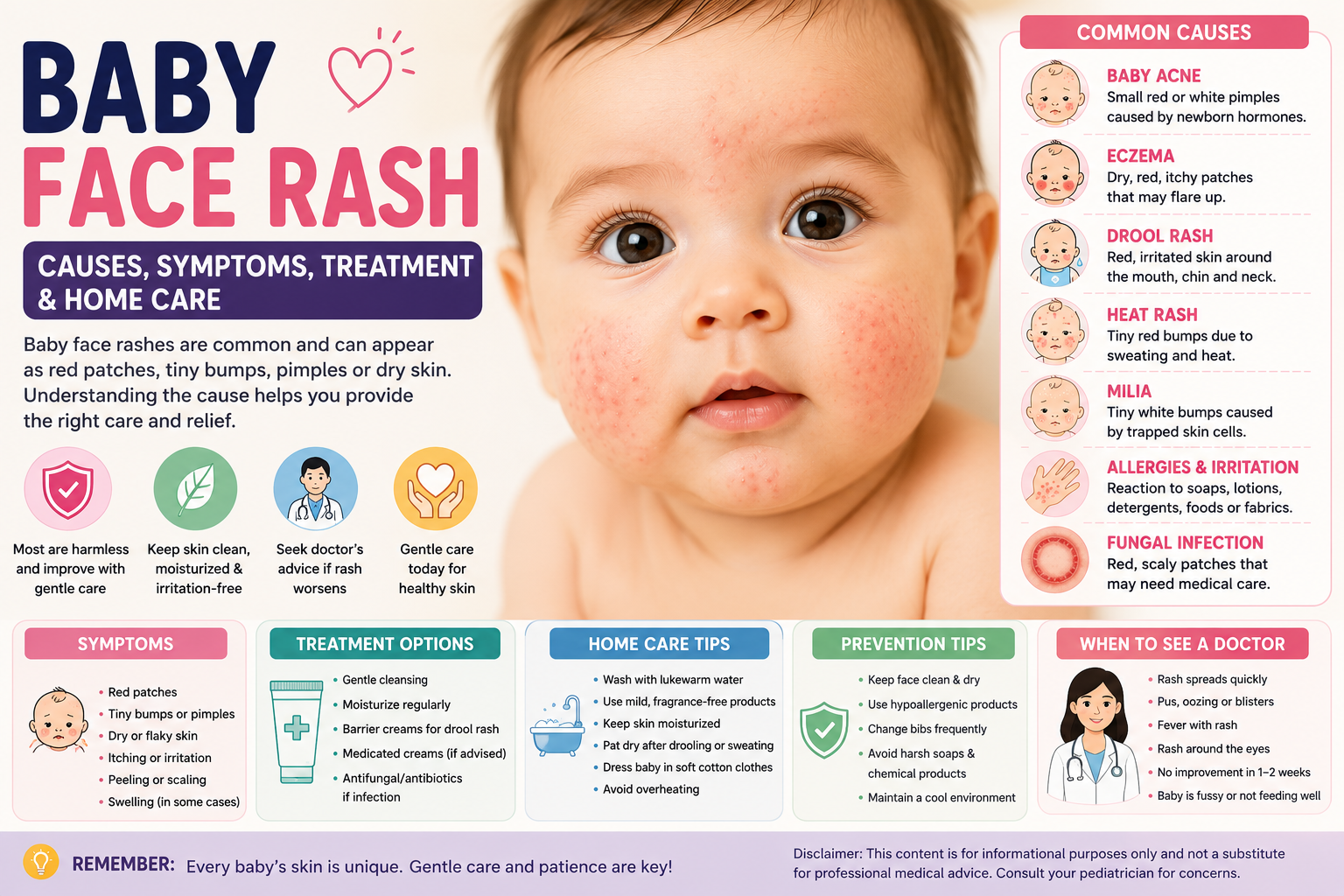
A baby face rash is one of the most common skin concerns during infancy. It can appear as red patches, tiny bumps, dry skin, peeling, or small pimples on your baby’s cheeks, chin, forehead, around the mouth, or near the eyes. While many facial rashes are harmless and disappear on their own, others may require medical treatment depending on the underlying cause.
Since babies have delicate and sensitive skin, facial rashes can develop due to irritation, eczema, heat, allergies, fungal infections, drooling, or common newborn skin conditions such as baby acne or milia. Identifying the cause is important because treatment varies for each condition.
This guide explains the causes, symptoms, diagnosis, treatment options, home care tips, prevention strategies, and warning signs parents should know.
What Is a Baby Face Rash?
A baby face rash refers to any redness, bumps, scaling, dryness, irritation, or skin discoloration that appears on a baby’s face. It may affect one small area or the entire face and can range from mild irritation to a skin condition requiring medical attention.
Some facial rashes are temporary and harmless, while others may indicate eczema, infection, or an allergic reaction.
Is Baby Face Rash Common?
Yes.
Facial rashes are extremely common during the newborn and infant stages because:
- Baby skin is thinner than adult skin.
- The skin barrier is still developing.
- Saliva, milk, sweat, and friction easily irritate the skin.
- Babies frequently touch their faces.
Most facial rashes improve within a few days or weeks with appropriate skincare.
Common Causes of Baby Face Rash
1. Baby Acne
Baby acne usually appears during the first few weeks of life.
Symptoms include:
- Small red bumps
- Tiny white pimples
- Pimples on the cheeks, forehead, or chin
Read our detailed guide on Baby Acne to learn how to care for newborn acne safely.
2. Baby Eczema
Eczema often causes:
- Dry red patches
- Itching
- Rough skin
- Inflamed cheeks
Babies with eczema may also develop dry skin on the arms and legs. Learn more in our Baby Eczema guide.
3. Drool Rash
Drool rash commonly affects:
- Chin
- Around the mouth
- Neck folds
Symptoms include:
- Red irritated skin
- Small bumps
- Dryness
Our article on Baby Drool Rash explains how saliva can irritate sensitive skin.
4. Heat Rash
Hot weather may cause:
- Tiny red bumps
- Mild itching
- Facial irritation
Read our guide on Baby Heat Rash for prevention tips.
5. Baby Milia
Milia are tiny white bumps caused by trapped keratin.
They usually appear on:
- Nose
- Cheeks
- Chin
They disappear naturally within a few weeks.
Learn more in our article on Milia in Newborns.
6. Allergic Contact Dermatitis
Some babies develop facial rashes after exposure to:
- Lotions
- Soaps
- Laundry detergents
- Fragrances
- Certain foods
Removing the irritant often improves the rash.
7. Fungal Infection
Although less common on the face, fungal infections may cause:
- Circular red patches
- Scaling
- Mild itching
Read our guides on Baby Ringworm and Baby Fungal Infection.
8. Dry Skin
Dry facial skin can cause:
- Rough patches
- Flaking
- Mild redness
Parents can also read our Baby Dry Skin guide.
Symptoms of Baby Face Rash
Symptoms depend on the underlying cause and may include:
- Red patches
- Tiny bumps
- White bumps
- Dry skin
- Peeling skin
- Itching
- Small pimples
- Scaling
- Crusting
- Mild swelling
Baby Face Rash vs Other Skin Conditions
| Condition | Key Features |
|---|---|
| Baby Acne | Small pimples on cheeks and forehead |
| Baby Eczema | Dry itchy patches |
| Baby Drool Rash | Rash around mouth and chin |
| Baby Heat Rash | Tiny sweat bumps |
| Baby Ringworm | Circular scaly patches |
| Milia | Tiny white bumps |
| Baby Dry Skin | Flaky rough skin |
Is Baby Face Rash Contagious?
Most baby face rashes are not contagious.
Not contagious:
- Baby acne
- Eczema
- Milia
- Heat rash
- Drool rash
- Dry skin
Contagious:
- Ringworm (fungal infection)
- Certain bacterial infections
Unlike Baby Chicken Skin (Keratosis Pilaris) (https://momsaathi.com/baby-chicken-skin/), fungal infections can spread through close contact.
How Is Baby Face Rash Diagnosed?
Doctors usually diagnose a baby face rash through:
- Physical examination
- Medical history
- Assessment of symptoms
- Skin examination
If infection is suspected, additional tests such as skin scrapings or cultures may be recommended.
According to the American Academy of Dermatology (AAD), many common childhood skin conditions can be diagnosed based on their appearance without laboratory testing.
Risk Factors
Your baby may be more likely to develop a face rash if they:
- Have sensitive skin
- Have eczema
- Drool excessively
- Sweat frequently
- Have a family history of allergies
- Are exposed to irritating skincare products
Can Baby Face Rash Heal on Its Own?
Many facial rashes, including baby acne, milia, heat rash, and mild drool rash, improve without medical treatment.
However, eczema, fungal infections, bacterial infections, or persistent allergic rashes may require evaluation and treatment by a healthcare professional.
Treatment for Baby Face Rash
Treatment depends on the underlying cause of the rash. Many mild facial rashes improve with gentle skincare, while eczema, fungal infections, allergies, or bacterial infections may require medical treatment.
According to the American Academy of Dermatology (AAD), proper diagnosis is important because different facial rashes require different treatments.
How Is Baby Face Rash Treated?
1. Baby Acne
Baby acne usually disappears without treatment within a few weeks or months.
Parents should:
- Wash the face with lukewarm water.
- Avoid scrubbing the skin.
- Do not squeeze pimples.
- Avoid applying adult acne products.
For more information, read our Baby Acne guide.
2. Baby Eczema
If eczema is causing the facial rash, treatment may include:
- Fragrance-free moisturizers
- Gentle cleansers
- Prescription creams (when recommended)
Our Baby Eczema article explains long-term eczema care.
3. Drool Rash
Drool rash improves when the skin is kept clean and dry.
Parents should:
- Wipe saliva gently.
- Apply a protective barrier cream if advised.
- Change wet bibs frequently.
Read our Baby Drool Rash article for complete care tips.
4. Heat Rash
If sweating is the cause:
- Keep your baby cool.
- Dress them in lightweight cotton clothing.
- Avoid overheating.
Our Baby Heat Rash guide explains how to prevent heat-related rashes.
5. Dry Skin
Dry facial skin improves with:
- Fragrance-free moisturizers
- Lukewarm baths
- Gentle cleansers
Parents can also refer to our Baby Dry Skin article.
6. Fungal Infection
If a fungal infection is responsible, your doctor may prescribe:
- Antifungal cream
- Oral antifungal medicine (in severe cases)
The NHS notes that fungal skin infections should be treated with appropriate antifungal medication rather than steroid creams alone.
Learn more in our Baby Fungal Infection guide.
7. Allergic Contact Dermatitis
If the rash is caused by an allergen:
- Stop using the suspected product.
- Switch to fragrance-free baby skincare products.
- Follow your pediatrician’s advice if medication is needed.
Home Care Tips
Most mild baby face rashes improve with consistent gentle skincare.
Wash the Face Gently
Clean your baby’s face with:
- Lukewarm water
- Soft cotton cloth
- Mild baby cleanser (if needed)
Avoid harsh rubbing.
Moisturize Daily
Use a fragrance-free moisturizer suitable for babies, especially if your baby has dry or sensitive skin.
Keep the Face Dry
Milk, saliva, and sweat can irritate delicate skin.
Gently pat the face dry after:
- Feeding
- Drooling
- Bathing
Avoid Irritating Products
Choose skincare products that are:
- Fragrance-free
- Alcohol-free
- Designed for babies
Trim Fingernails
Keeping your baby’s nails short helps prevent scratching and secondary skin infections.
What Parents Should Avoid
Avoid:
- Picking pimples or bumps
- Using adult acne creams
- Applying steroid creams without medical advice
- Scrubbing the rash
- Using heavily scented skincare products
- Trying home remedies such as toothpaste or lemon juice
Can Baby Face Rash Be Prevented?
Although not every facial rash can be prevented, these measures may reduce the risk:
- Wash your baby’s face gently every day.
- Moisturize dry skin regularly.
- Keep drool and milk from remaining on the skin.
- Use fragrance-free baby products.
- Avoid overheating.
- Wash bibs, towels, and bedding frequently.
- Introduce new skincare products one at a time.
The HealthyChildren.org (American Academy of Pediatrics) recommends gentle skincare and prompt medical evaluation if a rash worsens or is associated with other symptoms.
Possible Complications
Most baby face rashes heal without complications.
However, untreated rashes may occasionally lead to:
- Secondary bacterial infection
- Skin irritation
- Persistent itching
- Temporary skin discoloration
- Scarring (rare)
Baby Face Rash vs Baby Acne
| Baby Face Rash | Baby Acne |
|---|---|
| General term covering many skin conditions | A specific newborn skin condition |
| May be caused by eczema, drool, heat, fungus, or allergy | Usually caused by newborn hormonal changes |
| Treatment depends on the cause | Often resolves without treatment |
| May occur anywhere on the face | Most common on cheeks, forehead, and chin |
If your baby’s face has small pimples rather than a widespread rash, read our Baby Acne (https://momsaathi.com/baby-acne/) guide.
When Should You See a Doctor?
Consult your pediatrician if:
- Your baby is younger than 3 months and develops a widespread facial rash.
- The rash spreads rapidly.
- Fever develops.
- Blisters or pus appear.
- The rash affects the eyes.
- Your baby has difficulty feeding.
- The rash persists for more than 2 weeks despite home care.
- You suspect eczema, fungal infection, or an allergic reaction.
According to the Mayo Clinic, babies with persistent or worsening facial rashes should be evaluated by a healthcare professional.
Conclusion
A baby face rash is common during infancy and can result from baby acne, eczema, drool rash, heat rash, dry skin, allergies, fungal infections, or other skin conditions. Most facial rashes improve with gentle skincare, while others may require medical treatment.
Parents should also learn to distinguish baby face rashes from conditions such as Baby Acne, Baby Eczema, Baby Drool Rash, Baby Heat Rash, Baby Dry Skin, Baby Ringworm, Baby Fungal Infection, and Milia in Newborns so they can provide the most appropriate care.
Frequently Asked Questions (FAQs)
Is a baby face rash common?
Yes. Facial rashes are very common in newborns and infants.
What is the most common cause of a baby face rash?
Baby acne, eczema, drool rash, heat rash, and milia are among the most common causes.
Is baby acne the same as a facial rash?
Baby acne is one possible cause of a facial rash but not the only one.
Can teething cause a face rash?
Yes. Excessive drooling during teething may lead to drool rash around the mouth and chin.
Is baby face rash contagious?
Most facial rashes are not contagious. However, fungal and certain bacterial infections can spread.
Can dry skin cause a facial rash?
Yes. Dry skin can lead to rough, flaky, red patches on the face.
Should I apply baby lotion to a facial rash?
Use only fragrance-free moisturizers recommended for babies, and avoid applying medicated creams without medical advice.
Can heat cause a face rash?
Yes. Heat rash commonly affects babies during hot or humid weather.
How often should I wash my baby’s face?
Clean your baby’s face gently once or twice daily and after feeds or drooling episodes.
Can milk cause a facial rash?
Milk residue left on the skin may irritate sensitive skin but does not usually cause a true allergy-related rash unless advised by your doctor.
Does a baby face rash itch?
Some conditions like eczema are itchy, while baby acne and milia usually are not.
Can food allergies cause a facial rash?
Yes. Some babies may develop facial rashes as part of an allergic reaction to food, though this is less common in young infants.
When should I worry about a baby face rash?
Seek medical attention if the rash spreads quickly, develops blisters or pus, affects the eyes, is associated with fever, or does not improve with home care.
Will my baby’s face rash go away?
Most common facial rashes improve within a few weeks with appropriate care.
Can I prevent baby face rashes?
Good skincare, keeping the face clean and dry, avoiding irritants, and using fragrance-free baby products can help reduce the risk of many common facial rashes.