
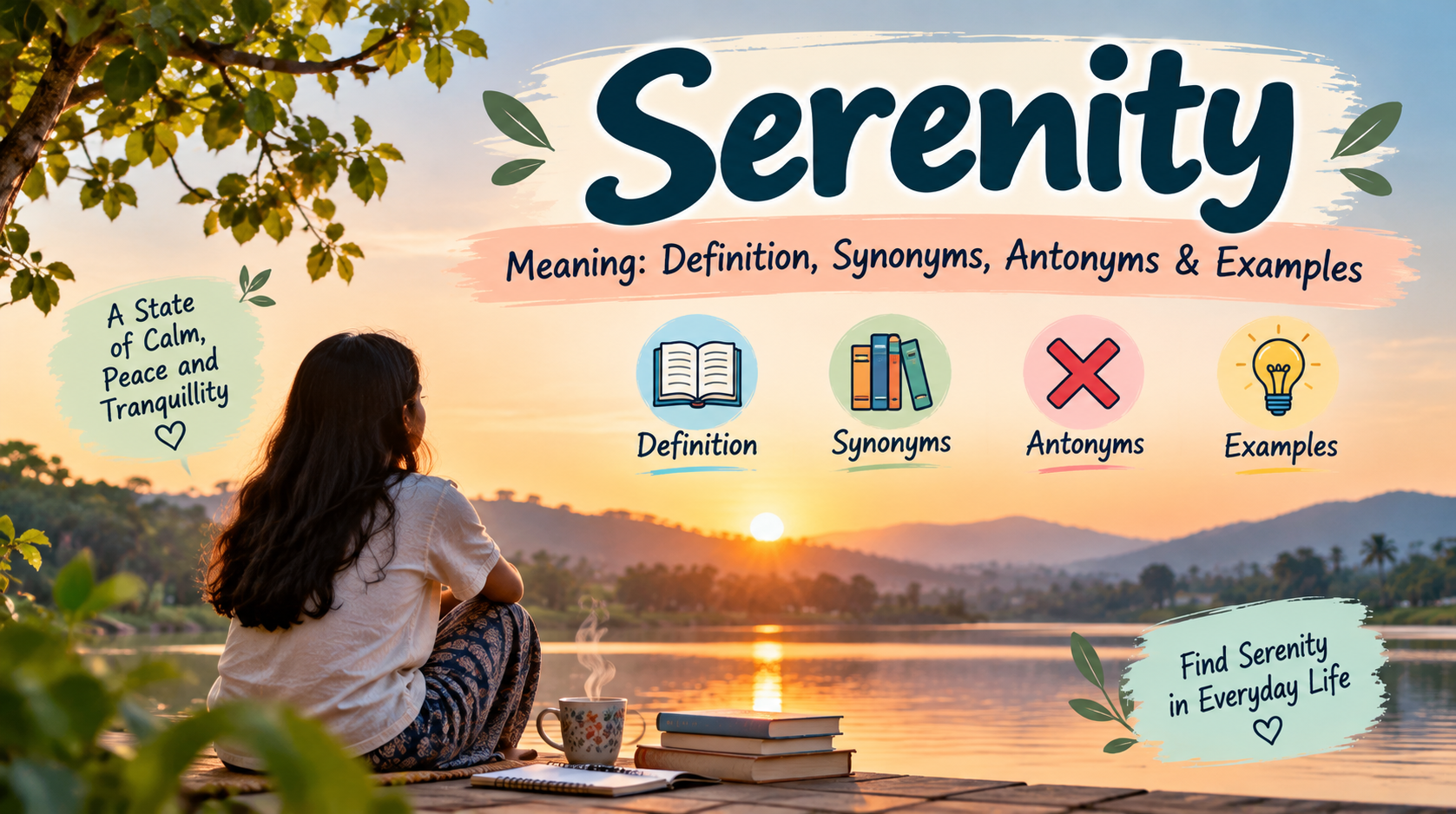

Have you ever felt completely peaceful while watching a sunset, listening to gentle music, or spending a quiet moment with your family? That feeling of calmness and peace can be described by one beautiful word: serenity.
The word serenity means a state of being calm, peaceful and free from disturbance. It can describe a peaceful mind, a quiet environment or a feeling of inner balance.
In this article, you’ll learn the meaning of serenity in English and Hindi, its synonyms and antonyms, examples of serenity in sentences, and the difference between serenity and peace.
What Is the Meaning of Serenity?
Serenity means a state of peace, calmness and tranquillity, especially when a person or environment is free from disturbance.
In simple words, serenity is the feeling of being calm and peaceful, even when life around you is busy or challenging.
According to the Cambridge Dictionary, serenity is the quality of being peaceful and calm.
Here are the essential details about the word:
- Serenity meaning in Hindi: शांति, सुकून, मन की शांति
- Serenity meaning in simple English: A peaceful and calm state.
- Part of speech: Noun
- Pronunciation: suh-REN-uh-tee
- Synonym: Peace, calmness, tranquillity
- Antonym: Agitation, turmoil, disturbance
Example: She enjoyed the serenity of the garden early in the morning.
In this sentence, serenity describes the peaceful atmosphere of the garden.
Serenity Meaning in Different Situations
The word serenity can describe different experiences, depending on the context. It may refer to a person’s emotions, a peaceful natural setting or a quiet moment in everyday life.
1. Serenity of the Mind
Mental serenity refers to a feeling of inner peace and calmness. Someone might experience it while meditating, reading a book or spending quiet time alone.
Example: A few minutes of quiet breathing brought serenity to her mind.
2. Serenity in Nature
Natural surroundings are often associated with serenity. Quiet beaches, green gardens, mountains and lakes can create a feeling of peace and tranquillity.
Example: The serenity of the mountains made the holiday unforgettable.
3. Serenity in Everyday Life
Serenity can also describe peaceful moments in ordinary routines, such as drinking tea in the morning, talking to a loved one or enjoying a quiet evening at home.
Example: She found serenity in her simple evening routine.
4. Serenity in Difficult Situations
Serenity can describe the ability to remain calm when facing pressure, uncertainty or disagreement.
Example: Despite the unexpected problem, he maintained his serenity and focused on finding a solution.
Synonyms of Serenity
Synonyms are words that have the same or a similar meaning.
The most common synonyms of serenity are peace, calmness, tranquillity and peacefulness. Other words may be suitable depending on the sentence.
| Synonym | Meaning |
|---|---|
| Peace | A state free from conflict or disturbance |
| Calmness | A relaxed and composed state |
| Tranquillity | A peaceful state without disturbance |
| Peacefulness | The quality of being calm and undisturbed |
| Composure | The ability to remain calm and in control |
| Stillness | A state of quiet or lack of movement |
| Equanimity | Mental calmness, especially during difficult situations |
| Placidity | A calm, peaceful and undisturbed state |
| Repose | A state of rest or relaxation |
| Quietude | A state of quietness or stillness |
Although these words are related, they are not always interchangeable.
For example, composure usually refers to remaining in control of your emotions, while tranquillity often describes a peaceful environment or state of mind.
Antonyms of Serenity
Antonyms are words with opposite or contrasting meanings.
The main antonyms of serenity describe emotional disturbance, anxiety, confusion or a lack of peace.
| Antonym | Meaning |
|---|---|
| Agitation | A state of nervous excitement or disturbance |
| Anxiety | A feeling of worry or uneasiness |
| Turmoil | A state of confusion, conflict or emotional disturbance |
| Chaos | A state of complete confusion or disorder |
| Restlessness | An inability to relax or remain still |
| Disturbance | An interruption of peace or calmness |
| Tension | A state of mental or emotional strain |
| Uneasiness | A feeling of discomfort or worry |
Example: The loud argument disturbed the serenity of the house.
Here, the argument interrupts the peaceful atmosphere.
10 Example Sentences Using the Word Serenity
Learning a new word becomes easier when you see how it is used in everyday English.
Here are 10 example sentences using the word serenity:
- The serenity of the lake made everyone feel relaxed.
- She enjoyed the serenity of the early morning.
- Meditation helped him find a sense of serenity.
- The garden offered a welcome feeling of serenity after a busy day.
- Her calm voice brought serenity to the room.
- The serenity of the countryside was refreshing.
- Reading her favourite book gave her a moment of serenity.
- The family enjoyed the serenity of their peaceful home.
- She tried to maintain her serenity during the difficult conversation.
- The sound of gentle rain added to the serenity of the evening.
These examples show that serenity can describe both a peaceful environment and a calm emotional state.
What Is the Difference Between Serenity and Peace?
Serenity and peace have similar meanings, but they are used in slightly different ways.
Serenity usually describes a deep sense of calmness and tranquillity. Peace has a broader meaning and can refer to the absence of conflict, disturbance or disagreement.
| Serenity | Peace |
|---|---|
| Often describes a deep sense of calmness and tranquillity. | Can describe the absence of conflict or disturbance. |
| Frequently refers to inner calm or a quiet atmosphere. | Can refer to personal, social or international situations. |
| Example: She felt serenity while sitting beside the lake. | Example: The two neighbours made peace after their disagreement. |
In simple terms, serenity often suggests a gentle, settled kind of peace, while peace can describe a wider range of situations.
How Can You Experience More Serenity in Everyday Life?
Modern life can feel busy, particularly when balancing work, family responsibilities and personal commitments. Although challenges cannot always be avoided, small habits may help you create more peaceful moments.
Here are a few simple ways to make room for serenity in your daily routine.
1. Take a short break: Step away from your daily tasks for a few minutes and give yourself time to relax.
2. Spend time in nature: A walk in a park or a few minutes in your garden can provide a welcome break from a busy routine.
3. Practise mindful breathing: Slow, comfortable breathing can help you pause and pay attention to the present moment.
4. Make time for yourself: Reading, listening to music or enjoying a cup of tea without distractions can become a calming part of your day.
5. Set realistic expectations: Accepting that you cannot do everything at once may help reduce unnecessary pressure.
6. Enjoy small family moments: Sharing a conversation, playing with your children or having an unhurried meal together can make ordinary days feel more meaningful.
7. Limit unnecessary distractions: Taking a short break from notifications and social media may help you enjoy the present moment.
For additional information, the National Center for Complementary and Integrative Health explains meditation and mindfulness practices, including research into their potential benefits and limitations.
Serenity does not mean that life must always be perfect. It means allowing yourself moments of calm even when responsibilities and challenges remain.
Words Related to Serenity
Understanding related words can help you expand your English vocabulary and use the word serenity more accurately.
Serene
Serene is an adjective meaning peaceful, calm and untroubled.
Example: The garden looked serene in the early morning.
Read more about the word in the Cambridge Dictionary’s definition of serene.
Serenely
Serenely is an adverb meaning in a calm or peaceful manner.
Example: She smiled serenely as she watched the children play.
Serenity
Serenity is a noun that describes the quality or state of being peaceful.
Example: The quiet surroundings gave her a feeling of serenity.
Related Names Associated with Peace
Serenity is also a popular concept in names that represent peace, calmness or harmony.
If you’re exploring meaningful names for your baby, you may also like these guides:
Frequently Asked Questions About Serenity
1. What does serenity mean in simple words?
Serenity means peace, calmness and a feeling of being relaxed without disturbance. It can describe a peaceful mind, a quiet place or a calming experience.
2. What is the meaning of serenity in Hindi?
Serenity means शांति, सुकून or मन की शांति in Hindi. The most suitable translation depends on the context.
3. Is serenity a noun or an adjective?
Serenity is a noun. Its related adjective is serene, which means calm or peaceful.
Example: The serene garden filled her with serenity.
4. What is the opposite of serenity?
Common opposites of serenity include agitation, turmoil, chaos and disturbance. Anxiety and restlessness may also be antonyms when describing emotional calmness.
5. What are the synonyms of serenity?
Common synonyms of serenity include peace, calmness, tranquillity, peacefulness, composure and quietude.
6. What does serenity of mind mean?
Serenity of mind means a state of inner calmness in which a person feels mentally peaceful and composed.
7. How do you use serenity in a sentence?
You can use serenity to describe a peaceful person, place or experience.
Example: The serenity of the beach helped her unwind after a long week.
8. What is the difference between serene and serenity?
Serene is an adjective used to describe someone or something peaceful. Serenity is a noun that describes the quality or state of being peaceful.
Example: The serene garden filled her with serenity.
9. Is serenity the same as tranquillity?
Serenity and tranquillity have very similar meanings. Serenity often emphasises a feeling of inner peace, while tranquillity can describe a quiet environment or a peaceful state. Both words can describe calmness.
10. Can serenity describe a person?
Yes. Serenity can describe a person’s calm and composed state of mind, particularly during stressful situations.
Example: Her serenity during the difficult discussion impressed everyone.
Final Thoughts
Serenity is more than just another word for peace. It describes a sense of calmness and tranquillity that can be found in nature, quiet surroundings and everyday experiences.
Whether you’re learning English, improving your vocabulary or looking for ways to express feelings of peace, understanding the meaning of serenity can help you communicate more clearly.
Sometimes, serenity begins with something as simple as pausing for a moment and appreciating what is already around you.
In simple words: Serenity = Peace + Calmness + Tranquillity.