

Medical note: You cannot always identify a baby’s rash accurately from an online description. A rash that is worsening, spreading, persistent or making your baby very uncomfortable should be assessed by a healthcare professional. The NHS nappy rash guidance recommends seeking medical advice if the rash does not go away, gets worse, spreads, occurs with a high temperature or your baby seems very uncomfortable.
You open your baby’s diaper and notice a red rash.
Yesterday, it was a small pink patch.
Today, it looks brighter.
Then you notice tiny bumps.
Naturally, you begin wondering:
What type of diaper rash does my baby have?
The answer is not always as simple as “diaper rash.”
Diaper rash, also called diaper dermatitis, is a general term for inflamed skin in the diaper area. The most common type is irritant diaper dermatitis, but yeast, bacteria, allergic reactions and other skin conditions can also affect the diaper region. The American Academy of Pediatrics’ HealthyChildren guide to common diaper rashes identifies irritant dermatitis as the most common type of diaper rash, while clinical references describe Candida and other inflammatory skin conditions as additional causes.
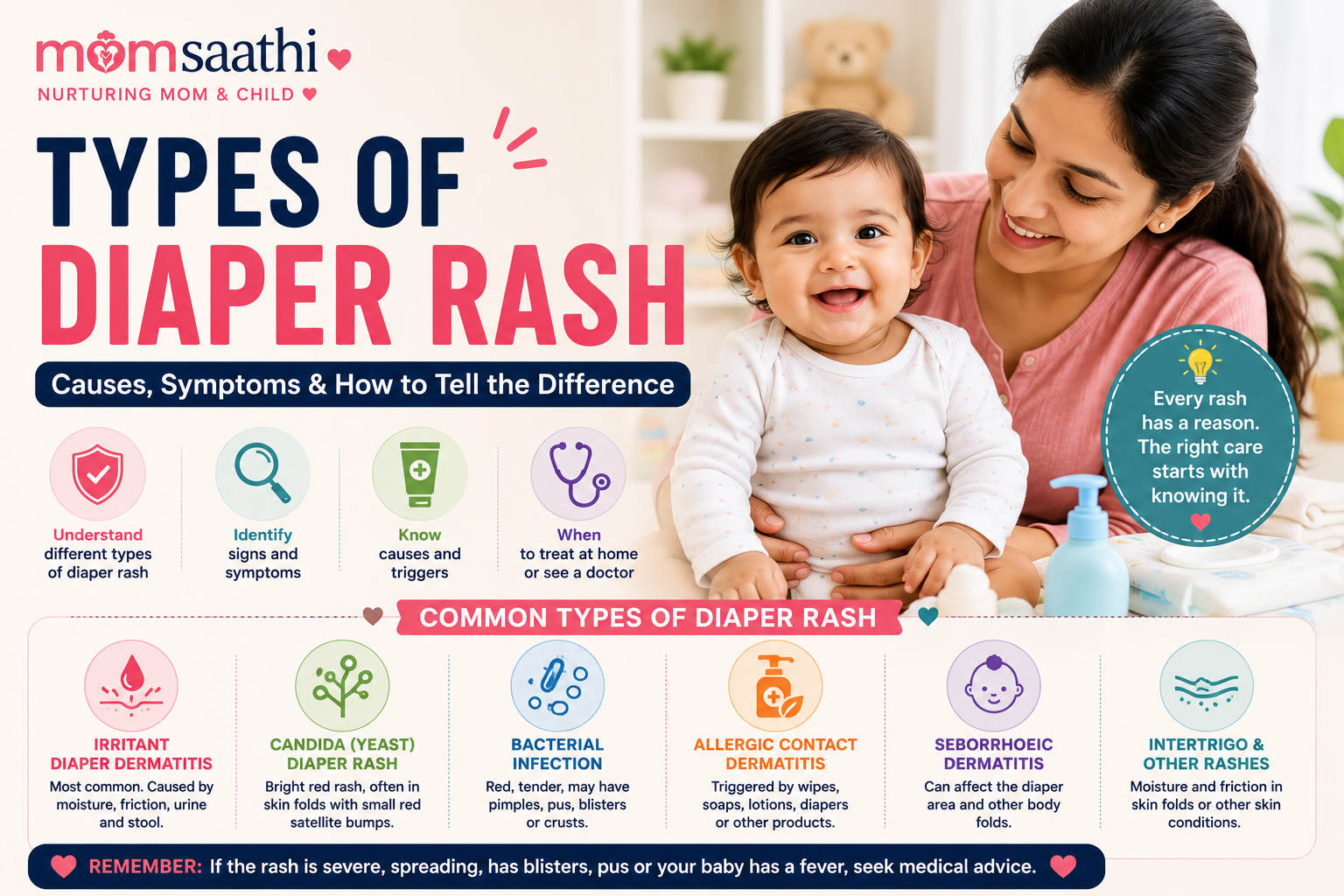
Quick answer: The main types of diaper rash include irritant diaper dermatitis, Candida or yeast diaper rash, bacterial skin infection, allergic contact dermatitis and rashes related to other skin conditions. Irritant rash often affects exposed areas and may spare the deep skin folds, while Candida commonly involves the folds and may have smaller surrounding “satellite” bumps.
What Is Diaper Rash?
Diaper rash is inflammation of the skin covered by a diaper.
You may notice changes around your baby’s:
- bottom;
- genitals;
- upper thighs;
- groin;
- lower abdomen.
The medical term often used is diaper dermatitis.
The diaper area creates a unique environment.
Your baby’s skin may be exposed to:
- urine;
- stool;
- moisture;
- friction;
- prolonged diaper contact.
Clinical guidance describes diaper dermatitis as an inflammatory reaction in the diaper area, with irritation being the most common cause.
If you are caring for a baby during the first year, MomSaathi’s complete baby care guide for Indian parents from 0 to 12 months also covers diaper changes, skin care, hygiene and other everyday baby-care concerns.
What Does Diaper Rash Look Like?
There is no single appearance shared by every diaper rash.
Depending on the cause, you may notice:
- red or discoloured skin;
- shiny-looking skin;
- dry patches;
- bumps;
- spots;
- scaling;
- irritated skin folds;
- raw-looking areas.
On darker skin tones, redness may be less obvious.
This is an important point for Indian parents.
Do not look only for a bright-red colour.
Also notice changes in:
- skin texture;
- swelling;
- warmth;
- bumps;
- your baby’s comfort.
The location and pattern of the rash can sometimes provide useful clues.
For example:
Does the rash spare the skin folds?
or:
Is the rash particularly noticeable inside the folds?
These patterns can help a healthcare professional consider possible causes, but they do not replace an examination.
Types of Diaper Rash at a Glance
| Type of Diaper Rash | Common Pattern |
|---|---|
| Irritant diaper dermatitis | Red or irritated exposed skin; folds may be relatively spared |
| Candida or yeast rash | Bright or deep red rash involving folds; may have satellite bumps |
| Bacterial infection | May appear intensely red, tender, crusted, blistered or infected |
| Allergic contact dermatitis | Rash after exposure to a product or material touching the skin |
| Seborrhoeic dermatitis | May involve folds and occur with rash elsewhere |
| Intertrigo | Irritation in skin folds caused by moisture and friction |
| Eczema or other skin conditions | May affect the diaper area as part of a broader skin condition |
Important: This table describes common patterns rather than providing a home diagnosis.
The AAP notes that irritant contact dermatitis typically spares the creases, while Candida infection commonly involves the creases and may appear beefy red with surrounding papules or satellite lesions.
1. Irritant Diaper Rash
Irritant diaper dermatitis is the most common type of diaper rash.
The AAP’s HealthyChildren guidance identifies irritant dermatitis as the most common diaper rash and explains that urine and stool can irritate skin in the diaper area.
Imagine your baby’s skin remaining:
warm + damp + exposed to urine or stool + rubbing against a diaper
That combination can damage the skin barrier and cause inflammation.
What Does Irritant Diaper Rash Look Like?
You may notice:
- redness or skin discolouration;
- irritated skin;
- shiny-looking areas;
- soreness;
- mild scaling.
The rash often affects areas with greater contact with the diaper and irritants.
These may include:
- buttocks;
- genital area;
- upper thighs.
One useful clinical clue is that the deeper skin folds may be relatively spared.
AAP clinical guidance specifically contrasts irritant dermatitis, which typically spares the creases, with Candida rash, which often involves them.
Think:
Exposed diaper-contact skin = irritated
Deep folds = less affected
This is a clue, not a guaranteed diagnosis.
What Causes Irritant Diaper Rash?
Common contributing factors include:
- prolonged contact with a wet diaper;
- stool exposure;
- diarrhoea;
- friction;
- infrequent diaper changes;
- excessive moisture.
The AAP explains that urine and stool are major irritants in the diaper area and that diarrhoea can increase the chance of diaper rash.
In India, hot and humid weather may also make keeping the diaper area dry more difficult.
MomSaathi’s monsoon baby care tips include frequent diaper changes and allowing the skin to air dry as practical diaper-rash prevention steps during humid weather.
How to Care for an Irritant Diaper Rash
The basic goal is simple:
Clean → dry → protect
Change wet or soiled diapers promptly.
Clean the area gently.
Avoid aggressive rubbing.
Allow the skin to dry.
A barrier preparation can help protect irritated skin from further contact with urine and stool.
The NHS recommends changing wet or dirty nappies as soon as possible, gently cleaning the area and using a thin layer of barrier cream to protect the skin.
MomSaathi’s complete baby care guide for 0 to 12 months also recommends frequent diaper changes, air exposure and barrier creams as basic diaper-rash care measures.
2. Yeast Diaper Rash or Candida Diaper Rash
A yeast diaper rash is commonly associated with Candida.
Candida is a type of yeast.
The warm, moist environment inside a diaper can provide conditions in which Candida can overgrow. Cleveland Clinic’s yeast diaper rash guide explains that Candida can grow in the warm and moist diaper area when the usual microbial balance changes.
A Candida rash can look different from a typical irritant rash.
What Does a Yeast Diaper Rash Look Like?
A Candida diaper rash may appear:
- bright or deep red;
- shiny;
- inflamed;
- particularly noticeable in skin folds.
You may also notice smaller red bumps around the main rash.
These are often called satellite lesions.
AAP clinical guidance describes Candida diaper rash as involving the creases, appearing beefy red and sometimes having surrounding papules at the edge.
A simple pattern to remember:
Irritant rash → folds may be spared
Candida rash → folds may be involved
Again, this is a clinical clue.
It is not a home diagnostic test.
What Are Satellite Lesions in Diaper Rash?
The phrase satellite lesions sounds complicated.
It simply describes smaller spots or bumps appearing outside the main area of rash.
Imagine:
one main red rash + several smaller red spots nearby
Those smaller spots are described as satellite lesions.
They can occur with Candida diaper dermatitis.
However, do not diagnose a yeast infection based on one bump.
A healthcare professional considers:
- the rash’s appearance;
- location;
- duration;
- your baby’s symptoms;
- medical history.
Why Do Babies Get Yeast Diaper Rash?
Candida grows well in warm and moist environments.
Factors that may contribute include:
- prolonged moisture;
- an existing irritated diaper area;
- changes in the balance of microorganisms on the skin.
Antibiotic exposure can also be relevant in some babies.
Cleveland Clinic notes that certain medications can disrupt the balance of yeast and healthy bacteria and contribute to Candida overgrowth.
If your baby’s rash developed during or after antibiotic treatment, tell your paediatrician.
Do not stop a prescribed antibiotic without medical advice.
Diaper Rash vs Yeast Infection: What’s the Difference?
| Irritant Diaper Rash | Yeast Diaper Rash |
|---|---|
| Commonly caused by skin irritation | Associated with Candida overgrowth |
| Folds may be relatively spared | Often involves skin folds |
| Red or irritated diaper-contact skin | May appear bright or deep red |
| Related to urine, stool, moisture and friction | Favoured by a warm, moist environment |
| Satellite spots are less characteristic | Satellite bumps may occur |
The pattern can help guide clinical assessment.
However:
Do not assume every bright-red rash is yeast.
and
Do not assume every diaper rash only needs barrier cream.
Different causes may require different treatment.
How Is Yeast Diaper Rash Treated?
A confirmed fungal rash may require antifungal treatment.
The NHS notes that a healthcare professional may prescribe an antifungal cream if the rash is caused by a fungal infection.
The exact treatment depends on your baby’s individual situation.
Do not use:
- leftover antifungal medicine;
- another family member’s cream;
- random combination creams;
without appropriate medical or pharmacist advice.
If the rash is persistent or you suspect yeast, contact your baby’s healthcare professional.
3. Bacterial Diaper Rash or Skin Infection
Not every rash in the diaper area is simple irritation.
Bacteria can infect damaged skin.
A bacterial infection may require medical treatment.
Possible concerning features can include:
- increasing redness;
- swelling;
- tenderness;
- crusting;
- blisters;
- pimples or pus;
- rapidly spreading rash;
- fever.
A rash with blisters, crusts or pimples deserves medical assessment rather than repeated home experimentation. General paediatric rash guidance also stresses medical review when a rash is associated with fever or significant illness.
What Does Bacterial Diaper Rash Look Like?
There is no single appearance for every bacterial infection.
Depending on the organism and condition, a rash may appear:
- intensely red;
- tender;
- swollen;
- crusted;
- blistered;
- pus-filled.
Some bacterial rashes may be particularly noticeable around the anus.
But appearance alone is not enough to determine:
“This is definitely bacterial.”
A healthcare professional may need to examine the skin.
If your baby’s rash appears infected, seek medical advice.
Diaper Rash Around the Anus
A red rash around the anus can have several possible causes.
Stool exposure may irritate the skin.
Diarrhoea can make irritation worse.
However, a sharply defined, very red and painful rash around the anus may need medical assessment because some infections can produce a perianal rash.
Do not repeatedly apply multiple creams without knowing the cause if the rash is:
- painful;
- worsening;
- spreading;
- persistent.
Tell your baby’s doctor if you also notice:
- fever;
- blood;
- pus;
- significant discomfort.
Diaper Rash With Blisters
Blisters are not something I recommend treating as an ordinary mild diaper rash without medical advice.
A blistering rash can have different causes.
Some may require prompt assessment.
Contact your baby’s healthcare professional if the diaper-area rash develops:
- blisters;
- crusting;
- open sores;
- pus.
If your baby also has a high temperature or seems unwell, seek medical advice promptly.
The NHS advises medical review when nappy rash occurs with a high temperature or the baby seems very uncomfortable.
4. Allergic Contact Diaper Rash
Allergic contact dermatitis occurs when the skin reacts to a substance it has come into contact with.
Possible exposures in the diaper area may include ingredients in:
- wipes;
- skin-care products;
- creams;
- cleansers;
- diaper-related products.
The rash may appear after:
starting a new product
or:
changing a product used on the baby’s skin
This does not mean every rash after changing diaper brands is an allergy.
Timing alone does not prove the cause.
But it is useful information to share with your baby’s healthcare professional.
What Does Allergic Diaper Rash Look Like?
Allergic contact dermatitis can cause:
- redness or skin discolouration;
- irritation;
- itching;
- inflamed skin.
The pattern may correspond to areas where the triggering substance contacts the skin.
If you suspect a product is irritating your baby’s skin:
- stop introducing additional new products;
- note when the rash started;
- keep the product packaging;
- discuss persistent or severe symptoms with your baby’s doctor.
Do not repeatedly switch between five different creams.
That can make it harder to understand what is affecting the skin.
Can Baby Wipes Cause Diaper Rash?
Some babies may develop skin irritation or contact reactions associated with products used in the diaper area.
If your baby’s rash appears after introducing a new wipe, note the timing.
The NHS recommends cleaning the diaper area with water or fragrance-free and alcohol-free baby wipes.
For irritated skin, be gentle.
Do not scrub.
If a particular product appears to repeatedly trigger symptoms, stop using it and discuss the reaction with your healthcare professional.
5. Seborrhoeic Dermatitis in the Diaper Area
Seborrhoeic dermatitis is another skin condition that can affect babies.
Parents often associate it with cradle cap on the scalp.
However, seborrhoeic dermatitis can also involve skin folds and the diaper area.
AAP clinical guidance notes that seborrhoeic dermatitis and candidiasis can primarily occur in folds, unlike typical irritant contact dermatitis.
This is another reason the rule:
“Rash in folds always means yeast”
is too simplistic.
Different skin conditions can affect similar areas.
Is Cradle Cap Related to Diaper Rash?
Cradle cap is a form of infant seborrhoeic dermatitis affecting the scalp.
A baby with seborrhoeic dermatitis may have skin changes in more than one body area.
If your baby has:
- scalp scaling;
- rash in body folds;
- diaper-area inflammation;
mention the full skin pattern to your baby’s doctor.
Do not describe only the diaper rash.
The distribution of a rash can help a healthcare professional consider possible causes.
6. Intertrigo in the Diaper Area
Intertrigo is inflammation that develops in skin folds.
It is associated with:
- moisture;
- friction;
- skin rubbing against skin.
DermNet describes intertrigo as a rash affecting flexures or body folds, including the groin and between the buttocks.
In a baby’s diaper area, warm and moist folds can become irritated.
You may notice inflammation:
- in the groin folds;
- between the buttocks;
- in other skin creases.
Because Candida can also affect skin folds, persistent fold rashes may need professional assessment.
7. Eczema and Other Skin Conditions in the Diaper Area
Sometimes a rash in the diaper area is part of a broader skin condition.
Conditions such as:
- eczema;
- psoriasis;
- other inflammatory skin disorders;
can sometimes affect or resemble diaper dermatitis.
The clinical differential diagnosis of diaper dermatitis includes atopic and seborrhoeic dermatitis as well as Candida and irritant causes.
Look at your baby’s whole skin, not only the diaper area.
Does your baby also have a rash:
- on the face?
- behind the ears?
- on the scalp?
- on the arms or legs?
- in other folds?
Tell your baby’s healthcare professional about all affected areas.
This may be more useful than saying:
“My baby has diaper rash.”
Diaper Rash With Bumps: What Could It Mean?
A bumpy diaper rash can have several possible causes.
Small bumps may occur with:
- Candida;
- skin irritation;
- infection;
- other inflammatory skin conditions.
With Candida, smaller surrounding papules or satellite lesions can occur around the main rash.
However, bumps alone do not diagnose yeast.
Ask:
Where are the bumps?
Are the skin folds involved?
Is the rash spreading?
Are there blisters or pus?
Does my baby have a fever?
These details are useful when speaking with a healthcare professional.
Diaper Rash in Skin Folds
A rash inside the folds deserves closer attention to its pattern.
Typical irritant dermatitis may relatively spare the folds.
Candida often involves the folds.
Seborrhoeic dermatitis can also occur primarily in folds.
Therefore:
Fold involvement is a clue—not a diagnosis.
If the rash is persistent, severe or worsening, contact your baby’s doctor.
Red Diaper Rash: Is It Always Irritation?
No.
A red diaper rash may be associated with:
- irritant dermatitis;
- Candida;
- bacterial infection;
- allergic contact dermatitis;
- another inflammatory skin condition.
Also remember that “red” is not an equally useful description across all skin tones.
On darker skin, inflammation may appear:
- darker;
- purple-toned;
- less obviously red;
- different in texture.
Notice the whole pattern.
Severe Diaper Rash: What Does It Mean?
Parents often use the phrase “severe diaper rash” when the skin looks extremely inflamed.
Concerning features may include:
- open or raw skin;
- bleeding;
- blisters;
- pus;
- crusting;
- significant swelling;
- rapidly spreading rash;
- severe discomfort.
A severe rash should be assessed by a healthcare professional.
The NHS recommends medical advice when nappy rash does not go away, becomes worse, spreads, occurs with a high temperature or makes the baby very uncomfortable.
Do not continue trying a new home remedy every day while the rash worsens.
How to Tell What Type of Diaper Rash Your Baby Has
You cannot always identify the exact type at home.
However, you can observe useful details.
Check the Location
Is the rash mainly on exposed diaper-contact skin?
Are the folds involved?
Look at the Pattern
Is there one broad irritated area?
Are there smaller spots around the main rash?
Notice the Surface
Is the skin:
- shiny?
- dry?
- scaly?
- crusted?
- blistered?
Check Your Baby’s Comfort
Does your baby seem:
- mildly uncomfortable?
- very distressed?
- painful during diaper changes?
Check for Other Symptoms
Is there:
- fever?
- diarrhoea?
- rash elsewhere?
- pus?
- bleeding?
Think About Recent Changes
Has your baby:
- had diarrhoea?
- taken antibiotics?
- started a new wipe?
- used a new skin product?
Write these details down before speaking with your baby’s healthcare professional.
How to Treat Diaper Rash at Home
Home care is most appropriate for a mild, uncomplicated rash.
The main goal is to reduce irritation and protect the skin.
Change Diapers Promptly
Do not leave your baby in a wet or soiled diaper longer than necessary.
The NHS recommends changing wet or dirty nappies as soon as possible.
Clean Gently
Use gentle cleaning.
Avoid aggressive rubbing.
Pat the skin rather than scrubbing it.
Allow the Skin to Dry
Give the diaper area time to dry before putting on a clean diaper.
MomSaathi’s monsoon baby care guide recommends allowing the skin to air dry for a few minutes during diaper changes, particularly when humidity makes moisture management difficult.
Use a Barrier Cream
A barrier preparation can protect the skin from further contact with urine and stool.
The NHS recommends a thin layer of barrier cream for nappy rash.
Give Diaper-Free Time
When practical and safe, brief diaper-free periods can allow air exposure.
Keep your baby in a warm, safe and easy-to-clean area.
Should You Use Zinc Oxide for Diaper Rash?
Zinc oxide is commonly used in barrier preparations for diaper dermatitis.
Barrier products help separate irritated skin from moisture and irritants.
MomSaathi’s monsoon baby care tips already recommends a zinc oxide-based diaper rash cream as a protective barrier during humid weather.
Use an age-appropriate product according to its directions.
If the rash appears infected, fungal or is worsening, barrier cream alone may not address the cause.
Can You Use Coconut Oil for Diaper Rash?
Coconut oil is commonly discussed in Indian parenting groups.
However, do not assume that every “natural” product is the correct treatment for every rash.
A yeast infection, bacterial infection and allergic contact dermatitis may require different management.
If your baby’s rash is mild, ask your healthcare professional whether a particular skin product is appropriate.
If the rash is persistent or worsening, do not delay assessment while trying multiple home remedies.
Can I Use Talcum Powder on Diaper Rash?
Avoid creating airborne powder around a baby’s face.
The NHS specifically advises not to use talcum powder when caring for nappy rash.
Keeping the skin clean and dry does not require covering the diaper area in powder.
Use evidence-based skin-care measures and follow your baby’s healthcare professional’s advice.
Can I Use Steroid Cream on Diaper Rash?
Do not casually apply a steroid cream to your baby’s diaper area without appropriate advice.
The diaper area is occluded by the diaper.
The correct treatment depends on the cause of the rash.
A healthcare professional may sometimes recommend a mild steroid for particular cases, but antifungal treatment may be needed for Candida and antibiotic treatment may be needed for a bacterial infection.
Do not use:
- an adult steroid cream;
- a family member’s prescription;
- a combination cream;
simply because it “worked last time.”
Can Diaper Rash Be Prevented?
Not every rash can be prevented.
But you can reduce prolonged moisture and irritation.
Try to:
- change wet and soiled diapers promptly;
- clean the area gently;
- allow the skin to dry;
- avoid unnecessary fragranced products;
- use a barrier preparation when appropriate;
- make sure the diaper is not excessively tight.
The NHS recommends keeping the skin clean and dry, changing diapers promptly and using barrier cream.
During humid Indian weather, MomSaathi’s monsoon baby care tips provide additional guidance on diaper changes, air drying and skin care.
When Should You See a Doctor for Diaper Rash?
Contact your baby’s healthcare professional if:
- the rash does not go away;
- the rash is getting worse;
- the rash spreads to other areas;
-
your
baby has a high temperature;
- your baby seems very uncomfortable.
These are specific reasons the NHS gives for seeking medical advice about nappy rash.
I would also seek medical advice for:
- blisters;
- pus;
- significant crusting;
- open sores;
- rapidly spreading inflammation;
- a rash you think may be infected.
For very young babies, fever needs particular attention. MomSaathi’s complete baby care guide notes that any fever in a baby under 3 months requires medical evaluation.
Types of Diaper Rash: Myths vs Facts
| Myth | Fact |
|---|---|
| All diaper rashes are the same | Different conditions can affect the diaper area |
| Every red rash is caused by a wet diaper | Yeast, bacteria and other skin conditions can cause rashes |
| A rash in the folds is always normal | Fold involvement can occur with Candida and other conditions |
| Every bumpy rash is yeast | Bumps can have different causes |
| More cream means faster healing | The correct treatment depends on the cause |
| Natural remedies are safe for every rash | “Natural” does not mean appropriate for every skin condition |
| Talcum powder is necessary to keep skin dry | The NHS advises against talcum powder for nappy rash |
| You should wait until a rash is severe | Worsening or persistent rashes should be assessed |
MomSaathi’s Diaper Rash Pattern Checklist
Before your baby’s next diaper change, ask:
1. Where is the rash?
Is it on exposed skin or inside the folds?
2. What does the rash look like?
Notice redness, discolouration, bumps, scaling or shine.
3. Are there smaller spots around the main rash?
Satellite bumps can occur with Candida.
4. Are there blisters, crusts or pus?
Seek medical advice.
5. Is the rash spreading?
The NHS advises medical review if nappy rash spreads.
6. Does my baby have a high temperature?
Contact a healthcare professional.
7. Has my baby recently had diarrhoea or antibiotics?
Tell your baby’s doctor.
8. Did I recently introduce a new wipe or skin product?
Note the timing.
9. Is my baby very uncomfortable?
Seek medical advice.
10. Is the rash getting worse despite basic diaper care?
Your baby may need professional assessment.
Frequently Asked Questions About Types of Diaper Rash
What are the different types of diaper rash?
Common types include irritant diaper dermatitis, Candida or yeast diaper rash, bacterial skin infection, allergic contact dermatitis and rashes related to conditions such as seborrhoeic dermatitis.
What is the most common type of diaper rash?
Irritant diaper dermatitis is the most common type of diaper rash. Urine, stool, moisture and friction can contribute to skin irritation.
How can I tell what type of diaper rash my baby has?
Look at the rash’s location, whether skin folds are involved, its surface and whether there are bumps, blisters or other symptoms. However, an online description cannot reliably diagnose every rash.
What does an irritant diaper rash look like?
Irritant diaper dermatitis often causes red or irritated skin on exposed diaper-contact areas. The deeper skin creases may be relatively spared.
What does a yeast diaper rash look like?
Candida diaper rash may appear bright or deep red, involve the skin folds and have smaller surrounding bumps or satellite lesions.
How do I know if diaper rash is yeast?
Fold involvement and surrounding satellite bumps can suggest Candida, but these features are not a home diagnostic test. A healthcare professional can assess a persistent or concerning rash.
What are satellite lesions in diaper rash?
Satellite lesions are smaller spots or bumps located around the main area of rash. They can occur with Candida diaper dermatitis.
Can diaper rash be bacterial?
Yes. Bacteria can infect skin in the diaper area. Increasing redness, tenderness, pus, crusting or blisters may require medical assessment.
Why does my baby have diaper rash in the skin folds?
Candida, seborrhoeic dermatitis, moisture-related fold irritation and other conditions can affect skin folds. Persistent fold rashes should be assessed if they are not improving.
Why does my baby have diaper rash around the anus?
Stool and diarrhoea can irritate skin around the anus. However, a painful, intensely red or persistent perianal rash may need medical assessment.
What causes diaper rash with bumps?
Bumps can occur with Candida and other inflammatory or infectious skin conditions. The rash’s location and overall pattern are important.
Should I use barrier cream for diaper rash?
Barrier cream can help protect irritated skin from urine and stool. The NHS recommends applying a thin layer of barrier cream for nappy rash.
Can I use talcum powder for diaper rash?
The NHS advises against using talcum powder for nappy rash.
When should I see a doctor for diaper rash?
Seek medical advice if the rash does not go away, gets worse, spreads, occurs with a high temperature or makes your baby very uncomfortable.
Is severe diaper rash dangerous?
A severe rash can sometimes indicate significant inflammation or infection. Blisters, pus, open sores, spreading inflammation or fever need medical attention.
Final Thoughts
So, what are the different types of diaper rash?
The most common type is irritant diaper dermatitis.
But the diaper area can also be affected by:
Candida or yeast → bacterial infection → allergic contact dermatitis → seborrhoeic dermatitis → fold irritation → other skin conditions
One of the most useful pattern differences is:
Irritant diaper rash may spare the skin folds.
Candida diaper rash often involves the folds and may have smaller satellite bumps.
However, do not use one visual clue to diagnose your baby.
A diaper-area rash can have several causes, and different types may require different treatment.
For a mild irritant rash, focus on:
frequent diaper changes → gentle cleaning → drying → air exposure → skin protection
The NHS recommends prompt diaper changes, gentle cleaning and barrier cream as basic nappy-rash care.
If your baby’s rash does not go away, gets worse, spreads, occurs with a high temperature or makes your baby very uncomfortable, seek medical advice.
Your baby’s skin does not need five random creams.
It needs the right care for the likely cause of the rash.