

Development note: This article provides general baby development information and is not a developmental assessment. If your baby has lost a skill, is not meeting one or more milestones, or you are concerned about how your baby moves or develops, discuss it with your child’s doctor.
Your baby is lying on the floor one day.
A few weeks later, they are pushing up, looking around and trying to see everything happening in the room.
Then comes the question many parents ask:
When can babies sit up on their own?
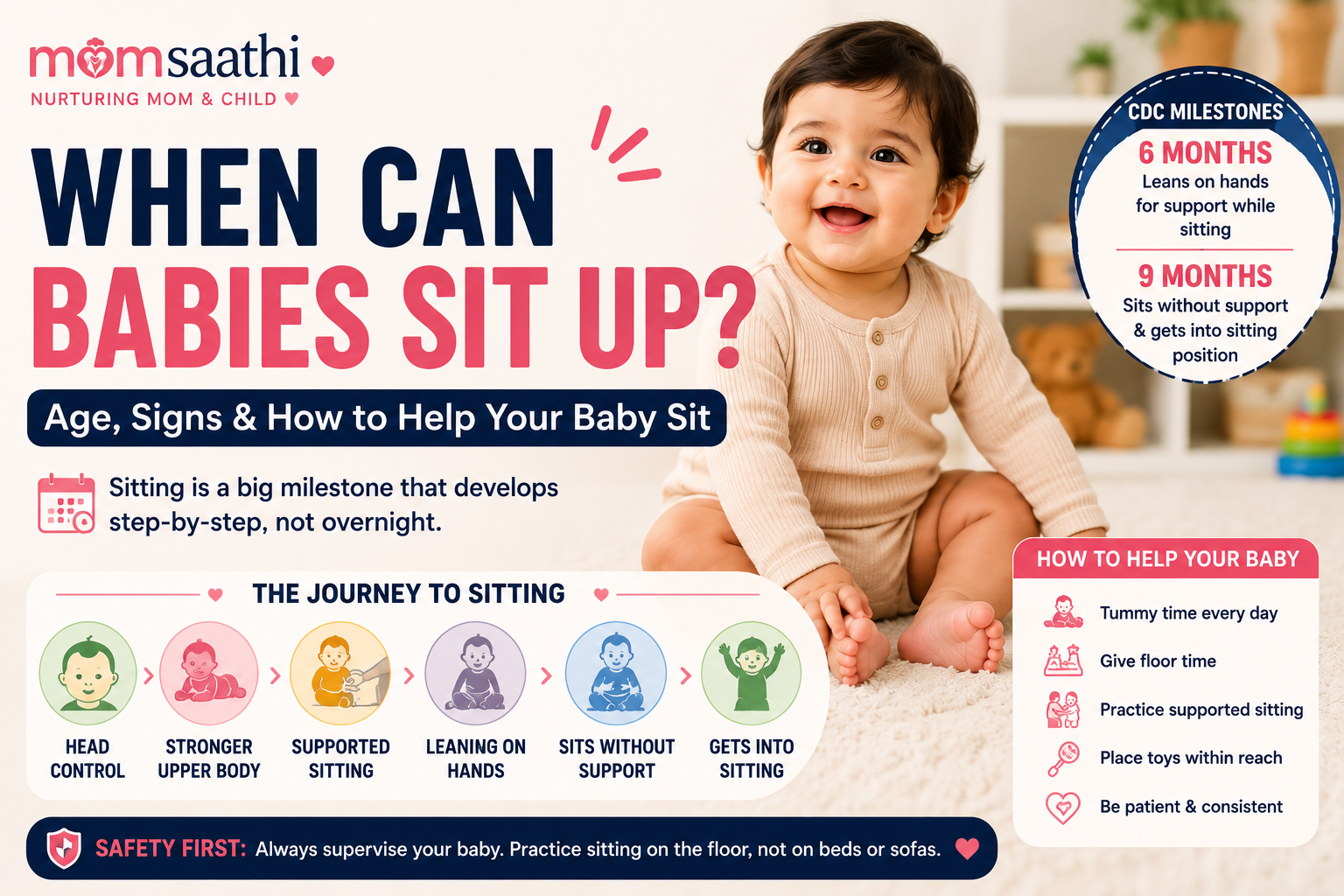
Babies develop sitting skills gradually rather than learning to sit in a single day. At 6 months, the CDC lists leaning on the hands for support while sitting as a developmental milestone. By 9 months, sitting without support and getting into a sitting position independently are listed as milestones.
Quick answer: Babies may begin practising supported sitting before they can balance independently. Sitting often develops from supported sitting to leaning forward on the hands and then sitting without support. The CDC lists hand-supported sitting at 6 months and independent sitting without support at 9 months.
When Can Babies Sit Up?
There is no single date on which every baby suddenly learns to sit.
Sitting develops in stages.
Your baby’s sitting journey may look something like this:
Head control → stronger upper body → supported sitting → leaning on hands → brief independent sitting → better balance → getting into a sitting position
The CDC 6-month developmental milestones guide lists leaning on the hands to support the body while sitting as a 6-month movement milestone.
By 9 months, the CDC 9-month milestones guide lists:
- getting into a sitting position independently; and
- sitting without support.
These milestone ages are useful developmental reference points.
They are not a competition between babies.
For a broader look at how sitting fits alongside rolling, crawling and walking, read MomSaathi’s child development milestones from birth to 5 years.
Baby Sitting Milestones by Age
Parents often search for an exact sitting age.
A more useful approach is to look at how the skill may develop over time.
| Baby’s Age | Sitting Development You May Notice |
|---|---|
| 3 months | Developing head and upper-body control |
| 4 months | Stronger head control and greater interest in upright positions |
| 5 months | May practise supported sitting |
| 6 months | May lean on hands for support while sitting |
| 7 months | May balance for short periods without support |
| 8 months | Sitting may become steadier for some babies |
| 9 months | Sitting without support is a CDC milestone |
| 9+ months | May increasingly move into and out of sitting independently |
This table is a general developmental overview, not a diagnostic timeline.
The CDC defines milestones on its checklists as skills that most children—75% or more—can do by a particular age.
Your baby may develop an individual skill earlier.
If your baby is not meeting a milestone or you are concerned, speak with your child’s healthcare professional.
What Does “Sitting Up” Actually Mean?
The phrase “baby can sit” can mean several different things.
This is why two parents may say:
“My baby started sitting at 5 months.”
and:
“My baby didn’t sit until 8 months.”
They may be describing different stages.
Supported Sitting
Your baby is upright but receives support from:
- your hands;
- your body;
- or an appropriate infant seat used according to its instructions.
Hand-Supported or Tripod Sitting
Your baby sits while leaning forward and using their hands for balance.
The CDC describes leaning on the hands to support oneself while sitting as a 6-month movement milestone.
Independent Sitting
Your baby can maintain a sitting position without being physically supported.
Getting Into a Sitting Position
Your baby moves into sitting independently rather than being placed in the sitting position by an adult.
The CDC lists both sitting without support and getting to a sitting position independently as 9-month milestones.
These are related but distinct developmental skills.
When Do Babies Start Sitting With Support?
Babies may begin practising upright positions before they are able to sit independently.
However, a baby needs developing:
- head control;
- neck strength;
- trunk control;
- balance.
The NHS children’s health guidance on learning to sit explains that sitting requires babies to develop balance and confidence, and independent sitting can initially happen only for short periods.
Your baby may initially wobble.
They may lean forward.
They may fall sideways.
This does not mean they are doing something wrong.
Sitting requires your baby to constantly adjust their body to remain balanced.
When Can Babies Sit Without Support?
Sitting without support is listed by the CDC as a 9-month developmental milestone.
This does not mean every baby first sits independently at exactly 9 months.
Some babies develop the skill earlier.
The CDC milestone tells parents that by 9 months, 75% or more of children are expected to be able to perform the listed skill under the agency’s milestone framework.
Independent sitting may initially last only a few seconds.
Your baby might:
sit → wobble → place a hand down → regain balance
Later, they may sit for longer periods.
Eventually, your baby may be able to sit and use both hands to:
- hold a toy;
- explore an object;
- transfer objects;
- play.
The American Academy of Pediatrics’ HealthyChildren movement milestones guide discusses sitting without support as part of the increasing mobility babies develop during the 8-to-12-month stage.
When Can Infants Sit?
If you searched “when can infants sit?”, the short answer is:
Sitting develops across the middle of the first year, with hand-supported sitting listed as a 6-month CDC milestone and unsupported sitting listed as a 9-month milestone.
Your baby does not go directly from lying down to perfect independent sitting.
They need to develop the physical skills required to control their:
- head;
- neck;
- shoulders;
- trunk.
This is why earlier movement experiences matter.
MomSaathi’s complete baby care guide for 0 to 12 months provides a broader month-by-month overview of physical, social and language development during your baby’s first year.
Can a 3-Month-Old Sit Up?
A 3-month-old is generally still developing the physical control needed for sitting.
At this age, your baby may be working on:
- improving head control;
- lifting the head during tummy time;
- strengthening the neck and upper body.
You may hold your baby upright with appropriate support.
However, this is not the same as independent sitting.
Do not expect a 3-month-old to maintain a sitting position independently.
Give your baby safe opportunities for age-appropriate floor play instead of trying to rush the sitting milestone.
Can a 4-Month-Old Sit Up?
At 4 months, your baby may have better head control than they did during the newborn stage.
They may enjoy looking around while being held upright.
Some babies may practise sitting with substantial support.
However, a 4-month-old who needs support is not “behind.”
The CDC does not list independent sitting as a 4-month milestone.
Sitting requires balance and trunk control that continue to develop over the following months.
Focus on safe movement and floor play.
Can a 5-Month-Old Sit Up?
At 5 months, some babies may begin showing greater interest in upright positions.
You may notice your baby:
- holding their head more steadily;
- pushing up during tummy time;
- trying to lean forward when supported;
- using their arms to stabilise themselves.
Your baby may practise supported sitting.
However, they may still tip:
- forward;
- sideways;
- backwards.
Always stay close.
Do not leave a baby who is learning to sit alone on a bed, sofa, table or other raised surface.
Sitting Milestones at 6 Months
Six months is an important stage in sitting development.
The CDC lists:
Leans on hands to support herself when sitting
as a 6-month movement and physical development milestone.
You may notice your baby sitting with their body leaning slightly forward.
Their hands may be placed on the floor.
This position is often called tripod sitting.
Think of the baby’s body and two arms creating three points of support.
Your baby may still fall sideways.
They may only hold the position briefly.
That is why supervision remains important.
For a wider view of your baby’s developmental progress, MomSaathi’s child development milestone guide explains how physical skills such as sitting, crawling and walking develop during early childhood.
Can a 6-Month-Old Sit Without Support?
Some 6-month-old babies may sit independently for short periods.
Others still rely on their hands or adult support.
The official CDC 6-month milestone is leaning on the hands for support while sitting, rather than sitting independently without support.
This distinction matters.
A baby who uses their hands for balance at 6 months may be developing exactly along the sitting progression described in the CDC milestone framework.
Avoid comparing your baby with a social media video of another 6-month-old sitting perfectly.
A short video does not show a child’s complete developmental history.
Sitting Milestones at 7 Months
At 7 months, some babies may become steadier while sitting.
You may notice your baby:
- sitting briefly without using their hands;
- reaching for a nearby toy;
- placing a hand down to regain balance;
- turning the upper body while sitting.
Balance is still developing.
Your baby may sit well for 30 seconds and suddenly topple when trying to grab an exciting toy.
Stay close during sitting practice.
A soft floor-based play area is safer than practising on a raised surface.
Sitting Milestones at 8 Months
By around 8 months, sitting may become increasingly stable for many babies.
The AAP’s HealthyChildren guidance explains that at around this stage babies become increasingly mobile, with sitting without support among the movement skills they may be working on.
Your baby may be able to:
- sit for longer;
- play with a toy while sitting;
- turn to look around;
- reach for objects.
Some babies may also begin experimenting with:
- scooting;
- rolling to move;
- crawling-like movements.
Sitting and crawling are related parts of gross motor development, but babies do not all follow an identical movement sequence.
Sitting Milestones at 9 Months
The CDC’s 9-month milestone checklist includes two particularly important sitting skills:
- gets to a sitting position by herself;
- sits without support.
Notice the difference.
A baby may sit well when you place them upright.
But moving from the floor into sitting independently requires additional movement control.
At 9 months, observe how your baby moves during normal floor play.
Do they:
- sit independently?
- try to change positions?
- move their body to reach toys?
- use both hands while sitting?
If your baby is not meeting one or more milestones or you have concerns about their movement, discuss them with your child’s doctor. The CDC specifically advises parents to act early when a child is not meeting milestones or has lost skills.
Signs Your Baby May Be Ready to Sit
Sitting requires several physical skills to work together.
Signs that your baby is developing towards sitting may include:
- improving head control;
- holding the head more steadily;
- pushing up during tummy time;
- using the arms for support;
- showing greater trunk control;
- trying to remain upright when supported.
NHS child health guidance explains that babies need sufficient muscle strength to hold their head up and control their movement before practising sitting.
These signs do not predict the exact day your baby will sit.
They simply show that your baby’s physical control is developing.
Why Is Head Control Important for Sitting?
Imagine trying to balance on a chair while your head moves unpredictably in every direction.
Sitting would be difficult.
Your baby faces a similar physical challenge.
Head control helps your baby maintain a more stable position while their trunk and balance skills develop.
Earlier movement skills help build the foundation for later ones.
This is one reason floor-based movement and tummy time are important parts of early development.
Do not pull a baby’s arms to repeatedly force them into a sitting position as a “sitting exercise.”
Your baby needs opportunities to develop active control of their own body.
Does Tummy Time Help Babies Learn to Sit?
Tummy time can support the physical development that contributes to later motor skills.
During tummy time, babies practise using muscles involved in:
- lifting the head;
- pushing up;
- upper-body control.
The CDC’s 6-month milestones include pushing up with straight arms while on the tummy alongside hand-supported sitting.
MomSaathi’s child development milestones guide also includes gentle tummy time as an early developmental activity.
Tummy time should be:
- supervised;
- done while the baby is awake;
- adapted to your baby’s age and ability.
If your baby strongly dislikes tummy time or you have concerns about their movement, ask your paediatrician for personalised guidance.
How to Help a Baby Sit Up
You cannot force a developmental milestone.
But you can provide safe opportunities for your baby to practise movement.
1. Give Your Baby Floor Time
A safe floor space allows your baby to:
- move;
- roll;
- push up;
- reach;
- change position.
The goal is not to make your baby sit for a photograph.
The goal is to give them opportunities to develop physical control.
2. Continue Supervised Tummy Time
Tummy time supports upper-body movement and strength development.
Place age-appropriate toys nearby to encourage your baby to look, reach and interact.
3. Practise Supported Sitting
When your baby shows appropriate head and trunk control, you can support them while sitting.
The NHS learning-to-sit guidance suggests providing support around the baby’s body while they develop sitting balance and gradually reducing support as skills improve.
Stay with your baby.
4. Place Toys Within Easy Reach
A toy placed nearby may encourage your baby to:
- look;
- reach;
- adjust their balance.
Do not place toys so far away that your baby repeatedly falls trying to reach them.
5. Let Your Baby Practise
Babies need movement opportunities.
You do not need to correct every tiny wobble immediately when your baby is safely practising on the floor and you are close enough to prevent injury.
Balance develops through controlled body adjustments.
Baby Sitting Exercises: What Can Parents Do?
Parents frequently search for baby sitting exercises.
A better term may be sitting practice activities.
Your baby is not doing a gym workout.
Simple activities may include:
Supported Floor Sitting
Sit on the floor with your baby and provide appropriate support around their trunk.
Reaching for a Toy
Place an age-appropriate toy close to your baby.
Encourage gentle reaching.
Floor Play
Allow your baby time to roll, push up and explore movement.
Tummy Time
Continue supervised awake tummy time according to your baby’s ability.
Interactive Play
Sit close to your baby.
Talk, smile and play while they practise an upright position.
Stop if your baby appears tired or distressed.
If you are concerned about your baby’s muscle tone, posture or movement, ask your paediatrician or an appropriately qualified child development professional for individual advice.
Should I Use Pillows to Help My Baby Sit?
You may see photos of babies surrounded by several large pillows.
Pillows should not be used to leave a baby sitting unattended.
A baby can:
- fall sideways;
- fall face-first;
- become trapped against soft materials.
For sitting practice, use a safe floor-based area and remain close.
Also remember that pillows, cushions and other soft items do not belong in a baby’s sleep space. Follow safe sleep guidance from your local health authority.
Do not treat a pillow nest as a babysitter.
Are Baby Floor Seats Good for Learning to Sit?
Baby seats and positioning products are not a replacement for active movement opportunities.
If you use a baby seat:
- choose an age-appropriate product;
- follow the manufacturer’s instructions;
- use all required restraints;
- place the product only where the instructions permit.
Do not put an infant seat on:
- a table;
- kitchen counter;
- bed;
- sofa;
- other raised surface.
A baby who can move unexpectedly may fall.
Floor time gives your baby opportunities to actively practise movement rather than remaining passively positioned for long periods.
Can Sitting Too Early Hurt a Baby’s Back?
Parents sometimes worry that allowing a baby to practise sitting will damage the spine.
The more useful question is:
Is my baby developmentally ready for this activity, and am I supporting them safely?
Do not force a baby who lacks head and trunk control to remain upright independently.
Instead, follow your baby’s developing abilities.
Support them appropriately.
Give them plenty of floor-based movement opportunities.
If you are concerned about your baby’s posture, spine or movement, speak with your child’s healthcare professional.
Should You Force a Baby to Sit?
No. Do not force your baby to sit independently before they have the control to maintain the position.
You can provide support and safe opportunities.
But repeatedly placing a baby in a position they cannot control is not the same as helping them develop the skill.
Watch your baby’s cues.
If they:
- slump significantly;
- cannot control their head;
- appear distressed;
- repeatedly collapse;
return to an activity appropriate for their current developmental ability.
Development is not improved by turning milestone practice into a test.
Baby Sits but Keeps Falling Sideways
Falling sideways can happen while a baby is developing sitting balance.
Your baby may sit steadily until they:
- turn their head;
- reach for a toy;
- become distracted.
Then:
tip!
Their balance system is still developing.
Practise on the floor.
Stay close.
Keep the surrounding area free from:
- sharp corners;
- hard objects;
- small choking hazards.
As sitting becomes steadier, your baby may learn to use a hand to help maintain balance.
Why Does My Baby Lean Forward When Sitting?
A baby may lean forward and use their hands for support.
This is sometimes described as tripod sitting.
At 6 months, the CDC specifically lists leaning on the hands to support oneself while sitting as a developmental milestone.
Therefore, leaning forward does not automatically mean something is wrong.
Your baby may be using their hands to create a wider base of support while balance develops.
If you are concerned about your baby’s posture, muscle tone or movement symmetry, discuss it with your child’s doctor.
Why Does My Baby Sit in a W Position?
W-sitting describes a position in which a child sits with their knees bent and legs positioned outside the hips, creating a “W” shape when viewed from above.
This is a different topic from learning to sit independently.
If your child frequently uses one sitting position and you have concerns about:
- movement;
- hip development;
- walking;
- muscle tone;
discuss the pattern with your child’s healthcare professional.
MomSaathi content opportunity: A dedicated “W-Sitting in Babies and Toddlers” article would be a better place to cover this question in detail rather than overloading the current baby-sitting milestone guide.
When Do Babies Sit Before Crawling?
Many babies develop sitting skills before or around the stage when crawling begins.
However, motor development does not follow an identical script for every baby.
The AAP’s HealthyChildren movement guide discusses sitting, flipping, crawling, scooting and slithering as movement skills babies may work on during the 8-to-12-month stage.
Some babies:
sit → crawl → pull to stand
Others may:
sit → scoot → pull to stand
Developmental monitoring should look at your baby’s overall movement progress.
For a broad developmental overview, use MomSaathi’s complete baby care guide from 0 to 12 months.
Can a Baby Skip Sitting and Start Crawling?
Babies may show different movement patterns.
However, sitting without support is still an important developmental skill listed on the CDC’s 9-month milestone checklist.
If your baby appears to be developing movement skills in an unusual sequence, this does not automatically mean there is a problem.
But if your baby is not meeting one or more milestones or you are concerned about their movement, discuss your observations with their doctor.
Do not rely on:
“My neighbour’s baby did the same thing.”
Your child’s healthcare professional can assess your baby’s individual development.
My Baby Is 7 Months and Not Sitting: Should I Worry?
At 7 months, some babies sit independently.
Others may still use their hands or require some support.
Remember:
- hand-supported sitting is a 6-month CDC milestone;
- sitting without support is a 9-month CDC milestone.
Look at your baby’s broader movement development.
Are they:
- controlling their head?
- pushing up?
- rolling?
- reaching?
- attempting to balance while supported?
If you have concerns, speak with your baby’s doctor.
You do not need to wait until a milestone deadline to ask a developmental question.
My Baby Is 8 Months and Not Sitting Independently
An 8-month-old who is not yet sitting independently may understandably worry parents.
The CDC lists sitting without support at 9 months.
NHS Inform says babies should be showing signs of sitting by 8 months and recommends seeking further advice if parents have concerns.
At 8 months, observe whether your baby:
- uses their hands while sitting;
- briefly maintains a sitting position;
- has good head control;
- pushes up during floor play;
- attempts to change position.
If your baby’s movement development concerns you, discuss it with your paediatrician.
My 9-Month-Old Is Not Sitting Without Support
Sitting without support is a CDC 9-month milestone.
The CDC advises parents to act early if a child:
- is not meeting one or more milestones;
- has lost skills they previously had;
- or the parent has other developmental concerns.
If your 9-month-old is not sitting without support, discuss this with your child’s doctor.
Your healthcare professional may ask about:
- head control;
- rolling;
- reaching;
- muscle tone;
- movement symmetry;
- other developmental skills.
Do not diagnose the cause yourself.
The next step is an individual developmental assessment when appropriate.
Baby Sitting Milestone and Premature Babies
If your baby was born prematurely, developmental assessment may use corrected age during early childhood.
This means your baby’s development may be considered in relation to their expected due date rather than only their birth date.
Tell your healthcare professional your baby’s gestational age at birth when discussing milestones.
The CDC’s milestone tools advise using corrected age for children born more than three weeks prematurely. Its milestone guidance also encourages parents to share concerns with their child’s doctor.
Your paediatrician can explain how corrected age applies to your baby’s sitting development.
Sitting and Starting Solid Foods: Are They Connected?
Parents often hear:
“Baby must sit before starting solids.”
The issue is more specific than simply asking whether your baby can sit completely independently on the floor.
Feeding readiness includes the baby’s ability to maintain a safe, stable upright position with appropriate head and neck control.
Do not use a baby’s interest in food as the only sign of readiness.
Follow your paediatrician’s advice on complementary feeding, particularly if your baby:
- was born prematurely;
- has developmental concerns;
- has swallowing difficulties;
- has a medical condition.
MomSaathi’s complete baby care guide for Indian parents from 0 to 12 months provides a broader overview of feeding and developmental changes during the first year.
Baby Sitting Safety Tips
When babies first learn to sit, they can fall unexpectedly.
Use these simple safety principles:
- Practise on the floor. Avoid raised surfaces.
- Stay close. A new sitter may suddenly topple.
- Clear hard objects. Remove items the baby could hit while falling.
- Check for choking hazards. Sitting gives babies better access to nearby objects.
- Babyproof early. Sitting is often followed by increasing mobility.
- Use restraints correctly. Follow instructions for high chairs and other approved baby equipment.
- Never leave a baby unattended in a sitting position near water.
Once your baby sits and begins reaching farther, your definition of “out of reach” may change very quickly.
When Should You Talk to a Doctor About Baby Sitting?
Contact your child’s healthcare professional if you are concerned about your baby’s development.
Discuss your baby’s movement if:
- your baby has lost a skill they previously had;
- your baby is not meeting one or more developmental milestones;
- your baby has poor head control that concerns you;
- your baby’s body seems unusually stiff or floppy;
- you notice significant movement asymmetry;
- your baby is not sitting without support at the 9-month milestone stage;
- something about your baby’s movement worries you.
The CDC advises parents not to wait when a child is not meeting milestones, has lost skills or when they have developmental concerns.
A milestone guide can help you notice development.
It cannot diagnose why a skill has or has not developed.
Baby Sitting Milestones: Myths vs Facts
| Myth | Fact |
|---|---|
| Every baby sits at exactly 6 months | Sitting develops over a range of stages |
| A 6-month-old must sit independently | CDC lists leaning on the hands for support at 6 months |
| Babies learn to sit in one day | Sitting develops through increasing control and balance |
| Pillows teach a baby to sit | Active movement and safe practice are more important |
| A baby seat replaces floor time | Babies benefit from opportunities for active movement |
| Falling sideways means the baby is failing | Wobbling can occur while balance develops |
| All babies crawl immediately after sitting | Movement sequences can vary |
| Parents should wait if they are concerned | CDC advises acting early when concerns arise |
MomSaathi’s Baby Sitting Readiness Checklist
Ask yourself:
1. Does my baby have improving head control?
Head control supports upright movement.
2. Does my baby push up during tummy time?
The CDC lists pushing up with straight arms on the tummy as a 6-month milestone.
3. Does my baby use their hands while sitting?
Hand-supported sitting is a 6-month CDC milestone.
4. Can my baby balance briefly?
Independent sitting may initially happen for short periods.
5. Can my baby sit without support by the 9-month milestone stage?
The CDC lists this at 9 months.
6. Can my baby get into sitting independently?
This is also a 9-month CDC milestone.
7. Has my baby lost a movement skill?
Contact your child’s doctor.
8. Am I concerned about my baby’s development?
Discuss your concerns rather than waiting for another parent to reassure you.
Frequently Asked Questions About When Babies Sit Up
When can babies sit up?
Babies develop sitting gradually. The CDC lists leaning on the hands for support while sitting at 6 months and sitting without support at 9 months.
When do babies start sitting with support?
Babies may practise supported upright positions as head and trunk control develop. By 6 months, leaning on the hands while sitting is a CDC milestone.
When can babies sit without support?
Sitting without support is listed as a 9-month developmental milestone by the CDC. Some babies may develop the skill earlier.
Can a 4-month-old sit up?
A 4-month-old may enjoy an upright position with appropriate support but is generally still developing the head, trunk and balance control required for independent sitting.
Can a 5-month-old sit up?
Some 5-month-olds may practise supported sitting. Independent sitting skills vary and continue developing over the following months.
Should a 6-month-old be sitting independently?
Not necessarily. The CDC’s 6-month milestone is leaning on the hands for support while sitting. Sitting without support is listed at 9 months.
What is tripod sitting?
Tripod sitting describes a baby leaning forward and using the hands for support while sitting. The CDC lists hand-supported sitting as a 6-month milestone.
How can I help my baby learn to sit?
Provide safe floor time, supervised tummy time and appropriate supported sitting practice when your baby shows developing head and trunk control.
Does tummy time help babies sit?
Tummy time gives babies opportunities to practise head and upper-body movement. The CDC’s 6-month milestones include pushing up with straight arms on the tummy and leaning on the hands while sitting.
Why does my baby fall sideways when sitting?
Babies can fall sideways while developing balance. Practise sitting on a safe floor surface and remain close to prevent injury.
Why does my baby lean forward while sitting?
Your baby may be using their hands for balance. This hand-supported sitting position is part of the sitting progression and is listed as a 6-month CDC milestone.
Is it normal for a 7-month-old not to sit independently?
Some 7-month-olds may still use their hands or need support. Sitting without support is listed as a 9-month CDC milestone. Discuss any developmental concerns with your baby’s doctor.
Should an 8-month-old be sitting?
Many babies show developing sitting skills by this stage. NHS Inform says babies should be showing signs of sitting by 8 months. Contact your healthcare professional if you have concerns.
What if my 9-month-old is not sitting without support?
Sitting without support is a 9-month CDC milestone. If your baby is not meeting this milestone, discuss it with your child’s doctor.
Do babies sit before they crawl?
Many babies develop sitting around or before crawling, but movement patterns can vary. Sitting without support remains an important developmental milestone.
Can premature babies sit later?
Developmental monitoring may use corrected age for babies born prematurely. Ask your paediatrician how corrected age applies to your baby’s milestones.
Final Thoughts
So, when can babies sit up?
The answer is not one exact month.
Sitting is a developmental process.
Your baby’s journey may look like:
stronger head control → supported sitting → leaning on the hands → brief independent balance → sitting without support → getting into sitting independently
At 6 months, the CDC lists leaning on the hands for support while sitting as a movement milestone.
By 9 months, the CDC lists both sitting without support and getting into a sitting position independently.
Give your baby safe opportunities for:
- floor play;
- supervised tummy time;
- age-appropriate movement;
- supported sitting when developmentally ready.
Do not turn sitting into a race.
At the same time, do not dismiss a genuine developmental concern with:
“Every baby is different.”
If your baby is not meeting one or more milestones, has lost a skill or you are concerned about how your baby moves, discuss it with your child’s healthcare professional.
Early questions are worth asking.