
Medical note: This article provides general pregnancy information. Contact your obstetrician, midwife or maternity care team if you are concerned about your baby’s movements. A change or reduction in movements you normally feel should not be assessed using online information alone.
A tiny flutter. A bubble-like feeling. A soft tap from inside your belly.
Then comes the question:
Was that my baby moving?
It might have been quickening.
Quickening in pregnancy means the first time you become aware of your baby’s movements inside the uterus. These early movements may feel like gentle flutters, bubbles, swishes or tiny taps rather than obvious kicks. Most pregnant women begin feeling their baby move between 16 and 24 weeks, while many first become aware of movements around 18 to 20 weeks.
Quick answer: Quickening is the first feeling of fetal movement during pregnancy. It commonly happens in the second trimester and may initially feel like butterflies, gas bubbles, flickering or tiny pulses in your lower abdomen.
What Is Quickening in Pregnancy?
Quickening is the first time a pregnant woman feels the baby move.
The ACOG Dictionary defines quickening as the first feeling of fetal movement.
Your baby can move before you are able to feel those movements. Quickening describes the point at which you first become aware of the movement.
Think of it this way:
Baby begins moving → movements are initially too subtle to feel → you notice the first flutter or tap → quickening
Quickening is therefore not a special type of movement.
It is the term used for your first perception of fetal movement.
As pregnancy progresses, those subtle sensations may become easier to recognise as:
- kicks;
- rolls;
- stretches;
- swishes;
- turns.
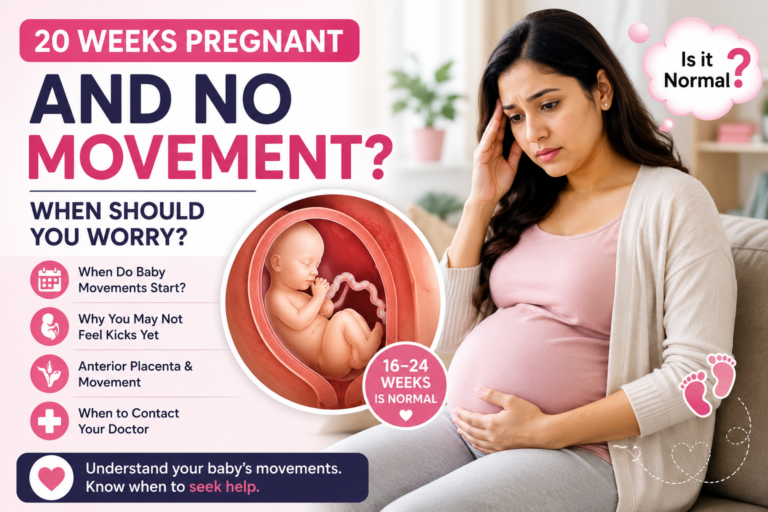
If you are currently around 20 weeks and have not yet recognised movement, read MomSaathi’s guide on 20 weeks pregnant and no movement for a detailed explanation of when to seek advice.
When Does Quickening Start?
Quickening usually occurs during the second trimester.
According to NHS guidance on baby movements, pregnant women should generally start feeling their baby move between 16 and 24 weeks. If it is your first baby, you may not feel movements until after 20 weeks.
The RCOG baby movements guidance says most women first become aware of their baby’s movements at around 18 to 20 weeks.
Quickening Timeline at a Glance
| Pregnancy Week | What You May Notice |
|---|---|
| 14–15 weeks | Usually too early for many women to confidently recognise movement |
| 16 weeks | Some women may begin noticing subtle sensations |
| 17–18 weeks | Flutters or gentle movements may become noticeable |
| 18–20 weeks | Many women first recognise baby movement |
| 20–24 weeks | Movements may become easier to identify |
| By 24 weeks | Contact your maternity professional if you have never felt your baby move |
This is a general timeline rather than an exact deadline for every pregnancy.
The timing of quickening can vary.
What Does Quickening Feel Like?
This is one of the most common questions about first baby movements.
Quickening does not necessarily feel like a strong kick.
In fact, you may initially wonder whether you felt your baby at all.
Early movements can feel like:
- butterflies in your stomach;
- bubbles popping;
- gentle fluttering;
- tiny taps;
- a flickering sensation;
- a soft pulse;
- light swishing;
- a fish moving inside your belly;
- a small muscle twitch;
- gentle rolling.
The NHS describes early fetal movement as sensations including a kick, flutter, swish or roll, while its 18-week pregnancy guidance notes that first movement may feel like gentle fluttering.
Cleveland Clinic also describes quickening as feeling like flutters, bubbles or tiny pulses.
At first, you may think:
“Was that the baby?”
A few weeks later, the sensations often become more recognisable.
Where Do You Feel Quickening?
Early quickening may be felt low in the abdomen.
The exact location can vary depending on:
- your stage of pregnancy;
- the baby’s position;
- placental position;
- where the movement is directed.
You may notice a flutter:
- below the belly button;
- in the lower abdomen;
- on one side;
- near the centre of your belly.
The sensation may not always occur in exactly the same place.
Your baby can change position, and early movements are still subtle.
As the uterus and baby grow, you may notice movements in more areas of the abdomen.
Quickening vs Gas: How Can You Tell the Difference?
Many pregnant women initially mistake quickening for gas.
That is completely understandable because the sensations can feel surprisingly similar.
Quickening vs Gas
| Quickening | Gas |
|---|---|
| May feel like fluttering or tiny taps | May feel like bubbling or pressure |
| Can occur repeatedly in a similar area | May move through the digestive tract |
| Often becomes more recognisable over time | May be associated with bloating |
| Gradually develops into clearer fetal movement | May improve after passing gas |
| May feel like flickers or soft pulses | May be accompanied by digestive discomfort |
Unfortunately, there is no home test that says:
“Yes, that flutter was definitely your baby.”
Often, the answer becomes clear with time.
You may notice the sensation repeatedly.
Then the movements become stronger.
Eventually, you realise:
Those early bubbles were probably quickening.
Quickening vs Baby Kicks: What’s the Difference?
Quickening and baby kicks are related, but the terms are not exactly interchangeable.
Quickening describes your first awareness of fetal movement.
Baby kicks are one type of fetal movement you may notice as pregnancy progresses.
| Quickening | Baby Kicks |
|---|---|
| First recognised fetal movement | A type of fetal movement |
| Often subtle | May become stronger |
| May feel like flutters or bubbles | Often feels like a tap, jab or push |
| Usually noticed in the second trimester | Can become increasingly obvious later |
| May be difficult to identify | Usually easier to recognise |
Quickening can therefore be considered the beginning of your awareness of baby movements.
As pregnancy progresses, read MomSaathi’s baby kicks during pregnancy guide to understand how movements may change and why your baby’s usual pattern matters.
As those first subtle flutters become easier to recognise, read our guide to baby kicks during pregnancy to understand when movements may begin and why changes in your baby’s usual movement pattern matter.
Can Quickening Feel Like Bubbles?
Yes. Quickening can feel like bubbles.
This is one of the most common descriptions of early fetal movement.
You may feel:
bubble… pause… tiny flutter…
and wonder whether it is digestion.
Early movements can be subtle enough to resemble gas bubbles.
The NHS describes fetal movements as including flutters, swishes and rolls, and first movement around 18 weeks may feel like gentle fluttering.
Over the following weeks, the sensations may become easier to recognise as fetal movement.
Can Quickening Feel Like Muscle Twitches?
Yes. Some women describe early baby movements as similar to a small muscle twitch.
It may feel like:
- a tiny flick;
- an internal twitch;
- a light tapping sensation;
- a brief pulse.
Unlike an obvious third-trimester kick, early quickening can be extremely subtle.
If you are unsure whether a sensation is fetal movement, you may become more confident as the pattern develops and movements become stronger.
Does Quickening Hurt?
Quickening itself is usually described as a gentle sensation rather than pain.
Early fetal movements may feel like:
- flutters;
- bubbles;
- soft taps;
- swishes.
Later in pregnancy, stronger fetal movements can sometimes feel uncomfortable.
However, significant or persistent abdominal pain should not simply be labelled as quickening.
Contact your healthcare professional if you experience concerning symptoms such as:
- severe abdominal pain;
- vaginal bleeding;
- fluid leakage;
- regular painful contractions before term;
- feeling significantly unwell.
Your healthcare professional can assess the cause.
Quickening in a First Pregnancy
If this is your first pregnancy, you may notice quickening later than someone who has previously been pregnant.
The NHS says first-time mothers may not feel movements until after 20 weeks.
ACOG also notes that many first-time mothers do not feel movement until around five months of pregnancy.
Why?
One possible reason is simply recognition.
A woman who has experienced pregnancy before may think:
“I know that flutter. That’s the baby.”
A first-time mother may think:
“Probably gas.”
This does not necessarily mean the baby is moving less.
You may simply not recognise the subtle sensation yet.
Does Quickening Happen Earlier in a Second Pregnancy?
Some women notice fetal movements earlier in a second or subsequent pregnancy.
RCOG says women who have been pregnant before may feel movements as early as 16 weeks.
Again, recognition may play a role.
You already know what early fetal movement can feel like.
A sensation you dismissed as digestion during your first pregnancy may be easier to identify the next time.
However, every pregnancy is different.
Do not assume something is wrong because quickening happened at 16 weeks in one pregnancy and later in another.
Quickening at 16 Weeks: Is It Possible?
Yes. Some pregnant women may notice fetal movement around 16 weeks.
The NHS gives a broad 16-to-24-week range for first feeling baby movements.
Its 16-week pregnancy guide also notes that you may start to feel your baby move around this stage.
At 16 weeks, quickening may be very subtle.
You might notice:
- faint flutters;
- tiny bubbles;
- light flickering.
If you do not feel movement at 16 weeks, that does not automatically mean something is wrong.
Sixteen weeks is at the early end of the usual movement window.
Quickening at 17 Weeks
At 17 weeks, some women begin noticing their baby’s first movements.
The NHS week-17 guide says you might start to feel your baby move around this stage.
The sensations may still be difficult to recognise.
You may notice a small flutter one day and then wonder why you cannot clearly identify it again.
Early movement awareness can develop gradually.
Do not compare your exact experience with someone else’s pregnancy timeline.
Quickening at 18 Weeks
Eighteen weeks is a common time to begin recognising fetal movement.
The NHS says that at 18 weeks you may feel your baby move for the first time, with the sensation possibly feeling like gentle fluttering.
You may begin noticing:
- gentle flutters;
- bubbling;
- tiny taps;
- slight shifting sensations.
MomSaathi’s Pregnancy Week 17 to 20 guide also covers the stage when fluttering movements may begin to be noticed.
If you are unsure whether you felt quickening, give yourself time to become familiar with the sensation.
Want to know what else is happening around this stage? Read our pregnancy weeks 17 to 20 guide for week-by-week symptoms, baby development and early movement changes.
Quickening at 19 Weeks
At 19 weeks, many pregnant women are entering the stage when first movements become noticeable.
RCOG says most women first become aware of their baby moving around 18 to 20 weeks.
You may still experience uncertainty.
One day you may notice several small flutters.
Another day, you may be less confident about what you felt.
At this stage, many women are still learning to recognise fetal movement.
Quickening at 20 Weeks
If you are 20 weeks pregnant, you may be waiting for the first unmistakable kick.
But quickening may still feel subtle.
The NHS states that women having their first baby may not notice movement until after 20 weeks.
If you are 20 weeks pregnant and not feeling baby movement, MomSaathi has a detailed guide explaining first pregnancy, anterior placenta and when to contact your maternity professional.
This is an important distinction:
Never felt movement yet at 20 weeks
is not necessarily the same situation as:
Previously felt regular movements that have now reduced or changed.
If movements you normally recognise become reduced or change, contact your maternity care team promptly.
If your ultrasound report contains terms such as BPD, HC, AC, FL or placental position, read our anomaly scan report guide to understand common measurements and scan findings.
Quickening With an Anterior Placenta
An anterior placenta is attached to the front wall of the uterus.
This means the placenta sits between the baby and the front of your abdomen.
Placental tissue may cushion some early fetal movements, making them more difficult to perceive.
Your ultrasound report may say:
Placenta: Anterior
or:
Anterior placenta
If you have an anterior placenta, you may notice movements differently.
Some sensations may be clearer:
- at the sides of the abdomen;
- lower in the belly;
- in areas not directly cushioned by placental tissue.
Read MomSaathi’s complete Anterior Placenta guide for more information about placental position and baby movements.
Important: An anterior placenta may affect movement perception, but a reduction or change in your baby’s usual movement pattern should not simply be dismissed because of placental position.
If your ultrasound report mentions a front-wall placenta, read our complete guide to anterior placenta to understand how placental position may affect the way early baby movements are perceived.
Quickening With a Posterior Placenta
A posterior placenta is attached to the back wall of the uterus.
Because the placenta is not positioned between the baby and the front abdominal wall, some women may notice front-directed movements more easily.
However, a posterior placenta does not guarantee early quickening.
You may still feel first movements at different stages depending on:
- whether this is your first pregnancy;
- your baby’s position;
- individual movement perception.
Placental position is only one factor.
Internal link recommendation: Add your existing MomSaathi posterior placenta article here using the anchor “posterior placenta in pregnancy.”
Can You See Quickening From Outside the Belly?
Usually, your first subtle fetal movements are something you feel internally.
You may not be able to see movement from outside the abdomen during early quickening.
As pregnancy progresses and movements become stronger, you may eventually notice:
- small bumps;
- visible shifts;
- the abdomen moving with a strong kick.
The NHS week-23 pregnancy guide notes that over the following weeks, movements may become strong enough for the tummy to visibly move.
The timing varies between pregnancies.
Can Your Partner Feel Quickening?
Quickening is your first personal awareness of fetal movement.
Because the earliest sensations can be extremely subtle, your partner may not immediately feel them by placing a hand on your abdomen.
External movements may become easier to detect as:
- the baby grows;
- movements become stronger;
- pregnancy progresses.
Do not worry if you can feel a tiny flutter internally but your partner feels nothing.
The sensation may simply be too subtle to detect from outside.
Does Baby Position Affect Quickening?
The baby’s position can affect where you perceive movements.
You may notice sensations:
- low in the abdomen;
- on one side;
- near the centre;
- later, in different areas as the baby changes position.
However, you cannot reliably diagnose your baby’s exact position based only on where you feel quickening.
Babies can change position frequently, particularly earlier in pregnancy.
Ultrasound or clinical assessment is more reliable when fetal position needs to be determined.
Is Quickening a Sign That the Baby Is Healthy?
Feeling fetal movement is an important part of pregnancy awareness.
The NHS states that feeling your baby move is a sign that they are well.
However, quickening is not a home diagnostic test.
You cannot use one flutter to assess every aspect of:
- fetal growth;
- placental function;
- fetal anatomy;
- pregnancy complications.
Continue attending your scheduled antenatal appointments and ultrasound scans.
If you are around the middle of pregnancy, MomSaathi’s anomaly scan report guide explains common terms such as BPD, HC, AC, FL and placental position.
Is There a Normal Number of Movements After Quickening?
There is no single number of normal movements that applies to every baby.
The NHS specifically says there is no set number of movements you should feel each day. The important thing is becoming familiar with your baby’s usual pattern.
During early quickening, you may still be learning what your baby’s movements feel like.
As pregnancy progresses, movements may become:
- stronger;
- easier to identify;
- more familiar.
Follow any specific fetal movement advice provided by your maternity care team.
Do not compare your baby’s movement count with another pregnant woman’s experience.
Does Quickening Happen Every Day?
Early movement perception can be difficult to recognise consistently.
However, as pregnancy progresses, you should become increasingly familiar with your baby’s movements and usual pattern.
The NHS advises that you should continue feeling your baby move right up to and during labour.
The important safety message is:
Do not dismiss a reduction or change in movements you normally recognise.
If your baby is moving less than usual, you cannot feel your baby moving anymore, or the usual pattern has changed, the NHS advises contacting your maternity unit immediately and not waiting until the next day.
What If I Haven’t Felt Quickening by 20 Weeks?
Not feeling definite fetal movement at exactly 20 weeks can still fall within the broad usual range.
This may be particularly relevant if:
- this is your first pregnancy;
- you have an anterior placenta;
- you have not yet recognised subtle early sensations.
The NHS says movement is generally first felt between 16 and 24 weeks, and first-time mothers may not notice it until after 20 weeks.
Read MomSaathi’s 20 Weeks Pregnant and No Movement article for a detailed answer to this exact question.
If you are concerned, contact your maternity professional for personalised advice.
What If I Haven’t Felt Quickening by 24 Weeks?
If you have never felt your baby move by 24 weeks, contact your maternity professional.
The NHS advises telling your midwife if you have not felt movement by 24 weeks so your baby’s heartbeat and movements can be checked.
RCOG similarly advises contacting your midwife or local maternity unit if you have never felt movement by 24 weeks. An ultrasound may be arranged depending on the assessment.
Do not simply wait several more weeks because:
“Maybe I have an anterior placenta.”
Your maternity team can assess your individual situation.
Can I Make Quickening Happen?
You cannot force the first perception of fetal movement to happen on a particular pregnancy week.
Online suggestions may tell you to:
- drink cold water;
- eat something sweet;
- lie in a certain position.
These should not be used to delay seeking professional advice if you are concerned about fetal movements.
If movements you previously recognised have reduced or changed, contact your maternity care team.
Do not rely on home techniques to assess fetal wellbeing.
Can I Use a Home Doppler Until I Feel Quickening?
A home Doppler should not be used as a substitute for professional pregnancy assessment.
The NHS specifically warns against using a home Doppler to check the baby’s heartbeat when you are concerned about movements. Even hearing a heartbeat does not mean the baby is well.
If you are worried about fetal movement, contact your healthcare professional.
Do not use a home Doppler to reassure yourself after movements have reduced or changed.
Quickening and the 20-Week Anomaly Scan
Quickening often occurs around the same broad stage of pregnancy as the mid-pregnancy anomaly scan.
During an ultrasound, you may see your baby:
- moving arms;
- stretching;
- changing position;
- moving legs.
You may not feel every movement visible on the screen.
This is because:
Fetal movement is what the baby is doing.
Movement perception is what you can feel.
At this stage, the two do not always match movement for movement.
If your ultrasound report contains terms such as BPD, HC, AC, FL or placental position, read MomSaathi’s anomaly scan report guide for an explanation of common measurements and findings.
Quickening Myths vs Facts
| Myth | Fact |
|---|---|
| Quickening is the baby’s first movement | It is your first awareness of fetal movement |
| Quickening always feels like a kick | It may feel like bubbles, flutters or tiny taps |
| Everyone feels quickening at 16 weeks | First movement is generally noticed between 16 and 24 weeks |
| No movement at 20 weeks always means a problem | First-time mothers may notice movement after 20 weeks |
| Anterior placenta means the baby does not move | It may cushion your perception of some movements |
| Quickening predicts baby gender | First fetal movement does not reliably predict sex |
| Every baby should move the same number of times | Babies have individual movement patterns |
| A home Doppler can replace movement assessment | Hearing a heartbeat does not assess fetal wellbeing |
MomSaathi’s Quickening Checklist
Think you may have felt your baby’s first movement?
Ask yourself:
1. Did I feel a flutter, bubble, swish or tiny tap?
That may be an early fetal movement.
2. Am I between 16 and 24 weeks pregnant?
This is the broad window when most women begin feeling movement.
3. Is this my first pregnancy?
You may recognise quickening later than someone who has previously been pregnant.
4. Do I have an anterior placenta?
Placental position may cushion some early movements.
5. Am I confusing the sensation with gas?
That is common. The difference may become clearer as movements grow stronger.
6. Have I never felt movement by 24 weeks?
Contact your maternity professional.
7. Have movements I normally recognise reduced or changed?
Contact your maternity care team promptly. Do not wait until the next day.
Frequently Asked Questions About Quickening in Pregnancy
What is quickening in pregnancy?
Quickening is the first time you become aware of your baby’s movements during pregnancy. ACOG defines quickening as the first feeling of fetal movement.
When does quickening start?
Most pregnant women begin feeling baby movements between 16 and 24 weeks. Many first become aware of movement at around 18 to 20 weeks.
What does quickening feel like?
Quickening may feel like gentle flutters, bubbles, tiny taps, swishes, flickering or small pulses inside the abdomen.
Where do you feel quickening?
Quickening may initially be noticed low in the abdomen. The exact location varies depending on pregnancy stage, baby position and placental position.
Does quickening feel like gas?
Yes, early fetal movement can feel similar to gas bubbles. The difference often becomes clearer as movements become stronger and more recognisable.
Can quickening feel like muscle twitches?
Yes. Some pregnant women describe early fetal movements as tiny internal twitches, flicks or pulses.
Can quickening happen at 16 weeks?
Yes. Sixteen weeks is within the broad 16-to-24-week range when fetal movements may first be noticed.
Is 18 weeks normal for quickening?
Yes. RCOG says most women first become aware of their baby moving at around 18 to 20 weeks.
Is it normal not to feel quickening at 20 weeks?
It can be, particularly during a first pregnancy. The NHS says first-time mothers may not notice movements until after 20 weeks.
Does an anterior placenta delay quickening?
An anterior placenta can cushion some fetal movements and make early movements harder to perceive. It does not necessarily mean the baby is moving less.
Is quickening the same as baby kicks?
Not exactly. Quickening describes your first awareness of fetal movement. Kicks are one type of movement you may feel as pregnancy progresses.
Does quickening hurt?
Quickening is usually described as gentle fluttering, bubbling or tapping rather than pain. Significant or persistent abdominal pain should be discussed with a healthcare professional.
Can my partner feel quickening?
The earliest movements may be too subtle to feel from outside the abdomen. Your partner may notice movements later as the baby’s kicks become stronger.
What if I haven’t felt quickening by 24 weeks?
Contact your maternity professional if you have never felt your baby move by 24 weeks. Your baby’s heartbeat and movements can be assessed.
Should I worry if baby movements reduce after quickening?
If movements you normally recognise become reduced, stop or change from your baby’s usual pattern, contact your maternity unit or healthcare professional immediately. Do not wait until the next day.
Final Thoughts
So, what is quickening in pregnancy?
Quickening is the first time you feel your baby move inside the uterus.
It may not feel like the dramatic kick you are expecting.
Instead, your first baby movement may feel like:
a flutter… a bubble… a tiny tap… or a soft swish.
Most pregnant women begin feeling their baby move between 16 and 24 weeks, while many first become aware of movements around 18 to 20 weeks. First-time mothers may not notice movements until after 20 weeks.
An anterior placenta may also make early movements more difficult to perceive.
As pregnancy progresses, those tiny flutters often become easier to recognise as your baby’s individual movements.
But remember the important safety distinction:
Waiting to feel your first quickening is different from movements you already recognise becoming reduced or changing.
If you have never felt your baby move by 24 weeks, contact your maternity professional. If your baby’s usual movements reduce or change, seek maternity advice immediately and do not wait until the next day.