
Development note: This article provides general developmental information and does not diagnose speech or language delay. If your child loses a communication skill, does not respond to sounds or you are concerned about speech, language or hearing, speak with your child’s healthcare professional.
You have been waiting for months.
Your baby smiles.
Looks directly at you.
Opens their mouth and says:
“Mamamama.”
You freeze.
Was that Mama?
Did your baby just say their first word?
Or was it babbling?
Then, of course, someone else in the family says:
“No, the baby clearly said Dada first!”
Welcome to one of the most debated baby milestones.
When do babies say Mama and Dada?
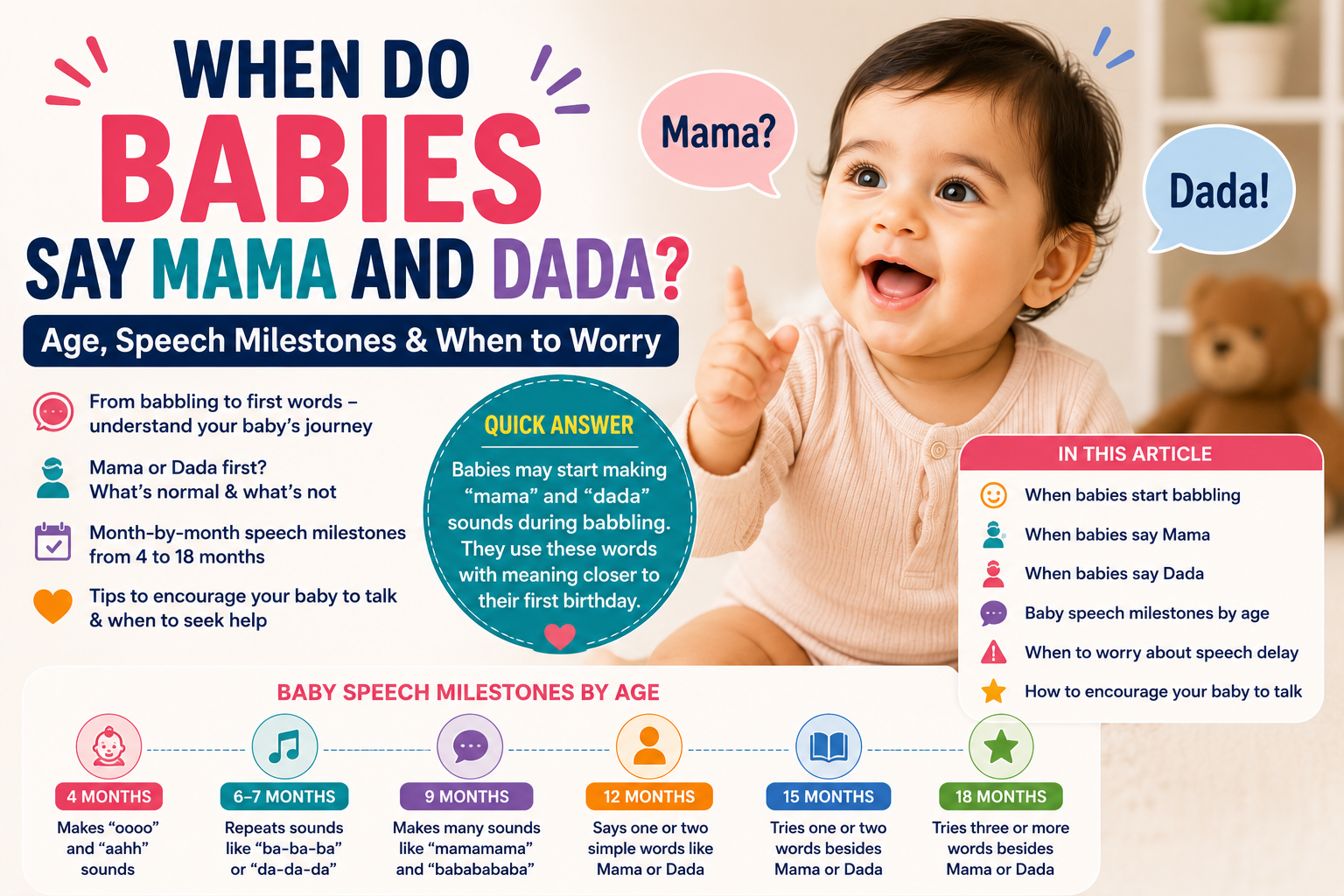
Babies may make repeated sounds such as “mamamama” during the babbling stage before they use “Mama” as a meaningful word for a parent. The CDC lists making many different sounds, including “mamamama” and “bababababa,” as a 9-month language milestone. By 15 months, the CDC milestone framework expects children to try one or two words besides “mama” or “dada.”
Quick answer: Babies may begin babbling sounds that resemble “mama” or “dada” during the first year. Around the first birthday, some babies may use one or two simple words such as Mama or Dada. The important difference is whether your baby is simply repeating sounds or consistently using the word with meaning. The American Academy of Pediatrics notes that around the first birthday, babies may say one or two simple words such as “mama,” “dada” or “bye-bye.”
When Do Babies Say Mama and Dada?
There is no single day when every baby wakes up and clearly says:
“Good morning, Mama.”
Speech develops gradually.
Your baby’s early communication journey may look something like this:
cooing → making sounds → babbling → repeated syllables → understanding familiar words → sounds used with meaning → first words
At 4 months, the CDC lists sounds such as “oooo” and “aahh” and making sounds back when spoken to as language and communication milestones.
At 9 months, the CDC lists:
making many different sounds such as “mamamama” and “bababababa.”
The American Academy of Pediatrics explains that babies may begin attaching meaning to familiar gestures, words and phrases between about 8 and 12 months. Around the first birthday, some babies may say one or two simple words such as Mama, Dada or bye-bye.
This is why the answer to:
“When do babies say Mama?”
depends on what you mean by say.
Do you mean:
“mamamama” as a repeated sound?
Or:
looking at you and consistently calling you “Mama”?
Those are different stages of language development.
For a broader view of communication, movement and social development, read MomSaathi’s Child Development Milestones Birth to 5 Years guide.
Baby Speech Development by Age
Parents often search for an exact first-word age.
The following table provides a general overview based on current developmental milestone guidance.
| Baby’s Age | Communication You May Notice |
|---|---|
| 2–4 months | Early sounds, cooing and vocal interaction |
| 4 months | Makes “oooo” and “aahh” sounds and responds with sounds |
| 5–6 months | Experiments with different sounds and voices |
| 6–7 months | May repeat simple sounds and imitate speech-like sounds |
| 8 months | Babbling may become increasingly varied |
| 9 months | Makes many sounds such as “mamamama” and “bababababa” |
| 10–11 months | May increasingly connect familiar sounds, gestures and people |
| 12 months | Some babies may use one or two simple words |
| 15 months | Tries one or two words besides Mama or Dada |
| 18 months | Tries three or more words besides Mama or Dada |
The CDC milestone pages use skills that most children—75% or more—can do by a particular age as milestone criteria.
Therefore, do not turn this table into a daily countdown.
A baby who says Mama before another baby is not automatically more intelligent.
And a baby who says Dada first has not chosen a favourite parent.
What Is Babbling?
Babbling is your baby’s way of experimenting with sounds.
You may hear:
ba-ba-ba
ma-ma-ma
da-da-da
ga-ga-ga
Your baby may repeat the same sound many times.
The CDC lists making lots of different sounds such as “mamamama” and “bababababa” as a 9-month language and communication milestone.
Babbling may sound surprisingly close to real words.
This creates the classic family argument:
“The baby said Mama!”
“No. That was just babbling.”
Sometimes, both observations are understandable.
The sound may be Mama-like, but the baby may not yet consistently use it to identify a particular person.
Does “Mamamama” Count as Saying Mama?
Not necessarily.
If your baby is sitting on the floor and says:
“mamamamamamama”
while looking at a toy, the ceiling fan or their own foot, this may be babbling.
Remember, the CDC specifically uses “mamamama” as an example of the varied sounds babies may make by 9 months.
A more meaningful use of Mama may look like this:
Baby sees you enter the room.
Baby looks at you.
Baby says “Mama.”
And the baby begins using the same sound consistently for you.
The difference is:
sound production vs meaningful word use
Do not worry about formally testing your baby.
Language meaning develops through everyday interaction.
What Counts as a Baby’s First Word?
Parents often disagree about the first word because babies rarely begin with perfect adult pronunciation.
Does:
“ba”
count as ball?
Possibly—if the child consistently uses “ba” when referring to a ball.
A first word does not necessarily need to sound perfectly pronounced.
The CDC’s 15-month milestone examples include approximations such as:
“ba” for ball
and:
“da” for dog.
This is important.
A baby’s first word may be an attempted word rather than a perfectly pronounced adult word.
The broader context matters.
Ask:
- Does my baby use the sound consistently?
- Does the sound refer to the same person, object or action?
- Is my baby intentionally trying to communicate?
For example:
“ba” every time the baby sees a ball
is different from:
“bababababa” while playing with anything
When Do Babies Start Babbling?
Babies experiment with sounds throughout the first year.
At 4 months, the CDC lists:
- making sounds such as “oooo” and “aahh”;
- making sounds back when you talk;
- turning towards the sound of your voice.
The American Academy of Pediatrics describes repetitive sounds such as “bah” and “dah” as part of early babbling and speech experimentation.
By 9 months, the CDC expects varied repeated sounds such as:
mamamama
and:
bababababa.
Your baby’s babbling may change over time.
Early sounds may be simple.
Later babbling may sound more speech-like.
Sometimes your baby may sound as if they are giving you a very serious five-minute explanation.
You simply do not understand the language yet.
When Do Babies Say Mama?
Babies may produce “ma-ma” sounds before they use Mama as a meaningful word.
Around the first birthday, babies may say one or two simple words such as Mama, Dada or bye-bye, according to the AAP’s HealthyChildren guidance.
However, there is variation.
One baby may clearly use Mama earlier.
Another may use Dada first.
Another baby’s first meaningful word may be:
ball
dog
bye
car
or a family-specific word.
Do not assume every baby’s first word must be Mama.
When Do Babies Say Dada?
Like Mama, Dada-like sounds may appear during babbling before they are used meaningfully.
A baby may repeat:
dadadadada
without referring to Dad.
Later, the baby may begin looking at their father and consistently using:
Dada
for that person.
The AAP notes that around the first birthday, babies may use one or two simple words such as Mama or Dada.
If your baby says Dada first, Mama has not lost the parenting competition.
First words are about language development.
Not family rankings.
Why Do Babies Say Dada Before Mama?
Many parents ask:
“Why did my baby say Dada first when I spend all day with them?”
First, check whether your baby is actually saying Dada meaningfully or simply repeating “da-da-da” sounds.
Babies experiment with different speech sounds.
Some sounds may appear earlier or be repeated more often.
A repeated syllable that sounds like Dada does not necessarily mean:
“I have formally selected Dad as my favourite parent.”
The baby’s mouth is learning to coordinate sounds.
Language development is not a popularity vote.
Mama or Dada: Which Word Do Babies Say First?
There is no universal rule.
Some babies appear to say Mama first.
Some say Dada.
Some say another word entirely.
The AAP’s HealthyChildren guidance uses Mama, Dada and bye-bye as examples of simple words babies may say around their first birthday.
The important question is not:
“Who won?”
It is:
“Is my baby developing communication skills?”
Look for broader communication such as:
- sounds;
- eye contact during interaction;
- gestures;
- responding to familiar language;
- pointing;
- attempts to communicate.
Speech is only one part of communication development.
Signs Your Baby May Be Getting Closer to First Words
There is no exact “first word countdown.”
However, you may notice changes in how your baby communicates.
1. Babbling Becomes More Varied
Instead of one repeated sound, your baby may experiment with different sounds.
You may hear:
ma-ma
ba-ba
da-da
ga-ga
The CDC lists varied sounds as a 9-month language milestone.
2. Your Baby Looks When You Call Their Name
The CDC lists looking when called by name as a 9-month social and emotional milestone.
This shows your baby is engaging with familiar communication.
3. Your Baby Takes Turns Making Sounds
You talk.
Your baby makes a sound.
You respond.
Your baby responds again.
This early back-and-forth interaction is important.
The CDC encourages parents to answer babies’ sounds by repeating them and adding words.
4. Your Baby Uses Gestures
Communication is not only speech.
Your baby may:
- lift their arms to be picked up;
- point;
- wave;
- reach.
The CDC lists lifting the arms to be picked up at 9 months and pointing to ask for something or get help at 15 months.
5. Your Baby Connects Familiar Words With Objects
You say:
“Where is the ball?”
Your baby looks towards the ball.
At 15 months, the CDC lists looking at a familiar object when you name it as a language and communication milestone.
Understanding language can develop alongside spoken language.
6. Your Baby Tries to Copy Sounds
You say:
“Ba.”
Your baby says:
“Ba.”
Not perfectly.
But there is an attempt.
The AAP notes that babies experiment with and imitate speech-like sounds during early language development.
7. Your Baby Uses the Same Sound Consistently
Your baby sees the dog.
Says:
“Da!”
The dog leaves.
The baby points and says:
“Da!”
That consistent use may be moving closer to meaningful word use.
Can a 6-Month-Old Say Mama?
A 6-month-old may produce sounds that resemble:
Mama
But this does not necessarily mean the baby is intentionally naming a parent.
At this stage, babies are experimenting with sounds.
The AAP notes that babies may begin mimicking simple word-like sounds at around 6 or 7 months.
Therefore:
A 6-month-old may make “mama” sounds without yet using Mama as a meaningful word.
Enjoy the moment.
You do not need to conduct a vocabulary test.
Should a 7-Month-Old Say Mama?
A 7-month-old does not need to meaningfully say Mama to meet the current CDC milestone framework.
At 6 months, the CDC’s communication guidance focuses on vocal interaction and experimenting with sounds.
By 9 months, the CDC lists making varied repeated sounds such as “mamamama.”
Therefore:
Not saying Mama at 7 months is not, by itself, evidence of a speech delay.
Observe your baby’s overall communication.
My 8-Month-Old Is Not Saying Mama
An 8-month-old may be:
- babbling;
- making different sounds;
- responding to voices;
- using facial expressions;
- communicating with movements.
The CDC’s 9-month milestone is varied sounds such as “mamamama” and “bababababa”—not necessarily meaningfully calling a parent Mama.
Do not compare your baby with a social media video titled:
“My 6-month-old says 20 words!”
Developmental assessment should use recognised milestone guidance and the child’s overall communication.
My 9-Month-Old Is Not Saying Mama
At 9 months, the CDC lists:
making lots of different sounds such as “mamamama” and “bababababa.”
Notice what the milestone does not say:
“Must meaningfully call mother Mama.”
Therefore, a 9-month-old who does not intentionally say Mama is not automatically delayed based on that single observation.
However, if your baby is not making varied sounds, has lost communication skills or you have concerns about hearing or development, discuss this with your child’s healthcare professional.
My 10-Month-Old Is Not Saying Mama
A 10-month-old may still be developing meaningful word use.
Your baby may communicate through:
- babbling;
- reaching;
- facial expressions;
- gestures;
- looking;
- vocal sounds.
Around 8–12 months, babies may increasingly connect familiar words, gestures and actions with meaning, according to the AAP.
Do not focus only on whether your baby says one specific word.
Ask:
How is my baby communicating overall?
My 11-Month-Old Is Not Saying Mama
Some babies may use a simple word around this stage.
Others may still primarily babble.
The AAP notes that around the first birthday, babies may say one or two simple words such as Mama, Dada or bye-bye.
If your baby does not say Mama specifically, look at broader communication.
Your baby’s first word does not have to be Mama.
My 12-Month-Old Is Not Saying Mama or Dada
This is a common parent concern.
Around the first birthday, some babies may say one or two simple words, according to AAP guidance.
However, developmental assessment should not focus on Mama and Dada alone.
Observe whether your child:
- makes sounds;
- attempts to communicate;
- uses gestures;
- responds during interaction;
- understands familiar communication.
If your child is not using words, has lost a communication skill or you have concerns about hearing or language development, discuss this with your child’s healthcare professional.
The CDC advises parents to act early when a child is not meeting milestones, loses skills or the parent has another developmental concern.
My 15-Month-Old Is Not Talking
The current CDC 15-month milestone checklist includes:
tries to say one or two words besides “mama” or “dada.”
Examples given by the CDC include:
“ba” for ball
and:
“da” for dog.
This means the words do not need perfect adult pronunciation.
If your 15-month-old is not trying one or two words besides Mama or Dada, discuss this with your child’s healthcare professional.
Do not diagnose a speech delay yourself.
A healthcare professional may consider:
- expressive language;
- understanding;
- gestures;
- social communication;
- hearing;
- overall development.
My 18-Month-Old Is Not Talking
At 18 months, the CDC lists:
tries to say three or more words besides “mama” or “dada.”
The CDC also lists following a one-step direction without a gesture as an 18-month language and communication milestone.
If your 18-month-old is not trying to use words or is not meeting one or more communication milestones, speak with your child’s healthcare professional.
The AAP notes that language delays are among the most common developmental delays and recommends discussing concerns rather than relying on a wait-and-see assumption.
Does Understanding Count as Talking?
Understanding language and speaking language are related but different.
You may notice that your child understands:
“Bring the ball.”
“Where is Papa?”
“Give me the cup.”
But uses very few spoken words.
Language development includes more than speech sounds. The CDC notes that listening, understanding and knowing the names of people and things are also parts of language development.
However:
Understanding language does not make speech milestones irrelevant.
If your child understands well but is not meeting spoken-language milestones, discuss the full picture with your healthcare professional.
This is an important topic, and MomSaathi will cover it separately in our upcoming guide:
2-Year-Old Not Talking but Understands Everything: What Parents Should Know
How to Encourage Your Baby to Say Mama and Dada
You cannot force a baby to say a word.
But you can create frequent opportunities for language interaction.
1. Talk to Your Baby Face to Face
Your baby learns through interaction.
Look at your baby.
Talk naturally.
For example:
“Mama is here.”
“Mama is holding you.”
“Dada is coming.”
The CDC recommends talking to babies and responding to the sounds they make.
2. Repeat and Add to Your Baby’s Sounds
Your baby says:
“Ba.”
You might respond:
“Ba! Ball. Red ball.”
The CDC recommends answering babies’ sounds by repeating them and adding words.
This is much more natural than demanding:
“Say ball. Say ball. Say ball.”
3. Name Familiar People
When Dad enters the room, say:
“Dada is here!”
When looking in a family photo:
“Mama.”
“Dada.”
Use words naturally and consistently.
4. Read to Your Baby
You do not need to finish every page.
Point to a picture.
Name it.
“Dog.”
“Ball.”
“Baby.”
The CDC recommends reading to babies to support understanding of language and sounds.
5. Respond to Pointing and Gestures
If your baby points to a cup, say:
“You want the cup? Here is your cup.”
The CDC specifically recommends responding with words when a baby points.
You are connecting:
gesture → object → word
6. Sing Simple Songs
Songs repeat sounds and words.
The CDC recommends singing to babies as part of positive parenting and language-rich interaction.
You do not need a perfect singing voice.
Your baby is not judging Indian Idol.
7. Give Your Baby Time to Respond
Ask:
“Where is the ball?”
Then wait.
Do not immediately answer your own question in half a second.
Your baby may need time to:
- look;
- point;
- make a sound.
Communication is a two-way interaction.
8. Use Everyday Language
You do not need expensive speech flashcards.
Talk during normal routines.
During a bath:
“Water.”
“Wash.”
“Towel.”
During meals:
“Cup.”
“Banana.”
“More?”
During dressing:
“Socks.”
“Shirt.”
“Arms up.”
Everyday routines create repeated language opportunities.
Should I Keep Asking My Baby to “Say Mama”?
Occasionally encouraging a word during playful interaction is fine.
But avoid turning every interaction into:
“Say Mama.”
“Say Mama.”
“Come on. Say Mama.”
“Why won’t you say Mama?”
Babies learn language through responsive communication.
Not oral examinations.
Talk.
Respond.
Repeat.
Read.
Sing.
Name things.
Allow your baby to communicate.
Does Screen Time Help Babies Learn Words?
Babies learn language through interaction with people.
The CDC’s current 1-year milestone guidance says screen time is not recommended for children younger than 2 years except video calling with loved ones. It emphasises that babies learn by talking, playing and interacting with others.
A video saying:
“Mama. Mama. Mama.”
is not the same as a parent responding to:
- the baby’s facial expression;
- a sound;
- a gesture;
- a point.
Real interaction is responsive.
For screen-free play ideas, read MomSaathi’s 15 Screen-Free Activities for Toddlers guide.
Can Bilingual Babies Say Mama and Dada Later?
Children can be exposed to more than one language.
Do not stop speaking your home language simply because you fear it will “confuse” your baby.
When discussing a child’s communication development, tell the healthcare professional all languages the child hears and uses.
A child’s language development should be considered in the context of their overall communication environment.
If you are concerned about speech or language development, seek individual professional advice rather than removing a family language without assessment.
Does Hearing Affect Speech Development?
Hearing and language development are closely connected.
A baby learns from the sounds and speech they hear.
If you are concerned that your baby:
- does not respond to sounds;
- does not turn towards familiar voices;
- has stopped responding to sounds;
- has communication concerns;
speak with your child’s healthcare professional.
The CDC’s 4-month milestone checklist includes turning the head towards the sound of a caregiver’s voice.
A healthcare professional may consider whether hearing assessment is appropriate.
Do not assume:
“My child ignores me because they are stubborn.”
If you genuinely have concerns about hearing or communication, raise them.
My Baby Said Mama and Then Stopped
Loss of a previously acquired communication skill should be discussed with a healthcare professional.
The CDC advises parents to act early if a child has lost skills they once had.
There is an important difference between:
a baby occasionally making a sound and then not repeating it;
and:
a child consistently using a meaningful word and then losing that communication skill.
Tell your child’s doctor:
- what word or skill your child previously used;
- how consistently it was used;
- when the change happened;
- whether other communication or developmental skills changed.
Do not diagnose the reason yourself.
When Should You Worry About a Baby Not Talking?
Speak with your child’s healthcare professional if:
- your child loses a communication skill;
- your baby is not making expected sounds or meeting language milestones;
- you are concerned about hearing;
- your child does not respond to sounds or familiar voices as expected;
- your child is not trying one or two words besides Mama or Dada by 15 months;
- your child is not trying three or more words besides Mama or Dada by 18 months;
- you have concerns about your child’s overall communication.
The 15- and 18-month word milestones above align with the current CDC milestone checklists.
Do not wait because someone says:
“Boys always talk late.”
or:
“The child understands everything, so speech doesn’t matter.”
If you have a developmental concern, discuss it.
The CDC’s Learn the Signs. Act Early. milestone resources are also useful for tracking age-based development.
Baby Speech Milestones: Myths vs Facts
| Myth | Fact |
|---|---|
| “Mamamama” always means Mama | It may be repeated babbling |
| Babies must say Mama first | Some say Dada or another word first |
| Dada first means baby prefers Dad | First sounds are not a parent popularity contest |
| First words must be perfectly pronounced | Word attempts such as “ba” for ball can count in milestone examples |
| A 9-month-old must meaningfully say Mama | CDC lists varied sounds such as “mamamama” at 9 months |
| A baby who talks early is more intelligent | First-word timing alone does not measure intelligence |
| Repeating “Say Mama” teaches speech faster | Responsive interaction is more useful than constant testing |
| Videos can replace talking to a baby | Babies learn through talking, playing and interacting |
| Understanding everything means speech milestones do not matter | Understanding and spoken language are different aspects of communication |
| Parents should always wait and see | Milestone concerns and skill loss should be discussed with a healthcare professional |
MomSaathi’s Early Communication Checklist
Ask yourself:
1. Does my baby make sounds?
At 4 months, the CDC lists cooing sounds such as “oooo” and “aahh.”
2. Does my baby make sounds back during interaction?
This is also a CDC 4-month language milestone.
3. Does my baby make varied repeated sounds?
At 9 months, the CDC lists sounds such as “mamamama” and “bababababa.”
4. Does my baby look when called by name?
The CDC lists this at 9 months.
5. Does my baby communicate with gestures?
Watch for reaching, lifting the arms and pointing as communication develops.
6. Does my child connect familiar words with objects?
At 15 months, the CDC lists looking at a familiar object when it is named.
7. Is my 15-month-old trying words besides Mama or Dada?
The CDC lists one or two word attempts besides Mama or Dada.
8. Is my 18-month-old trying three or more other words?
This is a current CDC 18-month milestone.
9. Has my child lost a communication skill?
Speak with your child’s healthcare professional.
10. Am I concerned about my child’s communication or hearing?
Raise the concern with your child’s healthcare professional rather than waiting for an arbitrary age.
Frequently Asked Questions About Babies Saying Mama and Dada
When do babies say Mama and Dada?
Babies may make Mama- and Dada-like sounds during babbling before using the words meaningfully. Around the first birthday, some babies may use one or two simple words such as Mama or Dada.
When do babies say Mama?
Babies may produce “ma-ma” sounds during babbling. Meaningful use develops when the baby begins consistently using Mama for a particular person.
When do babies say Dada?
Dada-like sounds may appear during babbling before a baby intentionally uses Dada as a meaningful word.
Does “mamamama” count as Mama?
Not necessarily. The CDC lists “mamamama” as an example of varied sounds babies may make at 9 months. Context and consistent meaningful use matter.
What counts as a baby’s first word?
A first word may be an intentional, consistently used sound or word for a person, object or purpose. Pronunciation does not need to be perfect; CDC milestone examples include “ba” for ball.
Can a 6-month-old say Mama?
A 6-month-old may make Mama-like sounds, but the sound may be early vocal experimentation rather than meaningful use of Mama.
Should a 9-month-old say Mama?
The current CDC 9-month milestone is making varied sounds such as “mamamama,” not necessarily meaningfully calling a parent Mama.
Is it normal for a 10-month-old not to say Mama?
A 10-month-old may still communicate mainly through babbling, gestures, facial expressions and other sounds. Look at overall communication development.
Should a 12-month-old say Mama and Dada?
Around the first birthday, some babies may use one or two simple words such as Mama or Dada. If you are concerned about your baby’s communication, discuss it with a healthcare professional.
Why do babies say Dada before Mama?
Babies experiment with speech sounds, and some repeated syllables may appear earlier or more often. Saying Dada first does not indicate a parent preference.
Is Mama or Dada usually the first word?
There is no universal first word. A baby’s first meaningful word may be Mama, Dada, bye, ball or another familiar word.
How can I encourage my baby to say Mama?
Use Mama naturally during face-to-face interaction, respond to your baby’s sounds, read, sing and name familiar people and objects.
Does babbling count as talking?
Babbling is an important part of early language development, but repeated sounds are not always meaningful spoken words.
Should a 15-month-old be talking?
The CDC lists trying one or two words besides Mama or Dada as a 15-month language milestone.
How many words should an 18-month-old say?
The current CDC milestone is trying to say three or more words besides Mama or Dada.
When should I worry if my baby is not talking?
Discuss concerns if your child loses communication skills, has possible hearing concerns or is not meeting age-based language milestones. The CDC advises acting early when a child misses milestones or loses skills.
Final Thoughts
So, when do babies say Mama and Dada?
The answer depends on whether you mean:
making the sound
or:
using the word with meaning
By 9 months, the CDC lists making many different sounds such as:
“mamamama”
and:
“bababababa.”
Around the first birthday, some babies may use one or two simple words such as Mama, Dada or bye-bye, according to the American Academy of Pediatrics.
At 15 months, the CDC lists:
trying one or two words besides Mama or Dada.
At 18 months:
trying three or more words besides Mama or Dada.
Therefore, do not panic because:
“My friend’s baby said Mama at 7 months.”
And do not start a family argument because:
“The baby said Dada first.”
Instead, observe your child’s broader communication.
Are they making sounds?
Responding during interaction?
Using gestures?
Trying to communicate?
Developing new language skills?
If your child loses a communication skill, has possible hearing concerns or is not meeting age-based language milestones, discuss this with your child’s healthcare professional.
Because your baby’s first word may be:
Mama.
Or:
Dada.
Or:
Ball.
And after months of waiting for them to talk?
One day, you may find yourself answering:
“Why?”
for the 47th time before breakfast.