
Medical note: This article is for general educational purposes and does not diagnose speech or language delays. If you are concerned about your baby’s hearing, communication or development, speak with your child’s healthcare professional.
Waiting to hear your baby’s first word can be exciting. Every babble may sound like the beginning of “mama,” “dada” or another familiar word, leaving many parents wondering: when do babies start talking?
Many babies begin trying to use early meaningful words around their first birthday, but communication starts much earlier. Babies listen to voices, react to sounds, coo, babble, use gestures and gradually connect sounds with people or objects. According to the CDC developmental milestones guidance, milestones are skills that most children—75% or more—can do by a particular age.
So, there is no single day when a baby suddenly “starts talking.” Speech and language development usually happens step by step.
If you are following your child’s overall progress, you can also explore MomSaathi’s Child Development resources for more age-based parenting guides.
Quick answer: Babies may begin trying early meaningful words around 12 months. By 15 months, the CDC lists trying to say one or two words besides “mama” or “dada” as a language milestone, and by 18 months, trying to say three or more additional words is a milestone. Development varies, so parents should look at the child’s overall communication rather than comparing one word count in isolation.
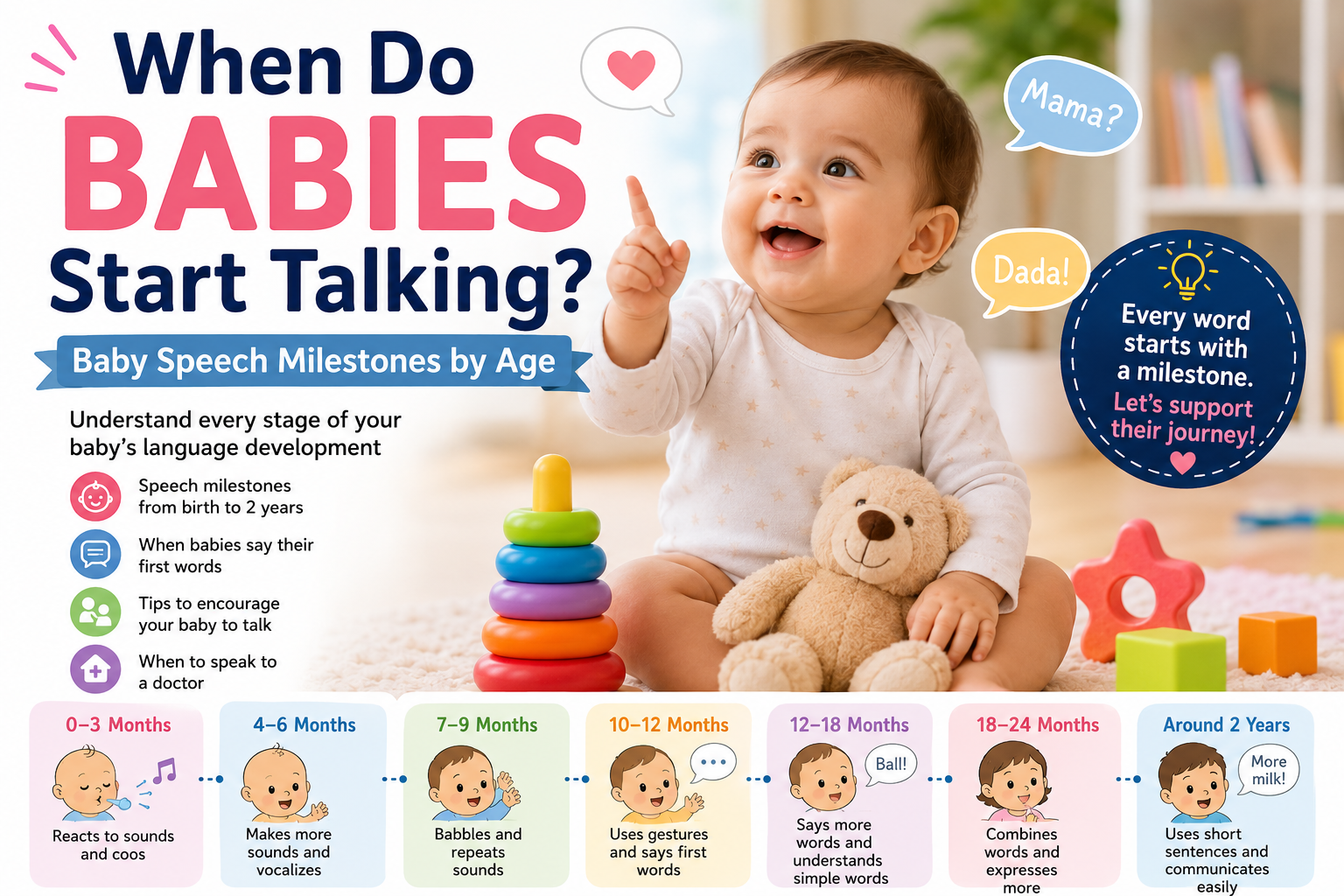
When Do Babies Start Talking? Quick Timeline
| Baby’s Age | Communication Skills You May Notice |
|---|---|
| Birth–3 months | Reacting to sounds, crying, early cooing |
| 4–6 months | More varied sounds and vocal play |
| 7–9 months | Babbling and repeated sound patterns |
| 10–12 months | Gestures, sound imitation and early word attempts |
| Around 12 months | Some babies may begin using meaningful words |
| 15 months | May try one or two words besides mama or dada |
| 18 months | May try three or more words besides mama or dada |
| 2 years | May combine at least two words |
| 30 months | About 50 words and short word combinations may emerge |
The CDC currently lists trying one or two words beyond “mama” or “dada” at 15 months, three or more additional words at 18 months, and combining at least two words at age 2 among its language and communication milestones. At 30 months, the CDC lists saying about 50 words and putting two or more words together with an action word.
These are milestone markers, not a competition or a rigid timetable.
What Does “Talking” Actually Mean for a Baby?
Before answering what age do babies start talking, it helps to understand what parents mean by “talking.”
A baby making:
“Ba-ba-ba-ba”
is babbling.
A baby consistently saying:
“Ba!”
while looking at or asking for a ball may be attempting a meaningful word.
The difference is usually intent and consistent meaning.
Early communication may include:
- looking toward a familiar voice;
- making different sounds;
- taking turns making noises with a caregiver;
- babbling;
- pointing;
- waving;
- reaching;
- showing objects;
- understanding familiar words;
- trying to imitate sounds;
- using early meaningful words.
Speech is only one part of communication.
The American Speech-Language-Hearing Association communication milestones cover hearing, understanding, gestures, sounds and spoken language across different age ranges—not simply the number of words a child says.
Baby Speech Milestones by Age
Here is a closer look at how early communication may develop.
Birth to 3 Months: Listening and Early Sounds
During the first few months, babies are not expected to use words.
Communication is much more basic.
You may notice your baby:
- reacts to sounds;
- quiets or changes behaviour in response to a familiar voice;
- cries differently in different situations;
- makes early cooing sounds;
- watches faces.
Parents can support communication simply by responding.
For example, if your baby coos:
“Ooooh.”
You might smile and respond:
“Ooooh! I hear you.”
It may feel like a one-sided conversation, but these early exchanges introduce the back-and-forth rhythm of communication.
4 to 6 Months: More Vocal Play
Between 4 and 6 months, many babies become more experimental with sounds.
You may hear:
- squeals;
- vowel-like sounds;
- growling sounds;
- laughter;
- repeated noises.
Your baby may also change the volume or pitch of their voice.
At this stage, parents sometimes hear a sound resembling “mama” or “dada.”
That does not always mean the baby is intentionally naming a parent yet.
What parents can do
Try:
- talking face-to-face;
- copying your baby’s sounds;
- singing simple songs;
- describing daily routines;
- pausing to let your baby respond.
You do not need special flashcards or expensive language toys.
Everyday interaction matters.
7 to 9 Months: Babbling Becomes More Noticeable
Babbling may become more complex during this period.
You might hear repeated sound patterns such as:
- ba-ba-ba;
- da-da-da;
- ma-ma-ma.
The sounds may begin to resemble speech, even when they do not yet have a specific meaning.
Your baby may also:
- react to their name;
- pay attention when you speak;
- copy sounds or gestures;
- use facial expressions;
- take turns making noises.
Is babbling the same as talking?
No.
Babbling is an important communication skill, but a meaningful word is used with a more consistent purpose.
For example:
“Mamamama”
during random vocal play may be babbling.
But consistently saying:
“Mama”
while looking for a parent may have meaningful intent.
10 to 12 Months: Early Word Attempts May Appear
This is the age when many parents begin listening closely for a first word.
Around the first birthday, communication may include:
- gestures;
- waving;
- pointing;
- copying sounds;
- responding to familiar words;
- trying early words.
Some babies may use “mama” or “dada” meaningfully.
Others may choose an unexpected first word such as:
- ball;
- dog;
- bye;
- no;
- car.
The exact first word is less important than the broader pattern of communication.
The CDC’s 1-year developmental milestone guidance can help parents look at communication alongside social, cognitive and movement development.
For a broader age-by-age overview, read MomSaathi’s Child Development Milestones from Birth to 5 Years.
When Do Babies Say Their First Word?
A baby’s first meaningful word may emerge around the first birthday, although the timing can vary.
A first word does not need perfect adult pronunciation.
For example:
- “ba” may mean ball;
- “da” may mean dog;
- “nana” may refer to banana.
What matters is whether the child appears to use the sound consistently and meaningfully.
Imagine your baby sees the family dog and repeatedly says:
“Da!”
If the same sound is consistently connected with the dog, it may function as an early word even though the pronunciation is incomplete.
The NIDCD speech and language developmental milestones resource provides a broader checklist of speech and language development from birth through age 5.
When Do Babies Say Mama or Dada?
“Mama” and “dada” are often among the sounds parents notice early because repeated consonant-vowel patterns can occur during babbling.
However, there is a difference between making the sound and using the word intentionally.
A baby might babble:
“Dadadadada.”
Later, the baby may look directly at a parent and say:
“Dada!”
with a clearer association.
The CDC uses words besides “mama” or “dada” in its 15- and 18-month milestones, reflecting that these familiar early words are considered separately when tracking broader vocabulary development.
Do not worry about whether “mama” or “dada” comes first. It is not a measure of which parent the baby loves more.
What Happens Between 12 and 15 Months?
During this stage, some babies begin experimenting more actively with words.
You may notice your child:
- trying to imitate words;
- pointing to request something;
- looking at familiar objects when they are named;
- combining sounds with gestures;
- trying simple words.
At 15 months, the CDC lists several language and communication milestones, including trying to say one or two words besides “mama” or “dada,” looking at a familiar object when it is named, and pointing to ask for something or get help.
Example
You say:
“Where is your cup?”
Your toddler looks toward the cup.
The child may not yet say “cup,” but understanding the familiar word is still part of language development.
When Do Babies Start Talking More?
The period between 12 and 24 months can bring noticeable changes in spoken language, although the pace differs among children.
A toddler may move from:
“Ball.”
to:
“More ball.”
and eventually use increasingly varied combinations.
The American Academy of Pediatrics’ HealthyChildren language development guide for 1-year-olds notes that many toddlers have at least 50 spoken words and can put two words together by the end of the second year.
Again, language development should be viewed as a pattern rather than judged by one day or one isolated word count.
Baby Talking at 15 Months
By 15 months, the CDC says most children may try to say one or two words besides “mama” or “dada.”
Examples might include approximate forms of:
- ball;
- dog;
- bye;
- milk;
- more.
A word does not need adult-level pronunciation.
If a toddler consistently says:
“Mo”
to request more food, that may function as a meaningful word.
Look beyond spoken words
Also notice whether your child:
- points;
- looks toward named objects;
- responds to communication;
- tries to get your attention;
- uses gestures.
These observations can give your healthcare professional a fuller picture if you have concerns.
Baby Talking at 18 Months
Parents often search “18 month old not talking” because speech differences become more noticeable during the toddler years.
At 18 months, the CDC lists trying to say three or more words besides “mama” or “dada” as a language and communication milestone. It also lists following a one-step direction without a gesture.
Examples of a simple direction might include:
“Give me the toy.”
or:
“Come here.”
Do not use another child’s vocabulary as the only comparison.
Instead, look at your child’s overall communication and discuss concerns with a healthcare professional.
When Do Toddlers Start Putting Words Together?
By age 2, the CDC lists saying at least two words together, such as “more milk,” as a language and communication milestone.
Early combinations may sound like:
- more milk;
- mama come;
- daddy go;
- want ball;
- doggie run.
Grammar does not need to be perfect.
These early combinations show that the child is beginning to connect words to express a larger idea.
By 30 months, CDC milestones include saying about 50 words and using two or more words together with an action word.
Babbling vs Talking: What Is the Difference?
| Babbling | Talking |
|---|---|
| Sound play | Meaningful communication |
| May be repetitive | Word connected to an idea or object |
| “Ba-ba-ba” | “Ba” consistently used for ball |
| May not have a specific meaning | Usually has communicative intent |
| Important pre-speech behaviour | Spoken language |
Babbling should not be dismissed as “just noise.”
It is part of early communication development.
The ASHA birth-to-1-year communication milestones include vocal play, sound development, gestures and interaction as part of the broader communication picture.
Signs Your Baby May Be Getting Ready to Talk
Before a first word appears, you may notice communication becoming more intentional.
Possible signs include:
- increased babbling;
- copying sounds;
- watching your mouth;
- pointing;
- waving;
- showing objects;
- taking turns making sounds;
- reacting to familiar words;
- using different sounds to get attention.
Not every baby will show these behaviours in exactly the same sequence.
Milestones help parents observe development; they are not intended to predict the exact date of a first word.
How to Encourage Your Baby to Talk
Parents do not need to turn the home into a speech classroom.
Simple everyday interaction can create opportunities for communication.
1. Talk During Daily Routines
Describe what you are doing.
For example:
“I’m washing your hands.”
“Here are your socks.”
“Let’s open the door.”
Use natural, simple language.
2. Follow Your Baby’s Attention
If your baby is staring at a dog, talk about the dog.
Say:
“Dog!”
“Big dog.”
“The dog is running.”
Talking about what already interests your child can make the interaction more relevant.
3. Copy Your Baby’s Sounds
If your baby says:
“Ba-ba.”
You can respond:
“Ba-ba!”
Then pause.
This creates a simple back-and-forth interaction.
ASHA encourages caregivers to respond to children, copy actions and support communication through everyday interaction.
4. Read Together
Choose age-appropriate books with:
- clear pictures;
- familiar objects;
- animals;
- everyday routines.
You do not always need to read every sentence.
Point and say:
“Cat.”
“The cat is sleeping.”
If your baby points at something else, follow their interest.
5. Sing Simple Songs
Songs with repetition can make sounds and words predictable.
You can use:
- nursery songs;
- family songs;
- action songs.
Pause occasionally before a familiar sound or word and give your child time to respond.
6. Use Gestures With Words
Say:
“Bye-bye”
while waving.
Say:
“Up?”
while opening your arms.
Gestures are part of communication and can accompany spoken language.
7. Give Your Child Time to Respond
Adults sometimes ask a question and answer it immediately.
Try pausing.
For example:
“Do you want the ball?”
Wait briefly.
Your baby may:
- look;
- point;
- reach;
- vocalise;
- attempt a word.
Communication does not begin only when a complete sentence appears.
8. Expand What Your Child Says
If your child says:
“Dog.”
You might respond:
“Yes, big dog!”
If the child says:
“Ball.”
You can say:
“Red ball.”
This models slightly longer language without demanding that the child repeat it perfectly.
Does Screen Time Affect Baby Speech?
Parents frequently worry about screens and language development.
The important distinction is between passive screen use and responsive human interaction. Babies learn communication through back-and-forth exchanges involving voices, facial expressions, gestures and responses.
For families reviewing digital habits, MomSaathi’s Screen Time and Learning resources cover screen-related parenting topics.
You can also review our Screen Time Chart by Age when planning your family’s routine.
Screens should not be treated as a replacement for responsive interaction with caregivers. If you have concerns about your child’s language development, reducing a complex developmental issue to screen exposure alone may also miss other possible factors.
My 12-Month-Old Is Not Talking. Should I Worry?
A 12-month-old not saying a clear word does not automatically tell you whether there is a speech or language problem.
Look at broader communication.
Ask yourself:
- Does my baby react to sounds?
- Do they use gestures?
- Do they try to get my attention?
- Do they make sounds?
- Do they respond during interaction?
- Have they lost a skill they previously had?
Milestone monitoring can help you decide what to discuss with your child’s healthcare professional.
The CDC advises parents not to wait when a child is not meeting milestones, has lost skills, or when the parent has other developmental concerns.
If you are worried, raise the concern.
You do not need to wait for a problem to become “serious enough” before asking a healthcare professional.
My 18-Month-Old Is Not Talking. What Should I Do?
At 18 months, the CDC lists trying to say three or more words besides “mama” or “dada” as a milestone.
If your 18-month-old is not using words or you are concerned about communication, speak with your child’s healthcare professional.
They may consider the child’s:
- hearing;
- understanding of language;
- gestures;
- social communication;
- developmental history;
- spoken language.
A hearing assessment or evaluation by a qualified speech-language professional may be considered depending on the child’s individual situation.
The ASHA communication milestone guidance is designed to help families understand expected communication development and when professional guidance may be useful.
Speech Delay Warning Signs Parents Should Not Ignore
Contact your child’s healthcare professional if you are concerned about communication development.
In particular, seek professional advice if your child:
- loses speech, language or communication skills they previously had;
- does not appear to react to sounds;
- has possible hearing concerns;
- is not meeting developmental milestones;
- has communication differences that concern you.
The CDC specifically advises acting early if a child is not meeting one or more milestones, has lost skills they once had, or if the parent has other concerns.
Do not use an online checklist to diagnose your child.
A developmental or communication assessment considers much more than the number of words a toddler says.
Can Hearing Problems Affect Speech Development?
Hearing and communication development are closely connected.
A child needs access to speech sounds to learn from spoken language. Hearing differences may affect how a child responds to sounds or develops speech and language.
If your baby:
- rarely reacts to sounds;
- seems to respond inconsistently;
- has a history that raises hearing concerns;
- shows communication differences;
discuss this with a healthcare professional.
The National Institute on Deafness and Other Communication Disorders speech and language milestones guide includes hearing and understanding alongside speech development.
Do Bilingual Babies Start Talking Later?
Growing up with more than one language does not mean parents should automatically assume a communication concern is “just because the child is bilingual.”
When considering a multilingual child’s language development, professionals may look at communication skills across the languages the child uses.
Parents can continue speaking languages they are comfortable using naturally with their child.
If you have concerns, tell the healthcare or speech-language professional:
- which languages the child hears;
- who speaks each language;
- how often each language is used;
- words or gestures the child uses across languages.
This gives a fuller picture of the child’s communication environment.
Should I Correct My Baby’s Words?
You generally do not need to repeatedly demand perfect pronunciation from a baby or young toddler.
If your child says:
“Wawa.”
You can respond naturally:
“Yes, water.”
This gives the correct model without turning every conversation into a test.
Similarly:
Child:
“Da!”
Parent:
“Yes, dog! The dog is running.”
The goal is communication and language exposure, not perfect pronunciation in early word attempts.
When Should Parents Speak to a Doctor?
Speak with your child’s healthcare professional whenever you have concerns about speech, language, hearing or overall development.
Do not wait simply because:
“Someone in the family talked late.”
or:
“Boys always talk later.”
or:
“They’ll talk when they’re ready.”
Individual variation exists, but persistent concerns deserve discussion.
The CDC’s Learn the Signs. Act Early. milestone resources encourage parents to monitor development and act early when milestones are missing, skills have been lost or other concerns arise.
Depending on the concern, your child’s healthcare professional may recommend further developmental, hearing or speech-language evaluation.
Frequently Asked Questions
When do babies start talking?
Some babies begin trying meaningful early words around their first birthday. Communication starts earlier through sounds, babbling, gestures and interaction.
What age do babies say their first word?
A first meaningful word may emerge around 12 months, although development varies. A word does not need perfect pronunciation if the child uses it consistently with meaning.
When do babies say mama?
Babies may make “ma-ma” sounds during babbling before using “mama” intentionally. The timing of a meaningful “mama” varies.
When do babies say dada?
“Da-da” may first appear as a babbling sound. Later, some babies begin consistently using “dada” for a parent.
Is babbling considered talking?
Babbling is an important early communication behaviour, but it is different from using a meaningful word consistently.
How many words should a 15-month-old say?
The CDC lists trying to say one or two words besides “mama” or “dada” as a 15-month language and communication milestone.
How many words should an 18-month-old say?
The CDC lists trying to say three or more words besides “mama” or “dada” as an 18-month milestone.
When do toddlers start combining words?
By age 2, saying at least two words together is a CDC language and communication milestone.
Is it normal for a 1-year-old not to talk?
Children develop at different rates, and one missing word alone does not diagnose a delay. Consider the child’s overall communication and discuss concerns with a healthcare professional.
Should I worry if my 18-month-old is not talking?
If your 18-month-old is not using words or you have concerns about communication, speak with your child’s healthcare professional rather than relying only on online comparisons.
How can I encourage my baby to talk?
Talk during everyday routines, respond to sounds, read together, sing, use gestures, follow your baby’s interests and allow time for back-and-forth communication.
Can hearing problems cause speech delays?
Hearing differences can affect access to speech sounds and language learning. Discuss possible hearing concerns with your child’s healthcare professional.
Do bilingual babies have speech delays?
Using more than one language should not automatically be treated as the cause of a communication delay. If concerns arise, communication should be considered across the languages the child uses.
Final Thoughts
So, when do babies start talking?
Many babies begin attempting meaningful early words around their first birthday, but speech does not begin with the first clear “mama” or “dada.” Communication develops earlier through listening, cooing, babbling, gestures, pointing and back-and-forth interaction.
By 15 months, the CDC lists trying one or two words besides “mama” or “dada” as a milestone. At 18 months, it lists trying three or more additional words. By age 2, combining at least two words is a language milestone.
Use milestones as a tool for observation rather than a way to compare babies.
For more age-based guidance, continue exploring MomSaathi’s Child Development resources and our Child Development Milestones from Birth to 5 Years guide.
If something about your child’s speech, hearing or communication concerns you, discuss it with a qualified healthcare professional.
[…] As she turns one and begins another exciting chapter of life, may her journey always be filled with joy, laughter, love, and countless blessings. Happy 1st Birthday to every beautiful baby girl celebrating this wonderful milestone! […]