
Nutrition note: This article provides general food and nutrition information. A child’s nutritional needs can vary according to age, body size, growth, activity, health and dietary pattern. Speak with your paediatrician or a qualified paediatric dietitian if you are concerned about your child’s growth, eating or nutrient intake.
Your child eats two bites of breakfast.
Leaves half the dal at lunch.
Asks for biscuits at 4 PM.
And suddenly you find yourself searching:
“Is my child getting enough protein?”
It is a common concern for parents, especially when a toddler or school-going child becomes a picky eater.
The good news?
Protein-rich food for kids does not have to mean expensive protein powder, imported foods or chicken at every meal. Dal, milk, curd, paneer, eggs, chickpeas, rajma, soy, nuts, seeds, fish and chicken can all contribute protein to a child’s diet.
India’s National Institute of Nutrition recommends including a variety of pulses, nuts, milk, eggs and fish or other suitable foods as part of a balanced diet to help provide protein and other nutrients.
Quick answer: Some of the best protein-rich foods for kids include eggs, paneer, milk, curd, dal, moong, chickpeas, rajma, soybeans, tofu, peanuts, nut butters, seeds, fish and chicken. Vegetarian children can also get protein from a varied diet containing pulses, dairy or soy, nuts and seeds.
Why Do Kids Need Protein?
Protein is one of the major nutrients required by the body.
Your child’s body uses dietary protein as part of normal:
- growth;
- tissue maintenance and repair;
- enzyme production;
- hormone production;
- immune function.
In simple words:
Protein provides amino acids that the body uses to build and maintain tissues and carry out many normal body functions.
Protein is important, but it is not the only nutrient that matters for growth.
Children also need:
- carbohydrates;
- fats;
- vitamins;
- minerals;
- adequate overall energy.
This is why feeding a child only “high-protein foods” does not automatically create a balanced diet.
The NHS balanced diet guidance describes beans, pulses, fish, eggs and meat as protein sources and explains that protein is essential for growth and repair.
How Much Protein Does a Child Need Per Day?
This is one of the most searched questions about children’s nutrition.
But there is a problem with giving every child one protein number.
Protein requirements vary by age and body size.
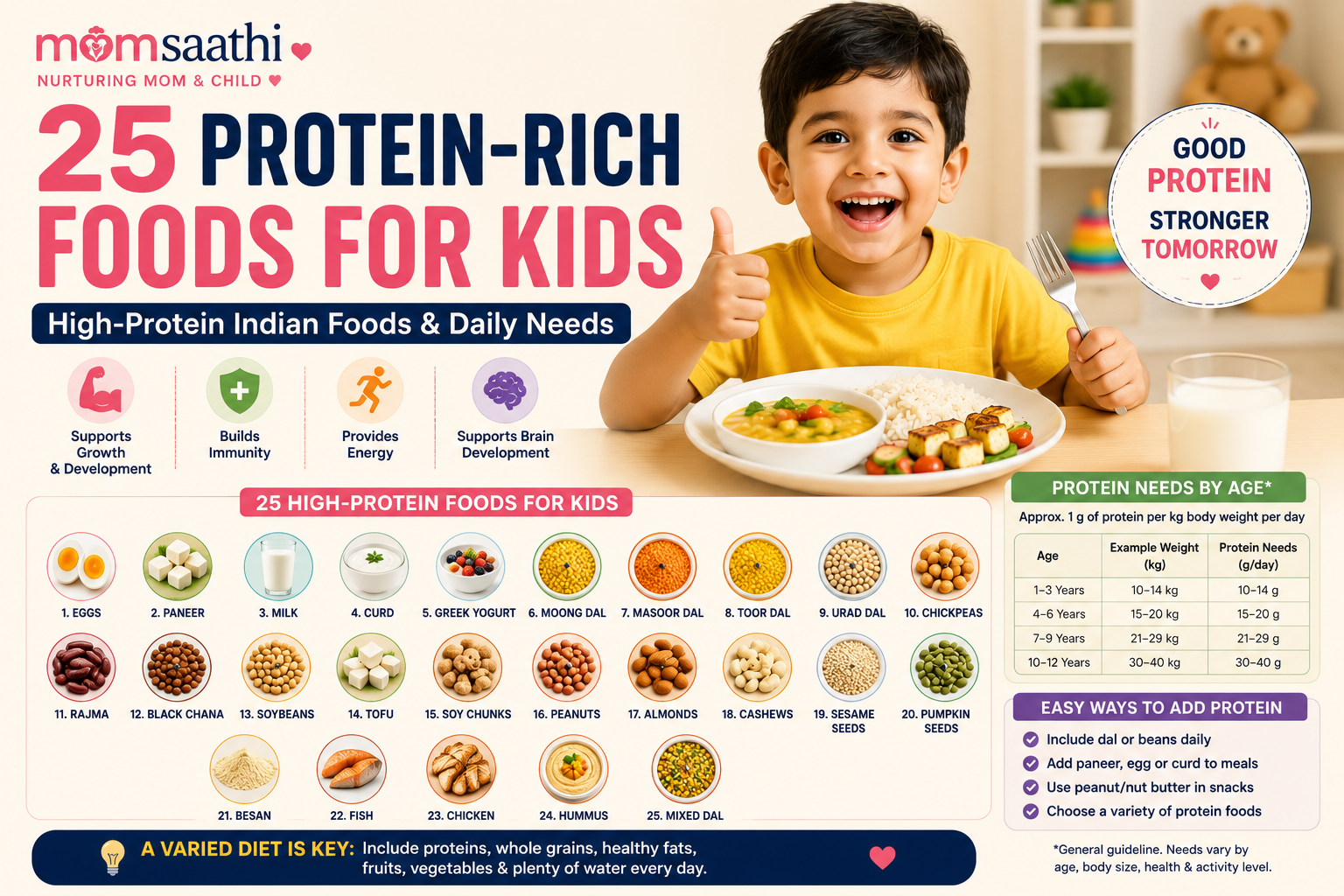
The ICMR-NIN brief note on nutrient requirements explains that protein requirements are calculated using body-weight and protein-quality considerations. For cereal-based diets with lower-quality protein, the document notes a requirement of about 1 g/kg body weight per day; the exact recommended intake depends on the reference group and dietary pattern.
Simple Protein Estimate for Parents
| Child’s Weight | 1 g/kg Example |
|---|---|
| 10 kg | About 10 g protein |
| 12 kg | About 12 g protein |
| 15 kg | About 15 g protein |
| 20 kg | About 20 g protein |
| 25 kg | About 25 g protein |
| 30 kg | About 30 g protein |
Important: This is a simple 1 g/kg illustration, not a personalised diet prescription or a substitute for the age-specific ICMR-NIN RDA.
Do not use this table to calculate a medical diet for a child with:
- kidney disease;
- liver disease;
- metabolic disorders;
- significant growth concerns;
- other chronic health conditions.
For these children, seek individual nutritional advice.
Does My Child Need Protein at Every Meal?
You do not need to stand with a calculator and count every gram your child eats.
However, a practical approach is to include a protein-containing food across meals and snacks during the day.
For example:
Breakfast: besan chilla + curd
Lunch: rice + dal
Snack: peanut butter toast
Dinner: paneer + roti
The protein does not come from one giant “protein meal.”
It adds up across the day.
The American Academy of Pediatrics’ HealthyChildren guide to protein-rich alternatives lists foods such as eggs, yoghurt, cheese, soy foods, tofu, lentils, nut butter and hummus among useful protein-containing options for children.
25 Protein-Rich Foods for Kids
Here are practical Indian and commonly available protein foods for children.
| Protein-Rich Food | Easy Way to Serve Kids |
|---|---|
| 1. Eggs | Boiled egg, omelette, egg bhurji |
| 2. Paneer | Paneer cubes, bhurji, stuffed paratha |
| 3. Milk | Plain milk or used in suitable foods |
| 4. Curd | Plain curd, raita |
| 5. Greek-style or strained yoghurt | Fruit yoghurt bowl |
| 6. Moong dal | Dal, khichdi, chilla |
| 7. Masoor dal | Dal, soup |
| 8. Toor dal | Dal-rice, sambar |
| 9. Urad dal | Dal, idli or dosa batter |
| 10. Chickpeas | Chana, hummus |
| 11. Rajma | Rajma-rice |
| 12. Black chana | Chana curry |
| 13. Soybeans | Cooked soybean dishes |
| 14. Tofu | Tofu bhurji, mild stir-fry |
| 15. Soy chunks | Soft cooked soy chunk curry |
| 16. Peanuts | Peanut chutney or age-safe peanut butter |
| 17. Almonds | Ground or age-appropriately prepared |
| 18. Cashews | Ground or age-appropriately prepared |
| 19. Sesame seeds | Til chutney or added to foods |
| 20. Pumpkin seeds | Ground into suitable foods |
| 21. Besan | Besan chilla |
| 22. Fish | Boneless, thoroughly cooked fish |
| 23. Chicken | Soft, thoroughly cooked chicken |
| 24. Hummus | Spread or dip |
| 25. Mixed dal | Dal, khichdi or soup |
The ICMR-NIN Dietary Guidelines for Indians encourage dietary variety and include pulses, nuts, milk and eggs among foods contributing protein and other nutrients.
Safety note: Whole nuts and other hard foods can be choking hazards for young children. Prepare foods in a texture and form appropriate for your child’s age and development.
1. Eggs
Eggs are one of the easiest protein-rich foods to add to a child’s diet if your family eats them and the child can safely consume egg.
You can serve eggs as:
- boiled egg;
- omelette;
- egg bhurji;
- egg dosa;
- egg sandwich.
A picky eater who refuses boiled egg may accept an omelette cut into strips.
The goal is not:
“My child must eat egg exactly this way.”
Try age-appropriate textures and preparations.
Eggs are among the protein foods included in children’s healthy eating guidance from the American Academy of Pediatrics.
2. Paneer
Paneer is a familiar protein-containing food in many Indian homes.
Try:
- paneer bhurji;
- soft paneer cubes;
- paneer paratha;
- paneer tikka prepared in a child-friendly way;
- paneer added to vegetable dishes.
For younger children, adapt the texture and size to reduce choking risk.
Paneer can be especially useful for vegetarian families that include dairy.
MomSaathi’s weight gain foods for babies guide also includes paneer among nutrient-dense foods that may be offered in age-appropriate forms.
3. Milk
Milk can contribute protein and other nutrients to a child’s diet.
But more milk is not always better.
A child who drinks large amounts of milk may feel too full to eat a varied diet.
Do not turn every refused meal into:
“Okay, drink another glass of milk.”
Look at the child’s total eating pattern.
If your child drinks milk but eats very few solid foods, discuss the pattern with your paediatrician.
4. Curd
Curd is easy to include in an Indian meal.
Serve it as:
- plain curd;
- vegetable raita;
- curd rice;
- fruit with plain yoghurt where appropriate.
Curd can contribute protein while also fitting naturally into family meals.
Avoid assuming that flavoured yoghurt and plain curd are nutritionally identical.
Check added sugar on packaged products.
5. Strained Yoghurt
Thicker, strained yoghurt can provide a convenient protein-containing snack.
Try:
plain yoghurt + banana + finely ground nut or seed ingredient where age appropriate
You do not need an expensive imported yoghurt brand.
The exact protein content varies by product and preparation.
Check the nutrition label when comparing packaged yoghurts.
6. Moong Dal
Moong dal deserves a place in a child nutrition article.
It is familiar.
Versatile.
And easy to use in several Indian foods.
Try:
- moong dal;
- moong dal khichdi;
- moong chilla;
- dal soup.
For babies starting complementary foods, MomSaathi’s 7-month baby food chart includes moong dal among protein-rich food options that can be prepared in an age-appropriate texture.
7. Masoor Dal
Masoor dal is another useful pulse.
It can be served as:
- simple dal;
- lentil soup;
- mixed dal;
- dal with rice.
If your child rejects a bowl of dal, do not immediately conclude:
“My child hates lentils.”
Try the same food in another form.
A child may reject thin dal but eat a dal-based chilla or mixed khichdi.
8. Toor Dal
Dal-rice is not an “inferior” meal because it looks simple.
Toor dal contributes protein, while cereals contribute additional amino acids and energy.
The ICMR-NIN brief note specifically discusses protein quality in relation to Indian cereal-legume-milk dietary patterns.
A varied diet matters more than chasing one fashionable “superfood.”
9. Urad Dal
Urad dal is used in several familiar Indian foods.
Think:
- idli;
- dosa;
- urad dal preparations.
This gives parents an important lesson:
A child’s protein does not only come from foods that look like a bowl of protein.
Ingredients inside mixed dishes also contribute to total intake.
10. Chickpeas or Chana
Chickpeas are a useful plant protein source.
Try:
- chana curry;
- mashed chickpeas;
- hummus;
- chana-based patties.
The NHS vegetarian diet guidance identifies pulses—including beans, peas and lentils—as sources of protein, fibre, vitamins and minerals.
For younger children, prepare chickpeas in a soft, age-appropriate form.
11. Rajma
Rajma is a familiar family food.
Serve:
- rajma-rice;
- mashed rajma;
- rajma patties.
A child does not need a separate “high-protein diet food” when nutritious family meals can be adapted appropriately.
If your child is a picky eater, start with a small portion.
A mountain of rajma on the plate can feel overwhelming.
12. Black Chana
Kala chana or black chickpeas can contribute plant protein.
Possible options include:
- soft chana curry;
- mashed cooked chana;
- chana-based patties.
Make sure the chana is thoroughly cooked.
Adapt the texture for younger children.
13. Soybeans
Soybeans are a protein-rich plant food.
Soy foods can be particularly useful in vegetarian diets.
The AAP includes soy products such as soy milk and tofu among non-meat protein options for children.
If your child has a known soy allergy, avoid soy and follow medical advice.
14. Tofu
Tofu can be used similarly to paneer in some meals.
Try:
- tofu bhurji;
- tofu cubes;
- tofu mixed into vegetables;
- mild tofu stir-fry.
Children may need repeated exposure to an unfamiliar food.
One refusal does not prove permanent dislike.
15. Soy Chunks
Soy chunks are widely available in India.
They can be added to:
- curry;
- pulao;
- mixed vegetables.
Cook them according to product instructions and prepare them in a size and texture appropriate for your child.
Remember:
Protein-rich does not automatically mean unlimited portions.
Children still need a balanced plate.
16. Peanuts and Peanut Butter
Peanuts can contribute protein and other nutrients.
For young children, whole peanuts can be a choking hazard.
Use an age-appropriate form such as smooth peanut butter or finely ground peanuts where suitable.
Plant-based protein sources such as nuts and seeds are recognised in NHS and AAP nutrition guidance.
Choose peanut butter thoughtfully.
Check the label for added sugar and sodium.
If your child has a diagnosed peanut allergy, avoid peanut products and follow their allergy management plan.
17. Almonds
Almonds contain protein, but do not hand whole hard nuts to a young child simply because they are “healthy.”
Age-appropriate options may include:
- finely ground almonds;
- nut butter;
- almond powder mixed into suitable foods.
Choking safety comes before a nutrition trend.
18. Cashews
Cashews can also contribute protein.
Use them in an age-appropriate form.
Possible options include:
- finely ground cashew;
- smooth cashew butter where available;
- cashew paste incorporated into suitable dishes.
Again, portion and preparation matter.
19. Sesame Seeds or Til
Sesame seeds can contribute protein and other nutrients.
Indian options include:
- til chutney;
- sesame added to suitable foods;
- ground sesame preparations.
If your child has a sesame allergy, avoid sesame and follow medical advice.
20. Pumpkin Seeds
Pumpkin seeds are frequently marketed as a “superfood.”
They can contribute protein.
But your child does not need to eat a bowl of seeds.
For younger children, seeds may need to be ground or prepared in another age-appropriate form.
Try adding a small amount to:
- yoghurt;
- porridge;
- suitable homemade mixtures.
21. Besan
Besan or gram flour is one of my favourite practical Indian protein foods for kids.
Why?
Because it easily becomes:
besan chilla
You can add finely prepared vegetables according to your child’s age and chewing ability.
Serve with curd.
Now you have a practical breakfast containing multiple nutrient sources.
22. Fish
Fish can provide high-quality protein and other nutrients.
The American Academy of Pediatrics notes that seafood can provide protein and nutrients important for children’s development.
For children:
- remove bones carefully;
- cook fish thoroughly;
- choose age-appropriate textures;
- follow local guidance on fish species and mercury exposure.
Do not give a young child a piece of fish without checking carefully for bones.
23. Chicken
Chicken can be included as part of a balanced non-vegetarian diet.
Try:
- shredded chicken;
- soft chicken curry;
- chicken added to rice;
- homemade chicken patties.
Cook chicken thoroughly.
Avoid turning “protein for kids” into:
nuggets every day.
The AAP specifically encourages parents to look beyond chicken nuggets and include a variety of protein-rich foods.
24. Hummus
Hummus is made primarily from chickpeas.
It can be used as:
- a spread;
- a dip;
- part of a snack plate.
Serve it with age-appropriate foods.
Homemade hummus can also allow you to control ingredients according to your family’s preferences.
25. Mixed Dal
Why use one dal when you can sometimes use a combination?
Mixed dal can increase dietary variety.
Try:
- mixed dal;
- mixed dal khichdi;
- dal soup.
Do not market it to your child as:
“You must eat this because it has protein.”
Sometimes the less nutrition pressure at the table, the better.
Best Vegetarian Protein-Rich Foods for Kids
Indian vegetarian diets have many protein-containing options.
| Vegetarian Protein Food | Easy Indian Meal Idea |
|---|---|
| Paneer | Paneer bhurji |
| Milk | Milk with breakfast |
| Curd | Curd rice |
| Moong dal | Moong chilla |
| Masoor dal | Dal-rice |
| Toor dal | Sambar-rice |
| Chickpeas | Chana or hummus |
| Rajma | Rajma-rice |
| Soy | Soy curry |
| Tofu | Tofu bhurji |
| Peanuts | Peanut chutney |
| Besan | Besan chilla |
| Sesame | Til chutney |
| Nuts | Ground into suitable foods |
| Seeds | Ground into yoghurt or porridge |
The NHS notes that pulses are particularly important protein sources for people who do not eat meat or fish, while nuts and seeds also provide protein and other nutrients.
The AAP also identifies beans, peas, grains, seeds and nuts as valuable plant protein sources.
Vegetarian does not automatically mean protein deficient.
The overall quality and variety of the child’s diet matter.
Protein-Rich Foods for Toddlers
Toddlers can be unpredictable eaters.
Monday:
“I love paneer!”
Tuesday:
“Paneer is my enemy.”
This behaviour can make parents panic about protein.
Instead of depending on one favourite food, rotate protein options.
Toddler Protein Ideas
- moong chilla with curd;
- scrambled egg;
- paneer bhurji;
- dal-rice;
- soft rajma-rice;
- curd with fruit;
- smooth peanut butter on toast;
- hummus;
- soft tofu;
- besan chilla.
Young children have small stomachs, and the AAP notes that three meals plus two or three healthy snacks can help meet their nutritional and energy needs.
Think:
small meals + nutritious snacks + repeated exposure
Not:
one huge plate + pressure + tears
Protein-Rich Food for a 2-Year-Old
A 2-year-old does not need a bodybuilder’s meal plan.
A practical day may include:
Breakfast: Besan chilla + curd
Snack: Fruit + age-safe nut butter
Lunch: Rice + dal + vegetable
Snack: Plain yoghurt
Dinner: Paneer bhurji + roti
The AAP’s feeding guidance for 2-year-olds includes protein foods such as meat, seafood, poultry, eggs, nuts, seeds and soy, alongside dairy and other food groups.
Do not focus only on protein.
A 2-year-old needs dietary variety.
Protein-Rich Food for a 5-Year-Old
School-going children may need practical meals that fit busy mornings.
Try:
Breakfast
- egg + toast;
- paneer paratha + curd;
- besan chilla;
- idli + sambar.
School Snack
- peanut butter sandwich where school allergy policies allow;
- paneer roll;
- curd or yoghurt where safe refrigeration is available;
- hummus sandwich.
Lunch
- dal-rice;
- rajma-rice;
- chole;
- paneer;
- chicken or fish where included in the family’s diet.
The goal is not to pack five protein foods in one tiffin.
Include a varied, balanced selection.
High-Protein Indian Breakfast Ideas for Kids
Breakfast does not have to be cereal and milk every day.
Try:
- Besan chilla + curd
- Moong dal chilla
- Egg bhurji + roti
- Paneer paratha + curd
- Idli + sambar
- Dosa + sambar
- Peanut butter toast + fruit
- Paneer sandwich
- Yoghurt + fruit + age-safe ground nuts
- Tofu bhurji + roti
Notice something?
These are mostly normal foods.
You do not need to write:
“HIGH-PROTEIN SUPER BREAKFAST”
on your child’s plate.
Protein-Rich Snacks for Kids
Snack time is where many children’s diets become dominated by:
- biscuits;
- chips;
- sweets;
- sugary drinks.
You do not have to ban every fun food.
But snacks are also an opportunity to add nutrition.
Try:
- curd;
- yoghurt;
- paneer cubes;
- hummus;
- smooth peanut butter toast;
- boiled egg;
- chana-based snack prepared appropriately;
- milk;
- tofu pieces;
- homemade besan snacks.
The AAP includes lentils, nut butter, hummus, yoghurt and cheese among protein-rich alternatives for children.
7-Day Protein-Rich Indian Meal Ideas for Kids
This is a general meal inspiration table, not a medical diet plan.
| Day | Breakfast | Lunch | Snack | Dinner |
|---|---|---|---|---|
| Monday | Besan chilla + curd | Dal-rice | Yoghurt | Paneer + roti |
| Tuesday | Egg + toast | Rajma-rice | Fruit + nut butter | Vegetable khichdi + curd |
| Wednesday | Idli + sambar | Chana + rice | Paneer cubes | Dal + roti |
| Thursday | Moong chilla | Paneer pulao | Yoghurt | Tofu bhurji + roti |
| Friday | Paneer paratha + curd | Dal-rice | Hummus | Chicken or soy curry |
| Saturday | Egg bhurji + roti | Chole-rice | Milk | Fish or paneer + vegetables |
| Sunday | Dosa + sambar | Mixed dal khichdi | Peanut butter toast | Rajma + roti |
Adapt:
- portions;
- textures;
- spice levels;
- allergens;
to your child’s age and needs.
How to Add More Protein to an Indian Child’s Diet
You do not always need to increase portion size.
Sometimes you can improve the composition of the meal.
Instead of:
plain toast
try:
toast + suitable nut butter
Instead of:
plain roti
try:
roti + paneer bhurji
Instead of:
rice alone
try:
rice + dal
Instead of:
fruit snack alone
try:
fruit + plain yoghurt
Instead of:
plain dosa
try:
dosa + sambar
Small combinations add up.
My Child Does Not Eat Dal: What Should I Do?
First:
Do not panic.
Dal is useful, but it is not the only protein-containing food.
Try dal in different forms:
- moong chilla;
- mixed dal dosa;
- khichdi;
- thicker dal;
- dal soup.
You can also rotate:
- paneer;
- curd;
- eggs;
- chickpeas;
- rajma;
- soy;
- tofu;
- suitable nut or seed foods.
A child who refuses one food can still eat a nutritionally varied diet.
My Child Is Vegetarian: Will They Get Enough Protein?
A well-planned vegetarian diet can include multiple protein sources.
Useful foods include:
- pulses;
- beans;
- chickpeas;
- dairy, if included;
- eggs, if included;
- soy;
- tofu;
- nuts;
- seeds.
The NHS identifies beans, peas and lentils as important protein sources in vegetarian diets and also notes nuts and seeds as protein-containing foods.
The AAP similarly notes that children can obtain protein from foods such as rice, beans, eggs, milk and peanut butter rather than meat alone.
For a strict vegan child, seek professional nutrition guidance to ensure the overall diet appropriately addresses protein and nutrients such as vitamin B12, iron, calcium, iodine and vitamin D.
Does Rice Have Protein?
Yes.
Rice contains some protein.
But it is not generally treated as the main protein food in a child’s meal.
The useful lesson is:
Many foods contribute small or larger amounts of protein to the day’s total.
A meal such as rice and dal contains protein from more than one ingredient.
This is why calculating protein from only:
eggs + chicken + paneer
can underestimate total dietary intake.
Is Dal a Complete Protein?
You may have heard:
“Dal is incomplete protein.”
This phrase can confuse parents.
Plant foods differ in their amino acid profiles.
However, children do not need every individual food to contain identical amounts of every essential amino acid.
A varied diet containing cereals, pulses and other protein foods can provide complementary amino acids.
The ICMR-NIN nutrient requirements brief specifically discusses protein quality in the context of Indian cereal-legume-milk diets.
You do not need to create a perfect amino-acid formula at every meal.
Focus on dietary variety across the day.
Does My Child Need Protein Powder?
Most healthy children eating a varied diet do not automatically need protein powder simply because protein is important.
Protein powder is not a replacement for:
- balanced meals;
- growth assessment;
- evaluation of persistent picky eating;
- medical nutrition advice.
Do not start a supplement because:
“My neighbour’s child drinks it.”
or:
“A fitness influencer said children need more protein.”
If you are concerned that your child is not eating enough or is not growing as expected, speak with their paediatrician.
The problem may require a broader assessment rather than a protein scoop.
Can Too Much Protein Be Bad for Kids?
More protein is not automatically better.
A child’s diet needs balance.
If protein foods crowd out:
- fruits;
- vegetables;
- grains;
- other nutrient-rich foods;
the overall diet may become unnecessarily restrictive.
Children with certain medical conditions may also need individual advice about protein intake.
Do not deliberately put a child on a very high-protein diet without appropriate professional guidance.
Signs Your Child May Not Be Eating Enough Overall
Parents sometimes focus on protein when the broader issue is total dietary intake.
Speak with your child’s healthcare professional if you are concerned about:
- poor growth;
- weight loss;
- persistent extreme food restriction;
- difficulty chewing or swallowing;
- frequent vomiting;
- ongoing diarrhoea;
- unusual tiredness;
- significant feeding distress.
These symptoms do not automatically mean protein deficiency.
A healthcare professional can assess the child’s growth and overall nutritional status.
Protein Foods and Picky Eaters
Here is a practical rule:
Do not make protein the battleground at every meal.
If you repeatedly say:
“Eat your protein.”
“Three more bites of paneer.”
“No play until you finish the egg.”
the food may become associated with pressure.
Instead:
- offer a small portion;
- include a familiar food;
- allow repeated exposure;
- vary the preparation.
The goal is to build eating skills and dietary variety over time.
Protein-Rich Foods for Kids: Myths vs Facts
| Myth | Fact |
|---|---|
| Only non-vegetarian food has protein | Pulses, dairy, soy, nuts and seeds also contribute protein |
| Kids need protein powder to grow | Many healthy children can obtain protein from food |
| Paneer is the only good vegetarian protein | Indian diets have many vegetarian protein sources |
| More protein always means faster growth | Growth depends on overall nutrition and health |
| Dal is useless because it is not a “complete protein” | A varied diet can provide complementary amino acids |
| A child must eat eggs every day | Protein can come from multiple foods |
| Every meal needs exact protein counting | Intake adds up across the day |
| A picky eater automatically has protein deficiency | Feeding and growth need broader assessment |
MomSaathi’s Protein Checklist for Parents
Ask yourself:
1. Does my child eat at least a few different protein foods?
Variety matters.
2. Do I include pulses regularly?
Dal, chana and rajma can contribute protein.
3. Does my vegetarian child eat dairy, soy, pulses, nuts or seeds as appropriate?
Rotate suitable sources.
4. Am I relying only on milk?
Too much milk may affect appetite for other foods.
5. Are my child’s snacks mostly biscuits and chips?
Snack time can also provide nutrition.
6. Am I preparing nuts and seeds safely?
Whole nuts can be a choking hazard for young children.
7. Am I forcing my child to finish protein foods?
Pressure can make feeding more stressful.
8. Am I worried about my child’s growth?
Speak with your paediatrician rather than relying only on online protein calculators.
Frequently Asked Questions About Protein-Rich Foods for Kids
What are the best protein-rich foods for kids?
Eggs, paneer, milk, curd, dal, chickpeas, rajma, soy, tofu, nuts, seeds, fish and chicken are useful protein-containing foods. The best options depend on the child’s age, dietary pattern and health.
Which Indian foods are high in protein for kids?
Moong dal, masoor dal, toor dal, urad dal, chana, rajma, paneer, curd, besan, soy and eggs are practical protein-containing Indian foods.
What are the best vegetarian protein foods for kids?
Pulses, beans, chickpeas, dairy products, soy, tofu, nuts and seeds can contribute protein to a vegetarian child’s diet.
How much protein does a child need daily?
Protein needs vary by age, body size and diet. ICMR-NIN discusses protein requirements using body-weight and protein-quality considerations; the exact age-specific RDA should be used for formal nutritional planning.
Is paneer good for protein in kids?
Paneer can contribute protein and can be included as part of a varied vegetarian diet if dairy is suitable for the child.
Is dal a good source of protein for children?
Yes. Lentils and pulses contribute plant protein and other nutrients. They can be included alongside cereals and other foods as part of a varied diet.
Are eggs good for children’s protein intake?
Eggs are a protein-containing food and are included among healthy protein food options in paediatric nutrition guidance.
What protein-rich breakfast can I give my child?
Besan chilla with curd, moong chilla, egg with toast, paneer paratha with curd, or idli with sambar are practical options.
What are high-protein snacks for kids?
Plain yoghurt, paneer, hummus, age-safe nut butter, boiled egg and suitable chana-based snacks can add protein to snack time.
How can a vegetarian child get enough protein?
Offer a varied diet containing pulses, beans, chickpeas, dairy or suitable alternatives, soy, tofu, nuts and seeds. Strict vegan diets in young children may benefit from professional nutritional guidance.
Does my child need protein powder?
Many healthy children can meet protein needs through a varied diet. If you are concerned about growth or restricted eating, speak with a paediatrician or paediatric dietitian before starting protein supplements.
Can I give peanut butter to my child for protein?
Peanut butter can contribute protein. Use an age-appropriate form and consider allergy guidance. Whole peanuts can be a choking hazard for young children.
Is milk enough protein for a toddler?
Milk can contribute protein, but it should not replace a varied diet containing other food groups and age-appropriate solid foods.
What if my child refuses dal?
Try pulses in other forms such as moong chilla, khichdi or hummus, and rotate other suitable protein foods such as paneer, curd, egg, soy or tofu.
Can children get too much protein?
More protein is not automatically better. Children need a balanced diet, and very high-protein diets or supplements should not be used without appropriate guidance.
Final Thoughts
So, what are the best protein-rich foods for kids?
You probably already have many of them in your kitchen.
Dal. Paneer. Curd. Eggs. Chana. Rajma. Besan. Soy. Peanuts. Fish. Chicken.
Protein does not have to come from a powder.
It does not need an expensive label.
And it does not need to become a daily argument at the dining table.
The ICMR-NIN Dietary Guidelines for Indians encourage dietary variety and the inclusion of pulses, nuts, milk, eggs and other suitable protein foods in a balanced eating pattern.
A simple strategy is:
Include a protein-containing food at several eating opportunities → rotate different sources → use familiar Indian meals → watch the child’s overall growth and diet.
For younger babies, food choices and textures need to match developmental readiness. MomSaathi’s 7-month baby food chart covers age-appropriate protein options such as dal, curd, paneer, egg and carefully prepared non-vegetarian foods.
And if your child has significant feeding difficulties, poor growth or a highly restricted diet?
Do not simply add more protein powder.
Ask for a proper nutritional assessment.
Because the goal is not to raise a child who eats the highest-protein diet.
The goal is to help your child eat a varied, balanced and developmentally appropriate diet that supports healthy growth.