

Development note: This article provides general child development information and is not a developmental assessment. If your child has lost a skill, is not meeting one or more milestones, or you have concerns about how your child plays, learns, speaks, acts or moves, discuss them with your child’s doctor. The CDC advises parents not to wait when they have developmental concerns.
Your 17-month-old may be walking from room to room, pointing at everything in sight and trying to tell you exactly what they want—even when the words are not quite there yet.
One minute, your toddler is copying you sweeping the floor.
The next, they are frustrated because you gave them the blue cup instead of the pink one.
Welcome to 17 months.
So, what are the typical 17-month-old milestones parents may notice?
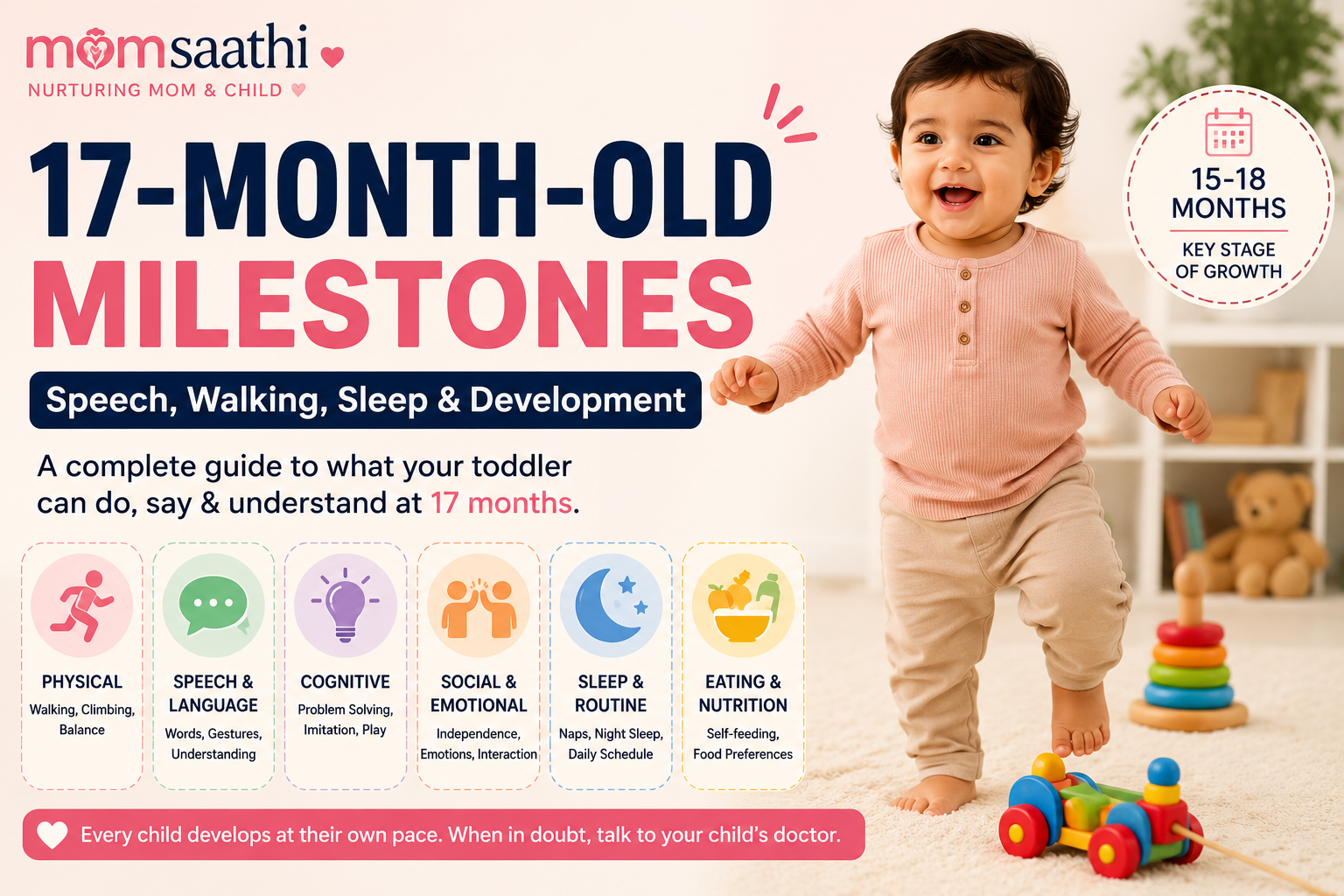
At 17 months, many toddlers are developing greater independence, improving their walking and fine motor skills, communicating through gestures and emerging words, copying everyday actions and exploring how toys and objects work. Development varies between children, so milestones are better used to monitor progress than to compare one toddler with another.
Quick answer: A 17-month-old may walk independently, point to request something, use a few meaningful words, understand simple language, imitate everyday activities and play with toys in increasingly purposeful ways. Because 17 months falls between official 15- and 18-month CDC milestone checklists, parents can look at development across this broader stage rather than expecting every skill on an exact day.
17-Month-Old Development at a Glance
Your toddler is approaching the 18-month stage, a period of rapid movement, communication and social development.
Here is a simple snapshot of skills you may notice around 17 months:
| Development Area | What You May Notice |
|---|---|
| Gross motor | Walking independently and climbing onto low furniture |
| Fine motor | Scribbling, using fingers to feed and handling small objects |
| Speech | Using a few meaningful words or word approximations |
| Communication | Pointing, gesturing and following familiar instructions |
| Cognitive | Copying chores and using toys in simple, purposeful ways |
| Social | Moving away to explore but checking that a caregiver is nearby |
| Emotional | Strong preferences, frustration and growing independence |
| Play | Pushing toy cars, looking at books and copying adult activities |
| Sleep | Usually one main daytime nap for many toddlers |
| Eating | Increasing independence but changing food preferences |
This is a general development overview, not a pass-or-fail checklist.
The CDC’s current 18-month checklist includes skills such as walking without holding on, scribbling, trying to use a spoon, copying simple chores, playing with toys in a simple way, and trying to say three or more words besides “mama” or “dada.”
At 17 months, your child may already do some of these things.
Other skills may emerge closer to or after 18 months.
Physical Milestones for a 17-Month-Old
Physical development can be one of the most noticeable changes at this age.
Your toddler may seem to be constantly moving.
You may notice them:
- walking independently;
- changing direction while walking;
- squatting to examine a toy;
- standing back up;
- pushing or pulling toys;
- carrying an object while moving;
- attempting to climb;
- getting onto low furniture;
- exploring stairs with assistance.
The CDC lists walking without holding on as an 18-month movement milestone. Its 15-month checklist uses taking a few steps independently as the earlier milestone.
This shows why development is best viewed as a progression:
A few independent steps → more confident walking → greater control while exploring
Your 17-month-old may be somewhere along that progression.
Should a 17-Month-Old Be Walking?
Many 17-month-olds are walking independently.
However, walking development does not occur on the same date for every child.
The CDC’s milestone framework moves from taking a few steps independently by 15 months to walking without holding on by 18 months.
If your 17-month-old is not walking independently yet, consider the broader picture.
Are they:
- pulling to stand?
- cruising along furniture?
- standing independently?
- taking supported steps?
- attempting a few independent steps?
Discuss your child’s movement development with their doctor if you are concerned.
Do not wait until another parent tells you:
“My baby walked at 10 months.”
Another child’s timeline is not a developmental assessment of your child.
17-Month-Old Walking Milestones
At 17 months, walking may be becoming more purposeful.
Your toddler is no longer only practising the act of walking.
They may walk because they want to:
- bring you a toy;
- follow you into another room;
- investigate an object;
- carry something;
- escape a nappy change.
You may also notice your toddler experimenting with balance.
They might:
- squat and stand;
- turn while walking;
- carry toys;
- push a toy;
- walk faster when excited.
Falls are still common while movement skills develop.
Create a safe environment for active exploration and supervise your toddler appropriately, particularly around stairs, furniture and climbing hazards.
Fine Motor Skills at 17 Months
Fine motor development involves the smaller movements of the hands and fingers.
At around 17 months, your toddler may enjoy activities that require more hand control.
You may notice them:
- picking up small pieces of food;
- turning book pages;
- stacking objects;
- putting objects into containers;
- taking objects out again;
- making marks with crayons;
- attempting to use a spoon;
- pressing buttons on toys.
The CDC includes scribbling and trying to use a spoon among its 18-month milestones.
Do not expect neat drawings.
A 17-month-old’s masterpiece may be three lines across a page—and one line on your table.
The developmental value is in the activity itself.
Scribbling gives your toddler opportunities to practise hand movement and tool use.
Always supervise art activities and use age-appropriate, non-toxic materials.
17-Month-Old Speech Milestones
Speech is one of the biggest concerns parents search for at this age.
You may ask:
How many words should a 17-month-old say?
The answer requires some context.
The CDC’s 15-month milestone checklist says a child may try to say one or two words besides “mama” or “dada.”
By 18 months, the CDC milestone is trying to say three or more words besides “mama” or “dada.”
Therefore, at 17 months, your toddler may be moving between these stages.
Words may include:
- ball;
- dog;
- milk;
- more;
- no;
- bye;
- car;
- up;
- dada;
- mama.
The pronunciation does not always sound perfect.
For example:
“Ba” may mean ball.
“Da” may mean dog.
“Wa-wa” may mean water.
The CDC’s 15-month guidance specifically recognises word attempts such as “ba” for ball or “da” for dog.
The important question is not simply:
Can my toddler pronounce the word perfectly?
Instead, observe how your toddler is attempting to communicate and use sounds, gestures and words meaningfully.
How Many Words Should a 17-Month-Old Say?
There is no single exact word count that every 17-month-old must have.
This is where online milestone articles can create unnecessary confusion.
One website says 10 words.
Another says 20.
A parent on social media says their toddler knows 100 words.
Official CDC milestone guidance uses a more specific benchmark: by 18 months, most children try to say three or more words besides “mama” or “dada.”
That does not mean three words is the maximum.
Some toddlers will use many more.
Others may be developing communication differently.
At 17 months, look at the broader communication picture.
Does your child:
- point to request something?
- use gestures?
- look towards familiar objects when named?
- try to imitate words?
- use sounds with meaning?
- follow familiar directions?
- attempt to get your attention?
If you have concerns about your child’s speech or communication, discuss them with your child’s healthcare professional.
The American Academy of Pediatrics’ HealthyChildren toddler language guidance notes that language delays are among the most common developmental delays and encourages parents to discuss concerns rather than relying only on comparisons with other children.
17-Month-Old Not Talking: Should I Worry?
A 17-month-old who is not using many words may cause parents to worry.
First, consider what you mean by “not talking.”
Does your toddler:
- babble?
- make different sounds?
- point?
- wave?
- show you objects?
- try to imitate sounds?
- understand familiar words?
- follow simple directions?
- use one or two meaningful word attempts?
Speech is only one part of communication.
At 15 months, CDC milestones include pointing to ask for something or get help, looking at a familiar object when it is named, and following directions when words and gestures are used together. By 18 months, the CDC lists following a one-step direction without gestures and trying to say at least three words besides “mama” or “dada.”
If your child is not meeting milestones, has lost words or communication skills they previously used, or you are concerned, speak with your child’s doctor.
Do not use “boys talk late” or “someone in our family didn’t speak until age three” as a reason to automatically delay discussing a concern.
Communication Milestones at 17 Months
Your toddler communicates in many ways before they can hold a conversation.
At 17 months, communication may include:
- pointing;
- reaching;
- waving;
- shaking the head;
- bringing you an object;
- making sounds;
- using a few words;
- looking towards a named object;
- copying sounds;
- following familiar directions.
You may ask:
“Where is your cup?”
and notice your toddler look towards it.
Or you may say:
“Give me the ball.”
and your child understands the request.
The CDC lists following a one-step direction without gestures as an 18-month language and communication milestone.
Communication development includes both:
Expressive language — how your child communicates.
and
Receptive language — what your child understands.
A toddler may understand considerably more language than they can say aloud.
Cognitive Development at 17 Months
Your toddler is learning through repetition, exploration and imitation.
At 17 months, you may notice increasingly purposeful behaviour.
Your child may:
- copy you sweeping;
- pretend to talk on a phone;
- push a toy car;
- put an object into a container;
- look for a familiar toy;
- experiment with buttons;
- repeat an action to see what happens.
The CDC’s 18-month cognitive milestones include copying you doing chores and playing with toys in a simple way, such as pushing a toy car.
This is why your toddler may be fascinated by everyday activities.
To you, putting laundry into a basket is a chore.
To a 17-month-old, it can be an observation and imitation opportunity.
Does a 17-Month-Old Understand Instructions?
Your toddler may understand simple, familiar instructions.
Examples include:
“Bring your shoes.”
“Give me the toy.”
“Come here.”
“Sit down.”
“Put it here.”
At 15 months, CDC guidance includes following directions when the adult uses both a gesture and words.
By 18 months, the milestone progresses to following a one-step direction without a gesture.
At 17 months, your toddler may be developing somewhere between these stages.
Keep instructions:
- short;
- simple;
- specific.
Instead of saying:
“Can you please go over there and find the red car you were playing with earlier and bring it to Mummy?”
try:
“Bring the car.”
Simple language makes the instruction easier to process.
Social and Emotional Milestones at 17 Months
Seventeen months can be a fascinating social stage.
Your toddler may want independence but still need frequent reassurance.
You may notice them:
- moving away to explore;
- checking that you are nearby;
- pointing to show you something interesting;
- copying you;
- showing affection;
- becoming upset when frustrated;
- showing strong preferences.
The CDC’s 18-month social and emotional milestones include moving away from a caregiver while checking that they remain close, pointing to show something interesting and looking at a few pages in a book together.
Your toddler may want to do something independently and then immediately seek your help.
This can look like:
“Me do it!”
followed five seconds later by:
“Mummy!”
Growing independence and a need for caregiver support can exist at the same time.
17-Month-Old Tantrums
Tantrums can begin or become more noticeable during the toddler years.
At 17 months, your child may know exactly what they want but not have the language or emotional regulation skills to explain it.
Imagine wanting:
the yellow banana on the table
but only being able to point and make a sound.
Then someone gives you an apple.
Frustration is understandable.
Your toddler may:
- cry;
- scream;
- drop to the floor;
- push an object away;
- become upset during transitions.
The CDC describes toddlers aged one to two as becoming more independent and sometimes displaying defiant behaviour.
During difficult moments, try to:
- remain calm;
- use simple language;
- name the emotion;
- keep boundaries consistent;
- offer limited choices when appropriate.
For example:
“You’re upset. You wanted the blue cup.”
You are helping your toddler connect feelings with language.
17-Month-Old Play Milestones
Play is a major part of toddler development.
Your 17-month-old does not need complicated toys to learn.
They may enjoy:
- stacking cups;
- blocks;
- board books;
- push-and-pull toys;
- toy cars;
- containers;
- simple shape toys;
- balls;
- pretend household items.
The CDC’s 18-month checklist includes playing with toys in a simple way, such as pushing a toy car.
Your toddler may also imitate what they see you doing.
For example:
- holding a toy phone;
- wiping a surface;
- brushing a doll’s hair;
- stirring with a spoon.
This simple imitation supports learning about everyday actions.
Best Activities for a 17-Month-Old
You do not need to create a Pinterest-perfect activity every afternoon.
Simple interaction is valuable.
Try these age-appropriate ideas:
- Container play: Give your toddler safe objects to put into and remove from a container.
- Scribbling: Offer large crayons and paper with close supervision.
- Ball rolling: Sit opposite your toddler and roll a soft ball.
- Body-part game: Ask, “Where is your nose?”
- Picture books: Name familiar objects in simple books.
- Toy car play: Push a car and make simple sounds.
- Action songs: Use songs with clapping and gestures.
- Simple chores: Let your toddler imitate wiping or putting clothes into a basket.
- Block stacking: Build a small tower and let your toddler experiment.
- Naming walk: Point out familiar objects during a walk.
The NHS emphasises that everyday moments such as talking, playing, cuddling and interacting support early learning and development.
For more play ideas, explore MomSaathi’s screen-free activities for toddlers and choose simple activities suited to your child’s developmental stage.
How to Encourage Speech at 17 Months
You do not need flashcards for every waking hour.
Language development can be supported through everyday interaction.
Talk About What You Are Doing
Say:
“Mummy is cutting the banana.”
“Shoes on.”
“Wash hands.”
Simple language helps connect words with actions.
Name What Your Toddler Points To
If your child points at a dog, say:
“Dog! Big dog.”
You are giving them language for what has captured their attention.
Expand Their Words
If your toddler says:
“Ball.”
you might say:
“Yes, red ball.”
You are adding language without demanding repetition.
Read Together
Use simple board books.
Point to pictures.
Name familiar objects.
The American Academy of Pediatrics’ HealthyChildren toddler resources include specific guidance for sharing books with children aged 15 to 17 months.
Give Your Toddler Time to Respond
Ask a simple question.
Then wait.
Adults sometimes fill every silence before a toddler has time to attempt a sound, gesture or word.
17-Month-Old Sleep Schedule
Sleep needs and routines vary between toddlers.
At 17 months, many toddlers are moving towards or already following a routine with:
- nighttime sleep;
- one main daytime nap.
However, not every toddler changes from two naps to one on exactly the same schedule.
Your child’s sleep routine may be affected by:
- illness;
- teething;
- travel;
- routine changes;
- developmental changes.
A sample routine might look like:
| Time | Example Routine |
|---|---|
| 7:00 AM | Wake |
| 7:30 AM | Breakfast |
| 10:00 AM | Snack and play |
| 12:00 PM | Lunch |
| 12:30–2:30 PM | Nap |
| 3:00 PM | Snack |
| 6:00 PM | Dinner |
| 7:00 PM | Calm bedtime routine |
| 7:30–8:00 PM | Bed |
This is only an example routine.
It is not a medical sleep schedule every 17-month-old must follow.
Look at your child’s individual sleep pattern and discuss persistent sleep concerns with their healthcare professional.
How Much Sleep Does a 17-Month-Old Need?
Rather than focusing only on nighttime sleep, consider your toddler’s total sleep across 24 hours.
Sleep recommendations are generally published for age ranges rather than specifically for 17 months.
Your toddler’s sleep may include nighttime sleep plus a daytime nap.
Signs that a routine may need review can include persistent difficulty settling, frequent waking that concerns you, or significant daytime sleepiness.
If you have concerns about your toddler’s sleep, discuss them with your child’s doctor.
MomSaathi content opportunity: We should create a dedicated 17-Month-Old Sleep Schedule article as a supporting page after this milestone guide.
17-Month-Old Nap Schedule
Many toddlers around this age have transitioned or are transitioning towards one daytime nap.
A common nap period may occur after lunch.
However, some toddlers may still be adjusting.
Watch your child’s cues.
Possible signs of tiredness include:
- rubbing eyes;
- becoming irritable;
- losing interest in play;
- becoming unusually clingy.
Consistency can help.
Try to maintain a predictable sequence around sleep:
lunch → quiet play → book → nap
The exact clock time can vary between families.
What Should a 17-Month-Old Eat?
At 17 months, toddlers may become increasingly independent during meals.
They may:
- attempt to use a spoon;
- pick up food with their fingers;
- drink from a cup;
- show strong food preferences;
- reject a food they ate yesterday.
The CDC lists trying to use a spoon and drinking from a cup without a lid—sometimes spilling—as 18-month milestones.
Offer a variety of age-appropriate foods from different food groups according to your child’s dietary needs and local healthcare guidance.
Meals may include suitable sources of:
- protein;
- grains or other starchy foods;
- vegetables;
- fruit;
- dairy or appropriate alternatives.
Always consider choking risk and prepare food in a developmentally appropriate way.
For nutrition ideas, link to MomSaathi’s relevant protein-rich foods for children content once we create the article from the IndiaParenting keyword opportunity.
Why Is My 17-Month-Old Suddenly a Picky Eater?
Toddler eating can feel unpredictable.
Your child may eat a large breakfast one day and barely touch lunch the next.
They may also develop strong preferences.
Do not turn every meal into a battle.
A calm, predictable meal environment can help.
Parents can generally decide:
- what suitable foods are offered;
- when meals and snacks happen;
- where eating takes place.
The child may show how much they want to eat from what is offered.
If you are concerned about your child’s growth, nutritional intake, swallowing, feeding behaviour or restricted diet, speak with your child’s healthcare professional.
17-Month-Old Milestones for Boys vs Girls
Parents often ask whether milestone expectations are different for boys and girls.
Development varies widely between individual children.
Avoid using statements such as:
“Boys always talk late.”
or:
“Girls always develop faster.”
as a reason to dismiss a concern.
Milestone monitoring should focus on your child’s development and progress.
If your child is not meeting one or more milestones, has lost skills or you have concerns, discuss them with your child’s doctor.
17-Month-Old Milestones and Premature Birth
If your child was born prematurely, your healthcare professional may consider corrected age when assessing early development.
The CDC’s online milestone checklist advises using corrected age if a child was born more than three weeks prematurely. It also advises using the checklist for the younger age when a child’s age falls between two checklist ages.
This is particularly relevant to a 17-month-old.
Because CDC checklists exist for 15 and 18 months, the CDC’s checklist guidance would direct parents to the younger checklist when between checklist ages.
Your child’s healthcare professional can advise you on how corrected age applies to your toddler.
17-Month-Old Development: When Should Parents Seek Advice?
Parents know their children in a way that a milestone chart cannot.
Contact your child’s healthcare professional if:
- your child has lost a skill they previously had;
- you are concerned about walking or movement;
- you are worried about speech or communication;
- your child rarely uses gestures to communicate;
- you have concerns about hearing;
- you have concerns about social interaction;
- your child is not meeting one or more milestones;
- something about your child’s development worries you.
The CDC advises parents to act early if a child is not meeting one or more milestones, has lost skills they once had or if the parent has other developmental concerns.
Do not wait because someone says:
“Every child is different.”
Yes, children develop at different rates.
But developmental variation and developmental concerns are not mutually exclusive.
You can respect individual development and still discuss a concern with a healthcare professional.
What Happens If My 17-Month-Old Is Behind on Milestones?
First, avoid self-diagnosing your child from a single online checklist.
Your child’s doctor may ask about:
- movement;
- speech;
- understanding;
- gestures;
- play;
- social interaction;
- hearing;
- skills your child previously had.
Developmental monitoring and developmental screening are not exactly the same thing.
Milestone checklists help parents and professionals observe development.
If concerns are identified, a healthcare professional may recommend further assessment based on the child’s individual needs.
The CDC recommends sharing concerns with the child’s doctor and asking about developmental screening when appropriate.
17-Month-Old Milestones Checklist
Use this as a general observation list, not a diagnostic test.
Movement
□ Takes independent steps or walks without support
□ Explores the environment actively
□ Squats or bends to investigate objects
□ Pushes or carries toys
Fine Motor
□ Makes scribble-like marks
□ Picks up small objects
□ Puts objects into containers
□ Attempts to use a spoon
Speech and Communication
□ Uses gestures to communicate
□ Points to request or show interest
□ Attempts meaningful words
□ Understands familiar words
□ Follows simple directions at their developmental level
Cognitive Development
□ Copies familiar activities
□ Uses simple toys purposefully
□ Explores cause and effect
□ Looks for familiar objects
Social and Emotional
□ Checks that a caregiver is nearby while exploring
□ Shows strong preferences
□ Seeks attention or help
□ Shows interest in shared activities
Remember that 17 months falls between the CDC’s 15- and 18-month milestone checklists. If you want to use the official CDC checklist, its guidance says to use the checklist for the younger age when your child falls between checklist ages.
17-Month-Old Milestones: Myths vs Facts
| Myth | Fact |
|---|---|
| Every 17-month-old should say 20 words | There is no universal exact 17-month word count |
| All toddlers should walk at the same age | Movement skills develop across a range |
| Boys always talk later | Do not dismiss speech concerns based on sex |
| Tantrums mean bad parenting | Limited language and developing emotional regulation can contribute to frustration |
| Expensive toys improve development faster | Simple play and everyday interaction can support learning |
| Toddlers learn only from educational videos | Talking, reading, playing and everyday interaction are important |
| “Every child is different” means never seek advice | Development varies, but concerns should still be discussed |
| A milestone checklist diagnoses a delay | Checklists support monitoring; they are not a diagnosis |
MomSaathi’s 17-Month Development Checklist for Parents
Ask yourself:
1. How does my toddler communicate?
Look at words, sounds, gestures, pointing and attempts to get your attention.
2. How does my toddler move?
Notice walking, standing, exploring and balance.
3. How does my child play?
Do they use simple toys purposefully or copy familiar activities?
4. What does my toddler understand?
Observe their response to familiar words and simple directions.
5. Is my child gaining skills over time?
Development is about progression, not competition.
6. Has my toddler lost a skill?
Tell your child’s doctor if your child has lost a skill they previously had.
7. Am I concerned?
Discuss your concern with your child’s healthcare professional rather than waiting for a specific birthday.
Frequently Asked Questions About 17-Month-Old Milestones
What should a 17-month-old be doing?
A 17-month-old may be walking independently, exploring actively, pointing, using a few meaningful words or word attempts, following familiar instructions, copying everyday activities and playing with simple toys purposefully. Development varies between toddlers.
How many words should a 17-month-old say?
There is no single exact word count for every 17-month-old. The CDC lists trying to say one or two words besides “mama” or “dada” by 15 months and three or more by 18 months.
Should a 17-month-old be talking?
Many 17-month-olds use some meaningful words or word attempts. Communication also includes gestures, pointing, sounds and understanding language. Discuss speech or communication concerns with your child’s doctor.
Is it normal for a 17-month-old not to talk?
Speech development varies, but a child who is not using words or whose communication concerns you should be discussed with a healthcare professional. Do not wait if your child has lost previously used communication skills.
Should a 17-month-old be walking?
Many 17-month-olds walk independently. CDC milestones progress from taking a few independent steps at 15 months to walking without holding on at 18 months.
What are the speech milestones for a 17-month-old?
A toddler around this age may use meaningful word attempts, point, imitate sounds, understand familiar words and follow simple instructions. The CDC’s 18-month milestone includes trying to say three or more words besides “mama” or “dada.”
Why is my 17-month-old having tantrums?
At this age, toddlers may have strong preferences but limited language and developing emotional regulation skills. Frustration, tiredness and transitions can contribute to tantrums.
How many naps should a 17-month-old take?
Many toddlers around 17 months have one main daytime nap, although sleep routines vary. Consider your child’s total sleep and individual pattern rather than comparing only nap numbers.
What activities are good for a 17-month-old?
Simple activities include scribbling, stacking blocks, rolling a ball, reading board books, container play, action songs, toy cars and supervised imitation of simple household activities.
Can a 17-month-old follow instructions?
Some toddlers around this age can follow familiar simple instructions. The CDC lists following a one-step direction without gestures as an 18-month milestone.
What should I teach my 17-month-old?
Focus on everyday language, naming objects, reading, simple play, movement and safe exploration. You do not need a formal academic curriculum for a 17-month-old.
Is picky eating normal at 17 months?
Changing food preferences can occur during toddlerhood. If you are concerned about growth, nutrition, swallowing or a very restricted diet, discuss the issue with your child’s healthcare professional.
What are signs of developmental concerns at 17 months?
Concerns may involve movement, communication, gestures, understanding, social interaction or loss of previously acquired skills. If you are worried or your child has lost skills, contact your child’s doctor.
Should I use the 18-month milestone checklist for a 17-month-old?
The CDC’s online checklist guidance says that when a child’s age falls between checklist ages, use the checklist for the younger age. For a 17-month-old, that means using the 15-month CDC checklist for formal milestone tracking until the 18-month checklist age.
When should I contact my child’s doctor about milestones?
Contact your child’s doctor if your child is not meeting one or more milestones, has lost skills or you have concerns about how they play, learn, speak, act or move. The CDC advises acting early rather than waiting.
Final Thoughts
At 17 months old, your toddler is developing rapidly across movement, communication, thinking, play and social interaction.
You may notice:
more walking… more pointing… more copying… more opinions.
Some 17-month-olds use several words.
Others rely heavily on gestures and sounds while spoken language develops.
Some walk confidently across the room.
Others may still be developing the transition from independent steps to more consistent walking.
The important point is that 17 months is not a separate official CDC milestone-checklist age. It falls between the 15- and 18-month checklists, and CDC guidance says to use the younger checklist when a child is between checklist ages.
Use milestones to monitor development, not rank your toddler against another child.
If your child has lost a skill, is not meeting one or more milestones, or you have concerns about how they play, learn, speak, act or move, discuss those concerns with your child’s healthcare professional.
You do not need to wait until the 18-month birthday to ask a developmental question.