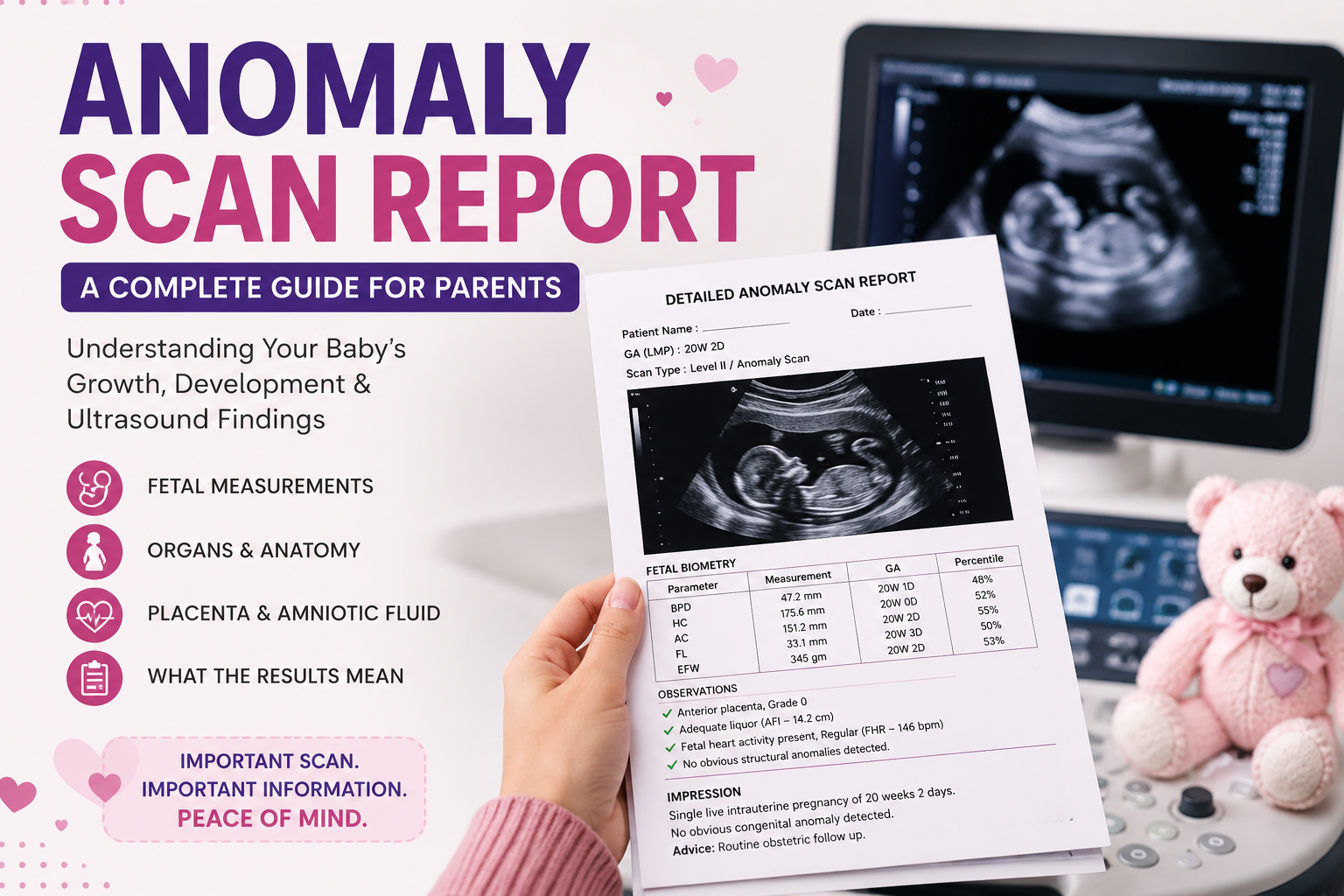

Pregnancy is filled with exciting milestones, and one of the most important scans during the second trimester is the anomaly scan. For many expecting parents, receiving an anomaly scan report can bring a mix of excitement, curiosity, and sometimes anxiety.
Questions such as “What does my anomaly scan report mean?”, “Is everything normal?”, and “What does the doctor look for during the scan?” are extremely common.
The good news is that an anomaly scan is a routine prenatal ultrasound designed to assess your baby’s growth and development. It helps healthcare providers examine major organs, body structures, and overall fetal well-being.
Understanding your anomaly scan report can help you feel more informed and confident throughout your pregnancy journey.
Your anomaly scan report may mention placental position such as anterior or posterior placenta. Learn more about posterior placenta in pregnancy and what it means for fetal movements and delivery.
In this comprehensive guide, we’ll explain what an anomaly scan is, why it is performed, what information appears in the report, normal findings, possible abnormalities, and frequently asked questions.
Medical Disclaimer: This article is intended for educational purposes only and should not replace professional medical advice. Always discuss your anomaly scan report and pregnancy concerns with your obstetrician, radiologist, or healthcare provider.
What Is an Anomaly Scan?
An anomaly scan, also known as a Level 2 Ultrasound, Mid-Pregnancy Scan, or Detailed Anatomy Scan, is a specialized ultrasound examination performed during the second trimester.
The primary purpose of the scan is to evaluate the baby’s physical development and identify any major structural abnormalities.
The scan is usually performed between:
18 and 22 weeks of pregnancy
This period provides the best opportunity to visualize important fetal organs and body structures.
Maintaining a nutritious pregnancy diet can support overall maternal and fetal health. Read our guide on amla during pregnancy for additional nutritional insights.
Why Is an Anomaly Scan Important?
The anomaly scan provides detailed information about your baby’s growth and development.
Doctors use the scan to:
- Assess fetal anatomy
- Monitor growth parameters
- Check organ development
- Evaluate amniotic fluid levels
- Examine the placenta
- Confirm gestational age
- Detect certain congenital abnormalities
For most pregnancies, the anomaly scan offers reassurance that the baby is developing normally.
What Does an Anomaly Scan Report Include?
A typical anomaly scan report contains several measurements and observations.
Maternal Information
The report usually includes:
- Mother’s name
- Age
- Pregnancy details
- Gestational age
- Expected due date
Maintaining a nutritious pregnancy diet can support overall maternal and fetal health. Read our guide on amla during pregnancy for additional nutritional insights.
Fetal Measurements
The sonographer measures different parts of the baby’s body.
Common measurements include:
BPD (Biparietal Diameter)
Measures the width of the baby’s head.
HC (Head Circumference)
Measures the size of the baby’s head.
AC (Abdominal Circumference)
Measures the baby’s abdomen.
FL (Femur Length)
Measures the length of the thigh bone.
These measurements help determine whether the baby is growing appropriately for the gestational age.
Regular prenatal checkups, scans, and healthy lifestyle habits are important throughout pregnancy. Our Complete Mom Health Guide covers everything expecting mothers should know.
Organs Evaluated During an Anomaly Scan
The anomaly scan carefully examines multiple organs and body systems.
Brain
The scan evaluates:
- Brain structure
- Ventricles
- Cerebellum
- Midline structures
Normal findings suggest appropriate neurological development.
Understanding fetal development can help parents better appreciate the milestones monitored during pregnancy scans. Explore our guide to child development milestones.
Face
Doctors check:
- Eye sockets
- Lips
- Nose
- Facial profile
This helps identify conditions such as cleft lip.
Spine
The baby’s spine is examined to ensure proper closure and alignment.
Heart
One of the most important parts of the anomaly scan is assessing the fetal heart.
The sonographer evaluates:
- Four heart chambers
- Heart rhythm
- Major blood vessels
The goal is to identify major congenital heart defects.
Abdomen
The scan checks:
- Stomach
- Kidneys
- Bladder
- Abdominal wall
Normal findings indicate healthy organ development.
Limbs
The sonographer examines:
- Arms
- Legs
- Hands
- Feet
Bone growth and limb formation are assessed.
Placenta Assessment in the Report
The anomaly scan also evaluates the placenta.
The report may mention:
Posterior Placenta
Placenta attached to the back wall of the uterus.
Anterior Placenta
Placenta attached to the front wall.
Fundal Placenta
Placenta located at the top of the uterus.
Low-Lying Placenta
Placenta positioned near the cervix.
Most placental positions are considered normal.
Amniotic Fluid Assessment
Amniotic fluid surrounds and protects the baby.
The report typically mentions whether fluid levels are:
- Normal
- Low
- Increased
Adequate fluid supports fetal growth and movement.
Cervical Length Measurement
In some cases, cervical length is measured to assess the risk of preterm birth.
A normal cervical length is generally reassuring.
Understanding Common Terms in an Anomaly Scan Report
Many parents find medical terminology confusing.
Here are some commonly used terms:
| Term | Meaning |
|---|---|
| GA | Gestational Age |
| EDD | Expected Due Date |
| BPD | Biparietal Diameter |
| HC | Head Circumference |
| AC | Abdominal Circumference |
| FL | Femur Length |
| FHR | Fetal Heart Rate |
| AFI | Amniotic Fluid Index |
Understanding these terms can help parents interpret the report more easily.
What Is Considered a Normal Anomaly Scan Report?
A normal anomaly scan generally indicates:
- Baby’s organs appear normal
- Growth matches gestational age
- Placenta is functioning appropriately
- Amniotic fluid levels are normal
- No major structural abnormalities are detected
However, no scan can guarantee that a baby will be completely free of all medical conditions.
Can an Anomaly Scan Detect Every Problem?
No.
While anomaly scans are highly valuable, they cannot identify every condition.
Some issues may:
- Develop later in pregnancy
- Be too subtle to detect
- Require additional testing
This is why regular prenatal care remains important.
Possible Findings That May Need Further Evaluation
Sometimes the report may identify findings that require additional monitoring.
Examples include:
Soft Markers
Minor ultrasound findings that may warrant further assessment.
Growth Concerns
Baby measuring smaller or larger than expected.
Placental Issues
Low-lying placenta or placenta previa.
Amniotic Fluid Variations
Too much or too little fluid.
Additional tests may be recommended depending on the findings.
What Happens If an Abnormality Is Found?
Finding an abnormality does not automatically mean a serious problem exists.
Doctors may recommend:
- Repeat ultrasound
- Fetal echocardiography
- Genetic counseling
- Additional prenatal testing
- Specialist consultation
Many findings ultimately have positive outcomes.
How Long Does an Anomaly Scan Take?
The procedure typically takes:
20 to 45 minutes
The duration depends on:
- Baby’s position
- Image quality
- Complexity of evaluation
Sometimes additional scanning may be needed if the baby is not positioned favorably.
Is the Anomaly Scan Safe?
Yes.
Ultrasound uses sound waves and is considered safe when performed by qualified healthcare professionals.
The anomaly scan has been used for many years as a routine component of prenatal care.
Preparing for an Anomaly Scan
Simple preparation may help improve the experience.
Wear Comfortable Clothing
Loose clothing allows easier access to the abdomen.
Follow Clinic Instructions
Some clinics may recommend drinking water before the scan.
Bring Previous Reports
Earlier ultrasound reports can help with comparison.
Stay Relaxed
Most anomaly scans provide reassuring information.
Frequently Asked Questions
What is an anomaly scan report?
An anomaly scan report is a detailed ultrasound report that evaluates a baby’s anatomy and development during the second trimester of pregnancy.
When is an anomaly scan done?
It is usually performed between 18 and 22 weeks of pregnancy.
Can an anomaly scan detect birth defects?
The scan can identify many major structural abnormalities, but it cannot detect every condition.
Is a normal anomaly scan report good news?
Yes. A normal report generally indicates that the baby’s growth and anatomy appear normal at the time of the scan.
Can I know my baby’s gender from the anomaly scan?
Gender disclosure depends on local laws and regulations. In India, revealing fetal sex is prohibited under the PCPNDT Act.
Tips for Parents After Receiving an Anomaly Scan Report
After receiving your report:
- Discuss findings with your doctor
- Ask questions if anything is unclear
- Keep copies of reports
- Attend all prenatal appointments
- Continue following pregnancy health recommendations
Understanding your report can help reduce unnecessary anxiety.
Common Myths About Anomaly Scans
Myth 1: A Normal Scan Guarantees a Perfect Pregnancy
While reassuring, no test can guarantee every outcome.
Myth 2: The Scan Is Only About Detecting Problems
The scan also confirms healthy growth and development.
Myth 3: Anomaly Scans Are Unsafe
Routine ultrasound scans are generally considered safe when medically indicated.
Myth 4: Every Finding Means Something Is Wrong
Many findings are minor and require only monitoring.
References & Resources
| Topic | Resource |
|---|---|
| Pregnancy Ultrasound Scans | NHS – Ultrasound Scans in Pregnancy |
| Fetal Development During Pregnancy | March of Dimes – Pregnancy Health |
| Prenatal Care & Pregnancy Monitoring | MedlinePlus – Prenatal Care |
Conclusion
An anomaly scan report is one of the most important assessments during pregnancy. Performed between 18 and 22 weeks, it provides valuable information about your baby’s growth, organ development, placental health, and overall well-being.
For most parents, the report offers reassurance that the pregnancy is progressing normally. While the scan can identify many structural abnormalities, it is important to remember that no test can detect every possible condition.
If your anomaly scan report contains medical terms or findings you do not understand, speak with your healthcare provider. Understanding the report and maintaining regular prenatal care can help you navigate pregnancy with confidence and peace of mind.
Ultimately, the anomaly scan is not just a medical test—it’s a special milestone that allows parents to gain a deeper understanding of their baby’s development and health.