

Editorial note: This article provides general educational information and does not diagnose trauma, dissociation, amnesia or another medical or mental-health condition.
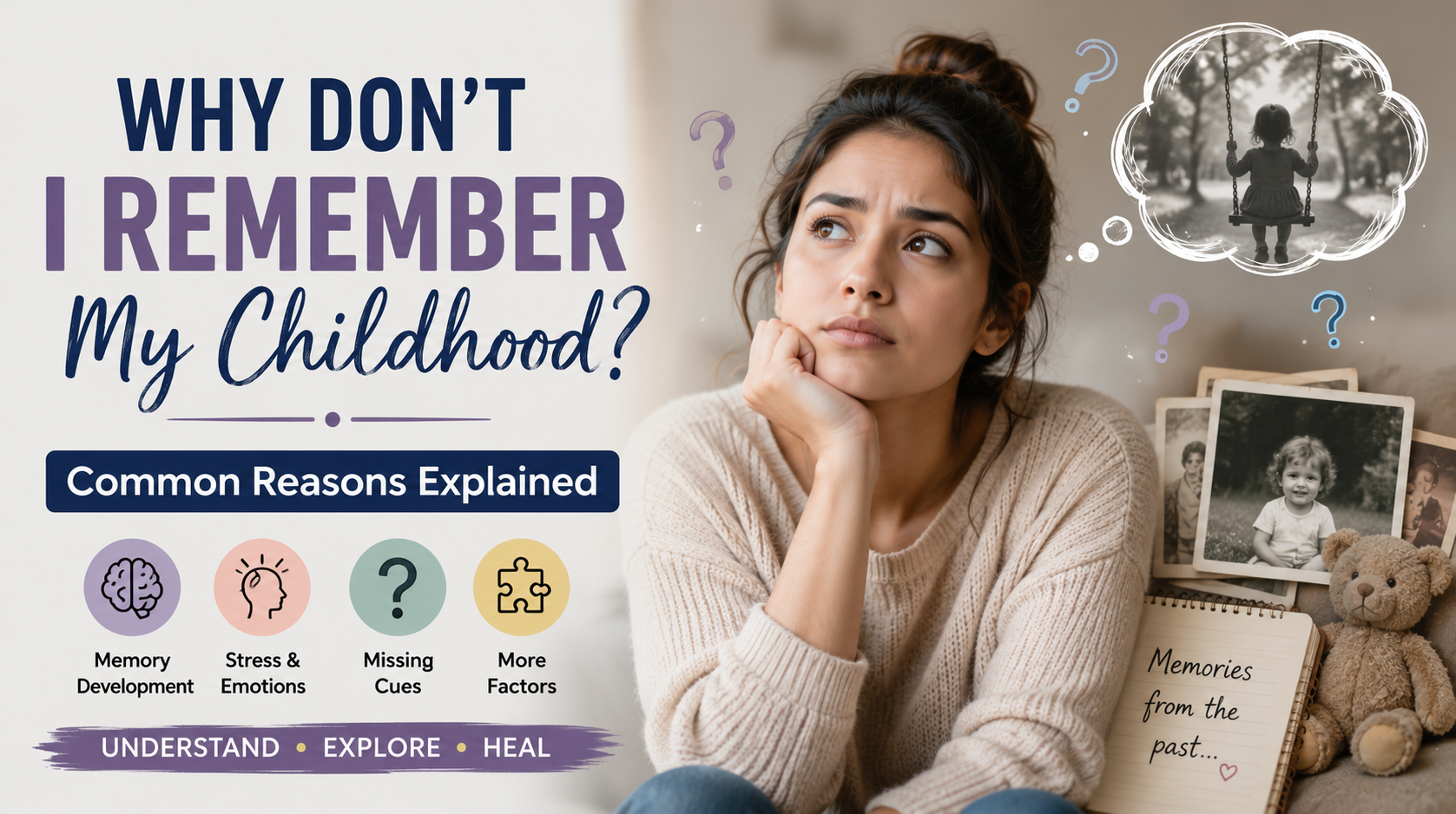
Have you ever looked at old family photos and wondered, “Why don’t I remember my childhood?” Perhaps relatives describe holidays, school events or family moments that you cannot recall. Maybe you remember only a few scattered scenes while large parts of your early years feel blank.
For many people, limited early-childhood memory can be part of normal memory development. Researchers use the term childhood amnesia or infantile amnesia for the relative scarcity of autobiographical memories from the earliest years of life. Research has found that early memories become less accessible as childhood progresses, and one prospective study reported an average earliest memory around age 3 years 8 months among children aged 7–11.
However, there is no single explanation for every person. Memory can also be influenced by ordinary forgetting, retrieval cues, stress, sleep, mood, health conditions and, in some cases, trauma-related processes. Having few childhood memories does not by itself prove that trauma occurred.
Quick answer: If you are asking, “Why don’t I remember my childhood?”, one possible explanation is normal childhood amnesia—especially when the missing period involves your first few years. Memory is reconstructive rather than a perfect recording, and early autobiographical memories can fade or become difficult to retrieve. If memory problems are new, worsening or affecting everyday life, seek medical advice.
Is It Normal to Not Remember Your Childhood?
It can be normal to remember little from the earliest years of life.
Adults typically do not have a continuous, detailed record of infancy and toddlerhood. Childhood-memory research describes a period in which autobiographical memories from early life are relatively sparse, and studies suggest that forgetting itself is an important part of how autobiographical memory develops.
That means these experiences can all occur without automatically indicating a disorder:
- having no clear memories of being a baby;
- remembering little from toddlerhood;
- recalling only a few scenes from preschool years;
- remembering feelings or places more easily than exact events;
- having family stories that feel familiar but not personally remembered;
- remembering some childhood periods much better than others.
The important distinction is between limited early autobiographical memory and new or ongoing memory difficulties that interfere with daily functioning.
What Is Childhood Amnesia?
Childhood amnesia, sometimes called infantile amnesia, refers to the difficulty adults have recalling autobiographical events from very early childhood.
This does not mean babies and toddlers are incapable of learning.
Young children can:
- recognize familiar people;
- learn routines;
- acquire language;
- develop skills;
- remember some events for periods of time;
- learn associations.
The puzzle is why many early autobiographical experiences do not remain easily accessible as detailed adult memories.
Scientific reviews have explored several possible contributors, including:
- development of brain systems involved in episodic memory;
- changes in the hippocampus;
- rapid forgetting during childhood;
- development of language;
- development of a stable sense of self;
- changes in how experiences are organized and retrieved.
Researchers continue to investigate the mechanisms, so it is better to avoid claiming that childhood amnesia has one simple proven cause. Researchers use the term childhood or infantile amnesia to describe the relative scarcity of autobiographical memories from the earliest years of life. A peer-reviewed study available through PubMed Central on the onset of childhood amnesia explores how early memories can become less accessible as children grow older.
Why Don’t I Remember My Childhood? 7 Possible Reasons
1. Childhood Amnesia May Explain Your Earliest Memory Gaps
The first possibility is also one of the most ordinary: your earliest experiences may fall within the period associated with childhood amnesia.
You may remember:
- a preschool classroom;
- a birthday cake;
- a grandparent’s home;
- a particular toy;
- the first day of school.
But you may not remember:
- learning to walk;
- being fed as a baby;
- your second birthday;
- everyday toddler routines.
Research shows that early autobiographical memories are subject to substantial forgetting across childhood.
Simple example
Imagine someone says:
“I remember almost nothing before age 4.”
That alone is not evidence of trauma or a memory disorder. It can be consistent with the broad phenomenon researchers call childhood amnesia.
2. Your Brain and Memory Systems Were Still Developing
Memory is not one single ability.
Different forms of memory involve different processes. A child may learn:
- words;
- faces;
- movements;
- routines;
- emotional associations;
without later being able to narrate a detailed autobiographical episode such as:
“I remember exactly what happened on that Tuesday when I was two.”
The hippocampus is important for episodic memory, and research continues to examine how neural development contributes to childhood amnesia. Evidence from developmental neuroscience supports a role for changes in memory-related brain systems, but the complete explanation remains an active research question.
So a better explanation than “children cannot form memories” is:
Early memory formation, retention and later retrieval differ from mature autobiographical memory.
3. Ordinary Forgetting Can Remove Details Over Time
Not every forgotten childhood event was suppressed.
Sometimes, forgetting is simply forgetting.
Consider how many ordinary days you have lived. You probably cannot reconstruct:
- every breakfast last year;
- every school lesson;
- every conversation;
- every car journey;
- every ordinary weekend.
Childhood contains thousands of similar experiences. Many may never remain distinctive enough to be recalled decades later.
Research on autobiographical memory emphasizes that forgetting is a significant part of memory development.
Events may be easier to remember when they are:
- unusual;
- emotionally meaningful;
- repeatedly discussed;
- connected with photographs;
- part of a family story;
- distinctive from normal routine.
This helps explain why someone might vividly remember one birthday but not the surrounding year.
4. You May Lack the Right Retrieval Cues
Sometimes a memory is difficult to access until something triggers it.
Possible cues include:
- a smell;
- an old song;
- a photograph;
- a childhood home;
- a familiar food;
- a relative’s story;
- a school uniform;
- an old toy.
Harvard Health explains that sensory and contextual cues can help reactivate components associated with older memories.
Example
You may think:
“I don’t remember my primary school classroom.”
Then you see an old photograph and suddenly recall:
- where you sat;
- the sound of a bell;
- a teacher’s voice;
- a particular friend.
That does not necessarily mean the entire memory was completely absent before. Retrieval depends partly on access and cues. Having limited childhood memories does not by itself prove that trauma occurred. The American Psychological Association guidance on memories of childhood abuse explains why forgotten, later-recalled and suggested memories require careful interpretation.
5. Childhood Memories Can Be Fragmentary
People sometimes expect memory to work like a video archive.
It does not.
A childhood memory may consist of:
- one image;
- a feeling;
- a room layout;
- a voice;
- a smell;
- a brief interaction.
You may remember standing near a school gate without remembering:
- the date;
- your age;
- who took you there;
- what happened afterward.
That does not automatically make the fragment meaningless or abnormal.
Autobiographical memory is selective and reconstructive. Details can be incomplete, and confidence should not be treated as perfect proof of accuracy.
6. Stress, Mood and Sleep Can Affect Memory
Memory can be influenced by many factors beyond childhood amnesia.
The NHS notes that memory problems can have treatable causes and advises medical evaluation when they affect everyday life.
Depending on the person and situation, memory difficulties may be associated with factors such as:
- stress;
- anxiety;
- depression;
- sleep problems;
- some medicines;
- alcohol or substance use;
- head injury;
- certain medical conditions.
This does not mean one of these factors explains your childhood memory gaps. It means memory concerns deserve context rather than a one-size-fits-all explanation.
If you are having difficulty with current memory as well as childhood memories, a healthcare professional can help assess what is happening.
7. Trauma Can Affect Memory in Some People—but Memory Gaps Do Not Prove Trauma
This is where online discussions often become misleading.
You may see claims such as:
“If you cannot remember your childhood, you definitely experienced trauma.”
That conclusion is not justified.
Research indicates that early childhood events are often forgotten whether they were traumatic or ordinary, and the American Psychological Association cautions that memory for childhood abuse is complex; both delayed recall and suggested or inaccurate memories are concerns that require careful handling.
At the same time, trauma-related conditions can affect memory in some people. Dissociative amnesia is a recognized condition involving inability to recall important autobiographical information and is distinct from simply having few memories of toddlerhood.
The balanced answer is:
Trauma may affect memory in some cases, but not remembering childhood does not, by itself, demonstrate that trauma occurred.
Does Not Remembering Your Childhood Mean Trauma?
No—not necessarily.
This deserves a direct answer because it is one of the most important questions around this topic.
Having few memories from:
- infancy;
- toddlerhood;
- preschool years;
can be related to normal childhood amnesia.
Even broader memory gaps should not be self-diagnosed as proof of hidden trauma based on a social-media post or online checklist.
The APA notes that childhood memories, including memories of abuse, require careful consideration because memory can be forgotten, later recalled, influenced or suggested.
Avoid this assumption
“I cannot remember age 3, therefore something terrible must have happened.”
That conclusion does not follow from the memory gap alone.
A more useful question
Ask:
“What exactly am I having trouble remembering, over what period, and is this causing distress or affecting my life now?”
That gives a healthcare or mental-health professional more useful information.
Memory concerns deserve medical attention when they begin affecting everyday life or are accompanied by other symptoms. The NHS guidance on memory loss and amnesia outlines when memory problems should be discussed with a healthcare professional.
Why Can’t I Remember Being 3 Years Old?
Not remembering age 3 clearly can fall within the broad pattern of childhood amnesia.
One study following childhood memory development found an average earliest memory of approximately 3 years 8 months among children aged 7–11, although individual variation is substantial and “average” is not a rule for every person.
You might have:
- no memory from age 3;
- one brief memory;
- several uncertain fragments;
- a story you know because parents repeated it.
All can occur.
Why Can’t I Remember Being 5 Years Old?
This question is more difficult because there is no universal age at which everyone “should” have clear memories.
Some people have several memories from age 5. Others have only fragments.
Possible contributors include:
- ordinary forgetting;
-
repetitive daily routines;
- few retrieval cues;
- limited family discussion of past events;
- difficulty dating memories;
- individual differences in autobiographical memory.
If the issue is not just age 5 but a large, unusual period of autobiographical memory loss—especially alongside present-day symptoms—it may be worth discussing with a professional.
Why Do I Only Remember Bits and Pieces of My Childhood?
Because autobiographical memory is often selective rather than continuous.
You might remember:
- one school trip but not the school year;
- a bedroom but not when you lived there;
- a friend but few conversations;
- a family holiday as disconnected images.
This “bits and pieces” experience can reflect the ordinary nature of memory.
A useful comparison is that your mind is not expected to preserve every day as a complete episode.
Why Do I Remember Bad Things but Not Good Things?
There is no single answer.
Emotion can influence:
- attention;
- encoding;
- consolidation;
- rehearsal;
- retrieval.
Some emotionally intense experiences may become highly memorable, but emotional memory is not automatically perfectly accurate. Other people may remember positive highlights more easily.
If painful memories are:
- intrusive;
- distressing;
- disrupting sleep;
- affecting relationships;
- interfering with everyday functioning;
consider seeking support from a qualified mental-health professional.
Why Do I Remember My Childhood Differently From My Siblings?
Siblings can experience the same family very differently.
Differences may arise because of:
- age;
- birth order;
- personality;
- attention;
- separate friendships;
- different relationships with caregivers;
- different interpretations;
- different events;
- memory reconstruction.
Two siblings can attend the same holiday and remember different moments.
One may remember:
the hotel swimming pool.
Another may remember:
getting lost for five minutes.
Different memories do not automatically mean one person is lying.
Are Childhood Memories Always Accurate?
No.
Memory is not a perfect recording.
People can:
- forget details;
- combine similar events;
- misremember timing;
- absorb details from family stories;
- confuse photographs with direct memory;
- become more confident in a memory without becoming more accurate.
This is particularly important when discussing possible trauma. The APA advises caution around recovered or suggested childhood memories and recommends neutral, professionally informed handling rather than assumptions.
Can Childhood Memories Come Back?
Sometimes cues can help people retrieve memories they had not recently thought about.
Possible triggers include:
- photographs;
- familiar places;
- music;
- smells;
- conversations;
- objects.
Harvard Health discusses how sensory details can act as retrieval cues for old memories.
However, use caution.
A sudden image, feeling or thought should not automatically be treated as a perfectly accurate historical record. Memory can be reconstructed and influenced.
Should I Try to Recover Lost Childhood Memories?
Be careful with the idea of “recovering” memories.
If you simply want to explore your past, low-pressure activities might include:
- looking at old photographs;
- making a life timeline;
- speaking with trusted relatives;
- revisiting familiar music;
- writing down memories without forcing certainty.
But avoid trying to manufacture a specific explanation for blank periods.
Particularly avoid:
- assuming every gap hides trauma;
- repeatedly pressuring yourself to remember;
- treating imagination as confirmation;
- using leading questions;
- relying on unqualified people who promise to uncover hidden memories.
The APA’s guidance on memories of childhood abuse emphasizes the complexity of forgotten, recovered and suggested memories.
How Can I Explore My Childhood Memories Safely?
1. Start a Memory Timeline
Write approximate stages:
- ages 0–3;
- ages 4–6;
- primary school;
- early adolescence;
- later adolescence.
Add only what you genuinely remember.
Use labels such as:
- clear memory
- fragment
- family story
- seen in photo
- uncertain
This helps separate direct recollection from information learned later.
2. Look at Old Photos Without Forcing a Story
Ask:
- Does this place feel familiar?
- Do I remember being there?
- Or do I simply recognize the photograph?
That distinction matters.
3. Ask Open-Ended Questions
Instead of asking a relative:
“Did something terrible happen to me when I was five?”
try:
“What was our daily life like when I was five?”
Open questions are less leading.
4. Use Sensory Cues
You might revisit:
- songs;
- foods;
- places;
- books;
- family traditions.
Sensory cues can sometimes help retrieval.
5. Accept Uncertainty
You do not need to fill every blank.
Some memories may remain:
- incomplete;
- undated;
- uncertain;
- inaccessible.
Forcing certainty can create more confusion rather than clarity.
When Should You Talk to a Doctor About Memory Problems?
Having few early-childhood memories is different from developing current memory problems.
The NHS recommends seeing a doctor when memory problems are affecting day-to-day life, noting that some causes may be treatable.
Consider seeking medical advice if you notice:
- worsening memory;
- difficulty managing everyday tasks;
- frequently forgetting recent conversations;
- getting lost in familiar places;
- confusion;
- major changes after a head injury;
- memory changes after starting medication;
- other new neurological symptoms.
Seek urgent medical help
Sudden confusion or sudden memory change—particularly with symptoms such as weakness, facial drooping, speech difficulty, severe headache, seizure or loss of consciousness—requires urgent assessment according to local emergency guidance.
When Might a Mental-Health Professional Help?
Consider speaking with a qualified professional if childhood memory concerns are causing:
- persistent distress;
- fear about possible trauma;
- intrusive memories;
- dissociation;
- panic;
- nightmares;
- difficulty functioning;
- relationship problems.
A professional can help you explore present symptoms without assuming in advance what happened in the past.
If dissociative amnesia is a concern, it requires professional assessment; it is not the same as ordinary childhood amnesia.
Childhood Amnesia vs Dissociative Amnesia
| Feature | Childhood Amnesia | Dissociative Amnesia |
|---|---|---|
| Basic idea | Relative scarcity of early autobiographical memories | Inability to recall important autobiographical information |
| Common period | Earliest years of life | Can involve other life periods or specific information |
| Normal phenomenon? | Broadly recognized developmental phenomenon | Clinical condition |
| Automatically caused by trauma? | No | Often associated with severe stress or trauma |
| Needs diagnosis? | Not usually | Professional assessment is appropriate |
This distinction is important. Not remembering toddlerhood is not equivalent to having dissociative amnesia.
Frequently Asked Questions
Why don’t I remember my childhood?
Possible reasons include normal childhood amnesia, ordinary forgetting, difficulty retrieving memories without cues, and individual differences in autobiographical memory. Stress, sleep, mood and health factors can also affect memory in some situations.
Why can’t I remember my childhood before age 10?
There is no single explanation. Having few memories from the earliest years can be normal, but sparse memory extending through later childhood varies by person and context. If the gaps are distressing, unusual for you or accompanied by current memory problems, consider professional advice.
Is it normal to not remember being 3?
Yes, having little or no clear autobiographical memory from around age 3 can occur within the broad phenomenon of childhood amnesia. Research shows substantial individual variation.
Does not remembering childhood mean trauma?
No. A lack of childhood memories does not by itself prove trauma. Early memories are commonly forgotten, including ordinary experiences. Trauma can affect memory in some people, but the relationship is complex.
Why do I remember only a few moments from childhood?
Autobiographical memory is selective. Distinctive or repeatedly discussed events may remain accessible while routine experiences fade.
Can anxiety make it hard to remember childhood?
Anxiety and stress can affect attention and memory, but they should not automatically be assumed to explain childhood memory gaps. If symptoms are significant, seek individualized professional advice.
Can depression affect memory?
Depression can be associated with concentration and memory difficulties in some people. If you have persistent low mood or current cognitive concerns, speak with a healthcare professional.
Can childhood memories suddenly return?
Old memories can sometimes be prompted by cues such as photographs, places, music or smells. However, retrieved memories are not automatically complete or perfectly accurate.
How far back should I remember?
There is no exact age everyone should remember. Research often places the boundary of earliest autobiographical memory in the preschool years on average, with substantial individual variation.
Why do my childhood memories feel like dreams?
Older memories may be fragmentary, lacking clear dates or context. Sometimes people also know events through photographs and family stories, which can make the source of familiarity difficult to distinguish.
Should I worry if I have no childhood memories?
Not necessarily, especially when referring to very early childhood. But if memory gaps are extensive, distressing, newly noticed alongside other symptoms, or current memory problems affect daily life, seek professional advice.
Can therapy help me understand childhood memory gaps?
Therapy can help with distress, current symptoms and uncertainty. A responsible professional should avoid assuming that a memory gap proves a particular hidden event.
Final Thoughts
If you keep asking yourself, “Why don’t I remember my childhood?”, the answer may be less alarming than social media sometimes suggests.
Many people have limited memories from their earliest years because autobiographical memory develops over time and early experiences are subject to substantial forgetting. This phenomenon is commonly called childhood or infantile amnesia.
Other factors can influence memory too, and individual experiences vary widely. The key point is that not remembering childhood does not automatically mean trauma. Research and professional guidance support a more cautious interpretation of early memory gaps and recovered-memory claims.
If your concern involves worsening present-day memory, daily functioning, significant distress or other symptoms, seek individualized advice from a qualified healthcare professional.


[…] attitudes toward such products have changed, Phantom remains one of the most remembered childhood […]