
Development note: This article provides general developmental information and does not replace an individual developmental assessment. If your child loses a previously acquired skill or you are concerned about how they stand or move, speak with your paediatrician.
Your baby pulls up against the sofa.
Lets go with one hand.
Looks at you.
Wobbles.
Sits down.
And you immediately wonder:
“Is my baby about to start walking?”
A baby’s first steps are one of the most anticipated developmental milestones.
But when do babies start walking?
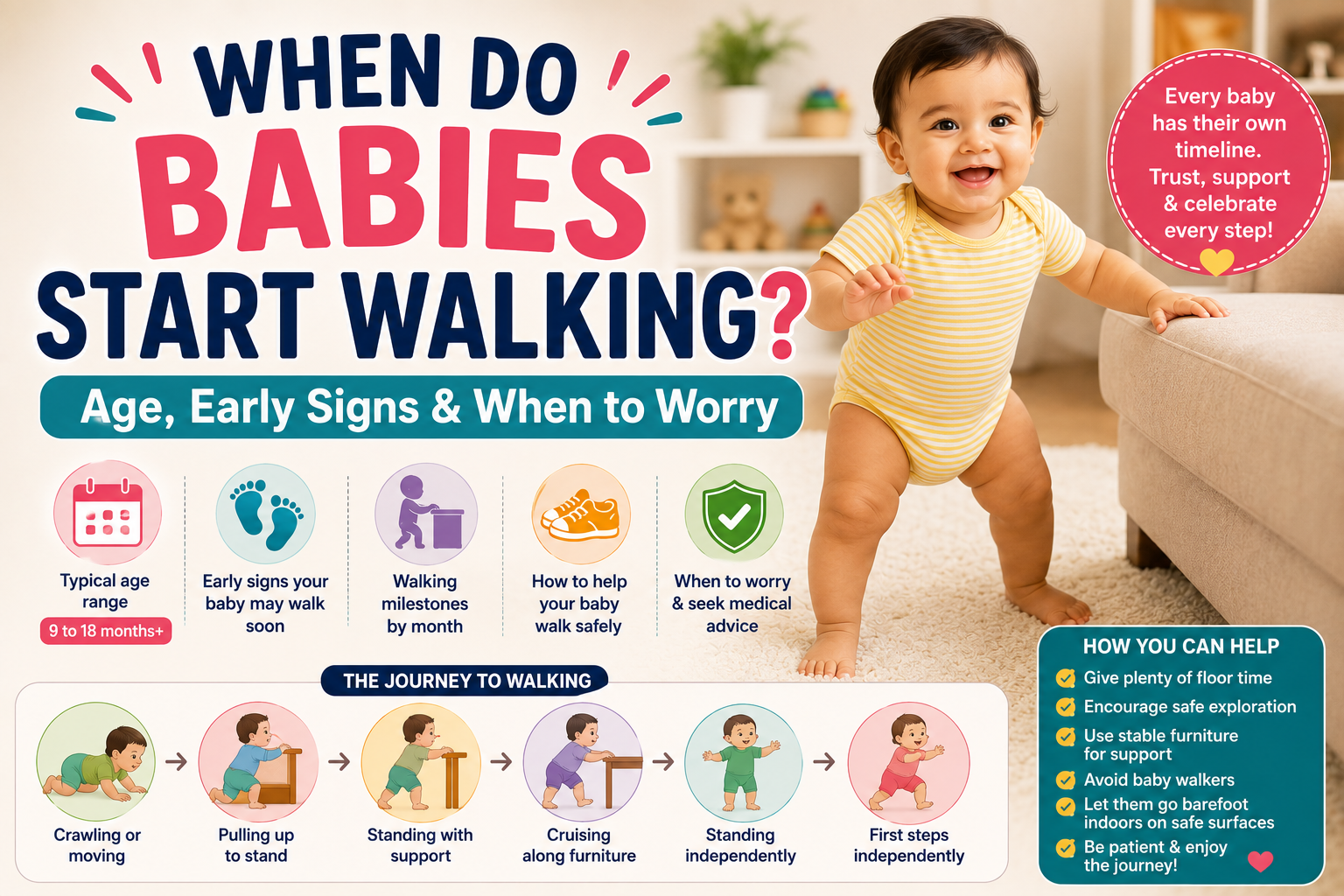
There is no single age when every baby starts walking independently. Walking develops gradually through standing, pulling up, cruising and taking early unsupported steps. The CDC lists pulling up to stand and walking while holding furniture as 1-year milestones, taking a few steps independently as a 15-month milestone, and walking without holding on as an 18-month milestone.
Quick answer: Some babies take independent steps before their first birthday, while others walk later. Instead of comparing your baby’s first-step date with another child’s, watch the overall progression from standing and cruising towards independent movement.
When Do Babies Start Walking?
Walking does not usually happen overnight.
Your baby’s movement journey may look something like this:
Sitting → crawling or another form of movement → pulling to stand → standing with support → cruising → brief independent standing → first steps → independent walking
But not every baby follows exactly this sequence.
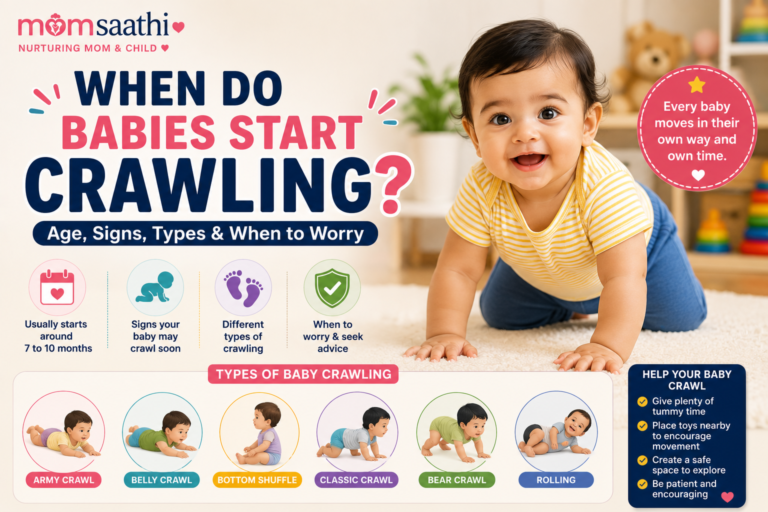
Some babies crawl quickly.
Some bottom shuffle.
Some belly crawl.
And some may use another way to move before progressing towards standing and walking.
The American Academy of Pediatrics explains that babies may use different movement patterns, and a few never use traditional hands-and-knees crawling.
If your baby is still exploring floor movement, read MomSaathi’s complete guide on when babies start crawling and the different types of baby crawling.
Before crawling, sitting balance also plays an important role in your baby’s broader motor development. MomSaathi’s When Can Babies Sit Up? guide explains the progression from supported sitting to independent sitting.
Baby Walking Age by Month
Parents frequently search:
“Should my 10-month-old walk?”
“Is it normal for a 12-month-old not to walk?”
“Should my 15-month-old be walking?”
The table below gives a general developmental overview, not a diagnostic deadline.
| Baby’s Age | Walking Development You May Notice |
|---|---|
| 6 months | Developing sitting and upper-body control |
| 7 months | Exploring floor movement and position changes |
| 8 months | May become increasingly mobile |
| 9 months | Sitting independently and getting into sitting may develop |
| 10 months | May explore pulling up or supported standing |
| 11 months | Some babies may stand with support or cruise |
| 12 months | Pulling to stand and walking holding furniture are CDC milestones |
| 13 months | May cruise, stand briefly or experiment with steps |
| 14 months | Some children take unsupported steps |
| 15 months | Taking a few independent steps is a CDC milestone |
| 16–17 months | Walking may become increasingly confident |
| 18 months | Walking without holding on is a CDC milestone |
The current CDC 1-year milestone checklist includes pulling up to stand and walking while holding on to furniture. At 15 months, the CDC lists taking a few steps independently. At 18 months, it lists walking without holding on to anyone or anything.
This gives parents a more accurate framework than:
“Every baby must walk at exactly 12 months.”
What Is the Average Age for a Baby to Walk?
There is wide variation in when babies take their first independent steps.
For SEO, you will see many websites provide one “average walking age.”
But parents should understand the difference between:
a commonly observed age
and
a developmental milestone deadline
The CDC milestone framework is particularly useful here because its milestones describe skills that most children—75% or more—can do by a certain age.
At 12 months, the CDC does not list independent walking.
It lists:
- pulling up to stand;
- walking while holding furniture.
At 15 months:
- taking a few steps independently.
At 18 months:
- walking without holding on.
Therefore:
A baby who is not independently walking on their first birthday is not automatically developmentally delayed based solely on the CDC milestone checklist.
What Happens Before a Baby Starts Walking?
Walking is the visible milestone.
But your baby’s body has been preparing for it through many earlier movement skills.
Before independent walking, you may notice:
- improved sitting balance;
- floor mobility;
- pulling up;
- standing with support;
- shifting weight between the legs;
- cruising along furniture;
- letting go briefly;
- standing independently;
- taking one or two steps.
Your baby is learning to coordinate:
balance + body position + weight shifting + leg movement
The first steps may look very different from an adult walking.
The NHS notes that when children first start walking, it is normal for them to walk with their feet apart and their arms stretched out to help with balance.
So do not expect:
heel-to-toe perfect walking on day one
Your baby is still learning.
10 Signs Your Baby May Walk Soon
There is no exact “walking countdown.”
A baby who cruises today may not necessarily walk independently next week.
However, these movement changes may show that your baby is progressing towards walking.
1. Pulling Up to Stand
Your baby may grab:
- the sofa;
- a low table;
- stable furniture;
and pull themselves into standing.
The CDC lists pulling up to stand as a 1-year movement milestone.
At first, your baby may be very good at standing up.
But have no idea how to get down.
This often leads to:
stand → panic → cry → parent rescue
Learning to lower the body safely is also part of movement development.
2. Standing While Holding Furniture
Your baby may stand while holding the sofa with both hands.
Then one hand.
Then fingertips.
This gradual reduction in support may show improving balance.
Make sure furniture used for support is stable.
A lightweight table that slides when your baby pulls on it can create an injury risk.
3. Cruising Along Furniture
Cruising means walking sideways while holding furniture for support.
Your baby may move:
sofa edge → one side step → another side step → favourite toy
Oxford Health NHS guidance describes cruising as walking sideways using furniture for support and notes that the skill can help build confidence towards independent walking.
Cruising is also reflected in the CDC 1-year milestone:
walks, holding on to furniture.
4. Letting Go for a Few Seconds
Your baby is holding the sofa.
They see a toy.
Both hands come off.
For three seconds, they are standing.
Then:
plop
This brief independent standing may show improving balance.
Do not turn it into a test by repeatedly removing your baby’s hands from furniture.
Let balance develop actively.
5. Standing Without Support
Some babies begin standing independently before taking their first unsupported steps.
At first, your baby may stand for:
- one second;
- three seconds;
- ten seconds.
They may look surprised when they realise:
“Nobody is holding me.”
Standing independently requires your baby to continually adjust their body to maintain balance.
6. Moving Between Furniture
Your baby may begin moving from:
sofa → table
or:
parent → sofa
If the gap is small, your baby may reach across and transfer support.
Later, they may experiment with one unsupported step.
Make sure the surrounding area is safe.
7. Walking While Holding Your Hands
Your baby may walk when you hold their hands.
This shows they are practising stepping.
However:
walking with adult support is not the same as independent walking
Do not compare a baby who walks holding both hands with a child who independently walks across a room.
If supporting walking, NHS children’s physiotherapy guidance recommends guiding from the hips or holding the baby’s hands lower rather than high above the head.
8. Pushing a Stable Object
Some babies enjoy pushing a stable, appropriate object while standing.
The object must be suitable for the child’s age and stable enough not to suddenly slide away.
This is different from a seated wheeled infant walker, which has significant safety concerns.
We discuss baby walkers later in this article.
9. Squatting and Standing Again
Your baby may hold furniture.
Bend down.
Pick up a toy.
Then return to standing.
This movement requires:
- balance;
- leg control;
- weight shifting.
Do not assume every baby must squat before walking.
It is simply one movement you may notice.
10. Taking One or Two Independent Steps
The first step may happen so quickly that nobody records it.
Your baby lets go.
Takes one step.
Falls into your arms.
Was that walking?
It may be the beginning.
The CDC lists taking a few steps independently as a 15-month movement milestone.
What Is Cruising in Babies?
Cruising is when a baby moves while holding furniture for support.
The movement is often sideways.
For example:
Your baby stands at the sofa and moves from one end to the other while keeping one or both hands on the sofa.
The CDC’s 1-year milestone checklist describes a closely related skill as walking while holding on to furniture.
Cruising gives your baby opportunities to practise:
- stepping;
- balance;
- weight shifting;
- standing.
However:
Cruising does not tell you the exact date your baby will walk independently.
One baby may cruise for a short period.
Another may cruise for longer.
Does Cruising Mean My Baby Will Walk Soon?
Cruising is part of the progression towards walking for many babies.
But “soon” is difficult to define.
A baby may cruise confidently and still prefer supported movement.
Why?
Independent walking adds a new challenge:
letting go
Your baby must maintain balance without furniture.
Therefore, do not start a countdown because your baby cruised today.
Continue providing safe opportunities for movement.
When Do Babies Pull to Stand?
Pulling up to stand is a CDC 1-year movement milestone.
Some babies may begin experimenting earlier.
Others develop the skill closer to their first birthday.
Your baby may pull up using:
- a sofa;
- a stable low surface;
- appropriate furniture.
Once pulling to stand begins, look around your home from your baby’s new height.
Things that were previously out of reach may suddenly become accessible.
This includes:
- hot drinks;
- tablecloths;
- remote controls;
- small objects;
- medicines;
- chargers.
Standing changes your baby’s reach.
Babyproofing needs to change too.
When Do Babies Stand Without Support?
Independent standing may develop before independent walking.
Some babies stand briefly.
Others may confidently stand for longer before taking steps.
There is no rule that says:
“Baby stood for 10 seconds today, so they will walk next week.”
Your baby may continue practising standing and cruising.
Look at overall progress.
If you are concerned about your child’s standing or movement, speak with your paediatrician.
When Do Babies Take Their First Steps?
A baby’s “first steps” usually describe the first unsupported steps.
This might be:
one step from the sofa to a parent
or:
three wobbly steps across the floor
The CDC lists taking a few steps independently as a 15-month milestone.
At 18 months, walking without holding on to anyone or anything is a CDC milestone.
Remember:
first steps and confident walking are not the same stage
A child may take two independent steps and continue crawling for transportation.
Why?
Crawling may still be faster.
Your child knows:
“Walking is interesting. Crawling gets me to the toy immediately.”
Can a Baby Walk at 8 Months?
Some babies may take independent steps earlier than others.
However, early walking should not become a competition.
Do not assume:
earlier walking = more intelligent
Walking age alone does not measure a baby’s intelligence.
If an early-moving baby is standing and walking, focus on:
- supervision;
- a safe environment;
- appropriate babyproofing.
Do not encourage dangerous climbing or unsupported movement to show off the milestone.
Can a Baby Walk at 9 Months?
Some babies may begin taking steps early.
But the current CDC 9-month movement milestones focus on:
- getting into a sitting position;
- sitting without support.
Independent walking is not listed as a 9-month milestone.
Therefore:
A 9-month-old does not need to walk to meet the CDC walking-related milestone framework.
If your baby is already mobile, update your babyproofing.
If your baby is not walking, that alone is not concerning at 9 months.
Is It Normal for a 10-Month-Old Not to Walk?
Yes.
Independent walking is not a CDC 10-month milestone because the CDC checklist uses selected milestone ages rather than a checklist for every month.
At 1 year, the relevant CDC movement milestones are:
- pulls up to stand;
- walks holding furniture.
A 10-month-old may be:
- crawling;
- belly crawling;
- scooting;
- pulling up;
- exploring floor movement.
MomSaathi’s crawling guide explains why babies may use different ways to move before walking.
Is It Normal for an 11-Month-Old Not to Walk?
Yes.
Some 11-month-old babies may walk.
Others may:
- pull to stand;
- cruise;
- crawl;
- bottom shuffle.
Do not use another baby’s first birthday video as a developmental checklist for your child.
Observe progression.
If you have concerns about your baby’s movement, speak with your healthcare professional.
Is It Normal for a 12-Month-Old Not to Walk?
A 12-month-old not independently walking is not automatically delayed based solely on the current CDC checklist.
At 1 year, the CDC lists:
pulls up to stand
and
walks, holding on to furniture
as movement milestones.
Independent steps appear on the CDC checklist at 15 months.
Therefore:
First birthday ≠ independent walking deadline
However, if your 12-month-old is not showing progress in movement, cannot bear weight as expected, has lost a skill or you have concerns, discuss them with your paediatrician.
My 13-Month-Old Is Not Walking
At 13 months, some children walk independently.
Others may still cruise or use another form of movement.
Ask:
- Does my child pull to stand?
- Does my child walk holding furniture?
- Is movement progressing?
- Does my child use both sides of the body?
- Has my child lost any skills?
Do not diagnose a delay based only on:
“My child is 13 months and not walking.”
But do not ignore broader movement concerns.
My 14-Month-Old Is Not Walking
At 14 months, your child may still be progressing towards independent steps.
The CDC’s 15-month milestone is:
takes a few steps on his own.
If your child is approaching 15 months and you are concerned about their movement, bring the concern to your paediatrician.
You do not need to wait for a milestone to become “late enough” before asking a question.
My 15-Month-Old Is Not Walking: Should I Worry?
This section needs an accurate answer.
The current CDC 15-month movement checklist includes:
takes a few steps on his own.
The CDC explains that developmental milestones are skills that most children—75% or more—can do by a particular age.
If your 15-month-old is not taking independent steps, discuss this with your child’s healthcare professional.
This does not mean you should diagnose your child yourself.
Your doctor may consider the broader developmental picture, including:
- standing;
- cruising;
- balance;
- muscle tone;
- movement symmetry;
- other milestones.
The CDC advises parents to act early if a child is not meeting one or more milestones, has lost skills, or the parent has other concerns.
My 16-Month-Old Is Not Walking
At 16 months, the CDC’s 15-month milestone of taking a few independent steps is relevant.
If your child is not independently stepping, contact your paediatrician for developmental guidance.
Tell the doctor what your child can do, not only what they cannot do.
For example:
“My child pulls to stand and cruises but has not taken independent steps.”
This is more useful than:
“My baby doesn’t walk.”
Developmental assessment considers the whole movement pattern.
My 18-Month-Old Is Not Walking
The CDC lists walking without holding on to anyone or anything as an 18-month movement milestone.
If your 18-month-old is not walking independently, speak with your child’s healthcare professional.
Do not simply wait because:
“Someone in the family walked at 2 years.”
A healthcare professional can assess:
- gross motor development;
- muscle tone;
- strength;
- movement pattern;
- overall development.
Early assessment does not mean assuming the worst.
It means discussing a milestone concern appropriately.
Early Walking vs Late Walking
Parents love labels.
“Early walker.”
“Late walker.”
These labels can become unnecessary comparisons.
Walking development exists within a broader motor-development picture.
An early walker is not automatically more advanced in:
- speech;
- social development;
- intelligence.
Similarly, a child who walks later should not automatically be labelled lazy.
Avoid saying:
“He is lazy. He doesn’t want to walk.”
Babies and toddlers do not delay milestones to annoy their parents.
If you are concerned about development, seek a professional assessment rather than giving the child a personality label.
Can Babies Walk Before Crawling?
Yes. A baby may not use traditional hands-and-knees crawling before progressing towards standing and walking.
The AAP notes that a few children never crawl and may use alternative movement patterns such as bottom scooting or stomach slithering.
Therefore:
Crawling is not a mandatory exam a baby must pass before walking.
Your baby may:
bottom shuffle → pull to stand → cruise → walk
Another may:
belly crawl → stand → walk
And another may:
classic crawl → cruise → walk
Read MomSaathi’s guide on when babies start crawling for a complete explanation of different baby movement styles.
How to Help a Baby Learn to Walk
You cannot force your baby to walk earlier.
But you can provide safe opportunities for movement.
1. Give Plenty of Safe Floor Time
Your baby needs space to practise:
- changing position;
- crawling or moving;
- pulling up;
- standing.
A baby who spends most waking time restrained in equipment has fewer opportunities for active movement exploration.
Create a safe floor area.
2. Let Your Baby Pull Up on Stable Furniture
Stable furniture can provide support for standing and cruising.
Check that furniture:
- does not tip;
- does not slide easily;
- has no dangerous sharp edges.
Secure furniture where appropriate.
3. Place Toys Within a Motivating Distance
Place a toy:
near enough to encourage movement
not:
so far away that your baby becomes distressed
Your baby may cruise along furniture to reach it.
Do not continuously move the toy away every time your baby gets close.
That is not encouragement.
It is frustrating.
4. Get Down to Your Baby’s Level
Sit nearby.
Open your arms.
Talk to your baby.
Your baby may experiment with moving towards you.
Do not repeatedly demand:
“Walk! Walk! Come!”
Keep movement play relaxed.
5. Allow Barefoot Indoor Practice on a Safe Surface
NHS children’s health guidance advises avoiding shoes when a baby is learning to walk so the child can feel the floor; being barefoot may also help stabilisation and balance.
Another NHS source notes that shoes are not necessary indoors when a child first begins walking.
Make sure the floor is:
- safe;
- clean;
- free of sharp objects;
- not dangerously hot.
This is particularly relevant in Indian homes with tile or stone flooring.
6. Reduce Support Gradually
If your baby is already stable while supported, you may gradually provide less assistance during appropriate play.
NHS children’s physiotherapy guidance suggests reducing support as the baby becomes more stable, such as loosening the grip or progressing from two hands to one.
Do not suddenly let go without considering your baby’s balance and safety.
Should I Hold My Baby’s Hands to Help Them Walk?
Many parents do this.
If your baby is developmentally ready and enjoys supported stepping, you can provide support.
However, avoid pulling your baby’s arms high above their head.
NHS children’s physiotherapy guidance recommends supporting from the hips or holding the hands lower rather than above the head.
The goal is not:
parent moves baby’s body
The goal is:
baby actively practises balance and movement with appropriate support
Do Baby Walkers Help Babies Learn to Walk?
Parents often buy a seated wheeled walker because the product looks like a walking-training device.
But a mobile infant walker is not necessary for learning to walk.
The American Academy of Pediatrics has long opposed mobile baby walkers because of injury risks.
For walking development, focus on:
- floor movement;
- pulling to stand;
- safe cruising;
- active balance.
Do not assume:
walker = faster walking
A product name is not developmental evidence.
Push Walker vs Seated Baby Walker
These are not the same product.
A seated wheeled infant walker places the baby inside a frame with wheels.
A push toy or push walker is an object a standing child pushes.
Even with a push toy:
- choose an age-appropriate product;
- check stability;
- supervise the child;
- use it on a suitable surface.
A lightweight object that shoots forward may cause a child to fall.
Do not use a push toy as a substitute for free movement practice.
Barefoot vs Shoes: What Is Better for Learning to Walk?
For safe indoor walking practice, barefoot movement can be useful.
NHS children’s health guidance says that when a baby is learning to walk, avoiding shoes allows them to feel the floor and experience different textures; barefoot movement may also help with stabilisation and balance.
For outdoor environments, shoes may be needed to protect the feet.
The AAP recommends comfortable footwear with nonskid soles for active toddlers.
A simple rule:
Safe indoor floor → barefoot may be appropriate
Outdoor or hazardous surface → protective footwear
Always consider the actual surface.
Do not allow barefoot walking where there may be:
- broken glass;
- sharp stones;
- hot surfaces;
- other hazards.
What Shoes Are Best for a New Walker?
For outdoor walking, look for shoes that:
- fit properly;
- are comfortable;
- allow appropriate movement;
- provide suitable grip.
The AAP recommends comfortable shoes with nonskid soles for active toddlers.
NHS children’s health guidance recommends soft-soled shoes for babies when footwear is needed for outdoor protection or warmth.
Do not buy shoes several sizes too large because:
“They will grow into them.”
Poorly fitting footwear can make walking uncomfortable.
My Baby Walks With Feet Wide Apart
When children first start walking, a wide-based walking pattern can be normal.
The NHS explains that new walkers commonly walk with their feet apart and arms stretched out to help maintain balance.
Your baby’s first walking style may look like:
wide legs + arms up + short steps + wobble
This is very different from mature walking.
If you are concerned about your child’s gait, pain or movement, speak with a healthcare professional.
My Baby Falls a Lot While Learning to Walk
Early walking involves balance practice.
Wobbles and falls can happen.
Your job is to make the environment safer.
Check for:
- sharp furniture corners;
- unstable furniture;
- slippery rugs;
- stairs;
- hard objects on the floor.
Do not attempt to prevent every small loss of balance by holding your child constantly.
But do supervise and remove significant hazards.
Seek medical attention after a fall if you are concerned about an injury or your child develops concerning symptoms.
My Baby Walks on Tiptoes
Some children may occasionally rise onto their toes while exploring standing and walking.
However, persistent toe walking can have different causes.
If your child consistently walks on their toes, cannot place their heels down, has pain, shows movement asymmetry or you have concerns, discuss this with a healthcare professional.
Do not force the child’s heels down or copy stretching exercises from random social media videos without appropriate advice.
Walking and Premature Babies
If your baby was born prematurely, developmental progress may sometimes be discussed using corrected age.
When discussing walking milestones with your baby’s healthcare professional, mention:
- gestational age at birth;
- expected due date.
Your paediatrician can explain how corrected age applies to your child.
Do not directly compare a baby born significantly prematurely with a full-term baby solely by chronological age.
My Baby Was Walking and Stopped Walking
Loss of a previously acquired developmental skill requires medical attention.
If your child was independently walking and stops using the skill they previously had, contact a healthcare professional.
The CDC advises parents to act early if a child has lost skills they once had.
Tell the doctor:
- what your child could previously do;
- when the change started;
- whether the change was sudden;
- whether there was an injury or illness;
- whether other skills have changed.
Do not simply wait several weeks to see whether the skill returns if you are concerned about developmental regression.
When Should You Worry About a Baby Not Walking?
Talk to your child’s healthcare professional if:
- your child is not meeting one or more developmental milestones;
- your child has lost a skill;
- movement appears significantly one-sided;
- your child appears unusually stiff or floppy;
- you are concerned about standing or walking;
- your child is not taking a few independent steps by 15 months;
- your child is not walking without holding on by 18 months.
The last two points align with the current CDC 15- and 18-month milestone checklists.
Do not wait because a relative says:
“Boys always walk late.”
or:
“The child is just lazy.”
If you have a developmental concern, discuss it with your child’s healthcare professional.
Baby Walking Milestones: Myths vs Facts
| Myth | Fact |
|---|---|
| Every baby must walk by 12 months | Independent walking is not a CDC 1-year milestone |
| A baby who walks early is more intelligent | Walking age alone does not measure intelligence |
| Babies must crawl before walking | Some babies use alternative movement patterns |
| Cruising means the baby will walk next week | Cruising does not predict an exact first-step date |
| Baby walkers teach babies to walk | Mobile infant walkers are not necessary walking tools |
| Shoes help babies learn to walk faster | Barefoot indoor practice can support floor awareness and balance |
| Parents can force a baby to walk early | Walking depends on active motor development |
| A late walker is lazy | Developmental concerns need assessment, not personality labels |
| Falling means the baby is not ready | Early walkers are still developing balance |
| Parents should wait until age 2 before asking for help | CDC milestones include independent steps at 15 months and walking independently at 18 months |
MomSaathi’s Walking Readiness Checklist
Ask yourself:
1. Does my baby pull up to stand?
This is a CDC 1-year movement milestone.
2. Does my baby walk holding furniture?
This is also listed at 1 year by the CDC.
3. Is my baby cruising?
Cruising involves moving along furniture with support.
4. Does my baby briefly let go?
Brief independent standing may show improving balance.
5. Does my baby move between nearby supports?
This may provide stepping practice.
6. Is my baby’s movement progressing?
Look at overall changes over time.
7. Does my baby use both sides of the body?
Persistent significant asymmetry deserves medical discussion.
8. Has my child lost a skill?
Contact a healthcare professional.
9. Is my 15-month-old taking independent steps?
The CDC lists taking a few independent steps as a 15-month milestone.
10. Is my 18-month-old walking without support?
The CDC lists independent walking without holding on as an 18-month milestone.
Frequently Asked Questions About When Babies Start Walking
When do babies start walking?
Walking timing varies. The CDC lists pulling up and walking while holding furniture at 1 year, taking a few independent steps at 15 months, and walking without holding on at 18 months.
What age do babies walk?
There is no single walking age for every baby. Some take independent steps before their first birthday, while others walk later. Development is better assessed using the child’s overall progression and age-appropriate milestones.
Is it normal for a 12-month-old not to walk?
Yes, a 12-month-old not independently walking is not automatically delayed based solely on the CDC checklist. At 1 year, pulling up to stand and walking while holding furniture are movement milestones.
Should a 15-month-old be walking?
The CDC lists taking a few independent steps as a 15-month movement milestone. If your child is not doing this, discuss it with your healthcare professional.
Should an 18-month-old be walking?
Walking without holding on is a CDC 18-month movement milestone. If your 18-month-old is not walking independently, speak with your child’s healthcare professional.
What are the signs a baby will walk soon?
Possible signs include pulling to stand, cruising, standing briefly without support, transferring between furniture and taking one or two unsupported steps.
What is cruising in babies?
Cruising is walking sideways or moving along furniture while holding it for support. The CDC lists walking while holding furniture as a 1-year movement milestone.
Does cruising mean my baby will walk soon?
Cruising is part of walking development for many babies, but it does not predict an exact date for independent walking.
Can babies walk before crawling?
Yes. Some babies do not use traditional hands-and-knees crawling and may use other ways of moving before standing and walking.
How can I help my baby learn to walk?
Provide safe floor time, stable furniture for supported standing and cruising, and age-appropriate movement opportunities. Do not force your baby to walk.
Do baby walkers help babies walk?
Mobile seated infant walkers are not necessary for learning to walk and have important safety concerns. Safe floor movement and active balance practice are better developmental opportunities.
Should babies learn to walk barefoot?
On a safe indoor surface, barefoot movement can allow a baby to feel the floor and may help stabilisation and balance.
What shoes are best for a new walker?
For outdoor use, choose properly fitting and comfortable footwear. The AAP recommends comfortable shoes with nonskid soles for active toddlers.
Why does my baby walk with feet wide apart?
New walkers commonly use a wide stance and hold their arms out to help with balance.
When should I worry about my baby not walking?
Discuss concerns with your healthcare professional if your child loses a skill or is not meeting developmental milestones. The CDC lists taking a few independent steps at 15 months and walking without holding on at 18 months.
Final Thoughts
So, when do babies start walking?
There is no single birthday on which every baby must suddenly take independent steps.
Walking develops through:
standing → pulling up → cruising → balancing → first steps → independent walking
The current CDC milestone framework gives parents a useful guide.
At 1 year:
pulls up to stand and walks holding furniture
At 15 months:
takes a few steps independently
At 18 months:
walks without holding on
Therefore, do not panic simply because:
“My friend’s baby walked at 10 months and mine is 12 months.”
Your baby’s development is not a race.
Instead, observe:
Is movement progressing?
Is my baby developing new skills?
Does my baby use both sides of the body?
Has my baby lost any previously acquired skill?
For babies still exploring floor mobility, read MomSaathi’s guide on when babies start crawling. If your baby is developing sitting balance, the MomSaathi baby sitting milestone guide explains the earlier stages of motor development.
And if your child is not taking a few independent steps by 15 months, is not walking without support by 18 months, loses a skill or you have another developmental concern, speak with your child’s healthcare professional.
Because the goal is not:
“Make my baby walk before everyone else.”
The goal is:
Give your child safe opportunities to move, explore and develop—and ask for help when a milestone concern deserves assessment.