
Medical Editorial Note: This article is for general educational purposes and does not diagnose miscarriage, ectopic pregnancy, or any other condition. Early-pregnancy bleeding and pain can have several causes. Seek medical care for concerning symptoms, and urgent care for severe pain, heavy bleeding, shoulder pain, fainting, dizziness, or feeling seriously unwell.
Seeing a positive pregnancy test can bring an immediate rush of emotion. If a later test turns negative, bleeding begins, or blood tests show falling pregnancy hormone levels, the experience can be confusing and distressing. One possible explanation is a chemical pregnancy.
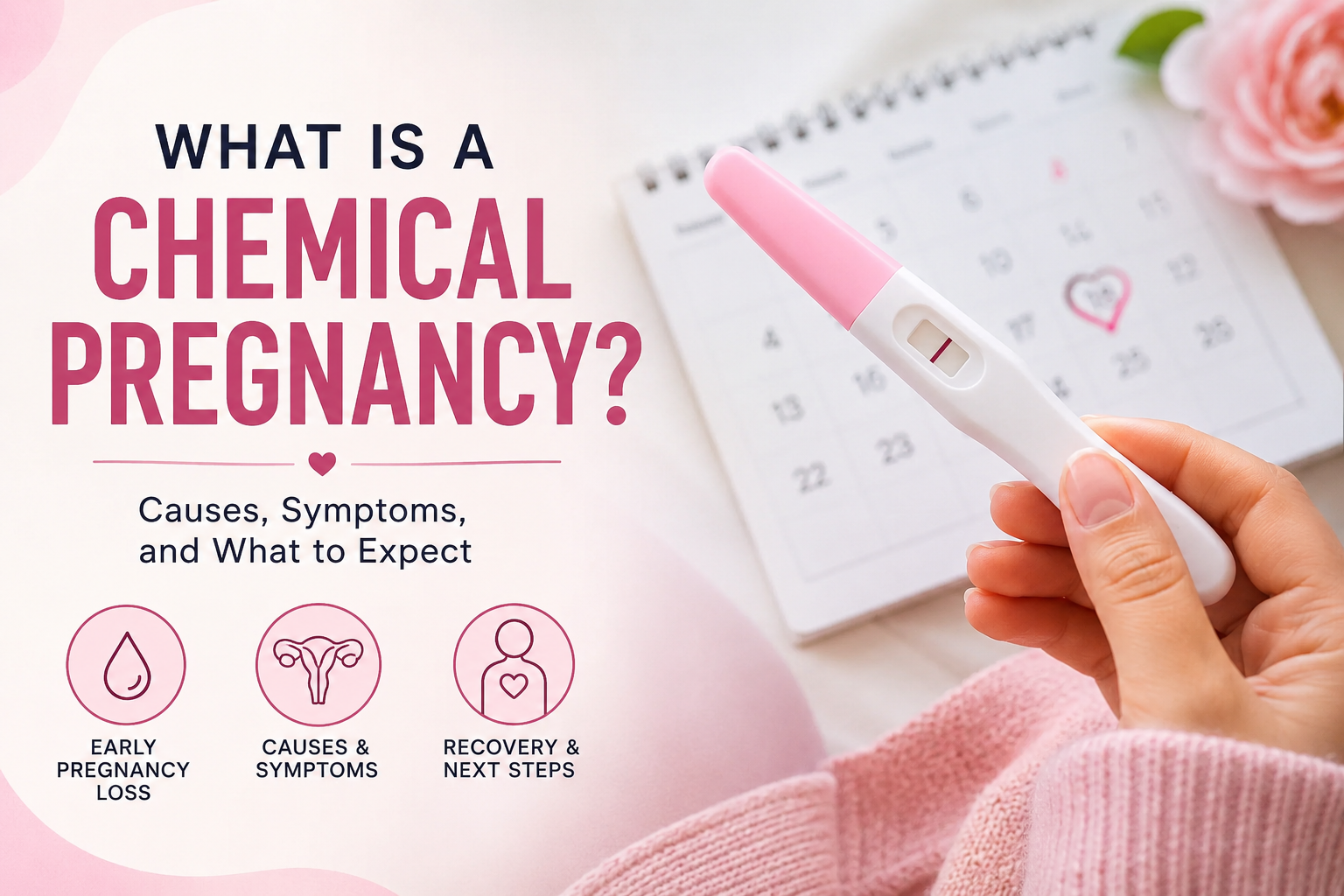
So, what is a chemical pregnancy? A chemical pregnancy is a very early pregnancy loss that happens after implantation has triggered production of the pregnancy hormone hCG (human chorionic gonadotropin) but before the pregnancy can typically be confirmed on ultrasound. It is also called a biochemical pregnancy.
Because modern home pregnancy tests can detect hCG very early, some people learn they were pregnant before the loss occurs. Others may never know and may interpret the bleeding as a slightly late or different period.
This guide explains chemical pregnancy symptoms, bleeding, hCG changes, possible causes, diagnosis, treatment, future fertility, and warning signs that need urgent medical attention.
Quick Answer: What Is a Chemical Pregnancy?
A chemical pregnancy is a very early pregnancy loss. Implantation occurs and the body produces enough hCG for a pregnancy test to become positive, but the pregnancy stops developing very early—often before it can be seen on ultrasound.
A person may notice:
- a positive pregnancy test followed by a negative test;
- bleeding around or after the expected period;
- mild cramping;
- low or falling hCG levels on blood tests.
However, these signs are not enough to diagnose a chemical pregnancy at home, because bleeding, pain, and changing test results can occur in other situations, including ectopic pregnancy. A chemical pregnancy is a very early pregnancy loss that occurs after hCG production has begun but before the pregnancy can typically be confirmed on ultrasound. For additional medical information, see the Cleveland Clinic overview of chemical pregnancy
Chemical Pregnancy at a Glance
| Question | Short Answer |
|---|---|
| What is it? | A very early pregnancy loss |
| Another name | Biochemical pregnancy |
| Was there a real pregnancy? | Yes; hCG was produced after implantation |
| Can a test be positive? | Yes |
| Can a later test become negative? | Yes, as hCG falls |
| Can it look like a period? | Sometimes |
| Can it be seen on ultrasound? | Typically not before the loss is identified |
| Does everyone have symptoms? | No |
| Is treatment always needed? | Not necessarily; assessment depends on the situation |
| Can pregnancy happen again? | Yes |
| Can bleeding alone confirm it? | No |
| Can ectopic pregnancy look similar early on? | Yes, which is why concerning symptoms need assessment |
Why Is It Called a “Chemical” Pregnancy?
The term can sound misleading. It does not mean the pregnancy was caused by chemicals, toxins, medication, cleaning products, or something the pregnant person touched or ate.
The name refers to the fact that pregnancy is detected biochemically, through the hormone hCG, rather than being confirmed visually on an ultrasound.
Cleveland Clinic explains that implantation triggers hCG production, which is what pregnancy tests detect. In a chemical pregnancy, development stops very early even though hCG has already become detectable.
So the word “chemical” describes the method or stage of detection, not the value or reality of the pregnancy.
Is a Chemical Pregnancy a Real Pregnancy?
Yes.
A chemical pregnancy involves implantation and hCG production. A positive pregnancy test may therefore have reflected a genuine early pregnancy.
This distinction matters emotionally. Someone may have already:
- celebrated the positive result;
- told a partner;
- calculated a due date;
- imagined the future;
- undergone fertility treatment;
- experienced previous losses.
The fact that the loss happened very early does not determine how significant it feels.
What Happens During a Chemical Pregnancy?
A simplified sequence may look like this:
- An egg is fertilized.
- Implantation begins in the uterine lining.
- Pregnancy-related tissue produces hCG.
- A urine or blood pregnancy test may detect hCG.
- Development stops very early.
- hCG levels begin to fall.
- Bleeding may occur.
- A later pregnancy test may become negative.
Cleveland Clinic describes chemical pregnancy as a miscarriage occurring very soon after implantation, after hCG production has begun.
The exact experience varies. Not everyone tests repeatedly or has blood hCG monitoring.
Chemical Pregnancy Symptoms
Possible signs can include:
- a positive pregnancy test followed by a negative one;
- bleeding after a positive pregnancy test;
- mild abdominal or pelvic cramping;
- low hCG levels;
- hCG levels that decrease rather than progress as expected.
Tommy’s lists an initially positive test followed by a negative one, mild cramping, period-like bleeding after a positive test, and low or decreasing hCG on blood testing among possible signs.
Some people have no obvious symptoms and never know a pregnancy occurred.
Important
Symptoms alone cannot confirm the diagnosis. ACOG notes that bleeding and cramping associated with early pregnancy loss can also occur in a normal pregnancy, ectopic pregnancy, and other complications. Recovery after an early pregnancy loss can involve both physical and emotional changes. For broader information on maternal wellbeing, explore MomSaathi’s pregnancy and maternal health guide
What Does Chemical Pregnancy Bleeding Look Like?
There is no single appearance that confirms a chemical pregnancy.
Bleeding may be described as:
- similar to a period;
- heavier than usual;
- lighter than expected;
- accompanied by cramps;
- beginning after a positive test.
Tommy’s notes that a bleed resembling a period can occur after an initially positive pregnancy test.
But color and flow alone cannot tell you whether you are experiencing:
- a chemical pregnancy;
- another early miscarriage;
- bleeding in an ongoing pregnancy;
- ectopic pregnancy;
- another cause of vaginal bleeding.
Do not rely on photographs or online comparisons to diagnose the cause.
Chemical Pregnancy vs Period
A chemical pregnancy can be mistaken for a menstrual period, especially if no pregnancy test was taken.
| Feature | Chemical Pregnancy | Period |
|---|---|---|
| Pregnancy occurred? | Yes | No |
| hCG produced? | Yes | No pregnancy-related hCG |
| Positive pregnancy test possible? | Yes | Not from a normal period |
| Bleeding occurs? | Often | Yes |
| Cramping possible? | Yes | Yes |
| Can timing overlap? | Yes | Yes |
| Can appearance alone distinguish them? | No | No |
The strongest clue may be a documented positive pregnancy test followed by falling hCG or a later negative result, but clinical interpretation may still be needed.
Chemical Pregnancy vs Implantation Bleeding
These terms describe very different situations.
| Feature | Chemical Pregnancy | Bleeding Around Implantation |
|---|---|---|
| Pregnancy outcome | Very early loss | Pregnancy may continue |
| hCG | Produced, then may fall | May begin rising after implantation |
| Pregnancy test | May turn positive then negative | May become positive as hCG rises |
| Bleeding | Can occur | Light spotting is sometimes reported |
| Diagnosis from bleeding alone? | No | No |
The phrase “implantation bleeding” is widely used, but you should not assume every episode of early spotting is caused by implantation.
If you have bleeding during a known or possible pregnancy, seek professional advice based on the amount of bleeding, pain, gestational timing, and other symptoms.
Chemical Pregnancy vs Miscarriage
A chemical pregnancy is a type of very early pregnancy loss.
The difference is mainly timing and how the pregnancy is detected.
| Feature | Chemical Pregnancy | Later Recognized Miscarriage |
|---|---|---|
| Timing | Very early | Can occur later |
| Positive test | Often possible | Usually possible |
| Ultrasound evidence before loss | Typically absent | May be present |
| hCG | Detectable | Detectable |
| Bleeding/cramping | May occur | May occur |
ACOG defines early pregnancy loss more broadly and emphasizes that diagnosis must be made carefully because symptoms can overlap with other pregnancy conditions. Early pregnancy loss can involve bleeding and cramping, but symptoms alone may not establish the diagnosis. The American College of Obstetricians and Gynecologists guidance on early pregnancy loss provides further information on symptoms, diagnosis, and care.
Chemical Pregnancy vs Ectopic Pregnancy
This is one of the most important distinctions in the article.
An ectopic pregnancy occurs when a pregnancy develops outside the main cavity of the uterus, most commonly in a fallopian tube. It can become life-threatening if rupture and internal bleeding occur.
Early on, ectopic pregnancy may involve:
- a positive pregnancy test;
- vaginal bleeding;
- pelvic or abdominal pain;
- abnormal hCG patterns.
That overlap means you should not assume that a positive test followed by bleeding is automatically a chemical pregnancy.
ACOG advises that abnormal bleeding and pelvic pain in early pregnancy should be reported to a healthcare professional. Emergency warning signs can include sudden severe abdominal or pelvic pain, shoulder pain, weakness, dizziness, or fainting. Bleeding or pain after a positive pregnancy test should not automatically be assumed to be a chemical pregnancy. Review the ACOG guidance on ectopic pregnancy and warning signs, particularly if symptoms include severe pain, shoulder pain, weakness, dizziness, or fainting.
Seek urgent medical care for:
- severe abdominal or pelvic pain;
- significant one-sided pain;
- shoulder pain;
- fainting;
- severe dizziness or weakness;
- heavy bleeding;
- feeling seriously unwell.
Can You Have a Chemical Pregnancy Without Knowing?
Yes.
A person may never realize a pregnancy occurred if:
- they did not take an early pregnancy test;
- bleeding arrived around the expected period;
- the cycle was only slightly delayed;
- symptoms were mild or absent.
Tommy’s notes that someone may not know they experienced a chemical pregnancy if they did not miss a period or take a pregnancy test.
Early-detection home tests have made some very early pregnancies more visible than they might have been in the past.
What Happens to hCG During a Chemical Pregnancy?
hCG, or human chorionic gonadotropin, is the hormone detected by pregnancy tests.
During an early developing pregnancy, hCG becomes detectable after implantation. In a chemical pregnancy, hCG may initially be high enough to produce a positive test and then decrease after development stops.
This may result in:
- a faint positive test;
- a stronger or weaker line over time;
- a positive test followed by a negative one;
- blood hCG values that fall.
However, home-test line darkness is not a reliable substitute for medical hCG monitoring.
Does a Faint Line Mean a Chemical Pregnancy?
No.
A faint positive line does not automatically mean chemical pregnancy.
A line may appear faint because:
- testing occurred very early;
- urine was diluted;
- tests differ in sensitivity;
- the test was read incorrectly;
- hCG concentration was low for various reasons.
If the result is unclear, follow the manufacturer’s instructions and contact a healthcare professional when appropriate.
Do not diagnose pregnancy viability from one photograph of a home test.
Will a Pregnancy Test Still Be Positive?
It can be.
After a very early loss, hCG does not necessarily disappear instantly. A pregnancy test may remain positive while hCG is still detectable.
As levels decline, the test may later become negative.
The timing varies, so there is no universal rule such as:
“Every chemical pregnancy test becomes negative within exactly three days.”
If a test remains positive, symptoms persist, or you have pain or bleeding, seek medical advice. If you are planning a future pregnancy, balanced nutrition remains an important part of preconception and pregnancy care. You may also explore our healthy pregnancy diet guide for practical meal-planning ideas.
How Long After a Chemical Pregnancy Will a Test Be Negative?
There is no exact timeline for everyone.
It depends on factors such as:
- the hCG level reached;
- how quickly levels fall;
- test sensitivity;
- urine concentration.
A healthcare professional may use repeat blood hCG measurements when clinically appropriate.
Persistent positive tests should not simply be ignored, particularly when accompanied by pain or bleeding, because other diagnoses may need consideration.
What Causes a Chemical Pregnancy?
Often, a person cannot identify one specific cause.
Very early pregnancy loss may occur because development cannot continue normally. Chromosomal abnormalities are a major recognized cause of miscarriage more broadly, and Cleveland Clinic notes chromosomal problems as a common reason miscarriages occur.
Potential factors discussed in relation to pregnancy loss can be complex, but it is important not to tell readers that one ordinary action caused the loss without evidence.
A chemical pregnancy is generally not something that can be traced to one meal, one stressful day, normal walking, or one episode of sex.
Can Chromosomal Problems Cause a Chemical Pregnancy?
They can be involved in very early pregnancy loss.
Chromosomal abnormalities may prevent normal development. However, unless specific testing has been performed—and in very early losses it often has not—you usually cannot know the exact cause of an individual chemical pregnancy.
Avoid assuming:
“It was definitely a chromosome problem.”
The medically responsible wording is:
Chromosomal abnormalities are an important cause of miscarriage, but the exact cause of an individual very early loss may remain unknown.
Can Stress Cause a Chemical Pregnancy?
It is not appropriate to assume that everyday stress caused a chemical pregnancy.
People often search for a cause after a loss and may replay:
- a difficult workday;
- an argument;
- poor sleep;
- anxiety;
- travel;
- emotional upset.
An individual episode of ordinary stress should not be presented as proof of causation.
If stress is affecting sleep, eating, functioning, or mental wellbeing, support is still worthwhile—but that is different from claiming it caused the pregnancy loss. If you receive a positive test in a future pregnancy, you may use our pregnancy due date calculator for an estimated timeline, while remembering that clinical dating may later be adjusted by your healthcare professional.
Can Exercise Cause a Chemical Pregnancy?
Routine physical activity should not automatically be blamed for a chemical pregnancy.
If you exercised before learning about the loss, do not conclude from timing alone that exercise caused it.
People with:
- significant bleeding;
- severe pain;
- dizziness;
- specific pregnancy complications;
- clinician-directed restrictions
should seek individualized medical guidance.
Can Sex Cause a Chemical Pregnancy?
Normal sexual activity should not automatically be blamed for a chemical pregnancy.
After a loss, it is common to look for a specific event that “must have caused it,” but timing does not establish causation.
If sex is followed by significant bleeding, severe pain, dizziness, or other concerning symptoms during a possible pregnancy, seek medical advice.
Can Caffeine Cause a Chemical Pregnancy?
Do not claim that one cup of coffee caused a pregnancy loss.
ACOG states that moderate caffeine consumption below 200 mg per day does not appear to be a major contributing factor in miscarriage or preterm birth.
People should still follow pregnancy-specific guidance from their healthcare professional, particularly if they have individual medical considerations.
How Is a Chemical Pregnancy Diagnosed?
Diagnosis may involve a combination of:
- pregnancy-test history;
- symptoms;
- quantitative blood hCG tests;
- repeat hCG measurements;
- ultrasound when appropriate;
- clinical assessment.
Because a chemical pregnancy occurs very early, ultrasound may not show an intrauterine pregnancy.
This creates an important diagnostic issue: a positive pregnancy test without a visible pregnancy on ultrasound may require follow-up rather than immediate assumptions.
ACOG emphasizes that early pregnancy loss symptoms overlap with normal pregnancy, ectopic pregnancy, and molar pregnancy, and that accurate diagnosis matters before treatment.
Does a Chemical Pregnancy Need Treatment?
Not every chemical pregnancy requires a procedure, but the correct answer depends on the clinical situation.
A healthcare professional may consider:
- symptoms;
- bleeding;
- pain;
- hCG trend;
- whether ectopic pregnancy has been excluded;
- signs of infection;
- individual medical history.
Do not assume that “very early” means medical follow-up is never needed.
If you have severe symptoms, persistent positive tests, significant pain, or heavy bleeding, seek care.
How Long Does Bleeding Last After a Chemical Pregnancy?
There is no exact duration that applies to everyone.
Bleeding may resemble a menstrual period for some people, but the amount and duration vary.
Seek medical advice if you have:
- very heavy bleeding;
- severe or worsening pain;
- fever;
- foul-smelling discharge;
- dizziness;
- fainting;
- persistent symptoms;
- concern about the amount of blood loss.
If you are unsure whether bleeding is excessive, contact a healthcare professional rather than relying on a generic online threshold.
When Will Your Period Return?
The menstrual cycle may resume after hCG falls and the reproductive cycle resets, but timing varies.
Factors may include:
- how early the loss occurred;
- how quickly hCG declines;
- usual cycle pattern;
- individual health factors.
If menstruation does not return when expected, pregnancy tests remain positive, or symptoms continue, contact your healthcare professional.
Can You Ovulate After a Chemical Pregnancy?
Yes, ovulation can return relatively soon after an early pregnancy loss.
ACOG notes that pregnancy can occur again as soon as about 2 weeks after an early miscarriage, which means fertility may return before the next period.
If you do not want to conceive immediately, discuss contraception.
If you do want to try again, ask your healthcare professional whether any personal medical reason suggests waiting.
When Can You Try to Conceive Again?
There is no single waiting period appropriate for every person.
ACOG notes that pregnancy can occur as soon as about two weeks after an early miscarriage.
The right timing may depend on:
- physical recovery;
- emotional readiness;
- whether ectopic pregnancy was excluded;
- ongoing symptoms;
- recurrent losses;
- fertility treatment;
- individual medical advice.
Do not pressure yourself to try again immediately simply because it is biologically possible.
Can You Get Pregnant After a Chemical Pregnancy?
Yes.
A chemical pregnancy does not automatically mean future pregnancy is impossible.
One very early loss by itself does not prove infertility. However, if losses repeat, or if you have difficulty conceiving, a healthcare professional may recommend evaluation based on your history.
Does One Chemical Pregnancy Mean Infertility?
No. One chemical pregnancy does not by itself diagnose infertility.
In fact, it indicates that fertilization and implantation-related hCG production occurred, although the pregnancy did not continue.
Fertility evaluation depends on a broader history, including:
- age;
- time trying to conceive;
- menstrual pattern;
- previous pregnancies;
- repeated losses;
- medical conditions;
- fertility treatment history.
Repeated Chemical Pregnancies
Repeated very early losses deserve individualized medical discussion.
A clinician may review:
- pregnancy history;
- age;
- medical conditions;
- uterine factors;
- genetic factors;
- hormone-related issues;
- fertility treatment details;
- other relevant risk factors.
Do not self-diagnose the cause from online symptom lists.
If you have had repeated positive tests followed by early losses, bring dates, test results, hCG values, and relevant medical records to your appointment if available.
Chemical Pregnancy After IVF or Fertility Treatment
Chemical pregnancies may be identified more often in fertility-treatment settings because pregnancy is monitored very early with blood hCG testing.
Someone undergoing IVF may know:
- embryo-transfer date;
- exact blood-test timing;
- serial hCG results.
This can make a very early loss visible before a person trying without treatment would necessarily know a pregnancy occurred.
If you are receiving fertility treatment, follow your clinic’s instructions about:
- repeat blood tests;
- medications;
- progesterone;
- stopping or continuing treatment.
Do not stop prescribed fertility medication solely because of a home pregnancy-test change unless your clinical team advises you to do so.
Emotional Recovery After a Chemical Pregnancy
A very early loss can bring many reactions, including:
- sadness;
- numbness;
- anger;
- confusion;
- disappointment;
- anxiety about future pregnancies;
- grief that feels difficult to explain to others.
There is no required level of grief and no correct timeline for emotional recovery.
Some people recover quickly. Others find the experience deeply painful, especially after:
- infertility;
- IVF;
- previous miscarriage;
- recurrent loss;
- a long period of trying to conceive.
Support may come from:
- a partner;
- trusted family or friends;
- a counselor;
- a pregnancy-loss support service;
- a fertility clinic;
- a healthcare professional.
Tommy’s provides dedicated information and support around chemical pregnancy and early loss. Emotional responses to very early pregnancy loss vary widely. The pregnancy-loss charity Tommy’s chemical pregnancy information and support resource offers additional guidance for people affected by early loss.
What Not to Say to Someone After a Chemical Pregnancy
Even well-meant comments can minimize the experience.
Consider avoiding:
- “At least it was early.”
- “It wasn’t a real pregnancy yet.”
- “Everything happens for a reason.”
- “You can just try again.”
- “Maybe you were too stressed.”
- “At least you know you can get pregnant.”
More supportive alternatives include:
- “I’m sorry you’re going through this.”
- “I’m here if you want to talk.”
- “You don’t have to explain how you feel.”
- “What would be helpful right now?”
- “I’m thinking of you.”
When Should You Call a Doctor?
Contact a healthcare professional if you have:
- bleeding after a positive pregnancy test;
- pelvic or abdominal pain;
- pregnancy tests that change unexpectedly;
- persistent positive tests;
- concerns about falling hCG;
- fever;
- worsening symptoms;
- repeated very early losses.
Bleeding and cramping are not specific enough to confirm a chemical pregnancy without considering other possibilities.
When to Seek Emergency Care
Seek urgent or emergency medical care for symptoms such as:
- sudden severe abdominal or pelvic pain;
- significant one-sided pain;
- shoulder pain;
- fainting;
- severe dizziness;
- marked weakness;
- heavy bleeding;
- feeling seriously unwell.
These symptoms should not be dismissed as a chemical pregnancy. ACOG identifies sudden severe abdominal or pelvic pain, shoulder pain, weakness, dizziness, and fainting among serious warning signs associated with ectopic pregnancy complications.
Frequently Asked Questions
What is a chemical pregnancy?
A chemical pregnancy is a very early pregnancy loss that occurs after hCG production begins but before the pregnancy can typically be confirmed on ultrasound.
Is a chemical pregnancy a real pregnancy?
Yes. Implantation-related hCG production has occurred, which can result in a positive pregnancy test.
Why is it called a chemical pregnancy?
The term refers to biochemical detection through hCG rather than ultrasound confirmation. It does not mean chemicals caused the loss.
What are the first signs of a chemical pregnancy?
Possible signs include an initially positive pregnancy test followed by a negative one, period-like bleeding, mild cramping, and low or decreasing hCG levels.
Can a chemical pregnancy look like a period?
Yes, it may resemble a period, particularly if the person did not know they were pregnant. Appearance alone cannot confirm the diagnosis.
How early does a chemical pregnancy happen?
It happens very early, soon after implantation and before the pregnancy is typically visible on ultrasound. Cleveland Clinic describes it as a miscarriage occurring within the first week after implantation.
Does a faint line mean chemical pregnancy?
No. A faint line can occur for several reasons, including very early testing and urine concentration. One faint test cannot diagnose a chemical pregnancy.
Can you have a chemical pregnancy without bleeding?
Experiences vary, and symptoms may be subtle. If hCG changes or pregnancy-test results concern you, seek professional advice rather than relying on bleeding alone.
How long does hCG stay positive after a chemical pregnancy?
There is no exact timeline for everyone. hCG may remain detectable for a period while levels decline.
Can a chemical pregnancy be seen on ultrasound?
Typically, the pregnancy has ended too early to be confirmed on ultrasound. However, ultrasound may still be part of clinical evaluation when another diagnosis needs to be considered.
Does a chemical pregnancy need a D&C?
Not routinely in every case. Management depends on symptoms, assessment, hCG trends, and whether other conditions have been excluded.
Can stress cause a chemical pregnancy?
Ordinary stress should not automatically be blamed for a chemical pregnancy. The exact cause of an individual early loss may remain unknown.
Can sex cause a chemical pregnancy?
Normal sexual activity should not automatically be blamed for a chemical pregnancy.
Can exercise cause a chemical pregnancy?
Routine exercise should not automatically be assumed to have caused a very early pregnancy loss.
Can you get pregnant after a chemical pregnancy?
Yes. Future pregnancy is possible, and one chemical pregnancy does not automatically indicate infertility.
How soon can you ovulate after a chemical pregnancy?
Fertility can return quickly. ACOG notes pregnancy can occur as soon as about two weeks after an early miscarriage.
Should I worry after one chemical pregnancy?
One very early loss does not automatically mean there is an underlying fertility problem. Discuss your individual history with a healthcare professional, especially if losses repeat.
Is a chemical pregnancy the same as an ectopic pregnancy?
No. They are different. However, early symptoms and hCG patterns can overlap, so bleeding and pain after a positive test may require assessment.
Final Thoughts
So, what is a chemical pregnancy? It is a very early pregnancy loss that occurs after implantation has triggered detectable hCG production but before the pregnancy can typically be confirmed on ultrasound. A pregnancy test may initially be positive and later become negative as hCG falls.
Some people experience period-like bleeding or mild cramps. Others may never know the pregnancy occurred. Importantly, bleeding and pain alone cannot confirm a chemical pregnancy, and early pregnancy symptoms can overlap with conditions such as ectopic pregnancy.
If you have severe or one-sided pain, shoulder pain, fainting, significant dizziness, heavy bleeding, or feel seriously unwell, seek urgent medical care.