Editorial & Safety Note: This article provides general educational information, not individualized developmental or medical advice. Babies develop at different rates. Always follow the manufacturer’s age guidance and safety instructions, supervise play appropriately, inspect toys regularly, and keep choking hazards and other unsafe items away from babies.
Choosing baby toys can feel surprisingly complicated. Walk into a store or browse online, and you will find flashing toys, musical toys, rattles, activity gyms, teethers, stacking cups, sensory balls, soft books, Montessori-style toys, and dozens of products claiming to make babies “smarter.”
But babies do not need a room full of expensive toys.
The most useful baby toys are generally those that match a child’s current abilities, are safe for their age and stage, and encourage active interaction. The American Academy of Pediatrics advises choosing toys that fit a child’s developmental skills and can support emerging abilities; it also emphasizes that simple, hands-on toys can encourage interaction between children and caregivers.
This age-by-age guide covers practical toy ideas from birth to 12 months, including newborn toys, tummy time toys, sensory play, teething toys, toys for sitting and crawling babies, budget-friendly options, and essential safety checks.
Quick Answer: What Are the Best Baby Toys?
The best baby toys are safe, age-appropriate, easy for the baby to explore, and suited to their current developmental abilities.
Depending on age and stage, useful options may include:
- high-contrast cards and books;
- sturdy baby-safe rattles;
- play mats;
- unbreakable baby mirrors;
- textured toys;
- soft cloth books;
- appropriately designed teethers;
- grasping toys;
- stacking cups;
- soft balls;
- simple cause-and-effect toys;
- containers for putting objects in and taking them out;
- sturdy board books.
The AAP recommends looking for toys that match a child’s developmental skills and abilities rather than assuming more electronic features make a toy more beneficial.
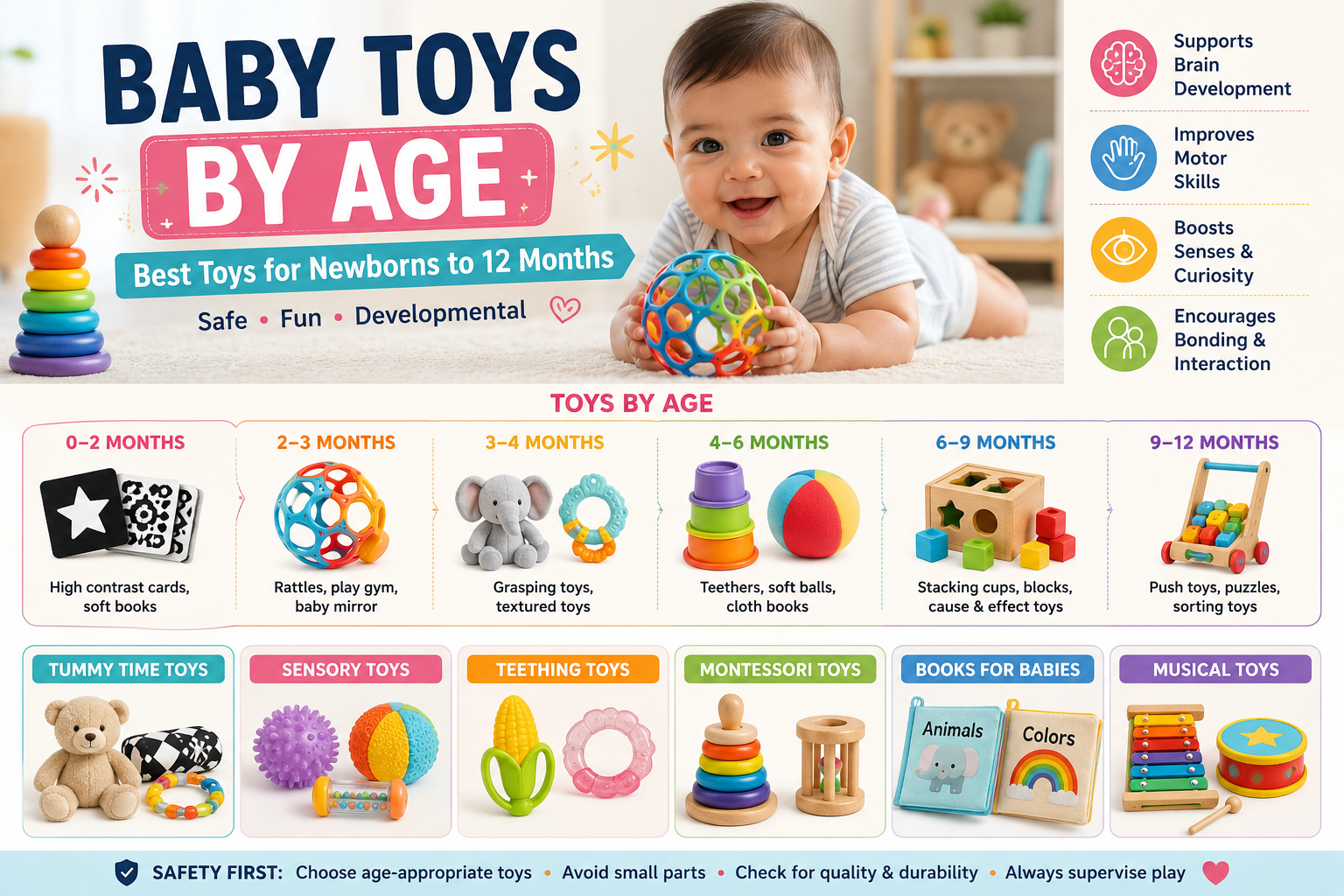
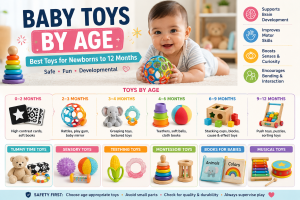
Baby Toys by Age at a Glance
| Baby’s Age | Toy Ideas |
|---|---|
| 0–2 months | High-contrast images, soft books, carefully positioned visual toys |
| 2–3 months | Lightweight rattles, play gym, baby-safe mirror |
| 3–4 months | Grasping toys, textured toys, tummy time toys |
| 4–5 months | Teethers, easy-grip toys, soft sensory toys |
| 5–6 months | Soft balls, textured books, simple cause-and-effect toys |
| 6–7 months | Stacking cups, larger blocks designed for babies, rolling toys |
| 7–8 months | Containers, balls, interactive cloth or board books |
| 8–9 months | Put-in/take-out toys, simple object-permanence play |
| 9–10 months | Push-and-roll toys, large stacking pieces, simple musical toys |
| 10–11 months | Nesting cups, sturdy activity toys, supervised imitation play |
| 11–12 months | Large shape sorters, simple puzzles designed for age, push toys where developmentally appropriate |
Important: Age bands are approximate. Always check the product’s own age rating and your baby’s actual abilities.
Why Are Baby Toys Important?
Play is one way babies explore people, objects, sounds, textures, movement, and cause and effect.
A toy can create opportunities for a baby to:
- look;
- listen;
- reach;
- grasp;
- mouth safe objects;
- shake;
- roll;
- transfer objects between hands;
- search for hidden objects;
- imitate;
- interact with a caregiver.
The AAP’s parent guidance highlights the value of developmentally appropriate toys and caregiver-child interaction.
The key point is that the toy itself does not “develop” the baby automatically. The play experience matters.
A simple cup can become:
- something to grasp;
- something to bang;
- something to hide;
- something to stack;
- something to put objects into.
That is why expensive electronic toys are not automatically better than simple open-ended toys. Choosing toys that match a baby’s age and current abilities can support meaningful play and interaction. The American Academy of Pediatrics guidance on choosing toys explains why developmentally appropriate, hands-on toys and caregiver interaction matter.
Best Baby Toys by Age
Best Toys for Newborn Babies: 0–2 Months
Newborns are not ready for complex toys. At this stage, interaction with caregivers is central, and visual experiences should be simple.
Good toy ideas may include:
- high-contrast black-and-white cards;
- high-contrast cloth books;
- simple bold-pattern images;
- soft books;
- an unbreakable baby-safe mirror used appropriately;
- carefully positioned visual toys;
- a simple play mat.
The AAP’s developmental guidance for early infancy includes high-contrast images or books among suggested activities and play materials.
How to play
You can:
- hold a high-contrast card within a comfortable viewing distance;
- slowly move an image from side to side;
- talk to your baby;
- sing;
- allow short periods of supervised floor play while the baby is awake.
What newborns do not need
A newborn does not need:
- complicated educational gadgets;
- loud electronic toys;
- small detachable pieces;
- screens marketed as developmental necessities.
Safety reminder: Toys and loose objects do not belong in an infant’s sleep space. Keep the crib or other sleep area clear according to current safe-sleep guidance. Before buying or giving a toy to a baby, check the recommended age range, construction, loose parts, sound level, and possible hazards. Parents can review the American Academy of Pediatrics guidance on how to buy safe toys for additional safety considerations.
Best Toys for 2 Month Old Babies
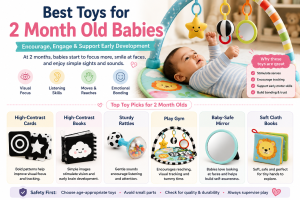
At around 2 months, babies may become more visually attentive and interested in faces, patterns, and sounds.
Toy ideas
- high-contrast cards;
- high-contrast books;
- sturdy lightweight rattles;
- play gym;
- baby-safe mirror;
- simple visual toys;
- soft cloth books.
The AAP’s milestone guidance specifically mentions high-contrast patterns, a varied mobile, sturdy rattles, singing, soft music at low volume, and appropriate chewable toys as examples around early infancy.
Play idea
Place your awake baby on a safe floor-level play surface and talk while showing one simple object at a time.
You do not need to keep a baby constantly entertained. Quiet observation is also part of early experience.
Best Toys for 3 Month Old Babies
Around 3 months, many babies become increasingly interested in reaching, batting, and bringing hands toward objects.
Useful options
- lightweight rattles;
- easy-grip rings designed for babies;
- play gyms;
- baby-safe mirrors;
- textured cloth toys;
- crinkle books;
- high-contrast books;
- tummy time toys.
What to look for
Choose toys that are:
- light enough for the baby to handle;
- too large to become a choking hazard;
- free from loose parts;
- easy to clean;
- designed for the baby’s age.
Simple play idea
Hold a lightweight toy where your baby can see it and allow time to:
- notice it;
- look toward it;
- reach;
- touch;
- grasp if ready.
Avoid turning every play session into a performance test.
Best Toys for 4 Month Old Babies
At around 4 months, some babies become more active with reaching, grasping, kicking, and mouthing.
Toy ideas
- easy-grip rattles;
- textured toys;
- baby-safe teethers;
- crinkle books;
- soft sensory balls designed for babies;
- tummy time toys;
- baby-safe mirror;
- play gym.
Why simple toys work well
A basic textured toy can allow a baby to:
- see a shape;
- feel a surface;
- grasp;
- transfer;
- mouth safely;
- shake.
One toy can support many forms of exploration without flashing lights.
Best Toys for 5 Month Old Babies
At 5 months, many babies enjoy more active object exploration.
Toy ideas
- easy-to-hold teethers;
- textured balls designed for infants;
- soft blocks;
- cloth books;
- rattles;
- simple cause-and-effect toys;
- play mats;
- baby-safe mirrors;
- lightweight grasping toys.
Play idea: Reach and choose
Place two safe toys within comfortable reach while your baby is awake and supervised.
Allow your baby to decide:
- which toy to look at;
- which to reach for;
- how long to explore.
This encourages active play rather than constant adult direction.
Best Toys for 6 Month Old Babies
Around 6 months, many babies become increasingly active in sitting practice, reaching, transferring objects, and exploring cause and effect.
Good options
- stacking cups;
- soft balls;
- large baby-safe blocks;
- textured books;
- sturdy board books;
- simple musical toys;
- easy-grip toys;
- containers for supervised play.
Play idea: Bang and listen
Give your baby two age-appropriate objects and demonstrate gently bringing them together.
Your baby may explore:
- sound;
- movement;
- two-handed play;
- repetition.
Best Toys for 7 Month Old Babies
A 7-month-old may enjoy toys that move, roll, disappear, or make a simple sound after an action.
Toy ideas
- rolling balls designed for babies;
- stacking cups;
- nesting cups;
- soft blocks;
- textured sensory toys;
- sturdy books;
- simple cause-and-effect toys;
- large containers.
Play idea: Where did it go?
Partly hide a toy under a cloth while your baby watches.
Allow the baby to:
- look;
- reach;
- pull the cloth;
- discover the object.
Use a lightweight, safe cloth only during active supervised play and keep loose fabric out of the baby’s sleep space.
Best Toys for 8 Month Old Babies
Around 8 months, many babies become interested in repeatedly dropping, banging, moving, and retrieving objects.
Toy ideas
- stacking cups;
- large balls;
- containers;
- simple put-in/take-out toys;
- soft blocks;
- board books;
- pop-up or cause-and-effect toys designed for age;
- simple musical toys.
Budget play idea
A safe household container and several large, baby-safe objects can become an engaging activity.
Show your baby how to:
- put an object in;
- take it out;
- repeat.
Do not use coins, bottle caps, buttons, beads, batteries, or other small household items.
Best Toys for 9 Month Old Babies
At around 9 months, many babies enjoy increasingly purposeful exploration.
Toy ideas
- put-in/take-out toys;
- stacking cups;
- nesting toys;
- large blocks;
- balls;
- sturdy books;
- simple object-permanence toys;
- supervised push-and-roll toys.
Play idea: Find the toy
Hide part of a familiar toy under a cup or cloth and encourage your baby to search.
Keep the activity playful. There is no need to repeatedly “test” the baby.
Best Toys for 10 Month Old Babies
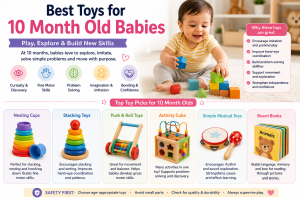
At 10 months, some babies enjoy imitation, movement, containers, and repetitive cause-and-effect play.
Toy ideas
- nesting cups;
- large stacking toys;
- simple activity toys;
- push-and-roll toys;
- sturdy toy drums;
- baby-safe musical instruments;
- board books;
- large shape-sorter pieces if designed for the age.
Play idea: Copy me
Try simple actions such as:
- tapping a toy;
- rolling a ball;
- clapping;
- putting a block into a container.
Pause and see whether your baby responds or imitates.
Best Toys for 11 Month Old Babies
An 11-month-old may be highly mobile and interested in using objects more deliberately.
Toy ideas
- large blocks;
- stacking rings designed for age;
- nesting cups;
- sturdy board books;
- simple puzzles designed for young children;
- large shape sorters;
- push toys if appropriate for the baby’s stage;
- pretend household objects designed as safe toys.
Play idea
Offer a few toys rather than filling the floor with everything at once.
A smaller selection may make it easier to:
- notice;
- choose;
- explore;
- return to an activity.
Best Toys for 12 Month Old Babies
Around the first birthday, many babies enjoy toys that involve movement, imitation, stacking, filling, emptying, and simple problem-solving.
Toy ideas
- large building blocks;
- stacking cups;
- nesting toys;
- shape sorters designed for age;
- simple inset puzzles;
- push toys;
- balls;
- board books;
- toy phones without hazardous detachable components;
- simple pretend-play objects;
- sturdy musical toys.
Remember: a 12-month-old is still very young. Avoid toys with small parts simply because the child appears advanced.
Best Newborn Toys
The keyword newborn toys deserves special attention because newborn play is very different from play later in infancy.
My preferred newborn toy categories are:
1. High-Contrast Cards
Simple black-and-white or bold contrasting images can provide visual interest.
2. High-Contrast Books
Choose sturdy or soft baby-appropriate formats.
3. Play Mat
A clear floor-level space can support supervised awake play.
4. Baby-Safe Mirror
A securely designed, unbreakable mirror intended for infant play can provide visual interest.
5. Simple Rattle
Use only a sturdy, age-appropriate rattle without loose parts.
6. Cloth Book
Look for secure construction and washable materials.
The AAP’s early developmental guidance includes high-contrast images, books, and sturdy rattles among age-relevant ideas.
Best Tummy Time Toys
Tummy time does not require special equipment.
Useful toy ideas may include:
- high-contrast cards;
- baby-safe mirror;
- lightweight rattle;
- textured toy;
- cloth book;
- simple floor-level activity toy.
How to use toys during tummy time
Place an interesting object:
- in front of your baby;
- slightly to one side;
- within a realistic visual and reaching range.
You can also get down at floor level and use your own:
- face;
- voice;
- smile;
- singing.
A caregiver can be more engaging than any toy.
Best Sensory Toys for Babies
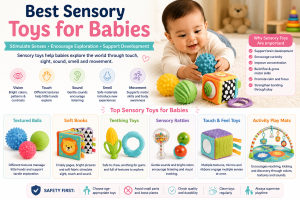
“Baby sensory toys” is a popular phrase, but parents should be cautious about exaggerated marketing.
A toy does not need to be labelled “sensory” to offer sensory exploration.
Useful sensory experiences can involve:
Texture
- smooth;
- bumpy;
- soft;
- ridged.
Sound
- gentle rattle;
- crinkle;
- soft musical sound.
Vision
- contrast;
- simple patterns;
- movement;
- reflections.
Movement
- rolling;
- shaking;
- turning;
- grasping.
Choose products designed for the baby’s age and inspect them for loose or damaged components.
Best Teething Toys for Babies
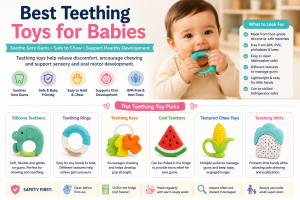
Teething toys are widely used, but safety and product condition matter.
Look for:
- age-appropriate design;
- secure one-piece or robust construction;
- no loose small parts;
- easy cleaning;
- intact surfaces;
- manufacturer instructions.
Avoid assuming that any household object is safe simply because a baby can chew it.
Inspect teethers regularly and stop using a product if it:
- cracks;
- tears;
- leaks;
- develops loose components;
- becomes damaged.
Best Montessori Toys for Babies
The phrase Montessori toys for babies is heavily used in marketing. A toy does not become developmentally superior simply because a seller labels it “Montessori.”
Parents often use the term for simple toys such as:
- grasping objects;
- stacking cups;
- object-permanence toys;
- simple wooden toys;
- nesting toys;
- open-ended play materials.
What matters more than the label?
Look at:
- age suitability;
- safety;
- size;
- construction;
- how the baby can interact with it;
- whether it matches current abilities.
Do not pay a premium for a marketing label alone.
Black and White Toys for Newborns
Black-and-white baby toys are popular because high-contrast patterns can be visually engaging in early infancy.
Options include:
- contrast cards;
- cloth books;
- board books;
- simple patterned toys;
- visual panels.
The AAP includes high-contrast patterns among suggested early developmental play ideas.
Musical Toys for Babies
Musical toys can be enjoyable, but louder is not better.
Look for:
- comfortable volume;
- simple controls;
- secure battery compartments;
- age-appropriate design;
- no loose pieces.
The AAP’s toy-safety guidance advises avoiding excessively loud toys because of hearing concerns.
A caregiver singing can also provide:
- interaction;
- language exposure;
- turn-taking;
- emotional connection.
Electronic Toys vs Simple Baby Toys
Electronic toys often promise:
- early learning;
- intelligence;
- language development;
- sensory stimulation.
But more buttons do not automatically mean more developmental value.
The AAP has emphasized traditional, hands-on toys and caregiver-child play, noting that the best toys support interaction rather than replacing it.
Example
A flashing electronic toy may:
play a sound when one button is pressed.
A set of stacking cups may allow a baby to:
- hold;
- bang;
- nest;
- stack;
- hide;
- fill;
- empty;
- knock down;
- share with a caregiver.
Simple can be highly versatile.
Expensive vs Budget Baby Toys
A baby does not understand the price tag.
Budget-friendly play can include carefully selected, age-appropriate items such as:
- stacking cups;
- balls;
- sturdy books;
- simple blocks;
- washable cloth books.
Some household objects can also support supervised play, but parents must assess hazards carefully.
Never offer babies household items such as:
- coins;
- buttons;
- bottle caps;
- medicine containers;
- batteries;
- magnets;
- sharp objects;
- breakable containers;
- plastic bags;
- items with detachable small parts.
A cheap toy is not automatically unsafe, and an expensive toy is not automatically safe. Evaluate the actual product.
How Many Toys Does a Baby Need?
There is no medically required number.
A baby does not need 50 toys available at once.
A smaller selection might include:
- one grasping toy;
- one book;
- one textured toy;
- one ball;
- one stacking or container toy;
- one visual toy appropriate for age.
You can rotate toys rather than constantly buying new ones.
Toy rotation example
Week 1:
- rattle;
- cloth book;
- mirror;
- textured ball.
Week 2:
- stacking cups;
- different book;
- grasping toy;
- soft block.
The goal is not to create a perfect “Montessori shelf.” It is simply to keep play manageable.
Baby Toy Safety: What Parents Must Check
This is the most important section of the guide.
The AAP recommends reading labels, choosing appropriately sized toys, avoiding excessively loud toys, and checking construction.
The U.S. Consumer Product Safety Commission also highlights choking risks from small parts; products intended for children under 3 that present specified small-parts hazards are subject to restrictions under U.S. rules.
Baby Toy Safety Checklist
Before giving a toy to your baby, check:
- Is it designed for the baby’s age?
- Does it contain small detachable parts?
- Is anything cracked?
- Are seams opening?
- Are eyes, buttons, beads, or decorations loose?
- Is the battery compartment secure?
- Are there accessible magnets?
- Are strings or cords hazardous?
- Is the sound excessively loud?
- Can the toy be cleaned as directed?
- Has the product been recalled?
- Is packaging fully removed?
The CPSC advises paying attention to age labels and promptly discarding toy packaging after opening.
Small Parts and Choking Hazards
Babies explore with their mouths. That makes small objects particularly dangerous.
Avoid giving babies:
- beads;
- marbles;
- coins;
- buttons;
- bottle caps;
- small balls;
- detachable toy pieces;
- older siblings’ small toys.
The CPSC states that the small-parts rules are intended to address choking, aspiration, and ingestion hazards for young children.
Important: Supervision does not transform a known choking hazard into a suitable baby toy.
Button Batteries and Toys
Be especially cautious with battery-operated products.
A battery compartment should be secure and inaccessible to the baby during normal use.
If you suspect a child has swallowed a button battery, treat it as an emergency and seek immediate professional help according to local emergency guidance.
Do not wait for symptoms.
Magnets in Baby Toys
Loose high-powered magnets can be extremely dangerous if swallowed.
Inspect toys for:
- damaged compartments;
- loose magnets;
- broken seams;
- missing components.
Stop using damaged products.
Strings, Cords and Ribbons
Long or accessible cords can create hazards.
Be cautious with:
- pull cords;
- ribbons;
- necklaces;
- homemade hanging toys;
- damaged activity toys.
CPSC toy standards address cords, straps, and elastics in certain toys intended for young children because these features can present hazards.
Are Second-Hand Baby Toys Safe?
Second-hand toys can be economical, but inspect them carefully.
Check for:
- missing parts;
- cracks;
- loose components;
- damaged battery covers;
- peeling surfaces;
- product recalls;
- unclear age suitability;
- hygiene issues.
Older toys may not match current safety expectations.
If you cannot confidently identify or inspect a product, consider not using it for a baby.
How to Choose Baby Toys Without Wasting Money
Use this simple approach.
Step 1: Start with the baby’s current abilities
Ask:
- Are they mainly looking?
- Reaching?
- Grasping?
- Mouthing?
- Sitting?
- Crawling?
- Putting objects into containers?
Step 2: Choose one toy for that action
Examples:
| Baby’s Current Interest | Toy Idea |
|---|---|
| Looking | High-contrast book |
| Reaching | Lightweight grasping toy |
| Mouthing | Age-appropriate teether |
| Rolling objects | Soft ball |
| Filling and emptying | Stacking cups or container toy |
| Searching | Simple hide-and-find play |
| Stacking | Large stacking pieces |
Step 3: Check safety
Age label, size, construction, batteries, magnets, cords and condition.
Step 4: Buy fewer toys
Observe what your baby actually uses before purchasing more.
What Toys Should You Avoid for Babies?
Avoid or reconsider toys that have:
- small detachable parts;
- accessible button batteries;
- loose magnets;
- sharp edges;
- broken components;
- hazardous cords;
- excessively loud sounds;
- unclear age suitability;
- damaged paint or surfaces;
- poor construction.
Also be cautious about exaggerated claims such as:
- “guaranteed to increase IQ”;
- “makes your baby talk faster”;
- “essential for brain development”;
- “every newborn must have this.”
Development is not purchased in a toy box.
Do Babies Need Educational Toys?
Not necessarily.
For a baby, learning can happen through ordinary play:
- shaking a rattle;
- dropping a ball;
- touching a texture;
- looking at a book;
- hearing a caregiver name an object;
- putting a cup into another cup.
The AAP recommends toys that match developmental abilities and encourage caregiver-child interaction rather than relying on digital features or marketing claims.
A toy does not need the word “educational” on the box to support meaningful play.
Baby Toys and Screen Time
A screen is not simply another baby toy.
The World Health Organization’s guidance for young children emphasizes active play and addresses sedentary screen exposure; WHO’s parent-facing guidance advises avoiding sitting and watching screens for children under 2.
For babies, prioritize:
- face-to-face interaction;
- floor play;
- songs;
- books;
- movement;
- safe object exploration.
For babies and very young children, active play and responsive interaction should take priority over passive screen viewing. Parents can review the World Health Organization guidance on physical activity, sedentary behaviour and sleep for children under 5 for broader recommendations.
Frequently Asked Questions About Baby Toys
What are the best baby toys?
The best baby toys are safe, age-appropriate, suited to the baby’s current abilities, and capable of encouraging active exploration or caregiver interaction. Examples include rattles, books, stacking cups, balls, grasping toys, and simple cause-and-effect toys.
What toys are best for newborn babies?
High-contrast images or books, simple visual materials, carefully chosen rattles, and age-appropriate play mats can be useful. The AAP includes high-contrast patterns and sturdy rattles among early play ideas.
When do babies start playing with toys?
Babies interact with their environment from early infancy, but “playing with toys” changes over time. Early interaction may involve looking, while later play may involve reaching, grasping, mouthing, shaking, dropping, and searching.
What toys are good for a 3 month old?
Possible options include lightweight rattles, easy-grip toys, play gyms, baby-safe mirrors, textured cloth toys, and tummy time toys.
What toys are good for a 6 month old?
Stacking cups, soft balls, large baby-safe blocks, textured books, sturdy board books, and simple cause-and-effect toys may be useful depending on development.
What toys are good for a 9 month old?
Put-in/take-out toys, stacking cups, large blocks, balls, sturdy books, and simple object-permanence play may suit many babies around this age.
Are expensive toys better for babies?
No. Price does not determine developmental value. Simple toys can offer many forms of exploration and interaction.
Are electronic toys good for babies?
Some may be enjoyable, but electronic features do not automatically make a toy better. The AAP emphasizes developmentally appropriate toys and interaction-rich play.
Are Montessori toys good for babies?
Some simple toys marketed as Montessori may support open-ended exploration, but the label alone does not prove quality, safety, or developmental superiority.
Are black and white toys good for newborns?
High-contrast patterns can provide visual interest in early infancy, and AAP developmental guidance includes high-contrast images or books among early play suggestions.
How many toys does a baby need?
There is no required number. A small, varied selection can be enough, and toys can be rotated.
Can babies play with household objects?
Some carefully selected household objects may be used in supervised play, but many ordinary items create choking, cutting, battery, magnet, suffocation, or breakage hazards. Assess every object carefully.
Are second-hand baby toys safe?
They can be, but check condition, missing parts, recalls, age suitability, battery compartments, magnets, hygiene, and overall construction.
How do I know if a toy is a choking hazard?
Follow age labels and safety warnings, and avoid small detachable parts. CPSC guidance specifically addresses small parts that can create choking, aspiration, or ingestion hazards for young children.
Should babies have toys in their crib?
Loose toys should not be added to an infant sleep space. Keep sleep and active play environments separate and follow current safe-sleep guidance.
Final Thoughts
The best baby toys are not necessarily the loudest, newest, most expensive, or most heavily advertised.
From newborn to 12 months, useful toys change as babies begin to:
- look;
- reach;
- grasp;
- mouth;
- sit;
- roll objects;
- search;
- stack;
- imitate;
- explore cause and effect.
A newborn may be interested in a simple high-contrast image. A 6-month-old may enjoy banging two safe objects together. A 9-month-old may repeatedly put objects into a container and take them out. A 12-month-old may enjoy stacking, rolling, and early pretend play.
The strongest approach is simple:
Choose safe baby toys that match what your child can do now, leave room for exploration, and make time for interaction.
The AAP’s guidance similarly emphasizes matching toys to developmental skills and choosing playthings that can support interaction and emerging abilities.