
Medical Editorial Note: This article provides general educational information and does not diagnose pregnancy, nutritional deficiencies, or medical conditions. Cravings vary widely between individuals and pregnancies. Speak with a qualified healthcare professional if cravings involve non-food substances, interfere with adequate nutrition, or occur with significant illness, weight loss, dehydration, or other concerning symptoms.
Pregnancy can change the way food smells, tastes, and feels. A favourite meal may suddenly seem unappealing, while a food you rarely thought about may become difficult to stop thinking about. These changes often lead to one common question: when do pregnancy cravings start?
The short answer is that there is no single week when pregnancy cravings begin for everyone. Food cravings and changing food preferences can occur in early pregnancy, including during the first trimester. The National Health Service notes that early pregnancy can bring new food cravings, food dislikes, unusual tastes, and greater sensitivity to smells; its week-5 guidance also lists new food likes and dislikes among possible early symptoms. Some people experience strong cravings, some notice only food aversions, and others have neither.
This guide explains how early cravings may appear, what they can feel like, how they may change across pregnancy, and when an unusual craving deserves medical attention.
Quick Answer: When Do Pregnancy Cravings Start?
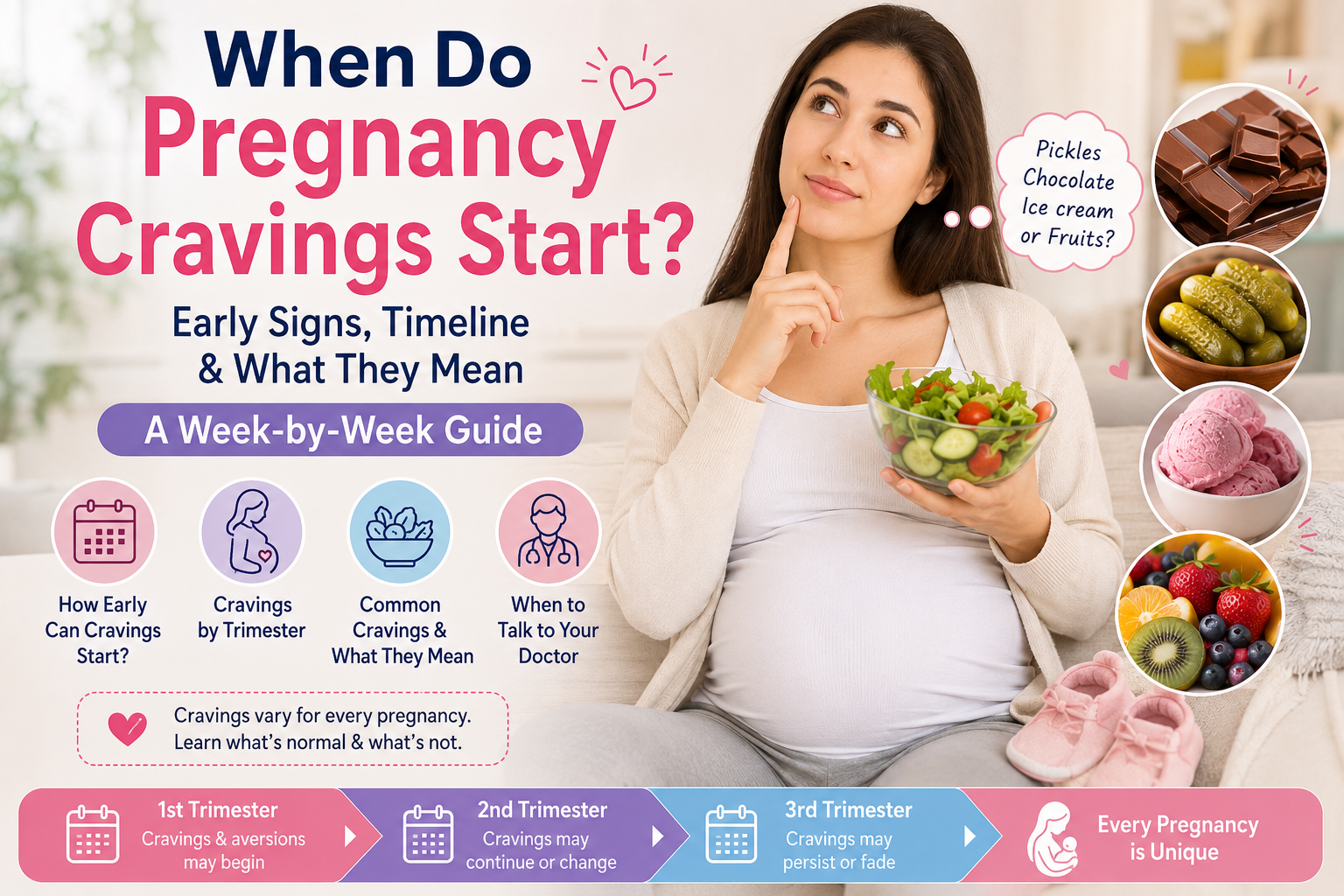
Pregnancy cravings can start during the first trimester, but there is no universal starting week. Some people notice changing food preferences in early pregnancy, while others develop cravings later or never experience them at all.
The NHS includes new food cravings among possible early pregnancy changes and lists new food likes and dislikes in its guidance for week 5. That means cravings can appear early, but it does not mean every pregnant person will start craving foods at exactly 5 weeks.
Pregnancy Cravings Timeline at a Glance
| Stage | What You Might Notice |
|---|---|
| Around 2 weeks | Usually too early to treat cravings as a reliable pregnancy sign |
| Around 3 weeks | Pregnancy-related symptoms may still be absent or difficult to distinguish |
| Around 4 weeks | Some people begin noticing early changes, but cravings are not diagnostic |
| Around 5 weeks | New food likes and dislikes can occur in early pregnancy |
| Around 6–8 weeks | Cravings, aversions, nausea and smell sensitivity may overlap |
| First trimester | Food preferences can change considerably |
| Second trimester | Cravings may continue, change or become more noticeable for some |
| Third trimester | Cravings may persist, change or disappear |
| No cravings at all | Can also occur; not everyone experiences cravings |
Important: This is a general guide, not a fixed biological schedule. Individual experiences vary.
What Are Pregnancy Cravings?
A pregnancy craving is a strong desire for a particular food, drink, taste, texture, or combination.
A craving may feel like:
- repeatedly thinking about one food;
- wanting a specific flavour;
- preferring a particular texture;
- suddenly liking something you rarely ate before;
- wanting one brand or preparation method;
- feeling unusually drawn to sweet, salty, sour, spicy, cold, or crunchy foods.
For example, someone may not simply want “fruit.” They may specifically want:
cold green grapes straight from the refrigerator.
Another person may suddenly want:
a particular type of pickle with a specific meal.
This specificity is one reason pregnancy cravings can feel different from ordinary hunger. Still, a craving by itself cannot confirm pregnancy.
How Early Can Pregnancy Cravings Start?
Pregnancy cravings can occur in early pregnancy, but reputable guidance does not establish one exact week that applies to everyone.
The NHS describes cravings among changes that may occur during early pregnancy. Its week-by-week guidance also mentions new food likes and dislikes at 5 weeks.
A more accurate answer is therefore:
Cravings may begin during the first trimester and can appear early, but timing differs from person to person.
This wording is preferable to claims such as:
“Pregnancy cravings always start at week 5.”
They do not.
Can Pregnancy Cravings Start at 2 Weeks?
If pregnancy is counted from the first day of the last menstrual period, “2 weeks pregnant” is often around the time ovulation occurs in a typical cycle. Conception may not yet have happened.
For that reason, a food craving at this stage should not be treated as reliable evidence of pregnancy.
You might crave food for many ordinary reasons, including:
- hunger;
- habit;
- stress;
- changes in routine;
- menstrual-cycle changes;
- food availability;
- personal preference.
If pregnancy is possible, use an appropriately timed pregnancy test rather than trying to diagnose pregnancy from cravings.
Can Pregnancy Cravings Start at 3 Weeks?
At around 3 weeks by standard pregnancy dating, it may still be very early. Some people notice no symptoms at all.
A sudden desire for a particular food is not enough to establish that implantation has occurred or that someone is pregnant.
If your period is not yet due, testing too early can also produce an unhelpful negative result. Pregnancy symptoms vary substantially, and some people do not feel pregnant until weeks after a positive test.
Pregnancy Cravings at 4 Weeks
Around 4 weeks, some people begin paying closer attention to possible pregnancy symptoms, especially if a period is due or late.
You might notice:
- changing appetite;
- food aversions;
- unusual tastes;
- smell sensitivity;
- nausea;
- breast changes;
- fatigue.
But these symptoms are variable and can overlap with other experiences.
A craving at 4 weeks is possible, but it is not a reliable standalone pregnancy test.
Pregnancy Cravings at 5 Weeks
This is one of the most searched questions around craving timing.
The NHS week-5 pregnancy guide lists new food likes and dislikes among possible early signs. It also notes other changes such as nausea, a metallic taste, heightened smell sensitivity, and tiredness.
So, can pregnancy cravings start at 5 weeks?
Yes, changes in food preferences can occur around this stage, but not everyone experiences them.
At 5 weeks, one person may crave a particular food while another may find previously loved foods intolerable.
Pregnancy Cravings at 6 Weeks
By around 6 weeks, food experiences may become more complicated for some people because cravings can overlap with:
- nausea;
- vomiting;
- smell sensitivity;
- food aversions;
- metallic taste;
- appetite changes.
For example, you might strongly want a cold fruit but feel nauseated by the smell of cooked food.
This does not mean one symptom causes the other. It simply illustrates how multiple early-pregnancy experiences can occur at the same time.
Pregnancy Cravings at 7 to 8 Weeks
During this stage, some people become more aware of patterns in what they want—or cannot tolerate.
You may notice:
- a preference for bland foods;
- strong reactions to cooking smells;
- sudden interest in sour tastes;
- preference for cold foods;
- aversion to tea or coffee;
- changing tolerance of spicy or rich meals.
Again, these experiences are highly individual.
First Trimester Pregnancy Cravings
The first trimester lasts through the early part of pregnancy, and it is a period when many symptoms and food-related changes can occur. Cleveland Clinic includes food cravings and food aversions among experiences that may occur in the first trimester.
During this stage, cravings may interact with:
- nausea;
- vomiting;
- smell sensitivity;
- food aversions;
- fatigue;
- appetite changes.
Some people may want only a narrow range of foods for a period of time, while others may experience few appetite changes.
When Do Pregnancy Cravings Peak?
You may see online claims that pregnancy cravings “always peak” during one particular trimester. That is too definite.
There is no universal peak week for every pregnant person. Cravings may:
- become stronger;
- remain stable;
- change from one food to another;
- disappear;
- return later.
The pattern can differ even between pregnancies in the same person.
For SEO accuracy and reader trust, it is better to acknowledge this variability than invent a precise peak week.
Do Pregnancy Cravings Change in the Second Trimester?
Yes, they can.
A person who disliked a food in early pregnancy may tolerate it later. Another person may develop an entirely new preference.
Possible patterns include:
- an early craving disappearing;
- a new craving emerging;
- food aversions easing;
- appetite changing;
- a preferred texture becoming less important.
Do not assume that every change is caused by hormones alone. Pregnancy is complex, and food choices can also be influenced by culture, access, habits, nausea, smell sensitivity, and ordinary preference.
Do Pregnancy Cravings Stop in the Third Trimester?
They may, but not necessarily.
Some people continue experiencing cravings late in pregnancy. Others find that cravings weaken or change.
Later pregnancy can also bring physical changes that affect eating, such as feeling full more quickly or experiencing heartburn. That may alter what feels appealing even if a previous craving has not completely disappeared.
What Do Pregnancy Cravings Feel Like?
There is no official test for a “real” pregnancy craving.
People may describe cravings as:
- unusually specific;
- repetitive;
- difficult to ignore;
- focused on a texture;
- focused on temperature;
- stronger than an ordinary preference.
Examples might include wanting:
- ice-cold watermelon;
- crunchy apples;
- sour lemon flavours;
- a particular curry;
- toast prepared a specific way;
- salty snacks;
- one exact type of cheese.
But intensity varies. A mild preference can still be part of someone’s pregnancy experience.
Common Pregnancy Cravings
Frequently discussed cravings include:
- fruit;
- dairy foods;
- chocolate;
- sweets;
- salty snacks;
- sour foods;
- spicy foods;
- pickles;
- ice;
- bread;
- potatoes;
- fast food;
- cold drinks.
However, a list of “common cravings” should not be interpreted as a prediction of what you will want.
Cultural context matters too. A pregnant person in India may think of:
- raw mango;
- imli or tamarind;
- chaat;
- curd;
- citrus fruits;
- spicy snacks.
Someone elsewhere may crave completely different foods based on their normal diet and environment.
Why Do Pregnancy Cravings Happen?
The exact reasons behind every pregnancy craving are not fully settled, and it is better to avoid pretending there is one proven explanation.
Possible influences discussed in relation to pregnancy food experiences include:
- physiological changes;
- changes in taste;
- heightened sensitivity to smells;
- nausea and food aversions;
- cultural expectations;
- emotional associations;
- ordinary food preferences.
The NHS confirms that early pregnancy can involve cravings, loss of interest in previously enjoyed foods, unusual tastes, and increased smell sensitivity.
That does not prove that every craving has one specific hormonal or nutritional cause.
Do Cravings Mean Your Body Needs a Nutrient?
Not necessarily.
A common claim says:
“Every pregnancy craving means your body is deficient in something.”
That is too simplistic.
Wanting chocolate does not automatically prove magnesium deficiency. Wanting pickles does not automatically diagnose a sodium deficiency.
However, cravings for non-food substances are different and require attention because they may represent pica.
Are Pregnancy Cravings an Early Sign of Pregnancy?
They can be part of early pregnancy, but cravings alone are not a reliable way to diagnose pregnancy.
The NHS includes new food cravings among possible early pregnancy changes. But early symptoms vary, and other causes can also change appetite or food preferences.
If you think you may be pregnant:
- use a pregnancy test at an appropriate time;
- follow the test instructions;
- seek medical advice if results are unclear or symptoms concern you.
Do not rely on cravings alone.
Pregnancy Cravings vs PMS Cravings
Food cravings can occur around the menstrual cycle as well as during pregnancy.
| Feature | Pregnancy-Related Food Changes | PMS-Related Cravings |
|---|---|---|
| Timing | Can occur during pregnancy | Often occur before a period |
| Food aversions | May occur | Can occur but pattern varies |
| Smell sensitivity | May become noticeable | Less specific as a distinguishing sign |
| Missed period | May accompany pregnancy | Period generally follows |
| Diagnostic value | Cravings alone cannot confirm pregnancy | Cravings alone cannot identify PMS with certainty |
Symptoms overlap. A pregnancy test is more informative than trying to interpret a craving.
Pregnancy Cravings vs Food Aversions
A craving means you strongly want something.
A food aversion means a food, smell, taste, or texture feels unpleasant or difficult to tolerate.
You can experience:
- cravings without aversions;
- aversions without cravings;
- both;
- neither.
For example:
You may crave oranges but suddenly dislike the smell of coffee.
Food aversions can occur during the first trimester, and severe aversions that interfere with adequate intake deserve medical attention.
What If You Have No Pregnancy Cravings?
Having no cravings does not automatically mean something is wrong.
Pregnancy symptoms vary. Some people experience:
- strong cravings;
- only mild preferences;
- mostly aversions;
- no obvious food changes.
You should not compare your pregnancy with social-media posts or assume that a missing symptom indicates a problem.
If you have concerns about your pregnancy, discuss them with your healthcare professional rather than using cravings as a measure of pregnancy health.
Can Cravings Predict a Baby Boy or Girl?
There is a popular belief that:
sweet cravings mean a girl;
and:
salty cravings mean a boy.
These ideas should be treated as folklore, not a reliable method of determining fetal sex.
Do not present craving patterns as a scientifically established gender-prediction test.
What Is Pica During Pregnancy?
Pica refers to cravings for or consumption of substances that are not ordinarily considered food or have no meaningful nutritional value.
Examples can include cravings for:
- soil;
- clay;
- paper;
- chalk;
- hair;
- other non-food materials.
Pregnancy is associated with pica, and unusual non-food cravings deserve discussion with a healthcare professional.
Why pica matters
Non-food substances can create risks depending on what is consumed. Pica can also be associated with nutritional issues in some cases.
For example, craving and chewing ice—known as pagophagia—has an association with iron deficiency, though the relationship is not a simple one-to-one diagnosis.
If you are craving non-food substances, tell your doctor, midwife, or other qualified maternity professional rather than feeling embarrassed or trying to manage it alone.
Is Craving Ice During Pregnancy Normal?
Wanting cold drinks is different from repeatedly craving and chewing ice.
Persistent ice craving can be associated with iron deficiency. The Mayo Clinic notes that pagophagia—craving and chewing ice—is often associated with iron deficiency, with or without anemia.
This does not mean everyone who likes ice has anemia. But if the craving is persistent or intense, especially during pregnancy, mention it to your healthcare professional.
How to Handle Pregnancy Cravings Safely
You do not necessarily need to fight every craving. Instead, consider the overall dietary pattern and whether the desired food is safe during pregnancy.
A practical approach is to:
- eat regular meals where possible;
- include a variety of foods;
- choose pregnancy-safe preparation methods;
- pay attention to food hygiene;
- avoid unsafe foods;
- discuss dietary restrictions with a professional;
- seek help if nausea or vomiting prevents adequate intake.
The NHS recommends a varied, healthy diet during pregnancy and also notes that certain foods should be avoided because of pregnancy-related risks.
For detailed meal-planning ideas, you can also read MomSaathi’s pregnancy nutrition resource: Diet Chart for Pregnant Women.
What If You Crave Foods That Are Not Recommended in Pregnancy?
A craving does not make a food automatically safe.
Before acting on a craving, consider whether the food involves:
- raw or undercooked meat;
- unpasteurised products;
- foods with higher foodborne-illness risk;
- fish choices affected by mercury guidance;
- alcohol;
- other pregnancy-specific restrictions.
Use current local medical or public-health guidance because recommendations can vary by country.
The NHS healthy eating in pregnancy guidance provides a useful overview of healthy eating and foods to avoid during pregnancy.
When Should You Talk to a Doctor?
Speak with your doctor, midwife, or another qualified healthcare professional if:
- you crave non-food substances;
- you repeatedly crave and chew ice;
- cravings prevent you from eating a reasonably varied diet;
- food aversions make adequate intake difficult;
- you are losing weight unexpectedly;
- you cannot keep food or fluids down;
- you have signs of dehydration;
- you suspect a nutritional deficiency;
- you have another medical condition affecting diet.
Frequent vomiting with inability to keep food or fluids down can require medical attention.
Frequently Asked Questions
When do pregnancy cravings start?
Pregnancy cravings can occur during the first trimester, including early pregnancy, but there is no single starting week for everyone. The NHS lists new food cravings among possible early pregnancy changes.
How early do pregnancy cravings start?
Some people notice food preference changes early in pregnancy. NHS week-5 guidance includes new food likes and dislikes among possible early symptoms, but this is not a universal timeline.
Can pregnancy cravings start at 2 weeks?
At 2 weeks by standard pregnancy dating, conception may not yet have occurred. A craving at this stage is not reliable evidence of pregnancy.
Can cravings start at 3 weeks pregnant?
It may still be very early, and symptoms vary widely. A food craving alone cannot confirm pregnancy.
Can you have pregnancy cravings at 4 weeks?
It is possible to notice changing food preferences early, but cravings at 4 weeks are not a diagnostic sign of pregnancy.
Can pregnancy cravings start at 5 weeks?
Yes, food preference changes can occur around this stage. NHS guidance for week 5 lists new food likes and dislikes among possible symptoms.
When do pregnancy cravings peak?
There is no universal peak week that applies to every pregnancy. Cravings can strengthen, weaken, change, disappear, or never occur.
Are cravings an early sign of pregnancy?
They can occur in early pregnancy, but cravings alone cannot confirm pregnancy.
Is it normal to have no pregnancy cravings?
Yes. Not everyone experiences the same symptoms, and the absence of cravings alone does not indicate a problem.
What are the most common pregnancy cravings?
People report many foods, including fruit, dairy, sweets, salty snacks, sour foods, spicy foods, pickles, and cold items. Individual and cultural patterns vary.
Do sweet cravings mean a baby girl?
There is no reliable scientific basis for using sweet versus salty cravings to determine fetal sex.
Should I worry about craving dirt or chalk?
Cravings for non-food substances may indicate pica and should be discussed with a healthcare professional.
Why am I craving ice during pregnancy?
Persistent craving and chewing of ice can be associated with iron deficiency. Speak with a healthcare professional if this is happening.
Final Thoughts
So, when do pregnancy cravings start? The most accurate answer is that they can begin during the first trimester and may appear early in pregnancy, but there is no exact starting week that applies to everyone. The NHS recognizes new food cravings and changing food preferences among possible early pregnancy experiences, including food likes and dislikes around week 5.
Some people experience intense cravings. Others notice food aversions instead. Some have both, and some have neither.
The most important distinction is between ordinary food preferences and cravings that may need attention. If you want to eat non-food substances, repeatedly crave and chew ice, cannot maintain adequate food or fluid intake, or feel unwell, speak with a qualified healthcare professional.