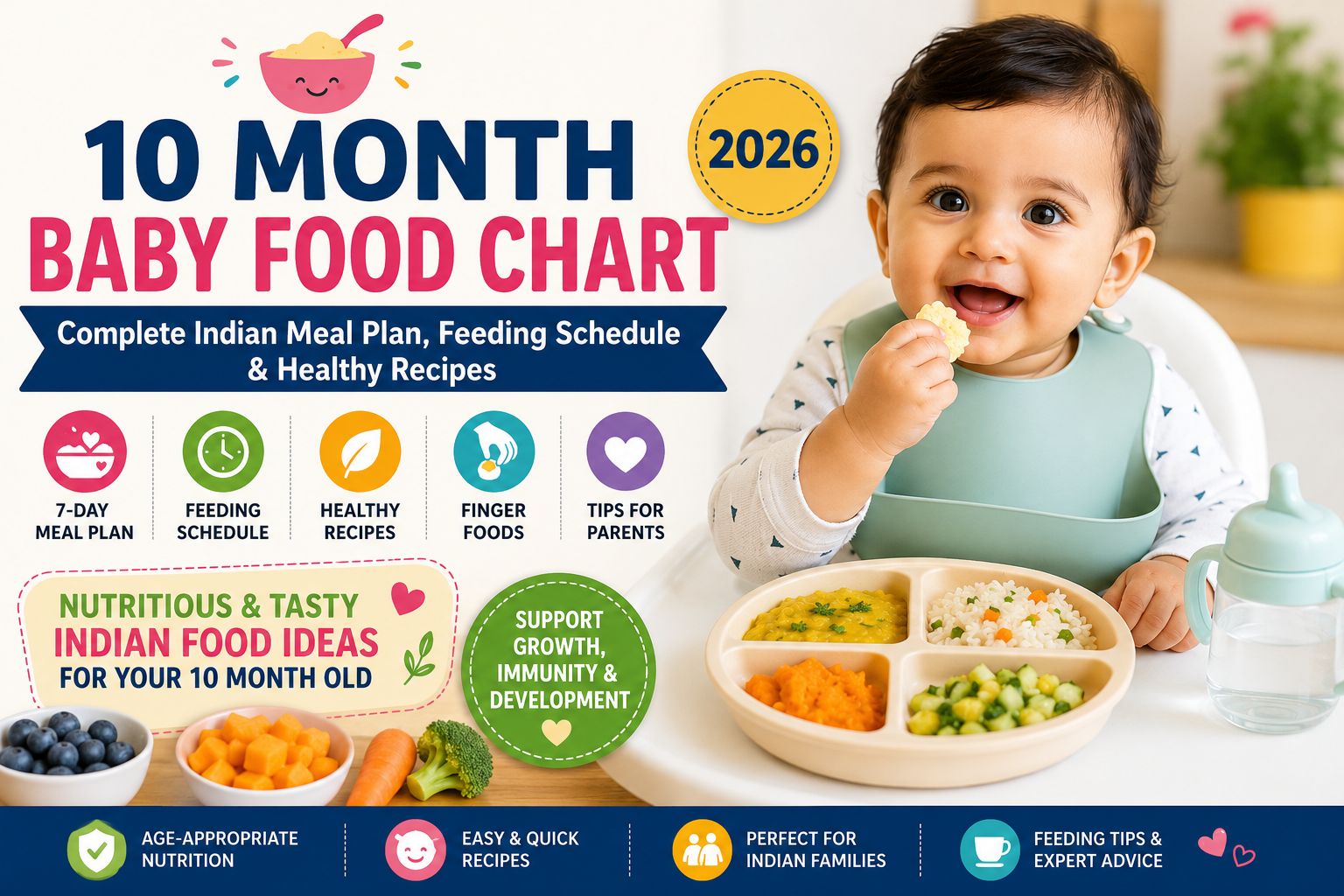

By 10 months, mealtimes can start looking very different from the early days of weaning. Your baby may now reach for food, try to feed themselves, pick up soft pieces with their fingers, drink small amounts of water from a cup, and show strong preferences for certain tastes and textures.
This stage is not simply about offering more food. It is about helping your baby gradually develop chewing skills, self-feeding confidence, texture acceptance, and familiarity with balanced family meals.
A practical 10 month baby food chart can help parents plan meals without making feeding rigid or stressful. The aim is to offer variety while continuing breast milk or infant formula and responding to the baby’s hunger and fullness cues.
In this guide, you will find a complete Indian meal plan for a 10-month-old baby, including a sample feeding schedule, 7-day food chart, vegetarian and non-vegetarian options, finger foods, texture guidance, healthy recipes, foods to avoid, and practical feeding tips.
Important: This article provides general educational information and is not a substitute for individual medical advice. Babies develop at different rates. Speak with a pediatrician or qualified dietitian if your baby was born prematurely, has poor growth, swallowing difficulties, severe eczema, food allergies, or another condition affecting feeding.
Quick Answer: What Should a 10-Month-Old Baby Eat?
A 10-month-old baby can eat a variety of soft, mashed, lumpy, finely chopped, and age-appropriate finger foods while continuing breast milk or infant formula. Suitable Indian foods may include khichdi, dal-rice, oats, ragi, idli, daliya, vegetables, fruits, curd, paneer, egg, chicken, and carefully prepared fish. Many babies at this age have 3–4 complementary feeding occasions daily, depending on appetite and milk feeds.
At 10 months, the focus should gradually move beyond only smooth purees. Where developmentally appropriate, babies can explore thicker textures, soft lumps, finely chopped family foods, and safe finger foods.
10 Month Baby Food Chart at a Glance
Here is a simple example of how meals and milk feeds may fit into the day:
| Time | Feed | Example |
|---|---|---|
| Early morning | Milk feed | Breast milk or infant formula |
| Breakfast | Main meal | Vegetable oats or soft idli |
| Mid-morning | Small food offering or milk | Fruit or usual milk feed |
| Lunch | Main meal | Dal-rice with vegetables |
| Afternoon | Milk feed | Breast milk or formula |
| Evening | Small food offering | Curd, fruit, or finger food |
| Dinner | Main meal | Vegetable khichdi or paneer rice |
| Bedtime | Milk feed | According to baby’s usual routine |
This is only an example. Your baby’s actual routine may differ because of:
- wake-up time;
- naps;
- breastfeeding frequency;
- formula schedule;
- appetite;
- teething;
- illness;
- family routine.
Avoid forcing your baby to follow the clock exactly.
What Changes When Your Baby Turns 10 Months?
There is no sudden nutritional switch on the day a baby turns 10 months. However, many babies are becoming increasingly active participants in mealtimes.
You may notice your baby:
- picking up food independently;
- attempting to use a spoon;
- chewing soft pieces;
- showing interest in family meals;
- accepting more textured foods;
- drinking from a cup with help;
- expressing clear food preferences;
- wanting to touch and explore food;
- becoming frustrated when always spoon-fed;
- eating different amounts from one day to another.
The biggest shift is often toward greater independence and more varied textures.
A practical progression may look like this:
Smooth puree → thick mash → soft lumps → finely chopped food → soft finger foods → modified family meals
Not every baby follows this sequence at exactly the same speed. Texture should match the baby’s developmental readiness and feeding skills.
How Many Meals Should a 10-Month-Old Baby Eat?
Many babies at 10 months can have:
- 3 main complementary meals
- an additional small feeding occasion when appropriate
- continued breast milk or infant formula
The World Health Organization’s infant and young child feeding guidance describes increasing complementary feeding frequency to around 3–4 times daily from 9–11 months, alongside continued breastfeeding.
This does not mean every baby must eat four large bowls of food.
One baby may prefer:
- three larger meals;
while another may manage:
- three smaller meals plus a small additional food offering.
Follow appetite rather than forcing a fixed quantity.
Sample 10 Month Baby Feeding Schedule
Below is a practical example for Indian families:
| Approx. Time | Feed | Food Ideas |
|---|---|---|
| 6:30–7:00 AM | Milk | Breast milk or formula |
| 8:30 AM | Breakfast | Vegetable oats / idli / egg |
| 11:00 AM | Small food offering | Fruit / curd / milk depending on routine |
| 1:00 PM | Lunch | Dal-rice / khichdi / chicken-rice |
| 3:30–4:00 PM | Milk | Breast milk or formula |
| 5:30 PM | Small food offering | Fruit / paneer / finger food |
| 7:30 PM | Dinner | Daliya / khichdi / soft family meal |
| Bedtime | Milk | According to baby’s usual routine |
Important
Use this schedule as a framework, not a compulsory timetable.
A baby who breastfeeds frequently may follow a very different pattern from a formula-fed baby. Nap timings can also change the entire routine.
7-Day 10 Month Baby Food Chart – Indian Meal Plan
The following weekly chart includes vegetarian and optional non-vegetarian foods.
| Day | Breakfast | Lunch | Evening | Dinner |
|---|---|---|---|---|
| Monday | Vegetable oats | Moong dal khichdi | Papaya + curd | Paneer vegetable rice |
| Tuesday | Ragi banana porridge | Dal-rice with spinach | Soft pear | Vegetable daliya |
| Wednesday | Soft idli with dal | Chicken vegetable rice* | Avocado | Oats vegetable khichdi |
| Thursday | Egg with soft toast fingers* | Paneer peas rice | Banana | Soft roti soaked in dal |
| Friday | Vegetable poha | Masoor dal rice | Plain curd with fruit | Pumpkin moong khichdi |
| Saturday | Daliya with stewed apple | Fish-rice vegetable meal* | Soft sweet potato | Vegetable suji upma |
| Sunday | Soft dosa with paneer | Mixed vegetable dal-rice | Mango | Chicken khichdi* / paneer khichdi |
*Optional and only where appropriate for the family’s diet, already introduced safely, fully cooked, and prepared in a texture the baby can manage. Fish must be carefully checked for bones.
Monday Meal Plan
Breakfast: Vegetable Oats
Ingredients
- 2 tablespoons oats;
- finely prepared carrot;
- pumpkin;
- water as required.
Method
- Cook the vegetables until soft.
- Add oats.
- Cook until tender.
- Adjust the texture according to your baby’s skills.
At 10 months, the final meal may be thicker than an early weaning puree if your baby manages texture safely.
Lunch: Moong Dal Vegetable Khichdi
Combine:
- rice;
- yellow moong dal;
- pumpkin;
- carrot;
- spinach.
Cook until very soft.
Instead of automatically blending the entire meal, consider a soft mash or lumpy consistency if developmentally appropriate.
Evening: Papaya with Plain Curd
Use:
- ripe papaya;
- plain pasteurized full-fat curd.
Mash lightly or offer in a suitable texture.
Avoid adding sugar.
Dinner: Paneer Vegetable Rice
Combine:
- soft rice;
- pasteurized paneer;
- pumpkin;
- peas prepared safely.
Keep the meal moist and easy to manage.
Avoid large, rubbery paneer cubes.
Tuesday Meal Plan
Breakfast: Ragi Banana Porridge
Ingredients
- ragi flour;
- water;
- ripe banana.
Method
- Mix the ragi carefully with water.
- Cook thoroughly.
- Allow it to cool slightly.
- Add mashed banana.
Do not add:
- sugar;
- honey.
At 10 months, you may gradually prepare a thicker consistency if your baby manages it comfortably.
Lunch: Dal-Rice with Spinach
Use:
- soft rice;
- well-cooked dal;
- finely prepared spinach.
This simple meal combines a grain, pulse, and vegetable.
Evening: Soft Pear
If the pear is very ripe and soft, prepare it appropriately for your baby’s skills.
If firm, cook until tender.
Dinner: Vegetable Daliya
Cook broken wheat with:
- carrot;
- pumpkin;
- peas;
- spinach.
The final texture should be soft and moist rather than dry.
Wednesday Meal Plan
Breakfast: Soft Idli with Dal
Idli can be:
- softened with dal;
- broken into soft manageable pieces;
- offered as a safe finger food depending on the baby’s abilities.
Avoid serving dry pieces that are difficult for the baby to manage.
Lunch: Chicken Vegetable Rice
For non-vegetarian families:
Ingredients
- thoroughly cooked chicken;
- soft rice;
- carrot;
- pumpkin.
Method
- Cook chicken completely.
- Remove all bones.
- Prepare it in a soft, manageable texture.
- Mix with rice and vegetables.
Vegetarian alternative
Replace chicken with:
- paneer;
- tofu;
- soft dal.
Evening: Avocado
Ripe avocado can be offered:
- mashed;
- on a preloaded spoon;
- in a developmentally appropriate self-feeding form.
Dinner: Oats Vegetable Khichdi
Combine:
- oats;
- carrot;
- pumpkin;
- peas prepared safely.
Cook until soft.
This provides an alternative to rice-based khichdi.
Thursday Meal Plan
Breakfast: Egg with Soft Toast Fingers
If egg has already been introduced safely:
- cook it thoroughly;
- keep the texture soft;
- avoid raw or undercooked preparations.
Possible forms include:
- soft omelette strips;
- scrambled egg prepared appropriately;
- cooked egg incorporated into a soft meal.
Allergy note
If your baby has severe eczema, a known food allergy, or has reacted to egg before, seek individual medical advice.
Lunch: Paneer Peas Rice
Combine:
- soft rice;
- pasteurized paneer;
- peas prepared in a safe texture;
- soft vegetables if desired.
Avoid large hard peas or rubbery paneer pieces.
Evening: Banana
Serve ripe banana:
- mashed;
- on a preloaded spoon;
- as an age-appropriate finger food.
Dinner: Soft Roti Soaked in Dal
Roti may be softened thoroughly in dal until easy to manage.
Avoid:
- dry roti pieces;
- tough chunks;
- heavily salted dal.
Friday Meal Plan
Breakfast: Soft Vegetable Poha
Cook poha until very soft.
Possible additions:
- carrot;
- pumpkin;
- peas prepared safely.
Avoid:
- whole peanuts;
- hard garnishes;
- excessive salt;
- strong chilli.
Lunch: Masoor Dal Rice
Combine:
- soft rice;
- well-cooked masoor dal;
- vegetables such as carrot or pumpkin.
Adjust the consistency to your baby’s skills.
Evening: Plain Curd with Fruit
Possible combinations include:
- curd + banana;
- curd + mango;
- curd + papaya;
- curd + soft pear.
Use plain pasteurized curd without added sugar.
Dinner: Pumpkin Moong Khichdi
Combine:
- rice;
- moong dal;
- pumpkin.
Cook until very soft.
This can be served as a thick mash or soft lumpy meal depending on feeding ability.
Saturday Meal Plan
Breakfast: Daliya with Stewed Apple
Ingredients
- broken wheat;
- apple;
- water.
Cook both until soft.
Do not add sugar.
Lunch: Fish-Rice Vegetable Meal
For families that eat fish:
- cook fish thoroughly;
- remove every bone carefully;
- flake it appropriately;
- combine with soft rice and vegetables.
Vegetarian alternative
Use:
- paneer;
- tofu;
- dal.
Evening: Soft Sweet Potato
Cook until very soft.
Offer:
- mashed;
- on a preloaded spoon;
- in an appropriate finger-food shape.
Dinner: Vegetable Suji Upma
Prepare suji with soft vegetables such as:
- carrot;
- pumpkin;
- peas prepared safely.
Keep the final meal moist.
Dry, crumbly food may be more difficult for some babies to manage.
Sunday Meal Plan
Breakfast: Soft Dosa with Paneer
Offer soft dosa pieces in a manageable texture.
Combine with:
- soft paneer;
- plain curd;
- mild vegetable preparation.
Avoid crispy, hard pieces.
Lunch: Mixed Vegetable Dal-Rice
Combine:
- rice;
- dal;
- carrot;
- pumpkin;
- spinach.
Cook until soft and adjust texture.
Evening: Mango
Use ripe, soft mango.
Offer in a developmentally appropriate form.
Dinner: Chicken Khichdi or Paneer Khichdi
Non-vegetarian version
Combine:
- rice;
- dal;
- thoroughly cooked chicken;
- vegetables.
Vegetarian version
Combine:
- rice;
- dal;
- paneer;
- vegetables.
Cook until soft.
Texture Progression at 10 Months
Texture progression is one of the most important differences between an early weaning guide and a 10 month baby food chart.
Many babies at this stage can gradually explore more complex textures.
| Earlier Stage | Possible 10-Month Progression |
|---|---|
| Thin puree | Thick mash |
| Smooth puree | Soft lumps |
| Fully blended khichdi | Lightly mashed khichdi |
| Blended fruit | Soft fruit pieces |
| Spoon feeding only | Spoon + self-feeding |
| Separate baby puree | Modified family food |
| Very soft mash | Finely chopped soft food |
The CDC guidance on tastes and textures explains that children can experience different textures as their eating skills develop.
Do not force texture progression
A baby should not be moved to difficult textures simply because they have reached a particular age.
Watch how your baby:
- sits;
- handles food;
- moves food in the mouth;
- chews;
- swallows.
If there are repeated coughing, choking, swallowing difficulties, or persistent distress with textures, speak with a healthcare professional.
My 10-Month-Old Still Eats Only Purees. What Should I Do?
If your baby is comfortable only with smooth purees, make changes gradually.
Try this progression:
- make the puree slightly thicker;
- mash instead of fully blending;
- add very soft tiny lumps;
- offer a preloaded spoon;
- place a safe soft finger food alongside the meal;
- gradually increase texture variety.
For example:
Smooth khichdi → thick khichdi → lightly mashed khichdi → soft lumpy khichdi
Avoid suddenly replacing a smooth puree with hard chunks.
Finger Foods for a 10-Month-Old Baby
At 10 months, many babies enjoy practising self-feeding.
Suitable options, when prepared safely and matched to developmental ability, may include:
- soft-cooked carrot;
- soft broccoli;
- ripe banana;
- avocado;
- soft pear;
- sweet potato;
- soft idli;
- omelette strips;
- soft paneer;
- toast fingers prepared appropriately;
- soft dosa;
- ripe mango;
- soft-cooked courgette;
- tender vegetable pieces.
Why finger foods can be useful
They may help babies practise:
- grasping;
- hand-eye coordination;
- bringing food to the mouth;
- chewing;
- self-feeding;
- texture exploration.
Safe Finger Food Rules
Finger foods should be:
- appropriately soft;
- prepared in a manageable shape;
- suitable for the baby’s developmental ability;
- eaten while sitting upright;
- offered under direct adult supervision.
Avoid assuming that a food is safe simply because it is labelled “baby food.”
Preparation matters.
Foods That May Be Choking Hazards
Take particular care with:
- whole grapes;
- whole nuts;
- popcorn;
- hard raw carrot;
- hard apple chunks;
- hard sweets;
- sausages cut into round coin shapes;
- large spoonfuls of thick nut butter;
- tough meat chunks;
- fish bones;
- other hard or round foods.
The NHS guidance for feeding babies from 10 to 12 months provides useful guidance on meals, textures, and finger foods during this stage.
Best Foods for a 10-Month-Old Baby
A varied diet is more useful than relying heavily on one or two “superfoods.”
Grains and Starchy Foods
Options include:
- rice;
- oats;
- ragi;
- daliya;
- suji;
- poha;
- soft roti;
- idli;
- dosa;
- potato;
- sweet potato.
Try rotating these rather than serving only rice every day.
Protein-Containing Foods
Vegetarian options may include:
- moong dal;
- masoor dal;
- other well-cooked pulses;
- plain curd;
- paneer;
- tofu;
- beans prepared safely.
Where included in the family diet:
- egg;
- chicken;
- fish;
- meat.
Vegetables
Rotate options such as:
- pumpkin;
- carrot;
- spinach;
- peas;
- broccoli;
- cauliflower;
- sweet potato;
- courgette;
- beetroot as part of dietary variety.
Fruits
Suitable options may include:
- banana;
- papaya;
- mango;
- pear;
- apple cooked when needed;
- avocado;
- peach;
- melon prepared safely.
Fruit should be part of the diet, not the entire diet.
Should a 10-Month-Old Eat Family Food?
Many babies can begin sharing appropriately modified family meals.
For example:
If the family eats dal-rice
Baby can have:
- soft rice;
- dal;
- vegetables;
- adjusted texture.
If the family eats khichdi
Baby can have:
- soft khichdi;
- lightly mashed if needed;
- without excessive salt or chilli.
If the family eats idli
Baby can have:
- soft idli;
- moistened appropriately;
- in a manageable texture.
If the family eats roti and dal
Baby can have:
- roti thoroughly softened in dal;
- prepared so it is easy to manage.
A useful approach is to remove the baby’s portion before adding excessive salt, chilli, or strongly seasoned sauces.
Portion Size for a 10-Month-Old Baby
There is no single bowl size that every 10-month-old should finish.
A practical approach is:
- start with a small portion;
- offer more if the baby remains interested;
- stop when fullness cues appear.
Possible fullness cues include:
- turning away;
- closing the mouth;
- pushing food away;
- losing interest;
- becoming upset when food is repeatedly offered.
The goal is not to make the baby finish the bowl.
What If My Baby Eats Less Than the Food Chart?
The weekly chart is a planning tool, not a minimum target.
A baby’s appetite can vary because of:
- teething;
- illness;
- sleep;
- milk intake;
- growth patterns;
- activity;
- individual appetite.
One day your baby may eat enthusiastically. The next day they may take only a few bites.
Look at the broader pattern rather than judging one meal.
Iron-Rich Foods for a 10-Month-Old Baby
Iron-rich foods deserve regular attention during complementary feeding. At 10 months, babies are eating a wider range of solids, so meals should gradually move beyond fruit purees, plain rice, biscuits, or thin cereal preparations.
Suitable iron-containing foods may include:
Vegetarian Options
- lentils and dals;
- beans, thoroughly cooked and prepared safely;
- iron-fortified infant cereals;
- tofu;
- peas;
- green leafy vegetables;
- sesame in a safe smooth form;
- smooth nut preparations where safely introduced;
- ragi as part of a varied diet.
Non-Vegetarian Options
- well-cooked egg;
- chicken;
- meat;
- carefully deboned fish.
A practical strategy is to pair plant-based iron sources with foods containing vitamin C.
Simple Indian Meal Combinations
| Iron-Containing Food | Pair With | Meal Idea |
|---|---|---|
| Moong dal | Tomato or vegetables | Vegetable moong khichdi |
| Masoor dal | Soft vegetables | Masoor dal-rice |
| Spinach | Dal | Spinach dal-rice |
| Peas | Potato | Soft pea-potato meal |
| Tofu | Vegetables | Tofu vegetable rice |
| Egg | Soft vegetables | Egg and vegetable meal |
| Chicken | Pumpkin | Chicken-pumpkin rice |
| Fish | Vegetables | Fish-rice vegetable meal |
The key is variety. Do not depend on a single ingredient as a nutritional “superfood.”
Protein-Rich Foods for a 10-Month-Old Baby
Protein-containing foods can be included throughout the week as part of a balanced diet.
Suitable options may include:
- moong dal;
- masoor dal;
- toor dal;
- well-cooked beans;
- chickpeas prepared in a safe texture;
- plain curd;
- paneer;
- tofu;
- egg;
- chicken;
- fish;
- meat.
Easy Indian Protein Meal Ideas
- Moong dal vegetable khichdi
- Paneer pumpkin rice
- Soft idli with dal
- Tofu vegetable mash
- Masoor dal-rice
- Egg with soft vegetables
- Chicken vegetable rice
- Fish with rice and pumpkin
- Daliya with moong dal
- Soft roti soaked in dal
Avoid serving the same protein source every day simply because your baby accepts it.
For example:
Monday → Moong dal
Tuesday → Paneer
Wednesday → Egg
Thursday → Masoor dal
Friday → Curd
Saturday → Fish or tofu
Sunday → Chicken or mixed dal
This creates greater variety across the week.
Healthy Fats for a 10-Month-Old Baby
Babies need energy-dense foods as part of a varied diet. Appropriate sources of fat may include:
- avocado;
- egg;
- oily fish where suitable;
- full-fat plain curd;
- smooth nut butter in safe forms;
- seed pastes;
- small amounts of oil used in family cooking.
Avoid assuming that every baby meal must be completely fat-free.
At the same time, there is no need to make every meal excessively oily.
Calcium-Rich Foods for a 10-Month-Old Baby
Depending on tolerance and family dietary choices, suitable foods may include:
- breast milk;
- infant formula;
- plain full-fat curd;
- pasteurized cheese in suitable amounts and forms;
- paneer;
- tofu where appropriate;
- other calcium-containing foods within a varied diet.
Remember that cow’s milk should not replace breast milk or infant formula as the main drink before 12 months.
10 Month Baby Food Chart for Vegetarian Families
Indian vegetarian families have many practical options.
Here is a sample one-day plan:
| Time | Meal | Vegetarian Option |
|---|---|---|
| Early morning | Milk | Breast milk or formula |
| Breakfast | Main meal | Vegetable oats |
| Mid-morning | Small food offering | Soft fruit |
| Lunch | Main meal | Moong dal vegetable khichdi |
| Afternoon | Milk | Breast milk or formula |
| Evening | Small food offering | Plain curd with fruit |
| Dinner | Main meal | Paneer vegetable rice |
| Bedtime | Milk | According to baby’s routine |
Vegetarian Foods to Rotate
Try including a variety of:
- moong dal;
- masoor dal;
- toor dal;
- paneer;
- tofu;
- plain curd;
- oats;
- ragi;
- rice;
- daliya;
- idli;
- vegetables;
- fruits;
- smooth nut or seed preparations where safely introduced.
Example 7-Day Vegetarian Protein Rotation
| Day | Protein-Containing Food |
|---|---|
| Monday | Moong dal |
| Tuesday | Paneer |
| Wednesday | Masoor dal |
| Thursday | Tofu |
| Friday | Plain curd |
| Saturday | Mixed dal |
| Sunday | Paneer or chickpea preparation |
This is only an example. Adapt it to your family’s food habits and your baby’s tolerance.
10 Month Baby Food Chart for Non-Vegetarian Families
A sample routine may include:
| Time | Meal | Example |
|---|---|---|
| Early morning | Milk | Breast milk or formula |
| Breakfast | Main meal | Egg with soft vegetables |
| Mid-morning | Small food offering | Fruit |
| Lunch | Main meal | Chicken-rice vegetable meal |
| Afternoon | Milk | Breast milk or formula |
| Evening | Small food offering | Plain curd |
| Dinner | Main meal | Dal khichdi |
| Bedtime | Milk | According to routine |
Possible foods to rotate include:
- egg;
- chicken;
- fish;
- meat;
- dal;
- curd;
- paneer.
Non-vegetarian food does not need to appear at every meal.
Best Breakfast Ideas for a 10-Month-Old Baby
Breakfast can become repetitive very quickly. A simple rotation makes planning easier.
Try:
- vegetable oats;
- ragi banana porridge;
- soft idli with dal;
- egg with soft vegetables;
- daliya with stewed fruit;
- soft vegetable poha;
- suji vegetable upma;
- oats with apple;
- soft dosa with paneer;
- sweet potato mash;
- plain curd with fruit;
- soft paneer and vegetables.
Simple 7-Day Breakfast Rotation
| Day | Breakfast |
|---|---|
| Monday | Vegetable oats |
| Tuesday | Ragi banana porridge |
| Wednesday | Soft idli with dal |
| Thursday | Egg with vegetables |
| Friday | Vegetable poha |
| Saturday | Daliya with apple |
| Sunday | Soft dosa with paneer |
This keeps variety manageable without requiring a completely new recipe every morning.
Lunch Ideas for a 10-Month-Old Baby
Suitable lunch options may include:
- moong dal khichdi;
- vegetable khichdi;
- dal-rice;
- spinach dal-rice;
- paneer vegetable rice;
- chicken vegetable rice;
- fish-rice meal;
- vegetable daliya;
- soft curd rice where appropriate;
- roti thoroughly softened in dal;
- pumpkin rice;
- masoor dal-rice.
Simple Balanced Lunch Formula
A practical formula is:
Grain or starch + protein-containing food + vegetable + suitable texture
Examples:
Rice + dal + pumpkin
Daliya + moong dal + carrot
Rice + paneer + peas
Rice + chicken + spinach
Rice + fish + pumpkin
This is more balanced than depending mainly on plain rice or fruit.
Dinner Ideas for a 10-Month-Old Baby
Dinner can remain simple.
Options include:
- moong dal khichdi;
- oats vegetable khichdi;
- soft dal-rice;
- vegetable daliya;
- paneer rice;
- roti softened thoroughly in dal;
- pumpkin rice;
- vegetable suji;
- curd rice where suitable;
- chicken khichdi;
- mixed vegetable rice.
Avoid forcing a large dinner simply because you hope the baby will sleep longer.
Sleep patterns are influenced by many factors, and overeating does not guarantee better sleep.
Healthy Snack Ideas for a 10-Month-Old Baby
Depending on appetite and routine, small food offerings may include:
- ripe banana;
- papaya;
- mango;
- avocado;
- plain curd;
- soft pear;
- cooked apple;
- soft idli;
- sweet potato;
- soft paneer;
- soft vegetable pieces;
- age-appropriate finger foods.
Avoid making these everyday defaults:
- sweet biscuits;
- packaged juice;
- sugary cereals;
- salty namkeen;
- sweetened yogurt;
- packaged desserts.
8 Simple Recipes for a 10-Month-Old Baby
1. Vegetable Moong Dal Khichdi
Ingredients
- 1 tablespoon rice
- 1 tablespoon yellow moong dal
- carrot
- pumpkin
- spinach
- water as needed
Method
- Wash rice and dal thoroughly.
- Add prepared vegetables.
- Cook until very soft.
- Mash lightly according to your baby’s feeding ability.
- Cool before serving.
Texture Tip
At 10 months, avoid automatically blending every meal into a completely smooth puree if your baby safely handles thicker textures.
2. Paneer Pumpkin Rice
Ingredients
- soft cooked rice
- cooked pumpkin
- pasteurized paneer
Method
- Cook rice until soft.
- Mash pumpkin.
- Prepare paneer in a soft, manageable texture.
- Combine.
- Add enough moisture to avoid a dry consistency.
3. Ragi Banana Porridge
Ingredients
- ragi flour
- water
- ripe banana
Method
- Mix ragi flour with water.
- Cook thoroughly.
- Cool slightly.
- Add mashed banana.
Do not add honey or sugar.
4. Oats Vegetable Khichdi
Ingredients
- oats
- carrot
- pumpkin
- peas prepared safely
- water
Method
- Cook vegetables until soft.
- Add oats.
- Continue cooking until tender.
- Adjust texture.
5. Apple Daliya
Ingredients
- broken wheat
- apple
- water
Method
- Cook the apple until soft.
- Cook daliya thoroughly.
- Combine.
- Mash lightly if required.
No added sugar is needed.
6. Chicken Pumpkin Rice
Ingredients
- thoroughly cooked chicken
- soft rice
- pumpkin
- carrot
Method
- Cook chicken completely.
- Remove all bones.
- Prepare chicken in a soft texture.
- Combine with rice and vegetables.
7. Soft Vegetable Poha
Ingredients
- poha
- carrot
- pumpkin
- peas prepared safely
Method
- Wash and soften the poha.
- Cook vegetables thoroughly.
- Combine.
- Keep the final texture moist and soft.
Avoid whole peanuts and hard garnishes.
8. Paneer Vegetable Daliya
Ingredients
- broken wheat
- pasteurized paneer
- carrot
- pumpkin
- water
Method
- Cook daliya until soft.
- Add cooked vegetables.
- Prepare paneer appropriately.
- Combine and adjust texture.
Foods to Avoid for a 10-Month-Old Baby
Some foods should be avoided, while others require careful preparation.
| Food | Reason |
|---|---|
| Honey | Not suitable before 12 months |
| Whole nuts | Choking hazard |
| Popcorn | Choking hazard |
| Hard raw carrot | Choking risk |
| Hard apple chunks | Choking risk |
| Whole grapes | Choking risk unless prepared safely |
| Sugary drinks | Unnecessary added sugar |
| Excessively salty foods | Babies need very little salt |
| Unpasteurized dairy | Infection risk |
| Raw or undercooked meat | Food-safety risk |
| Fish with bones | Choking and injury risk |
| Cow’s milk as main drink | Not suitable before 12 months |
| Large spoonfuls of thick nut butter | Choking risk |
Can a 10-Month-Old Baby Have Honey?
No.
Honey should not be given to babies under 12 months because of the risk of infant botulism.
This includes:
- raw honey;
- cooked honey;
- honey mixed into porridge;
- honey added to milk;
- foods intentionally sweetened with honey.
Should You Add Salt to Baby Food?
Avoid adding salt unnecessarily.
Be especially careful with:
- packaged foods;
- stock cubes;
- sauces;
- pickles;
- papad;
- namkeen;
- salty cheese;
- instant noodles;
- processed foods.
A baby does not need adult levels of salt.
Should You Add Sugar?
Added sugar is unnecessary.
Instead, use naturally sweet foods such as:
- banana;
- mango;
- apple;
- pear;
- pumpkin.
Avoid training the baby to expect every meal to taste sweet.
Introducing Common Food Allergens
Common allergenic foods can include:
- egg;
- peanut;
- cow’s milk protein;
- wheat;
- soy;
- fish;
- shellfish;
- sesame;
- tree nuts.
These foods must be offered in safe, age-appropriate forms.
For example:
- whole nuts are not suitable because they are a choking hazard;
- a large spoonful of thick peanut butter may also be difficult to manage.
Extra Caution May Be Needed If Your Baby Has
- severe eczema;
- a diagnosed food allergy;
- a previous immediate food reaction;
- another significant allergy-related concern.
In such situations, seek individual medical advice.
Signs of a Possible Food Allergy
Possible symptoms may include:
- hives;
- swelling;
- vomiting;
- coughing;
- wheezing;
- breathing difficulty;
- sudden unusual lethargy or collapse.
Breathing difficulty, severe swelling, or collapse requires immediate emergency medical attention.
Water for a 10-Month-Old Baby
Small amounts of water can generally be offered with meals after complementary feeding has started.
Possible options include:
- an open cup;
- a suitable free-flow cup;
- another developmentally appropriate cup.
Water should not unnecessarily displace breast milk or infant formula.
Avoid:
- fruit juice;
- soft drinks;
- sweetened water;
- sugary beverages.
Cup Drinking at 10 Months
This is a useful stage to practise cup skills.
Your baby may experiment with:
- holding the cup;
- taking small sips;
- spilling water;
- pushing the cup away;
- wanting to copy adults.
Mess is normal.
Do not expect perfect independent cup drinking immediately.
What If My 10-Month-Old Baby Refuses Food?
Food refusal can happen for many reasons, including:
- teething;
- illness;
- tiredness;
- recent milk feed;
- lack of hunger;
- unfamiliar texture;
- distraction;
- strong preference for another food;
- constipation or discomfort.
What Parents Can Try
- offer smaller portions;
- keep meals calm;
- reduce distractions;
- avoid forcing;
- offer familiar and new foods together;
- vary texture;
- eat together when possible;
- try rejected foods again another day.
A refusal today does not always mean permanent dislike.
My Baby Eats Only 2–3 Spoons. Is That Enough?
There is no universal spoon count that every baby must achieve.
Appetite varies between babies and from day to day.
Instead of judging only the number of spoonfuls, consider:
- overall growth;
- energy levels;
- milk intake;
- feeding development;
- wet nappies;
- general health.
If you are concerned about poor growth, persistent food refusal, dehydration, or a major change in appetite, speak with a pediatrician.
My 10-Month-Old Wants Only Milk
Breast milk or infant formula remains important, but persistent refusal of complementary foods deserves attention.
Possible reasons include:
- milk feeds too close to meals;
- teething;
- illness;
- texture difficulty;
- feeding pressure;
- unfamiliar foods.
Try observing the pattern rather than abruptly reducing milk without professional guidance.
If your baby persistently refuses solids, has poor growth, or struggles with chewing or swallowing, seek medical advice.
Common Feeding Mistakes to Avoid
1. Keeping Every Meal Completely Smooth
At 10 months, many developmentally ready babies can explore thicker and more varied textures.
Do not delay texture progression unnecessarily.
2. Forcing the Baby to Finish the Bowl
The bowl size is chosen by the adult.
The baby’s appetite belongs to the baby.
Watch fullness cues.
3. Using Screens for Every Meal
A phone or television may distract a baby into opening their mouth, but constant distracted feeding can reduce active participation in meals.
Aim for engaged mealtimes where practical.
4. Giving Biscuits Every Day
Biscuits are convenient but should not replace nutrient-dense foods.
Many contain:
- added sugar;
- refined flour;
- salt.
5. Offering Only Sweet Foods
If every meal contains banana, sweet cereal, or fruit puree, the baby’s exposure to savoury tastes becomes limited.
Offer variety.
6. Making Every Meal Watery
Very thin foods may be less energy-dense per spoonful than appropriately thick meals.
Texture must still remain safe and manageable.
7. Comparing Your Baby With Social Media Videos
A video showing another 10-month-old eating a large plate does not establish what your baby “should” eat.
Babies differ in:
- appetite;
- growth;
- development;
- milk intake;
- temperament;
- feeding skills.
8. Offering Too Many New Foods at Once
When several unfamiliar ingredients are introduced together, it may be harder to understand what caused a reaction.
A practical gradual approach makes observation easier.
Can a 10-Month-Old Eat Family Food?
Many babies can eat appropriately modified versions of family meals.
Examples include:
Family Meal: Dal-Rice
Baby version:
- soft rice;
- dal;
- vegetables;
- adjusted texture.
Family Meal: Khichdi
Baby version:
- soft khichdi;
- lightly mashed;
- without excessive salt or chilli.
Family Meal: Idli
Baby version:
- soft idli;
- moistened if needed;
- manageable pieces.
Family Meal: Roti-Dal
Baby version:
- roti thoroughly softened in dal;
- prepared in a safe texture.
Remove the baby’s portion before adding:
- excess salt;
- strong chilli;
- salty sauces;
- adult-style seasoning.
This can reduce the need to cook a completely separate meal.
Gagging vs Choking
Parents often confuse gagging with choking.
| Gagging | Choking |
|---|---|
| Often noisy | May be silent |
| Baby may cough | Baby may be unable to cough effectively |
| Baby may make sounds | Baby may be unable to cry |
| Can occur while learning textures | Medical emergency |
Parents and caregivers should learn infant choking first aid from a qualified provider.
Frequently Asked Questions
1. What should a 10-month-old baby eat in India?
A 10-month-old can eat a variety of soft, mashed, lumpy, finely chopped, and age-appropriate finger foods. Indian options may include khichdi, dal-rice, oats, ragi, idli, daliya, vegetables, fruits, curd, paneer, egg, chicken, and carefully prepared fish.
2. How many meals should a 10-month-old eat?
Many babies at 10 months have around three main meals and an additional small complementary feeding occasion where appropriate, while continuing breast milk or infant formula.
3. Can a 10-month-old eat three meals a day?
Yes. Many babies can have three meals daily at this stage, with milk feeds continuing according to their routine and needs.
4. Can a 10-month-old baby eat rice?
Yes. Rice can be offered well cooked and in a texture the baby can safely manage.
5. Can I give roti to a 10-month-old?
Roti may be offered in a soft, manageable form, such as thoroughly softened in dal. Avoid dry or tough chunks.
6. Can a 10-month-old eat curd?
Plain pasteurized full-fat curd can be suitable for many babies as part of complementary feeding. Avoid added sugar.
7. Can I give paneer to a 10-month-old?
Soft pasteurized paneer may be offered in an age-appropriate texture. Avoid large, rubbery chunks.
8. Can a 10-month-old eat eggs?
Egg can be included when appropriately introduced and thoroughly cooked. Seek individual medical advice if there is severe eczema, a known food allergy, or a previous reaction.
9. Can I give chicken to a 10-month-old?
Yes. Chicken should be thoroughly cooked, free from bones, and prepared in a soft texture appropriate for the baby’s feeding skills.
10. Can a 10-month-old eat fish?
Suitable fish may be offered thoroughly cooked and carefully checked for bones. Consider individual allergy history and professional advice where needed.
11. Can a 10-month-old eat idli?
Yes. Soft idli can be offered in a manageable texture. It may be moistened with dal or another suitable food if needed.
12. Can a 10-month-old eat dosa?
Soft dosa may be offered in an appropriate texture. Avoid very crispy or hard pieces.
13. Can I add salt to baby food?
Avoid adding salt unnecessarily. Babies need only small amounts, and many packaged foods already contain sodium.
14. Can I add sugar to baby food?
Added sugar is unnecessary. Naturally sweet foods such as banana, mango, or cooked apple can provide flavour.
15. Can a 10-month-old eat biscuits?
Biscuits should not become a routine substitute for nutrient-dense meals and snacks. Many contain added sugar, salt, and refined flour.
16. Can a 10-month-old drink cow’s milk?
Cow’s milk should not replace breast milk or infant formula as the main drink before 12 months. Follow appropriate local guidance regarding its use in cooking.
17. Can I give honey to a 10-month-old?
No. Honey should not be given before 12 months because of the risk of infant botulism.
18. What finger foods can I give a 10-month-old?
Depending on developmental readiness, options may include soft-cooked vegetables, ripe fruit, soft idli, omelette strips, sweet potato, avocado, soft paneer, and other foods prepared safely.
19. What if my 10-month-old has no teeth?
Many babies can manage soft foods with their gums. Food should still be prepared according to the baby’s individual skills and safety needs.
20. Why is my 10-month-old suddenly refusing food?
Possible reasons include teething, illness, tiredness, recent milk feeds, distraction, constipation, unfamiliar textures, or normal appetite variation.
When Should Parents Consult a Pediatrician?
Seek professional advice if your baby:
- is not gaining weight as expected;
- persistently refuses most complementary foods;
- repeatedly coughs or chokes during meals;
- has difficulty swallowing;
- frequently vomits after feeding;
- develops signs of food allergy;
- appears dehydrated;
- has ongoing diarrhea;
- seems distressed during most meals;
- has a medical condition affecting feeding;
- was born prematurely and requires individualized guidance.
Final Thoughts
A practical 10 month baby food chart should make feeding easier, not turn every meal into a test.
At this stage, focus on:
- varied foods;
- iron-containing meals;
- protein variety;
- gradual texture progression;
- safe finger foods;
- self-feeding opportunities;
- modified family meals;
- responsive feeding;
- continued breast milk or infant formula.
Some days your baby may eat a generous meal. On other days, they may take only a few bites. Appetite can change with teething, sleep, illness, growth, and milk intake.
The goal is not to make your 10-month-old finish a fixed bowl. The goal is to gradually build feeding skills, dietary variety, confidence, and a positive relationship with food.