
Development note: This article provides general developmental information and is not a developmental assessment. If your baby has lost a skill, appears to use one side of the body much more than the other, or you are concerned about their movement, discuss it with your child’s healthcare professional.
One day, your baby is sitting on the floor happily playing with a toy.
Then the toy rolls away.
Your baby looks at it.
Leans forward.
Pushes with their legs.
And suddenly, you realise:
My baby is trying to move!
This often leads to one of the biggest first-year milestone questions:
When do babies start crawling?
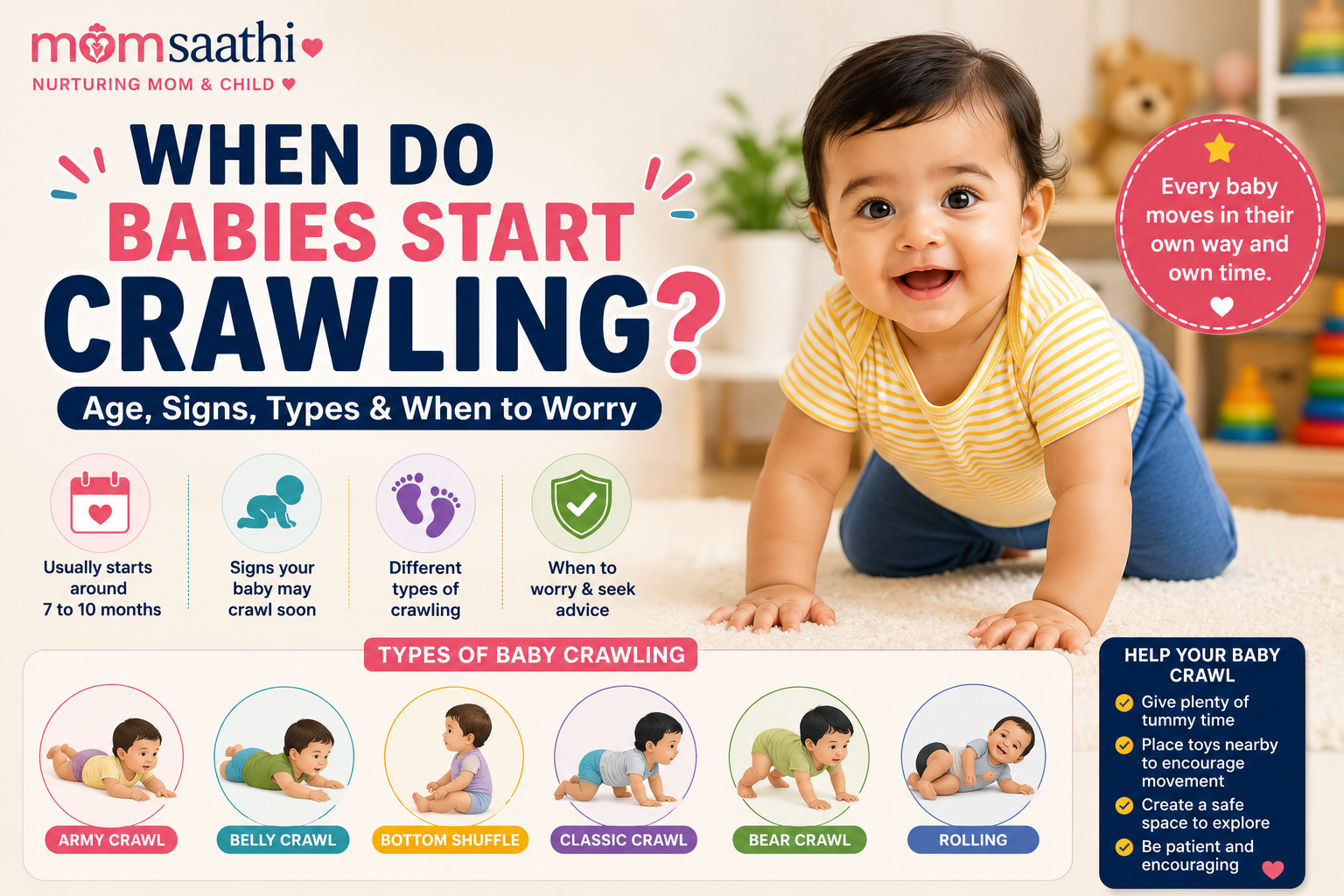
Many babies start crawling at around 7 to 10 months, but there is no single crawling age for every baby. Some babies crawl on their hands and knees, while others belly crawl, bottom shuffle, roll or use another way to move. A few babies never crawl in the typical way at all. The NHS says babies will probably begin crawling at around 7–10 months, although some bottom shuffle instead.
Quick answer: Babies often start crawling around 7 to 10 months. However, crawling styles and timing vary. Some babies use a classic hands-and-knees crawl, while others belly crawl, scoot or shuffle. The American Academy of Pediatrics notes that a few children never crawl and instead use other methods of movement.
When Do Babies Start Crawling?
Many parents expect crawling to happen at exactly 6 or 9 months.
Baby development does not work according to an exact calendar.
The NHS says babies will probably start crawling at around 7 to 10 months, although not all babies crawl and some move by shuffling on their bottoms.
Your baby’s movement journey might look something like this:
tummy time → pushing up → rolling → sitting → reaching → rocking → scooting → crawling
But another baby’s journey might look like:
rolling → sitting → bottom shuffling → pulling to stand
And another baby may:
sit → move on their tummy → pull to stand → walk
There is no rule that every baby must follow exactly the same movement sequence.
The American Academy of Pediatrics’ HealthyChildren movement guide explains that some children never crawl and instead scoot on their bottoms or slither on their stomachs. The important broader question is how the baby moves, coordinates both sides of the body and develops mobility.
If your baby is still developing sitting balance, read MomSaathi’s guide on when babies sit up before comparing crawling progress.
Baby Crawling Age by Month
Parents often search for:
“Should my 7-month-old crawl?”
“Why is my 9-month-old not crawling?”
“Is 10 months too late to crawl?”
The following table gives a general movement overview, not a diagnostic timeline.
| Baby’s Age | Crawling Development You May Notice |
|---|---|
| 4 months | Developing head and upper-body control |
| 5 months | Pushing up and exploring floor movement |
| 6 months | Stronger arm support and developing sitting skills |
| 7 months | May pivot, scoot, move backwards or begin crawling |
| 8 months | Some babies become increasingly mobile |
| 9 months | May crawl, belly crawl, shuffle or use another movement style |
| 10 months | Many babies are actively exploring through movement |
| 11 months | May combine crawling with pulling to stand or cruising |
| 12 months | May crawl, shuffle, cruise or progress towards walking |
Important: Crawling is not listed on the current CDC 9-month milestone checklist. The CDC’s 9-month movement milestones include getting into a sitting position and sitting without support.
Therefore, do not treat:
“My baby is 9 months and not crawling”
as an automatic diagnosis of developmental delay.
Look at the baby’s broader movement development.
What Age Do Babies Crawl?
If you searched “what age do babies crawl?”, the simplest answer is:
Many babies begin crawling around 7 to 10 months, but some start earlier or later and some do not crawl in the traditional hands-and-knees style.
The NHS uses the 7–10 month range as a general guide.
However, “crawling” can describe several ways of moving.
Your baby does not need to look like the crawling baby in a diaper advertisement.
The NHS children’s health guidance describes crawling broadly and includes movements such as:
- belly crawling;
- bottom shuffling;
- rolling.
NHS children’s health guidance on learning to crawl describes crawling as a broad term covering different types of independent movement.
What Happens Before a Baby Starts Crawling?
Crawling may look sudden.
But your baby’s body has often been practising movement skills for months.
Before crawling, you may notice your baby developing:
- head control;
- upper-body strength;
- arm support;
- trunk control;
- sitting balance;
- reaching skills;
- movement coordination.
Your baby may also experiment.
They might push backwards when trying to move forward.
They might rotate in a circle.
They might lift their bottom into the air.
They might rock without going anywhere.
Think of this stage as:
movement experimentation
Your baby is learning what happens when different parts of their body push against the floor.
Signs Your Baby May Crawl Soon
There is no single “crawling readiness test.”
However, you may notice several movement changes before your baby becomes mobile.
1. Pushing Up During Tummy Time
Your baby may begin supporting more of their upper body with their arms.
The current CDC 6-month checklist includes pushing up with straight arms while on the tummy as a movement milestone.
This does not mean crawling comes next week.
But it shows developing upper-body control.
2. Sitting More Steadily
As sitting balance develops, your baby may have greater freedom to reach and change position.
The CDC lists sitting without support and getting into a sitting position as 9-month milestones.
MomSaathi’s guide on when babies sit up explains the progression from supported sitting to independent sitting in detail.
3. Reaching for Toys
Your baby sees a toy.
It is slightly too far away.
They lean.
Stretch.
Push.
That desire to reach an interesting object may encourage movement experimentation.
4. Pivoting on the Tummy
Your baby may turn their body in a circle while lying on their tummy.
They are moving.
Just not in the direction you expected.
5. Moving Backwards
Many parents say:
“My baby is trying to crawl but keeps going backwards!”
This can happen while babies experiment with pushing through their arms and legs.
Backward movement is still movement practice.
6. Rocking on Hands and Knees
Some babies move into a hands-and-knees position and rock backwards and forwards.
They may do this for days or weeks before crawling.
Others never have an obvious rocking stage.
7. Scooting or Wriggling
Your baby may discover that they can move by:
- pushing;
- pulling;
- wriggling;
- shuffling.
The route may look unusual to you.
To your baby, the only question is:
“Did I reach the toy?”
Do Babies Have to Crawl on Hands and Knees?
No.
The classic crawling style is only one way babies may move.
The AAP’s HealthyChildren guidance says a few children never crawl and instead use alternatives such as bottom scooting or stomach slithering.
NHS child development guidance also describes several different crawling and movement patterns.
Some babies may use one style.
Others may switch styles.
Your baby might belly crawl for several weeks and later crawl on hands and knees.
Another baby may bottom shuffle until they begin pulling to stand.
The overall movement pattern matters more than whether your baby performs the “perfect crawl.”
Types of Baby Crawling
Here are some movement styles parents may notice.
| Crawling Style | What It May Look Like |
|---|---|
| Classic crawl | Moving on hands and knees |
| Belly crawl | Tummy stays close to the floor |
| Army or commando crawl | Pulling forward mainly with the arms |
| Bottom shuffle | Moving while sitting |
| Bear crawl | Moving with hands and feet while knees are lifted |
| Crab-like movement | Moving sideways or in an unusual direction |
| Rolling | Using repeated rolling to reach a destination |
| Mixed crawling | Switching between several movement styles |
These descriptions are general.
Do not use the table to diagnose a movement problem.
1. Classic Hands-and-Knees Crawling
This is the crawling style most people imagine.
The baby supports their body on:
- hands;
- knees.
They move their arms and legs to travel across the floor.
The movement may initially look slow and awkward.
Later, your baby may become surprisingly fast.
One day you are encouraging them to reach a toy.
A week later you are saying:
“How did you get into the kitchen?”
Once crawling begins, babyproofing becomes much more urgent.
2. Army Crawling or Commando Crawling
Army crawling is also called:
- commando crawling;
- belly crawling in some descriptions.
Your baby’s tummy stays close to the floor.
They may pull themselves forward mainly using their arms.
NHS children’s health guidance describes the belly crawl as also being called an army crawl, commando crawl or inchworm crawl. It notes that some babies continue belly crawling until they begin walking.
Therefore:
Army crawling does not automatically mean something is wrong.
Watch how your baby uses their body.
If you notice persistent strong asymmetry or have concerns about movement, discuss it with your child’s healthcare professional.
3. Belly Crawling
In a belly crawl, much of your baby’s body remains in contact with the floor.
They may use their arms to pull.
They may push with their legs.
Or use a combination.
Some babies belly crawl before progressing to hands-and-knees crawling.
Others may continue using this movement style.
NHS guidance describes belly crawling as a normal crawling variation.
4. Bottom Shuffling or Bum Scooting
Your baby sits upright.
Then somehow moves across the room while remaining seated.
Welcome to bottom shuffling.
The AAP notes that some babies use bottom scooting instead of crawling.
The NHS also explicitly notes that not all babies crawl and some shuffle around on their bottoms.
Your baby may use:
- their legs;
- their hands;
- twisting movements;
to move while sitting.
If you are concerned about your baby’s overall movement or notice significant one-sided movement, speak with your paediatrician.
5. Bear Crawling
A bear crawl usually describes movement on:
- hands;
- feet;
with the knees lifted away from the floor.
The baby’s bottom may be raised.
Some babies briefly experiment with this position.
Do not force your baby into a bear-crawling posture.
Allow normal floor movement and exploration.
6. Crab Crawling
Parents sometimes describe a baby as “crab crawling” when the baby moves:
- sideways;
- backwards;
- using an unusual combination of limbs.
There is no requirement that a baby’s first independent movement must be perfectly forward.
However, pay attention to movement symmetry.
The AAP advises discussing concerns with a paediatrician if you feel your child is not moving normally and highlights coordination of both sides of the body as important.
7. Rolling Instead of Crawling
Some babies discover a very effective transport system:
roll → roll → roll → toy
NHS children’s health guidance includes rolling within the broad range of ways babies may independently move.
A baby may later crawl.
Or use another method of movement.
Observe your baby’s overall physical development rather than judging one movement style in isolation.
Why Is My Baby Crawling Backwards?
Your baby wants the toy in front of them.
They push.
And move farther away.
This can be frustrating for the baby—and amusing for parents.
Backward movement may happen while a baby is learning how pushing through the arms and legs affects their body.
Your baby is still developing movement coordination.
They may:
- push backwards;
- rotate;
- move sideways;
- eventually discover forward movement.
Do not repeatedly pull your baby forward by the arms.
Give them safe floor space to experiment.
Why Does My Baby Rock on Hands and Knees?
Rocking can happen when a baby gets into a hands-and-knees position.
They move:
forward → backward → forward → backward
without actually travelling.
Your baby may be experimenting with:
- balance;
- weight shifting;
- body position.
Some babies begin crawling after a rocking stage.
Others use another movement pattern.
Do not treat rocking as a countdown timer.
There is no rule that says:
“Baby rocked today, so crawling starts in seven days.”
Can a 6-Month-Old Crawl?
Some babies may begin moving early.
However, the NHS’s general crawling range is around 7–10 months.
At 6 months, many babies are still developing skills such as:
- pushing up;
- rolling;
- supported sitting;
- reaching.
The CDC 6-month movement milestones include pushing up with straight arms while on the tummy and leaning on the hands for support while sitting.
If your 6-month-old is not crawling, that alone is not a reason to assume a developmental problem.
Is It Normal for a 7-Month-Old Not to Crawl?
Yes, a 7-month-old may not yet be crawling.
The NHS says babies will probably begin crawling around 7–10 months, but the timing and movement style vary.
Your 7-month-old may instead be:
- sitting;
- rolling;
- pivoting;
- reaching;
- moving backwards.
Look at the broader movement picture.
If you have concerns about how your baby moves, ask your child’s doctor.
Is It Normal for an 8-Month-Old Not to Crawl?
An 8-month-old who is not crawling may still be developing mobility.
Some babies may:
- belly crawl;
- bottom shuffle;
- roll;
- move backwards.
Others may not yet move far independently.
The AAP notes that some children never use typical crawling at all.
Do not use another baby’s crawling age as your baby’s developmental assessment.
However, if you notice unusual stiffness, floppiness, marked asymmetry or loss of skills, discuss your concerns with a healthcare professional.
Is It Normal for a 9-Month-Old Not to Crawl?
This is one of the most important sections of the article.
Crawling is not listed as a 9-month milestone on the current CDC checklist.
The CDC’s 9-month movement milestones include:
- getting into a sitting position;
- sitting without support.
Therefore:
A 9-month-old not crawling is not automatically “delayed” based solely on the CDC milestone checklist.
Your baby may:
- scoot;
- shuffle;
- belly crawl;
- roll;
- begin pulling towards objects.
Look at the overall movement pattern.
If your baby is not meeting one or more CDC milestones, has lost a skill or you have other concerns, discuss them with your child’s doctor.
My 10-Month-Old Is Not Crawling: Should I Worry?
At 10 months, some babies may already crawl quickly.
Others may use a different movement style.
Ask:
- Does my baby sit independently?
- Does my baby reach for toys?
- Does my baby move in another way?
- Does my baby use both sides of the body?
- Is my baby’s movement progressing?
The AAP explains that some children never crawl and instead use alternative methods of mobility.
However, you do not need to wait for an arbitrary deadline if you are concerned.
Speak with your paediatrician.
A healthcare professional can assess your baby’s overall motor development rather than one isolated skill.
My Baby Is Not Crawling at 12 Months
The NHS advises seeking advice if a baby isn’t showing any signs of moving by 12 months.
Notice the wording:
not showing any signs of moving
This is broader than:
not classic crawling
A baby may move by:
- bottom shuffling;
- belly crawling;
- rolling;
- another method.
If your 12-month-old is not showing signs of independent movement, discuss this with your child’s healthcare professional.
Also seek advice earlier if you have concerns about:
- muscle tone;
- movement symmetry;
- loss of skills;
- broader development.
Can Babies Skip Crawling?
Yes. Some babies do not crawl in the traditional hands-and-knees style.
The AAP’s HealthyChildren movement guidance says a few children never crawl and instead use alternative methods such as bottom scooting or slithering on their stomachs.
The AAP also directly addresses concerns about skipping crawling and explains that babies do not always follow the same developmental sequence.
Therefore:
Skipping classic crawling does not automatically mean your baby has a developmental problem.
The more useful questions are:
- How does your baby move?
- Is movement progressing?
- Does your baby use both sides of the body?
- Are other developmental skills progressing?
If something concerns you, discuss it with your paediatrician.
Does Skipping Crawling Cause Learning Problems?
Parents sometimes hear:
“If your baby skips crawling, they will have reading problems later.”
This claim can create unnecessary worry.
The American Academy of Pediatrics has specifically addressed this question. Its HealthyChildren guidance says babies do not always follow the same developmental playbook and may master skills in a different order.
Do not diagnose a future learning problem because your baby bottom shuffled instead of crawling.
Development should be assessed based on the child’s overall progress.
How to Help a Baby Crawl
You cannot force a baby to crawl.
But you can create safe opportunities for movement.
1. Give Your Baby Floor Time
A safe floor area gives your baby room to:
- roll;
- push;
- reach;
- pivot;
- change position.
Your baby needs opportunities to move their own body.
2. Continue Supervised Tummy Time
Tummy time gives babies opportunities to practise upper-body movement.
The CDC’s 6-month milestone checklist includes pushing up with straight arms while on the tummy.
Tummy time should happen:
- while the baby is awake;
- under supervision.
Babies should still be placed on their backs for sleep according to safe sleep guidance.
3. Place an Interesting Toy Nearby
Place a favourite toy slightly out of reach.
The goal is to encourage exploration.
Not frustration.
If the toy is placed across the room, your baby may simply cry.
Try:
close enough to be interesting, far enough to encourage movement
4. Get on the Floor With Your Baby
Sometimes you are more interesting than the toy.
Sit or lie nearby.
Talk.
Smile.
Encourage your baby to move towards you.
5. Allow Movement Experimentation
Your baby may move backwards.
Let them experiment.
They may rotate.
Let them experiment.
They may scoot.
Movement learning can look messy.
6. Avoid Turning Crawling Into a Test
Do not repeatedly say:
“Come on! Crawl!”
while moving the toy farther away every time your baby reaches it.
Developmental play should not become a performance test.
Baby Crawling Exercises: What Can Parents Do?
Parents frequently search for baby crawling exercises.
A better approach is to think about movement play.
Try simple activities such as:
Supervised Tummy Play
Place your baby on their tummy while awake and supervised.
Toy Reaching
Place an age-appropriate toy nearby.
Floor Exploration
Create a safe space for rolling, pivoting and movement.
Parent-to-Baby Play
Sit a short distance away and interact with your baby.
Position Changes
Allow your baby opportunities to move between positions according to their current ability.
If your baby has a diagnosed developmental or physical condition, ask their healthcare team or paediatric physiotherapist for individual activities.
Do not copy therapeutic exercises from a random social media video.
Should I Put My Baby’s Hands and Knees Into Crawling Position?
You may gently support your baby during age-appropriate play.
But repeatedly forcing a baby into a hands-and-knees position does not guarantee earlier crawling.
Your baby needs to develop active:
- balance;
- strength;
- coordination;
- movement control.
If your baby cannot maintain a position, return to floor activities appropriate for their current abilities.
If you are concerned about your baby’s motor development, ask a healthcare professional for personalised guidance.
Are Baby Walkers Good for Crawling?
A seated baby walker does not teach a baby to crawl.
More importantly, baby walkers with wheels raise safety concerns.
The American Academy of Pediatrics has long called for a ban on mobile infant walkers because of injury risk.
For movement development, focus on safe floor play.
Do not use a wheeled walker as a crawling training device.
Crawling and Babyproofing: What Parents Must Check
Do not wait until your baby performs a perfect crawl.
If your baby can:
- roll;
- scoot;
- shuffle;
- wriggle;
they may already reach areas you considered “safe.”
Once mobility begins:
- Cover or secure accessible electrical hazards appropriately.
- Keep medicines out of reach and securely stored.
- Keep cleaning products locked away.
- Remove small choking hazards from the floor.
- Secure unstable furniture where appropriate.
- Use safety gates according to manufacturer instructions.
- Keep hot drinks away from edges.
- Check blind and curtain cords.
- Keep your baby away from stairs.
- Never leave a mobile baby unattended near water.
The NHS recommends creating a safe space for babies to explore once crawling begins.
The biggest babyproofing mistake is thinking:
“My baby cannot reach that yet.”
Mobility can change quickly.
Baby Crawling on Hard Floors
A baby may crawl on:
- tile;
- wooden flooring;
- mats;
- carpet.
The priority is a clean, safe surface free from:
- sharp objects;
- small choking hazards;
- dangerous items.
You do not need to put your baby in knee pads simply because they crawl.
Watch your baby’s skin and comfort.
Avoid slippery clothing that makes movement unnecessarily difficult.
In Indian homes with tile or stone floors, also check that the surface is not excessively slippery and that nearby furniture edges are safe.
Should Babies Wear Shoes While Crawling?
Babies generally do not need outdoor-style shoes for indoor floor crawling.
Your baby’s feet need freedom to move during floor play.
Use clothing appropriate for:
- temperature;
- floor surface;
- safety.
When your child progresses towards walking, footwear decisions may depend on where they are walking.
We will cover this separately in MomSaathi’s upcoming “When Do Babies Start Walking?” guide.
Crawling and Premature Babies
If your baby was born prematurely, developmental progress may sometimes be considered using corrected age.
Tell your baby’s healthcare professional:
- gestational age at birth;
- expected due date;
when discussing developmental milestones.
Do not directly compare a baby born significantly prematurely with a full-term baby of the same chronological age without considering medical guidance.
Your paediatrician can explain how corrected age applies to your baby’s motor development.
Why Is My Baby Using One Leg More While Crawling?
Babies may experiment with unusual movement styles.
However, persistent movement asymmetry deserves attention.
The AAP’s HealthyChildren guidance says that as long as a baby is coordinating both sides of the body and using each arm and leg equally, alternative methods of movement are generally not a cause for concern. It advises discussing concerns if you feel your child is not moving normally.
Speak with your child’s healthcare professional if you notice:
- persistent dragging of one limb;
- one side doing most of the movement;
- significant differences between the two sides;
- loss of a previously used movement.
Do not diagnose the cause yourself.
My Baby Was Crawling and Stopped Crawling
Loss of a previously acquired skill needs medical attention.
If your baby was crawling or moving in a particular way and has stopped using a skill they previously had, contact your child’s healthcare professional.
The CDC advises parents to act early if a child has lost skills they once had.
Tell the doctor:
- what your baby could do before;
- when the change started;
- whether the change was sudden;
- whether your baby has other symptoms.
Do not simply wait for the skill to return if you are concerned about developmental regression.
When Should You Worry About a Baby Not Crawling?
Not crawling at one exact month is not the only issue to consider.
Talk to your child’s healthcare professional if:
- your baby has lost a movement skill;
- your baby is not meeting one or more developmental milestones;
- your baby seems unusually stiff or floppy;
- your baby consistently uses one side much more than the other;
- your baby drags a limb;
- you are concerned about your baby’s movement;
- your baby is not showing signs of moving by 12 months.
The NHS specifically advises seeking guidance if a baby is not showing any signs of moving by 12 months.
The AAP also advises discussing concerns when a baby does not appear to be moving normally.
You do not need to wait until your baby’s first birthday if something concerns you.
Baby Crawling Milestones: Myths vs Facts
| Myth | Fact |
|---|---|
| Every baby crawls at 6 months | Many babies start around 7–10 months |
| A 9-month-old must crawl | Crawling is not on the current CDC 9-month milestone checklist |
| All babies crawl on hands and knees | Babies may belly crawl, scoot or shuffle |
| Bottom shuffling is not movement | Some babies use bottom shuffling to move |
| Crawling backwards means something is wrong | Babies may move backwards while experimenting |
| Every baby must crawl before walking | Some babies skip classic crawling |
| Skipping crawling causes reading problems | AAP guidance does not support assuming this |
| Parents can force a baby to crawl earlier | Development depends on the baby’s active motor control |
| A baby walker teaches crawling | A seated wheeled walker is not a crawling tool |
| Parents should ignore movement concerns | Developmental concerns should be discussed with a healthcare professional |
MomSaathi’s Crawling Readiness Checklist
Ask yourself:
1. Is my baby developing head and upper-body control?
These skills support floor movement.
2. Does my baby push up during tummy time?
Pushing up with straight arms is on the CDC 6-month milestone checklist.
3. Can my baby reach for toys?
Reaching may encourage movement experimentation.
4. Does my baby pivot, roll or scoot?
These are forms of movement exploration.
5. Is my baby sitting more steadily?
Sitting without support is a CDC 9-month milestone.
6. Does my baby rock on hands and knees?
Some babies do this before crawling.
7. Does my baby move in another way?
Bottom shuffling and belly movement can be alternative mobility patterns.
8. Does my baby use both sides of the body?
Persistent strong asymmetry should be discussed with a healthcare professional.
9. Has my baby lost a movement skill?
Contact your child’s healthcare professional.
10. Am I concerned about my baby’s development?
Ask your paediatrician rather than waiting for an arbitrary crawling deadline.
Frequently Asked Questions About When Babies Start Crawling
When do babies start crawling?
Many babies start crawling at around 7 to 10 months. However, some babies begin earlier or later, and not all babies use a traditional crawling style.
What age do babies crawl?
The NHS says babies will probably start crawling around 7–10 months. Some babies bottom shuffle instead of crawling.
What are the signs a baby will crawl soon?
Possible signs include pushing up during tummy time, reaching for toys, pivoting, scooting, moving backwards and rocking on hands and knees. Not every baby shows all these signs.
Do babies crawl at 6 months?
Some babies may begin moving early, but many are still developing upper-body and sitting control at 6 months. The NHS gives around 7–10 months as a general crawling range.
Is it normal for a 7-month-old not to crawl?
Yes. Seven months is at the beginning of the NHS’s general 7–10 month crawling range, and crawling development varies.
Is it normal for an 8-month-old not to crawl?
An 8-month-old may still be developing mobility or may move by scooting, rolling or belly crawling. Some children never use classic crawling.
Should a 9-month-old be crawling?
Crawling is not listed on the current CDC 9-month milestone checklist. The movement milestones listed include getting into sitting and sitting without support.
What is army crawling?
Army or commando crawling describes movement with the baby’s tummy close to the floor, often using the arms to pull forward. NHS children’s health guidance describes this as a normal crawling variation.
Is belly crawling normal?
Yes. NHS children’s health guidance describes belly crawling as a normal crawling variation. Some babies may belly crawl until they begin walking.
Is bottom shuffling normal?
Some babies use bottom shuffling instead of traditional crawling. Both the NHS and AAP describe bottom shuffling or scooting as an alternative way babies may move.
Why is my baby crawling backwards?
Babies may move backwards while experimenting with pushing through their arms and legs. They are still developing movement coordination.
Why does my baby rock on hands and knees?
Rocking may happen while a baby experiments with balance and weight shifting. Some babies later crawl, while others use another movement style.
Can babies skip crawling?
Yes. The AAP notes that a few children never crawl and instead use alternative methods such as bottom scooting or slithering on the stomach.
Does skipping crawling cause learning problems?
The AAP explains that babies do not always follow the same developmental sequence and may master skills in a different order. Skipping crawling alone should not be used to predict future reading problems.
How can I help my baby crawl?
Provide supervised tummy time, safe floor play and age-appropriate opportunities to reach and move towards interesting objects. Do not force your baby into a crawling position.
When should I worry if my baby is not crawling?
The NHS advises seeking guidance if your baby is not showing any signs of moving by 12 months. Seek advice earlier for loss of skills, significant movement asymmetry or other developmental concerns.
Final Thoughts
So, when do babies start crawling?
Many babies begin crawling at around 7 to 10 months.
But crawling does not always look like:
right hand → left knee → left hand → right knee
Your baby may:
belly crawl → bottom shuffle → scoot → roll → use another movement style
The NHS notes that not all babies crawl and some move by bottom shuffling.
The AAP also explains that a few children never crawl and instead use alternative ways to move.
Most importantly, crawling is not on the current CDC 9-month milestone checklist. At 9 months, the CDC lists getting into a sitting position and sitting without support among its movement milestones.
Therefore, do not panic because:
“My neighbour’s baby crawled at 7 months and mine is 9 months.”
Instead, observe your baby’s overall movement.
Are they developing new skills?
Do they use both sides of their body?
Are they finding ways to explore?
And if your baby loses a skill, shows significant movement asymmetry, is not showing signs of moving by 12 months, or you have concerns about development, discuss them with your child’s healthcare professional.
Your baby’s first route across the room may not look like a textbook crawl.
But once they discover a way to reach the TV remote?
Babyproofing becomes your next developmental milestone.