
Medical note: This article provides general pregnancy information and does not replace personalised obstetric advice. If you are worried about your baby’s movements, contact your obstetrician, midwife or maternity unit rather than relying only on online information.
You are 20 weeks pregnant and not feeling your baby move.
Your anomaly scan may be approaching—or perhaps you have already seen your baby moving on the ultrasound—but you still cannot feel those expected little kicks.
Naturally, you may wonder:
Is it normal to be 20 weeks pregnant and feel no movement?
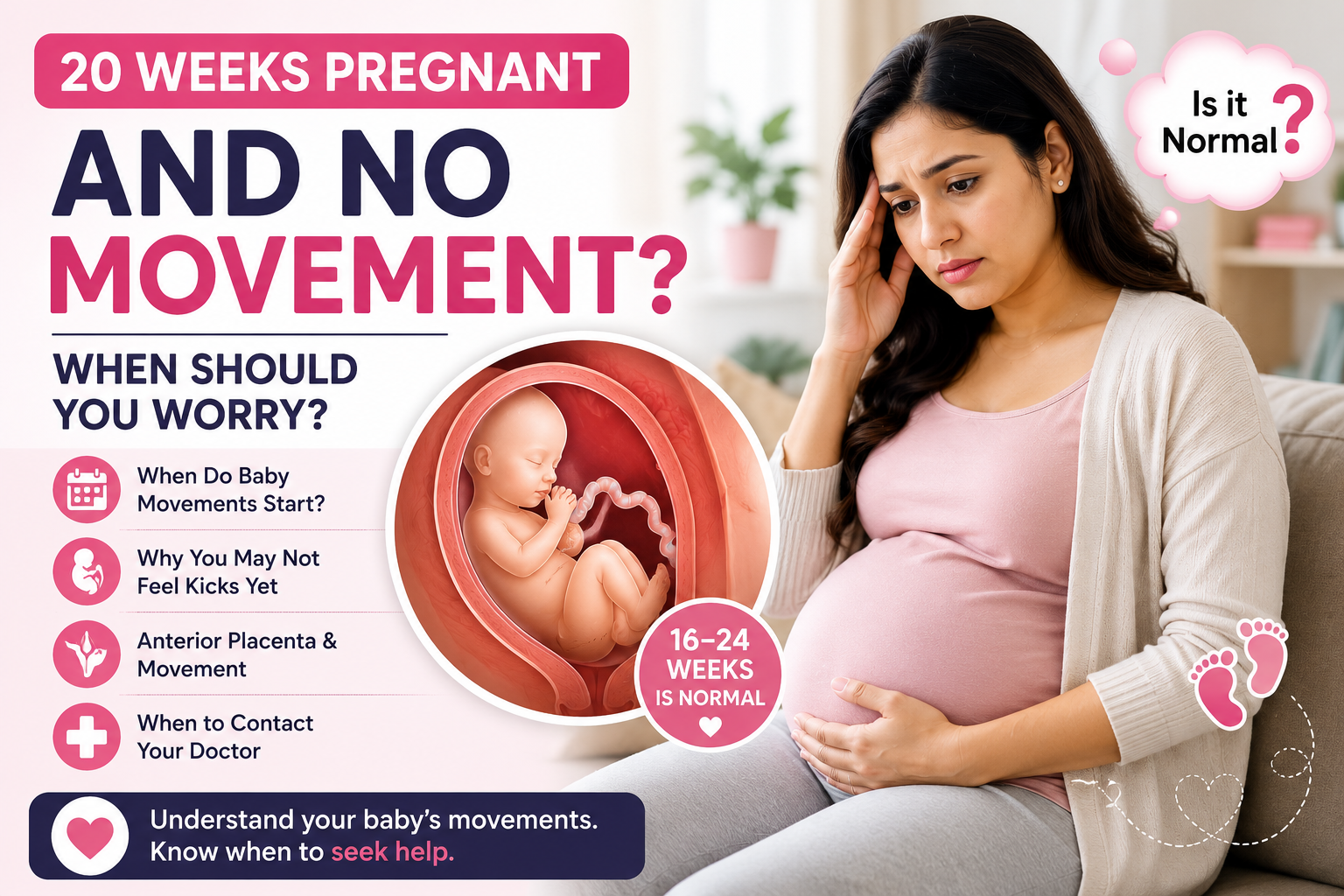
Yes, not feeling your baby move at exactly 20 weeks can still be normal, particularly during a first pregnancy or if you have an anterior placenta. Most pregnant women begin feeling fetal movements between 16 and 24 weeks, and first-time mothers may not notice movements until after 20 weeks.
However, there is an important difference between never having felt your baby move yet and previously feeling regular movements that have now reduced or changed.
Quick answer: If you are 20 weeks pregnant and have never felt your baby move, this can still fall within the usual 16–24-week range. If you have previously felt movements and they are now reduced, absent or noticeably different from your baby’s usual pattern, contact your maternity care team promptly.
Is It Normal to Feel No Baby Movement at 20 Weeks?
It can be normal not to feel clear baby movements at exactly 20 weeks.
According to NHS guidance on your baby’s movements, most pregnant women begin feeling their baby move between 16 and 24 weeks.
If this is your first pregnancy, you may not feel movements until after 20 weeks.
The RCOG guidance on baby movements in pregnancy similarly states that most women first become aware of their baby moving at around 18–20 weeks. Women who have been pregnant before may recognise movements as early as 16 weeks.
Baby Movement Timeline at a Glance
| Pregnancy Week | What You May Notice |
|---|---|
| 16 weeks | Some women may notice very early flutters |
| 17–18 weeks | Subtle bubbles, flickers or swishes may begin |
| 18–20 weeks | Many women first recognise baby movement |
| 20–22 weeks | Movements may become easier to identify |
| 22–24 weeks | More women begin recognising their baby’s movements |
| By 24 weeks | Contact your maternity professional if you have never felt movement |
This is a general timeline, not a deadline for every pregnant woman.
Pregnancies differ.
The baby’s position, placenta location and whether this is your first pregnancy can all affect when you first recognise movements.
What Does Baby Movement Feel Like at 20 Weeks?
If you are waiting for a dramatic kick, you may already be feeling your baby without realising it.
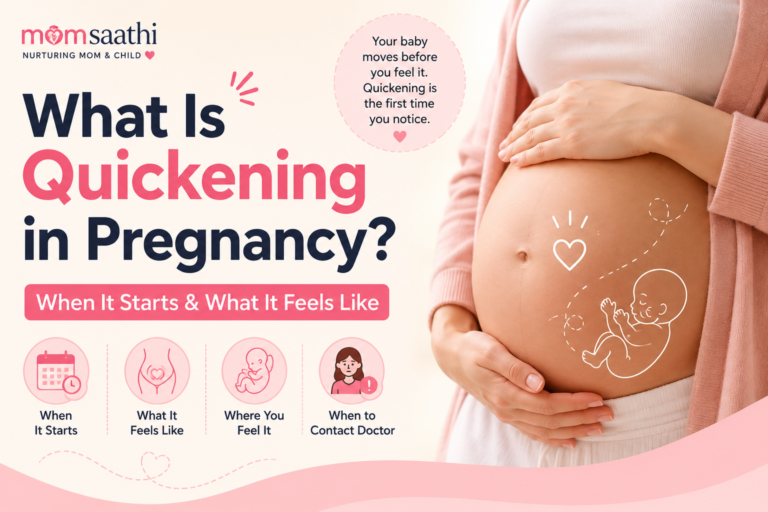
The first fetal movements are called quickening.
Early movements do not always feel like kicks.
They may feel like:
- bubbles in your belly;
- gentle fluttering;
- tiny taps;
- flickering;
- a swishing sensation;
- a small muscle twitch;
- a rolling sensation;
- popcorn popping;
- a fish moving inside your abdomen.
The RCOG describes baby movements as sensations such as a kick, flutter, swish or roll.
At 20 weeks, movements may be subtle.
You may even think:
“Was that my baby or was it gas?”
This is especially common during a first pregnancy because you do not yet know what fetal movement feels like.
As pregnancy progresses, the sensations usually become easier to recognise.
As pregnancy progresses, flutters may become more recognisable as kicks, rolls and stretches. Our guide to baby kicks during pregnancy explains when movements usually begin and how they may change through pregnancy.
Why Am I 20 Weeks Pregnant and Not Feeling Baby Move?
There are several possible reasons you may not yet recognise baby movement at 20 weeks.
1. This Is Your First Pregnancy
First-time mothers may notice fetal movements later.
The NHS notes that if this is your first baby, you may not feel movement until after 20 weeks.
During a second or subsequent pregnancy, you may recognise those early flutters sooner because you already know what they feel like.
This does not mean the baby in a first pregnancy is necessarily moving less.
You may simply not recognise the sensations yet.
2. You Have an Anterior Placenta
An anterior placenta means the placenta is attached to the front wall of the uterus.
The placenta is positioned between your baby and the front of your abdomen.
This can cushion some fetal movements.
The 2026 RCOG Green-top Guideline notes that, before 28 weeks, an anterior placenta may reduce a woman’s perception of fetal movements.
If your anomaly scan or ultrasound report says:
Placenta: Anterior
this may help explain why early kicks are more difficult to perceive.
Read MomSaathi’s complete Anterior Placenta: Meaning, Baby Movements, Risks & Delivery guide for a detailed explanation of how placental position can affect movement perception.
Important: An anterior placenta may affect how movements feel, but it should not be used to dismiss a later reduction or change in your baby’s established movement pattern.
If your ultrasound report describes the placenta on the back wall of the uterus, read our guide to posterior placenta in pregnancy and how placental location may influence the way early movements are perceived.
3. Your Baby’s Movements Are Still Very Gentle
Your baby has been moving before you can actually feel those movements.
At around 18 weeks, the NHS notes that the baby has already been moving for the previous couple of months, although you may not yet have noticed it.
At 20 weeks, the baby is still relatively small.
Some movements may therefore be too subtle for you to perceive clearly.
As pregnancy progresses, the movements often become stronger and more recognisable.
4. You May Be Mistaking Movement for Gas
Early fetal movement can feel surprisingly similar to digestive sensations.
You may think you are experiencing:
- gas bubbles;
- digestion;
- muscle twitches.
Then, a few weeks later, the sensation becomes stronger and you realise:
“That was the baby.”
This is why many women find it difficult to identify the exact date of their first fetal movement.
5. Your Baby’s Position May Affect What You Feel
The baby’s position can influence where movements are perceived.
Depending on the baby’s position, you may notice movement:
- low in your abdomen;
- at the sides;
- close to the pelvis;
- around the belly button later in pregnancy.
If movements are directed towards an area where the placenta provides cushioning, they may feel less obvious.
Your baby’s position can also change.
Therefore, you may feel movement clearly one day in one area and later notice sensations somewhere else.
6. You Are Busy During the Day
Subtle fetal movements may be easier to miss when you are:
- walking;
- travelling;
- working;
- caring for another child;
- exercising;
- focused on daily tasks.
This does not mean you should use a home activity test to assess your baby’s wellbeing.
It simply means that very early, subtle sensations can be difficult to identify when your attention is elsewhere.
20 Weeks Pregnant With No Movement in First Pregnancy
If this is your first pregnancy, not feeling definite baby movements at 20 weeks can still fall within the expected range.
The NHS specifically says first-time mothers may not feel their baby move until after 20 weeks.
Why?
One reason is recognition.
A woman who has been pregnant before may immediately identify a tiny flutter as fetal movement.
A first-time mother may think:
“That was probably gas.”
You may not confidently identify the sensation until movements become stronger.
What Should You Do?
Continue attending your scheduled antenatal appointments.
If you have never felt your baby move by 24 weeks, contact your midwife, obstetrician or maternity unit. NHS and RCOG guidance recommends assessment in this situation.
If you are worried before 24 weeks, you do not need to wait for a calendar deadline before discussing your concern with your maternity professional.
20 Weeks Pregnant, No Movement and Anterior Placenta
This is a very common search concern.
You have had your ultrasound.
Your report says:
Anterior placenta
And now you are 20 weeks pregnant but cannot feel clear kicks.
An anterior placenta can make early fetal movements harder to perceive because the placenta may cushion sensations towards the front of the abdomen. Current RCOG guidance recognises reduced maternal perception of movement with an anterior placenta before 28 weeks.
You may notice movement more clearly:
- at the sides of your abdomen;
- lower in the belly;
- in areas not directly cushioned by the placenta.
However, every pregnancy is different.
Do not compare your exact movement timeline with another pregnant woman.
Important: Once you become familiar with your baby’s movement pattern, a noticeable reduction or change should not simply be blamed on an anterior placenta.
Read MomSaathi’s Anterior Placenta guide to understand placental position, baby kicks and delivery in detail.
Can the Baby Be Moving Even If I Cannot Feel It?
Yes.
Your baby can move before you are able to perceive those movements.
The NHS’s week-18 pregnancy guidance explains that the baby has already been moving for months before some pregnant women begin noticing bubbling or fluttering sensations.
During an ultrasound, you may even see your baby:
- moving arms;
- changing position;
- stretching;
- moving legs
without feeling every movement yourself.
This can seem strange.
But visible fetal movement on an ultrasound and maternal perception of movement are not exactly the same thing.
Factors such as gestational age and placental position can affect what you feel.
Is No Movement at 20 Weeks a Sign of Miscarriage?
Not feeling movement at exactly 20 weeks does not, by itself, mean you have had a miscarriage or pregnancy loss.
There is a broad normal range for first recognising fetal movements.
Most women begin feeling movements between 16 and 24 weeks.
However, online articles cannot assess fetal wellbeing.
If you are experiencing concerning symptoms such as:
- vaginal bleeding;
- severe abdominal pain;
- fluid leakage;
- feeling very unwell;
- or any other urgent pregnancy concern,
contact your healthcare professional or maternity service.
If you are worried about your baby’s movements, seek professional advice.
Do not try to diagnose pregnancy loss based on a Google search or one symptom.
What Happens at the 20-Week Anomaly Scan?
Around this stage of pregnancy, you may have your 20-week screening or anomaly scan.
According to the NHS, the 20-week screening scan is usually performed between 18 and 21 weeks of pregnancy. It checks the baby’s development and growth and screens for specified physical conditions.
During the scan, the ultrasound professional may assess various fetal structures and pregnancy findings.
Your report may contain terms such as:
- BPD;
- HC;
- AC;
- FL;
- fetal heart activity;
- amniotic fluid;
- placenta anterior;
- placenta posterior;
- cervical findings.
These abbreviations can be confusing when you see them for the first time.
Read MomSaathi’s Anomaly Scan Report: Meaning, Results and Normal Findings guide to understand common scan terms and fetal measurements.
Can the Scan Show the Baby Moving?
Yes.
You may see fetal movement during the ultrasound even if you have not yet clearly felt it.
However, your healthcare professional should interpret your scan findings.
Do not use a scan image or report in isolation to self-diagnose a pregnancy concern.
If terms such as BPD, HC, AC, FL or placental position appear on your ultrasound report, use our anomaly scan report guide to understand the common measurements and findings.
No Movement at 20 Weeks but Heartbeat Is Normal
You may have recently had an antenatal appointment where your baby’s heartbeat was assessed.
Yet you still cannot feel movement.
At 20 weeks, it may still be early for some women to recognise fetal movement clearly, particularly during a first pregnancy or with an anterior placenta.
However, a previously detected heartbeat does not mean you should ignore future pregnancy concerns.
If you are worried about movement, contact your maternity professional.
Do not rely on a previous appointment as a guarantee that every future symptom is normal.
No Movement at 20 Weeks but Baby Was Moving on Ultrasound
This can happen.
An ultrasound may show the baby moving even when you cannot feel the movement externally.
Remember:
Fetal movement is what the baby is doing.
Movement perception is what you can feel.
At this stage, your baby may move without every action creating a sensation you recognise.
An anterior placenta may further cushion some movements.
As your baby grows, movements may become easier to identify.
Should I Count Kicks at 20 Weeks?
At 20 weeks, many women are still learning to recognise fetal movements.
There is no universal number of normal movements that every baby must make at this stage.
The NHS emphasises getting to know your baby’s usual pattern of movement rather than relying on a set number that applies to every pregnancy.
Do not compare your baby with:
- a pregnancy app;
- a friend’s pregnancy;
- a social media post;
- another mother’s kick count.
Your healthcare provider may give you specific movement-monitoring advice based on your pregnancy and local clinical practice.
Follow that advice.
Is 10 Kicks in 2 Hours Necessary at 20 Weeks?
You may see the phrase:
“10 kicks in 2 hours”
online.
Do not automatically apply a later-pregnancy kick-counting rule to yourself at 20 weeks without guidance from your maternity professional.
At 20 weeks, you may only recently have started noticing movement.
The NHS does not recommend a fixed number of kicks that every baby should make each day. Instead, it advises becoming familiar with your baby’s normal pattern.
If your healthcare provider has given you a specific fetal movement monitoring plan, follow their instructions.
Can I Make My Baby Move at 20 Weeks?
You may find many online suggestions such as:
“Drink cold water.”
“Eat something sweet.”
“Lie on your left side.”
“Play music.”
These should not be used as a substitute for professional assessment when you are concerned about your baby’s movements.
The NHS specifically advises against trying to make the baby move before seeking help when movements are reduced or changed.
Do not delay contacting your maternity service because you are waiting for:
- juice to work;
- chocolate to work;
- cold water to work;
- a home Doppler result.
If you have a movement concern, seek professional advice.
Can I Use a Home Doppler If I Feel No Movement?
A home fetal Doppler is not a reliable way to assess your baby’s wellbeing.
The NHS advises not to use a home Doppler to check the baby’s heartbeat when you are concerned about movements. Even if you hear a heartbeat, this does not mean the baby is well.
There is also a risk that an untrained person may mistake:
- their own pulse;
- placental blood flow;
- another sound
for the baby’s heartbeat.
MomSaathi safety note: Do not use a home Doppler to reassure yourself after a noticeable reduction or change in fetal movements.
Contact your maternity care provider.
Never Felt Baby Move vs Reduced Baby Movements
This distinction is extremely important.
| Situation | Meaning |
|---|---|
| 20 weeks and never felt movement | May still be within the usual first-movement window |
| First pregnancy and no movement at 20 weeks | May still be normal |
| Anterior placenta and subtle movement | Placenta may cushion movement perception |
| Never felt movement by 24 weeks | Contact maternity professional |
| Previously felt movements, now noticeably reduced | Contact maternity team promptly |
| Usual movement pattern has changed | Seek maternity advice promptly |
| Cannot feel movements you normally feel | Do not wait until the next day |
The NHS says that if your baby is moving less than usual, you cannot feel movement anymore, or the usual pattern changes, you should contact your maternity service immediately and not wait until the next day.
This advice is different from a 20-week pregnant woman who has never yet confidently identified quickening.
When Should I Worry About No Movement at 20 Weeks?
Contact your healthcare professional whenever you are concerned.
You should particularly seek advice if:
- you previously felt your baby moving and movements have now reduced;
- you cannot feel movements you normally notice;
- your baby’s usual movement pattern has changed;
- you have vaginal bleeding;
- you have severe abdominal pain;
- you have fluid leakage;
- you feel significantly unwell;
- you have another urgent pregnancy concern.
If you have never felt your baby move by 24 weeks, NHS and RCOG guidance advises contacting your maternity professional.
Do not wait until your next routine appointment if your baby’s established movements have reduced or changed.
What Will the Doctor Do If I Have Not Felt Movement?
The assessment will depend on:
- your gestational age;
- whether you have ever felt movement;
- your pregnancy history;
- other symptoms;
- local maternity protocols.
For a woman who has never felt fetal movement by 24 weeks, RCOG patient guidance says the maternity professional should check the baby’s heartbeat. An ultrasound may be arranged, and specialist fetal medicine assessment may sometimes be considered.
Your healthcare team may ask questions such as:
- How many weeks pregnant are you?
- Have you ever felt your baby move?
- When did you last notice movement?
- Has the usual pattern changed?
- Do you have bleeding?
- Do you have pain?
- Is there fluid leakage?
Answer as accurately as you can.
You do not need to know the medical cause before asking for help.
Baby Movement at 20 Weeks With Posterior Placenta
A posterior placenta is attached to the back wall of the uterus.
Some women with a posterior placenta may notice front-directed movements more easily because the placenta is not positioned between the baby and the front abdominal wall.
However, having a posterior placenta does not create a guaranteed week when you must feel movement.
You may still recognise movements earlier or later than another pregnant woman.
Placental position is only one factor.
Internal linking recommendation: Link here to your MomSaathi Posterior Placenta article using the anchor text “posterior placenta in pregnancy.”
Baby Movement at 20 Weeks With Anterior vs Posterior Placenta
| Feature | Anterior Placenta | Posterior Placenta |
|---|---|---|
| Placenta location | Front uterine wall | Back uterine wall |
| Early movement perception | May be cushioned | May sometimes be easier to notice |
| Baby still moves? | Yes | Yes |
| Normal placental position? | Usually | Usually |
| Exact movement week guaranteed? | No | No |
| Reduced established movements should be ignored? | No | No |
Neither placental position gives you permission to ignore a meaningful change in your baby’s usual movement pattern.
What Baby Movements May Feel Like From 20 to 24 Weeks
Between 20 and 24 weeks, movements may gradually become easier to identify.
At 20 Weeks
You may notice:
- flutters;
- bubbles;
- tiny taps.
Or you may not yet confidently recognise movement.
At 21 Weeks
Some movements may feel more distinct.
You may begin noticing repeated sensations.
At 22 Weeks
You may become more confident that a sensation is the baby rather than digestion.
At 23 Weeks
Movements may feel stronger, although individual experiences vary.
At 24 Weeks
Many pregnant women have begun recognising fetal movements.
If you have never felt your baby move by 24 weeks, contact your maternity professional.
This timeline is descriptive.
It is not a diagnostic chart.
20 Weeks Pregnant and No Movement: Myths vs Facts
| Myth | Fact |
|---|---|
| Everyone feels kicks by 20 weeks | First movement may occur between 16 and 24 weeks |
| No kick at 20 weeks always means a problem | It can still fall within the usual range |
| Baby movement always feels like kicking | Early movement may feel like bubbles or flutters |
| Anterior placenta means the baby does not move | It may cushion your perception of movement |
| A normal scan means future movement changes can be ignored | New concerns should still be assessed |
| Drink cold water before calling the doctor | Do not delay professional advice for movement concerns |
| Home Doppler proves the baby is fine | A home Doppler cannot assess fetal wellbeing |
| Every baby must move the same number of times | Babies have individual movement patterns |
MomSaathi’s 20-Week Movement Checklist
If you are 20 weeks pregnant and not feeling baby movement, ask yourself:
1. Have I ever felt my baby move?
Never feeling movement yet is different from movements that have stopped or reduced.
2. Is this my first pregnancy?
First-time mothers may recognise movement later.
3. Do I have an anterior placenta?
This may cushion early movement perception.
4. Am I sure I know what early movement feels like?
Quickening can feel like bubbles, flutters, swishes or tiny taps.
5. Have movements I previously felt changed?
If yes, contact your maternity care team promptly.
6. Am I approaching 24 weeks without ever feeling movement?
Contact your maternity professional if you have not felt your baby move by 24 weeks.
7. Am I worried?
You can contact your healthcare professional for advice before 24 weeks if you have concerns.
Frequently Asked Questions
Is it normal to be 20 weeks pregnant and feel no movement?
Yes, it can still be normal. Most pregnant women begin feeling their baby move between 16 and 24 weeks, and first-time mothers may not notice movements until after 20 weeks.
Why am I 20 weeks pregnant and not feeling baby move?
Possible reasons include being in your first pregnancy, having an anterior placenta, not yet recognising subtle quickening sensations or the baby’s position affecting where movements are felt.
Should I worry if I haven’t felt my baby move at 20 weeks?
Not necessarily. Twenty weeks can still fall within the normal first-movement window. However, contact your maternity professional if you are worried. If you have never felt movement by 24 weeks, seek advice.
Is no movement at 20 weeks normal in a first pregnancy?
It can be. The NHS says women having their first baby may not feel movements until after 20 weeks.
Can an anterior placenta cause no movement at 20 weeks?
An anterior placenta may make fetal movements harder to perceive because the placenta can cushion movements towards the front of the abdomen.
Can my baby be moving even if I cannot feel it?
Yes. Babies move before pregnant women can perceive those movements. At around 18 weeks, some women may only begin noticing subtle bubbling or fluttering sensations.
What do baby movements feel like at 20 weeks?
They may feel like flutters, bubbles, swishes, tiny taps or gentle rolling sensations.
When should a first-time mother feel baby movement?
Movement is commonly first felt between 16 and 24 weeks. In a first pregnancy, it may not be noticed until after 20 weeks.
What if I haven’t felt my baby move by 24 weeks?
Contact your maternity professional. They can check the baby’s heartbeat, and further assessment may be arranged if needed.
Should I count kicks at 20 weeks?
At 20 weeks, many women are still learning to recognise movement. The NHS advises becoming familiar with your baby’s usual movement pattern rather than relying on a universal set number of daily kicks.
Can I drink cold water to make my baby move?
Do not use cold water or another home technique as a substitute for contacting your maternity team when you are concerned about movements.
Can I use a home Doppler if I feel no movement?
A home Doppler should not be used to assess fetal wellbeing. The NHS warns that hearing a heartbeat on a home Doppler does not mean the baby is well.
Is it normal to see the baby moving on ultrasound but feel nothing?
Yes, this can happen. The baby may move without every movement being strong enough for you to perceive, particularly earlier in pregnancy or with an anterior placenta.
Is no movement at 20 weeks a miscarriage sign?
Not feeling movement at exactly 20 weeks does not by itself diagnose pregnancy loss. There is a broad 16–24-week range for first recognising fetal movement. Contact your healthcare professional if you have concerns or other worrying symptoms.
What is the difference between no movement and reduced movement?
“No movement yet” means you have never confidently felt your baby move. “Reduced movement” means movements you previously recognised have become less frequent, stopped or changed from your baby’s usual pattern.
Should I go to the hospital if my baby stops moving?
If you have been feeling your baby move and movements are now reduced, absent or have changed from the usual pattern, contact your maternity unit or healthcare professional immediately. Do not wait until the next day.
Final Thoughts
If you are 20 weeks pregnant and not feeling baby movement, it can still fall within the usual timeline for first fetal movements.
Most pregnant women begin feeling their baby move between 16 and 24 weeks. If this is your first pregnancy, you may not recognise movements until after 20 weeks.
An anterior placenta may also cushion early fetal movements and make kicks harder to perceive before 28 weeks.
The most important distinction is this:
Never felt movement yet at 20 weeks is not the same as movements you previously felt becoming reduced or changing.
If you have never felt your baby move by 24 weeks, contact your maternity professional. If movements you already recognise become reduced, absent or change from your baby’s usual pattern, seek maternity advice promptly and do not wait until the next day.
For more information, read MomSaathi’s Anterior Placenta guide and Anomaly Scan Report guide to understand placental position, baby movements and common ultrasound findings.