

Medical Editorial Note: This article is for general educational purposes and is not a diagnosis or a substitute for care from a pediatrician or other qualified healthcare professional. If your baby is unwell, has a persistently bulging or clearly sunken soft spot, has had a head injury, or you are concerned about a change in the fontanelle, seek medical advice promptly.
Noticing a soft spot on your baby’s head can be unsettling, especially for first-time parents. The area may feel softer than the rest of the skull, appear slightly dipped, or even seem to pulse with your baby’s heartbeat. In most cases, this is a normal part of infant development.
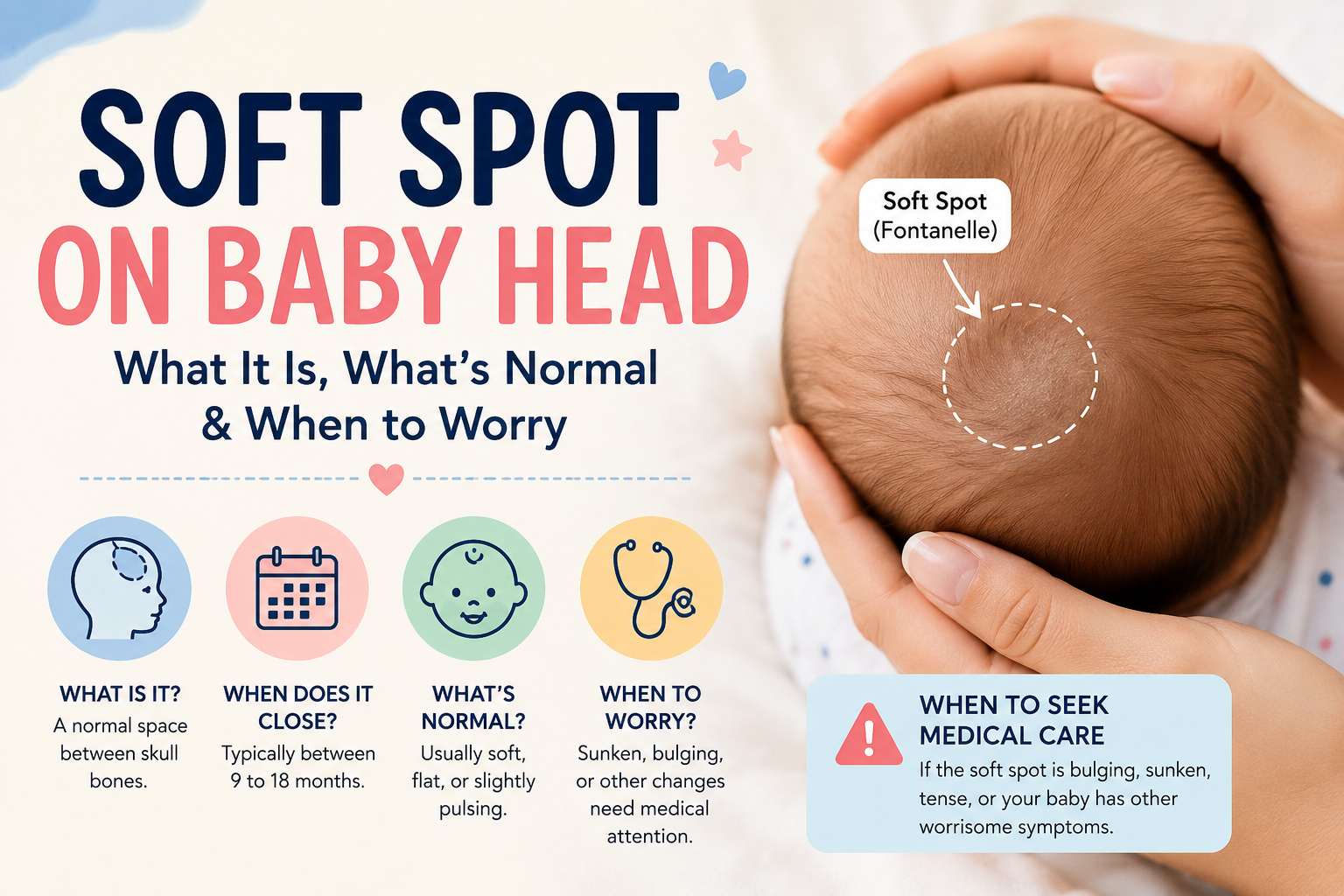
The soft spot on a baby head is called a fontanelle. It is a membrane-covered space where the skull bones have not yet fully joined. These spaces help the skull accommodate birth and allow room for rapid brain and skull growth during infancy.
However, the appearance of a fontanelle can sometimes provide clues about a baby’s health. A clearly sunken soft spot may occur with dehydration, while a tense or persistently bulging soft spot can require urgent medical assessment.
Quick Answer: What Is the Soft Spot on a Baby’s Head?
The soft spot on a baby’s head is called a fontanelle. It is a normal membrane-covered gap between skull bones that have not yet fully fused. Babies have several fontanelles, but parents most commonly notice the larger one near the top/front of the head and a smaller one toward the back.
A normal fontanelle is generally described as flat and firm, although its appearance can vary somewhat.
Soft Spot on Baby Head at a Glance
| Question | Short Answer |
|---|---|
| What is it called? | Fontanelle |
| Is it normal? | Yes |
| Where is it? | Most noticeable at the top/front and back of the head |
| Can you touch it? | Gentle touching is generally safe |
| Can it pulse? | A visible pulse can occur |
| What may a sunken spot suggest? | Possible dehydration |
| What may a bulging spot suggest? | Needs prompt medical assessment, especially if persistent or accompanied by illness |
| Does it close? | Yes, as skull development progresses |
| Should closure timing be identical for every baby? | No; timing varies |
What Is a Fontanelle?
A fontanelle, sometimes spelled fontanel, is one of the soft, membrane-covered spaces between a baby’s developing skull bones.
A newborn’s skull is not one solid piece of bone. It consists of bony plates separated by sutures, and the larger spaces where these structures meet are called fontanelles. These open areas are part of normal development.
The two soft spots parents are most likely to notice are:
- the anterior fontanelle toward the top/front of the head;
- the posterior fontanelle toward the back of the head.
MedlinePlus notes that these front and back fontanelles are two particularly large gaps in a newborn’s skull.
A baby’s skull consists of developing bones connected by sutures, with soft areas called fontanelles between them. For additional medical background, see the MedlinePlus overview of cranial sutures
Why Do Babies Have Soft Spots?
Baby soft spots have important developmental functions.
1. They Help the Head Adapt During Birth
Because the skull bones are not rigidly fused at birth, the head has flexibility. This helps it change shape during passage through the birth canal.
2. They Allow Room for Growth
The brain and skull grow rapidly during infancy. Fontanelles and sutures provide space for this development before the skull bones gradually harden and join.
So, a soft spot is not a defect or a “missing piece” of skull. It is part of normal infant anatomy.
Where Are the Soft Spots on a Baby’s Head?
Parents usually notice two main areas.
Anterior Fontanelle
The anterior fontanelle is the larger and more noticeable soft spot toward the top/front of the baby’s head.
Because of its size and location, this is often the area parents mean when they say:
“I can feel a soft spot on top of my baby’s head.”
Posterior Fontanelle
The posterior fontanelle is smaller and located toward the back of the head.
It may be more difficult for a parent to identify, particularly as it closes earlier than the larger front fontanelle in many babies.
Although six fontanelles are described anatomically in infancy, the anterior and posterior fontanelles are the most notable in routine discussion.
What Should a Normal Baby Soft Spot Feel Like?
A normal fontanelle is generally flat and firm, according to the NCBI clinical overview of infant fontanelles.
When gently touched, it may feel:
- softer than the surrounding skull;
- slightly flexible;
- covered by skin;
- subtly level with or a little different from the surrounding area.
What matters is not a tiny moment-to-moment variation but a clear or persistent change, particularly when the baby also appears unwell.
Is It Normal for a Baby’s Soft Spot to Pulse?
Seeing movement in the soft spot can surprise parents. A visible pulse may occur because the fontanelle is a membrane-covered area rather than solid bone.
A slight rhythmic movement can therefore be noticeable in some babies.
However, pulsing is not the same as persistent bulging. If the area looks tense, swollen, or pushed outward—particularly while the baby is calm—or the baby has fever, vomiting, unusual sleepiness, seizures, or other concerning symptoms, seek urgent medical assessment.
Can You Touch a Baby’s Soft Spot?
Yes, gentle touching is generally safe. The soft spot is covered by a protective membrane and skin; it is not an uncovered opening into the brain.
Australia’s government-supported Pregnancy, Birth and Baby resource states that it is safe to gently touch a baby’s fontanelles.
Normal gentle activities may include:
- washing the baby’s hair;
- gently drying the scalp;
- softly touching the head;
- routine handling during care.
Avoid pressing hard on the area. If you notice swelling, an unusual lump, tenderness, or a major change in appearance, contact a healthcare professional.
When Does the Soft Spot on a Baby’s Head Close?
Closure timing varies according to the fontanelle and the individual baby.
The smaller posterior fontanelle generally closes earlier, while the larger anterior fontanelle remains open longer. One clinical source notes that the back fontanelle often closes around 2 to 3 months, while the front fontanelle may close between about 9 and 18 months; broader variation exists across children and sources.
This is why it is better not to treat one exact month as a universal deadline.
Your child’s clinician assesses more than whether a soft spot is open. They may also consider:
- head circumference;
- head shape;
- growth pattern;
- development;
- physical examination findings;
- other symptoms.
Sunken Soft Spot on Baby Head: What Does It Mean?
A sunken soft spot on a baby’s head can be associated with dehydration.
The NHS dehydration guidance lists a sunken fontanelle among possible signs of dehydration in a baby, alongside features such as:
- fewer wet nappies than usual;
- sunken eyes;
- few or no tears when crying;
- drowsiness;
- irritability.
When should you seek help?
Seek prompt medical advice if the soft spot appears clearly sunken, particularly if your baby:
- is feeding poorly;
- has fewer wet diapers or nappies;
- has vomiting or diarrhea;
- has a dry mouth;
- seems unusually sleepy;
- is difficult to wake;
- appears weak or unwell.
Young babies can become unwell quickly. Do not rely on the fontanelle alone to decide whether dehydration is present.
Bulging Soft Spot on Baby Head: When to Worry
A bulging fontanelle curves outward rather than appearing flat. A persistently tense or bulging soft spot can be concerning and should be medically assessed.
MedlinePlus describes a bulging fontanelle as an outward curving of the infant soft spot. Potential causes can include serious conditions that increase pressure inside the skull or involve infection, which is why assessment matters.
Seek urgent medical care if a bulging soft spot occurs with:
- fever;
- repeated vomiting;
- unusual sleepiness;
- poor feeding;
- marked irritability;
- seizures;
- reduced responsiveness;
- abnormal eye movements;
- recent head injury;
- a baby who otherwise appears very unwell.
A tense or bulging fontanelle is included among warning signs of an unwell baby in NHS hospital guidance. A persistently bulging fontanelle can require prompt medical assessment. The MedlinePlus guidance on a bulging fontanelle explains why this finding should be evaluated in context.
Important nuance
The appearance of the fontanelle should be interpreted in context. Temporary fullness may look different during crying or certain positions. But a persistent bulge when the baby is calm should not be dismissed or diagnosed at home.
Soft Spot on Baby Head After a Fall
If your baby falls or hits their head, do not use the soft spot alone to decide whether the injury is serious.
A swollen or bulging fontanelle after trauma can be concerning, and vomiting may accompany head injury.
Seek urgent medical advice after a head injury if your baby has symptoms such as:
- loss of consciousness;
- repeated vomiting;
- seizure;
- unusual drowsiness;
- difficulty waking;
- abnormal behavior;
- worsening symptoms;
- a tense or bulging soft spot.
For a young infant, it is reasonable to have a low threshold for professional assessment after a significant head injury. Gentle touching of the fontanelle is generally considered safe because the area is covered by protective tissue and skin. See the Australian government-supported Pregnancy, Birth and Baby fontanelle guidance
What If the Soft Spot Closes Early?
Parents sometimes worry when they can no longer easily feel the fontanelle.
An early-closing or difficult-to-feel soft spot does not by itself diagnose a condition. A clinician needs to assess the entire picture.
One condition doctors may consider when skull sutures fuse too early is craniosynostosis. The NHS overview of craniosynostosis describes it as a rare condition in which a baby’s skull does not grow properly and the head may develop an unusual shape.
Speak with your baby’s clinician if you notice:
- unusual head shape;
- a hard ridge along the skull;
- poor head growth;
- marked asymmetry;
- concerns that the soft spot disappeared unusually early.
Do not diagnose craniosynostosis simply because you cannot find the fontanelle yourself.
What If the Soft Spot Does Not Close?
A fontanelle that remains open longer than expected may still require interpretation in the context of the child’s age, growth, head size, and overall health.
Some babies naturally have variation in fontanelle size and closure timing. However, delayed closure or unusually large fontanelles can sometimes be associated with medical conditions. MedlinePlus notes that enlarged fontanelles may have a range of causes and should be evaluated in context.
Speak with your pediatrician if:
- the soft spot seems unusually large;
- it remains open beyond the timeframe your clinician expects;
- your baby has poor growth;
- head size changes unusually;
- there are developmental concerns;
- other symptoms are present.
Is a Large Soft Spot on a Baby’s Head Normal?
Fontanelle size varies among babies, so a larger soft spot is not automatically evidence of disease.
However, a fontanelle that is larger than expected for a baby’s age may warrant assessment. MedlinePlus describes enlarged fontanelles as soft spots larger than expected for age.
A pediatrician may consider:
- the baby’s age;
- head circumference;
- growth over time;
- physical examination;
- development;
- other health findings.
Avoid comparing your baby’s fontanelle with photographs online as a substitute for examination.
Soft Spot vs Flat Spot: They Are Not the Same
These two terms are easy to confuse.
| Soft Spot | Flat Spot |
|---|---|
| Called a fontanelle | Often refers to head-shape flattening |
| Normal gap between developing skull bones | Area of skull that appears flattened |
| Common in babies | May occur with positional head-shape changes |
| Usually felt at top/front or back | Often seen on one side or back of head |
A flat spot may be associated with positional plagiocephaly, which is different from a fontanelle.
Can a Baby’s Soft Spot Be Damaged Easily?
The word “soft” can make the fontanelle sound extremely fragile. In reality, it is covered by skin and a tough protective membrane.
Normal gentle care is generally safe.
Still:
- do not press hard;
- protect the baby from head injuries;
- seek care after significant trauma;
- ask a clinician about unusual swelling or changes.
Does the Soft Spot Move When a Baby Breathes?
Parents may notice subtle movement in the fontanelle. Because it is not covered by rigid bone, motion related to circulation can sometimes be more visible there than elsewhere on the skull.
A slight visible pulse is different from:
- a clearly sunken fontanelle;
- a tense, outward bulge;
- swelling after trauma.
If you are uncertain about what you are seeing, a healthcare professional can examine the area directly.
When Should You Call a Doctor About a Baby’s Soft Spot?
Contact a healthcare professional promptly if you notice:
- a clearly sunken fontanelle;
- a persistently bulging or tense fontanelle;
- a major change in the soft spot;
- poor feeding;
- fewer wet diapers;
- repeated vomiting;
- unusual head growth;
- abnormal head shape;
- a hard ridge on the skull;
- concerns about early or delayed closure.
The baby’s overall condition is often more important than the soft spot alone.
When to Seek Emergency Care
Seek urgent or emergency medical care if your baby has a concerning soft-spot change together with serious symptoms such as:
- difficulty waking;
- seizure;
- reduced responsiveness;
- severe breathing difficulty;
- repeated vomiting with marked illness;
- a significant head injury;
- a tense or bulging fontanelle with fever or neurological symptoms.
A bulging fontanelle can occur in serious illness, and a sunken fontanelle may accompany significant dehydration.
If you think your baby may be seriously ill, seek urgent medical care rather than waiting for an online answer.
Frequently Asked Questions
What is the soft spot on a baby head?
The soft spot is called a fontanelle. It is a normal membrane-covered space between skull bones that have not yet fully joined.
Is the soft spot on a baby’s head normal?
Yes. Fontanelles are a normal part of infant skull development and allow room for growth.
Can I touch my baby’s soft spot?
Gentle touching is generally safe because the fontanelle is protected by skin and a membrane.
Why is my baby’s soft spot pulsing?
A subtle visible pulse can occur because the area is not covered by rigid bone. A pulse is different from a persistent outward bulge.
What does a sunken soft spot mean?
A clearly sunken fontanelle can be a sign of dehydration, especially when accompanied by fewer wet diapers, sunken eyes, few tears, drowsiness, or irritability.
What does a bulging soft spot mean?
A persistently bulging or tense fontanelle can be associated with serious illness or increased pressure and requires prompt medical assessment.
When does the baby soft spot close?
Timing varies. The smaller back fontanelle generally closes earlier, while the larger front fontanelle often remains open longer into infancy.
Is it normal for the soft spot to look slightly dipped?
Small variations can occur, but a clearly sunken fontanelle—particularly with signs of dehydration or illness—should be medically assessed.
Is a baby soft spot the same as a flat head?
No. A fontanelle is a normal soft space between skull bones. A flat spot refers to head-shape flattening, such as positional plagiocephaly.
Should I worry if I cannot feel my baby’s soft spot?
Not necessarily. Fontanelle size and closure timing vary. However, if you are concerned about early closure, unusual head shape, a hard skull ridge, or head growth, speak with your child’s clinician.
Final Thoughts
The soft spot on a baby head is usually a completely normal part of early development. Called a fontanelle, it provides flexibility and room for the skull and brain to grow.
Parents may notice that the area feels soft, appears subtly different from the surrounding skull, or seems to pulse. These observations can be normal. The changes that deserve more attention are a clearly sunken soft spot, a persistent tense or bulging fontanelle, unusual head growth or shape, or any soft-spot change accompanied by a baby who appears unwell.
When in doubt, especially with a newborn or young infant, professional assessment is safer than trying to diagnose the appearance of a fontanelle at home.