

Editorial Note: This article provides general information about parent orientation programmes in schools and preschools. The format, schedule, purpose, attendance requirements, and activities may vary depending on the institution, class level, curriculum, and school policy. Parents should follow the specific instructions shared by their child’s school.
Starting a new school, preschool, nursery, LKG, or UKG can bring many questions for parents. What will the daily routine look like? Who should parents contact if a child is struggling? What are the school timings? How will teachers communicate progress? What should a child bring every day?
A parent orientation is designed to answer many of these questions before or at the beginning of a new academic session.
Unlike a regular parent-teacher meeting, an orientation session usually focuses on helping families understand the school environment, academic approach, routines, policies, communication methods, and expectations. This guide explains the parent orientation meaning, its purpose, what usually happens during the programme, and how parents can prepare.
Quick Answer: What Is Parent Orientation?
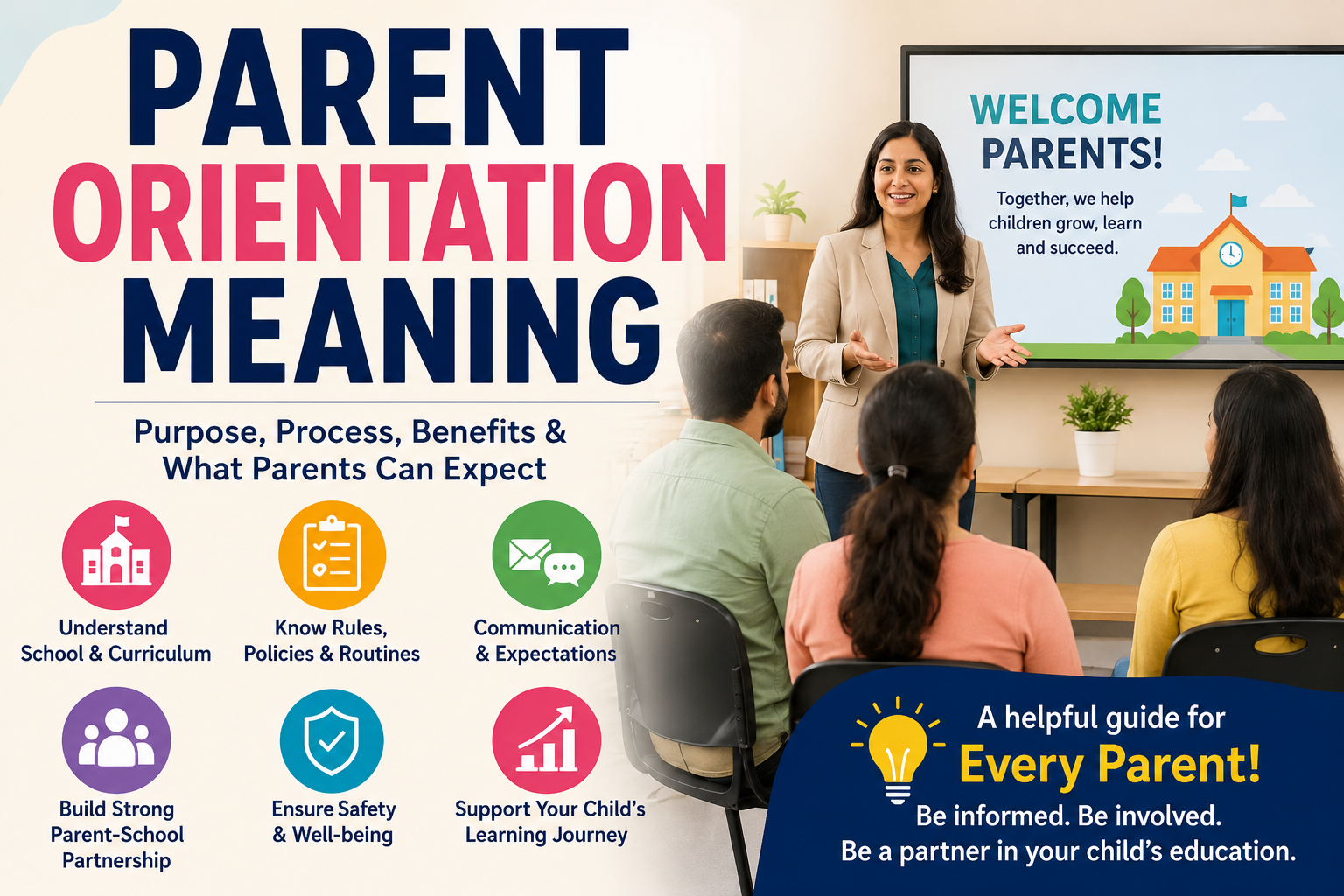
Parent orientation is an introductory session organised by a school, preschool, or educational institution to help parents understand how the institution works. It may cover the curriculum, daily routine, school rules, attendance, safety procedures, communication channels, assessments, transport, meals, activities, and ways parents can support their child.
In simple words, a parent orientation helps answer:
“What should parents know before their child begins or continues the school journey?”
Parent Orientation Meaning
The term parent orientation refers to a structured introductory meeting or programme conducted for parents or guardians.
During the session, the school may introduce:
- teachers and coordinators;
- school leadership;
- curriculum and teaching approach;
- classroom routines;
- academic expectations;
- attendance rules;
- communication systems;
- assessment methods;
- health and safety procedures;
- transport arrangements;
- school activities;
- parent responsibilities.
The exact content depends on the age of the child and the type of institution.
For example, a preschool parent orientation may focus heavily on separation anxiety, toilet routines, snacks, pick-up procedures, and settling into school. An orientation for parents of older children may spend more time on subjects, homework, assessments, digital platforms, examinations, and academic expectations.
Parent Orientation Meaning in Simple Words
In simple words:
Parent orientation is a meeting where the school explains important information to parents about their child’s school life.
It helps parents understand what to expect, whom to contact, what rules to follow, and how they can support their child.
Parent Orientation Meaning in Hindi
Parent Orientation का हिंदी में सरल अर्थ अभिभावक परिचय एवं मार्गदर्शन सत्र समझा जा सकता है।
इस कार्यक्रम में स्कूल माता-पिता या अभिभावकों को स्कूल की कार्यप्रणाली, पढ़ाई के तरीके, दैनिक दिनचर्या, नियमों, शिक्षकों से संपर्क, उपस्थिति, सुरक्षा, गतिविधियों और बच्चों से जुड़ी अपेक्षाओं के बारे में जानकारी देता है।
सरल शब्दों में:
Parent Orientation एक ऐसा सत्र है जिसमें स्कूल अभिभावकों को यह समझाता है कि स्कूल कैसे काम करता है और वे अपने बच्चे की शिक्षा व स्कूल जीवन में किस प्रकार सहयोग कर सकते हैं।
Parent Orientation at a Glance
| Topic | Details |
|---|---|
| Meaning | Introductory and informational session for parents |
| Conducted By | School, preschool, college, or educational institution |
| Participants | Parents, guardians, teachers, coordinators, school leaders |
| Common Timing | Before or near the beginning of an academic session |
| Main Purpose | Help parents understand the institution and expectations |
| Common Topics | Curriculum, routine, rules, safety, communication, assessment |
| Duration | Varies by institution |
| Format | Offline, online, or hybrid |
| Is the Child Present? | Depends on the school and programme |
| Is It a PTM? | No, the purpose is generally different |
What Is the Purpose of Parent Orientation?
The main purpose of a parent orientation programme is to build clarity between the school and families.
1. To Introduce Parents to the School
New parents may know the school by name but still be unfamiliar with its everyday functioning.
An orientation can introduce:
- school leadership;
- class teachers;
- coordinators;
- counsellors;
- administrative contacts;
- support staff, where relevant.
This helps parents know whom to approach for different concerns.
2. To Explain the Curriculum
Schools may use different curricula and teaching methods. During orientation, parents may receive information about:
- subjects taught;
- learning goals;
- classroom activities;
- projects;
- homework;
- reading programmes;
- assessments;
- co-curricular learning.
For preschool and kindergarten, the emphasis may be on play, language, early numeracy, motor skills, social interaction, and age-appropriate development rather than formal examinations.
3. To Explain the Daily Routine
Parents often want practical information about a typical school day.
The school may explain:
- reporting time;
- dispersal time;
- assembly;
- snack or lunch breaks;
- activity periods;
- outdoor play;
- nap time for younger children;
- pick-up and drop-off procedures.
4. To Clarify School Rules
Orientation can help parents understand policies related to:
- attendance;
- punctuality;
- uniforms;
- leave applications;
- late arrival;
- authorised pick-up;
- mobile phones;
- school ID cards;
- behaviour;
- communication with staff.
Clear information can reduce misunderstandings later.
5. To Build Parent-School Communication
Parents need to know how the school communicates.
Possible channels include:
- school diary;
- email;
- mobile app;
- parent portal;
- circulars;
- SMS;
- scheduled meetings;
- official messaging groups.
An orientation may also clarify which channel should be used for urgent matters, academic questions, transport issues, or leave requests. Clear communication between families and schools can help parents understand expectations, raise concerns through appropriate channels, and stay involved in their child’s education. The U.S. Department of Education also provides resources on family partnership and engagement.
6. To Help Parents Support Their Child
A school may offer practical suggestions on:
- creating a regular sleep routine;
- encouraging independent eating;
- reading at home;
- preparing a child for separation;
- establishing homework habits;
- supporting without excessive pressure.
The advice should ideally be appropriate to the child’s age and stage.
What Happens in a Parent Orientation Programme?
A parent orientation programme may begin with a welcome address and then move through several informational sessions.
A typical programme may include:
- Welcome and introduction.
- Introduction to the school leadership.
- Introduction to teachers or coordinators.
- Overview of the school’s educational approach.
- Explanation of the curriculum.
- Daily routine and timetable.
- Attendance and leave policies.
- Assessment or progress-reporting system.
- Health and safety information.
- Transport or dispersal procedures.
- Parent communication channels.
- Question-and-answer session.
Some schools may also organise a campus tour or classroom visit.
Parent Orientation Programme in School
A parent orientation programme in school is usually designed to create a shared understanding between parents and the institution.
For primary or secondary classes, topics may include:
- subject structure;
- homework expectations;
- examinations;
- assessment patterns;
- attendance;
- school discipline;
- extracurricular activities;
- digital learning platforms;
- parent-teacher communication.
The programme may be organised for all parents together or separately for each grade.
Parent Orientation in Preschool
A preschool orientation is often more focused on the child’s transition from home to a group-learning environment.
Common topics include:
- settling-in period;
- separation anxiety;
- toilet training expectations;
- snack policy;
- food allergies;
- spare clothing;
- comfort objects;
- school bag requirements;
- authorised pick-up;
- nap routine;
- classroom activities;
- communication with teachers.
For parents of first-time school-goers, this type of session can be especially useful because even small practical details may affect a child’s adjustment. For younger children, schools may also explain how play supports early learning and development. Parents can explore UNICEF’s guidance on learning through play.
Parent Orientation for Nursery, LKG and UKG
For children entering nursery, LKG, or UKG, the orientation may focus on school readiness and age-appropriate routines.
| Area | What May Be Discussed |
|---|---|
| Arrival | Reporting time and drop-off process |
| Separation | Helping children settle without prolonged goodbyes |
| Food | Snack box rules and allergy information |
| Toilet Needs | School procedures and independence expectations |
| Learning | Play, phonics, numbers, stories, art and activities |
| Communication | Diary, app, email or teacher contact |
| Safety | Pick-up cards and authorised guardians |
| Absence | Leave and attendance procedure |
| Items to Bring | Bag, bottle, spare clothes or other requirements |
| Progress | How development and learning are communicated |
Parents should treat the school’s own instructions as final because practices vary considerably.
Is Parent Orientation the Same as a Parent-Teacher Meeting?
No. A parent orientation and a parent-teacher meeting (PTM) usually have different purposes.
| Parent Orientation | Parent-Teacher Meeting |
|---|---|
| Usually introductory | Usually progress-focused |
| Often held near the start of a session | Held during the academic term |
| Explains school systems and expectations | Discusses an individual child |
| May involve many parents together | Often one family meets the teacher |
| Covers policies and routines | Covers learning and development |
| Focuses on preparation | Focuses on progress and concerns |
A parent orientation is generally about understanding the school system, while a PTM is more likely to focus on the individual child.
Is Parent Orientation the Same as Student Orientation?
Not exactly.
Parent orientation is designed mainly for parents or guardians. Student orientation is designed for students.
A student orientation may include:
- meeting classmates;
- exploring the campus;
- understanding the timetable;
- learning classroom rules;
- meeting teachers;
- becoming familiar with facilities.
Some schools combine both programmes, especially for younger children.
Is Parent Orientation Compulsory?
Whether parent orientation is compulsory depends on the school or institution.
Some schools may strongly recommend attendance, while others may treat it as optional. In certain cases, important operational information is shared during the session, making attendance highly useful even if it is not formally mandatory.
If you cannot attend, ask the school whether it can provide:
- presentation slides;
- a parent handbook;
- a recording;
- written instructions;
- another session.
Who Should Attend Parent Orientation?
Usually, one or both parents can attend. A legal guardian may attend where appropriate.
The school invitation should clarify:
- whether both parents may attend;
- whether children should accompany parents;
- whether siblings are allowed;
- whether prior registration is required;
- whether the session is online or offline.
Avoid assuming that children are invited unless the school specifically says so.
How Long Does Parent Orientation Last?
There is no universal duration.
A short online orientation may last less than an hour, while a detailed school programme involving presentations, classroom visits, or question sessions may take longer.
The duration can depend on:
- number of topics;
- class level;
- number of speakers;
- campus tour;
- Q&A session;
- school size.
Parents should check the invitation rather than assume a fixed duration.
What Should Parents Ask During Orientation?
A good orientation is not only about listening. It is also an opportunity to ask relevant questions.
Consider asking:
- How will the school communicate with parents?
- Who should I contact for an academic concern?
- What is the absence procedure?
- How are children handed over during dispersal?
- What happens if someone else needs to pick up my child?
- How are food allergies managed?
- What should my child bring daily?
- How is progress communicated?
- Is homework given at this age?
- What happens if a child has difficulty settling?
- How are emergencies handled?
- Where can parents find official announcements?
For younger children, parents may also ask about toilet assistance, snack routines, spare clothes, and separation support.
How Should Parents Prepare for an Orientation Programme?
Preparation can make the session more useful.
Read the Invitation Carefully
Check:
- date;
- time;
- venue;
- online meeting link;
- dress instructions, if any;
- whether children are invited;
- documents required.
Write Down Your Questions
It is easy to forget important questions during a presentation. Keep a short list on your phone or in a notebook.
Carry Something for Notes
You may receive information about:
- timings;
- teacher contacts;
- holidays;
- apps;
- transport;
- books;
- deadlines.
Avoid Asking Highly Personal Questions in a Group
If your concern relates specifically to your child’s health, behaviour, learning, or family circumstances, request a private conversation where appropriate.
Benefits of Parent Orientation
A well-planned orientation can offer several practical benefits.
Better Clarity
Parents understand school procedures before problems arise.
Easier Communication
Families learn whom to contact and how.
Reduced Confusion
Clear explanations about attendance, transport, uniforms, and routines can prevent avoidable misunderstandings.
Better Preparation
Parents can prepare bags, meals, schedules, and documents in advance.
Stronger Home-School Coordination
When parents understand the school’s expectations, it may become easier to maintain consistent routines at home.
Opportunity to Ask Questions
Parents can clarify doubts directly instead of depending on informal messages or assumptions.
Common Mistakes Parents Should Avoid
Skipping the Orientation Without Checking Its Importance
The session may contain practical information that is not obvious from the school website.
Comparing Every Rule With Another School
Schools may have different systems. Focus first on understanding your child’s institution.
Turning the Session Into a Personal PTM
A group orientation may not be the right setting for detailed discussion about one child.
Depending Only on Parent WhatsApp Groups
Informal groups can be useful, but official school communication should be the primary source for policies and deadlines.
Putting Pressure on the Child
If orientation is linked with the first days of school, avoid repeatedly telling a young child that school will be difficult or frightening.
What Should Schools Include in a Good Parent Orientation?
A useful programme should ideally provide clear and practical information.
Important areas may include:
- school contact details;
- key staff roles;
- academic approach;
- timetable;
- attendance;
- leave process;
- safety;
- child pick-up;
- transport;
- health procedures;
- communication channels;
- assessments;
- parent responsibilities;
- escalation process for concerns.
For preschool families, additional guidance on settling in and age-appropriate independence can be particularly useful.
Sample Parent Orientation Programme Schedule
| Time | Session |
|---|---|
| 9:00 AM | Registration |
| 9:15 AM | Welcome Address |
| 9:30 AM | Introduction to School Philosophy |
| 9:45 AM | Curriculum Overview |
| 10:15 AM | Daily Routine and Classroom Expectations |
| 10:35 AM | Safety, Health and Dispersal Procedures |
| 10:55 AM | Parent Communication System |
| 11:15 AM | Teacher Introduction |
| 11:30 AM | Questions and Answers |
| 11:50 AM | Campus or Classroom Visit |
| 12:15 PM | Conclusion |
Note: This is only a sample format. Actual programmes vary by institution.
Parent Orientation Checklist
Before leaving the orientation, try to make sure you know:
- school start and closing time;
- drop-off procedure;
- pick-up procedure;
- attendance rule;
- leave process;
- teacher communication method;
- emergency contact;
- snack or lunch policy;
- uniform requirements;
- items needed daily;
- transport contact, if applicable;
- school app or portal details;
- assessment method;
- holiday calendar location.
Saving this information in one place can be helpful throughout the academic year.
Frequently Asked Questions
What is parent orientation?
Parent orientation is an introductory programme that helps parents understand a school’s curriculum, routines, rules, communication systems, safety procedures, and expectations.
What is the meaning of parent orientation in school?
In a school context, parent orientation means a structured session where parents are introduced to important information about the institution and their child’s school experience.
Why is parent orientation important?
It can improve clarity about school procedures, communication, daily routines, academic expectations, and parent responsibilities.
What happens at a parent orientation?
Schools may introduce teachers, explain the curriculum, discuss routines and policies, describe communication systems, and answer parent questions.
Is parent orientation a PTM?
No. Orientation is generally introductory and system-focused, while a PTM usually discusses an individual child’s progress.
Should children attend parent orientation?
It depends on the institution. Parents should check the invitation before bringing children.
What is preschool parent orientation?
It is a session designed to help parents understand preschool routines, settling-in procedures, food policies, toilet needs, safety, classroom activities, and communication methods.
What is parent orientation meaning in Hindi?
Parent orientation can be understood as अभिभावक परिचय एवं मार्गदर्शन सत्र, where the school provides parents with important information about its functioning and expectations.
What questions should I ask at parent orientation?
Ask about communication, attendance, safety, pick-up, food allergies, daily requirements, progress updates, homework, and whom to contact for concerns.
Is parent orientation compulsory?
This depends on the school. Even when optional, it may be useful because important academic and operational information can be shared.
Final Takeaway
The parent orientation meaning is simple: it is an introductory and guidance session that helps parents understand how a school or educational institution works.
For families entering preschool, nursery, LKG, UKG, or a new school, the programme can provide practical clarity about routines, teachers, communication, safety, curriculum, attendance, and expectations.
The most useful approach is to attend with a short list of questions, take note of official communication channels, and keep school-specific instructions for future reference.