

Safety note: Choose age-appropriate activities, supervise young children around tools, soil, water and small objects, and teach children not to taste unknown plants. Gardening tasks should match a child’s age and abilities; youth-safety guidance also emphasizes supervision and age-appropriate work.
Gardening does not have to mean giving children a long list of chores. With the right approach, soil, seeds, leaves and even kitchen scraps can become materials for play, observation and simple hands-on learning.
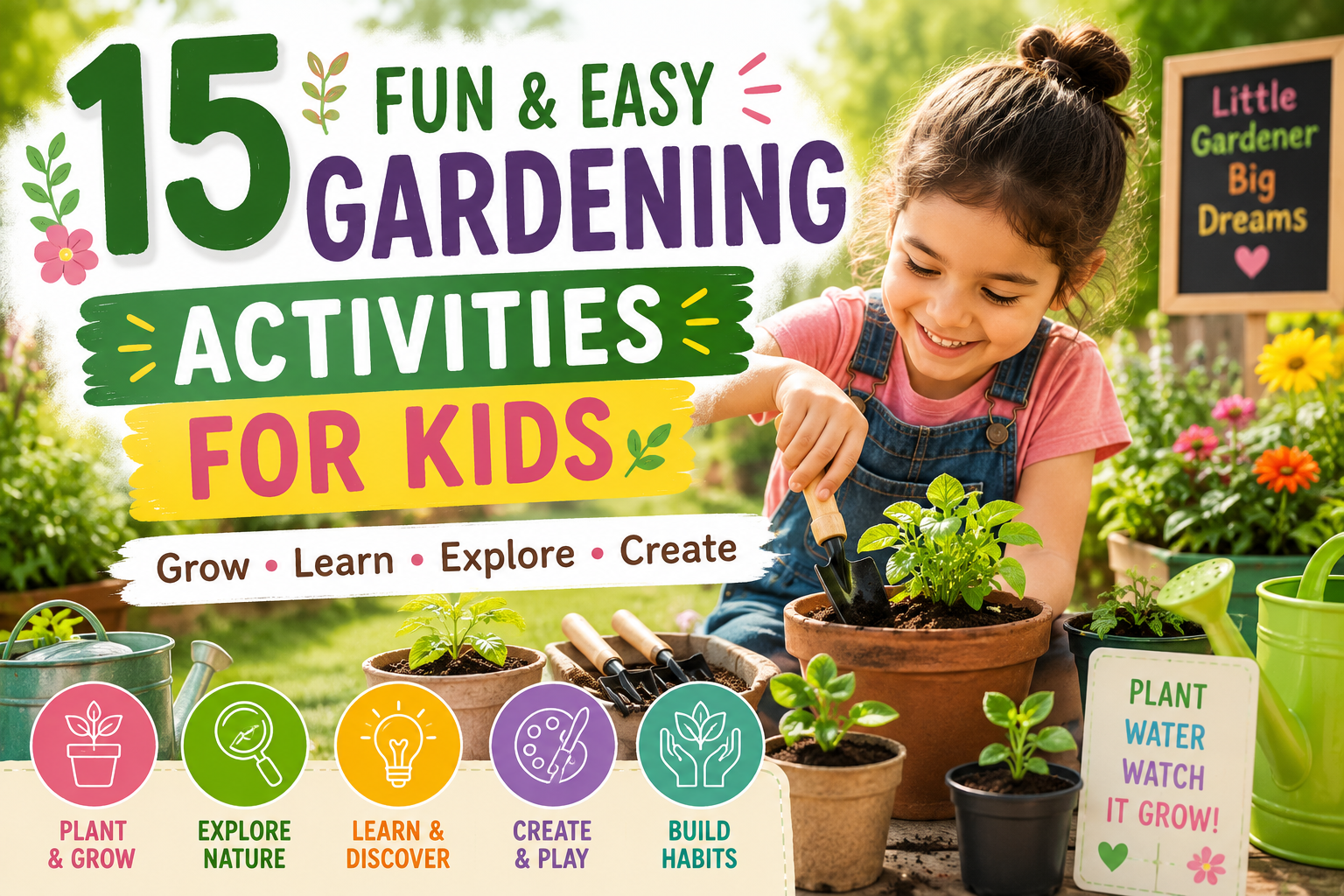
These gardening activities for kids are designed to be practical for families, teachers and caregivers. Some can be done in a backyard, while others work on a balcony, windowsill or in a classroom. Children can watch seeds sprout, compare plant growth, explore herbs through smell, make garden art and learn what happens to organic scraps.
If your child enjoys hands-on play away from digital devices, explore these screen-free activities for toddlers for more simple ideas using play, movement and everyday materials.
The best part? You do not need to be an experienced gardener. Start with one small activity, use materials you already have where possible, and let children ask questions as they go.
Quick answer: Some of the easiest gardening activities for kids include growing seeds in a clear container, planting herbs, regrowing selected vegetables from scraps, making plant markers, keeping a garden journal, creating a scavenger hunt and starting a simple compost observation project.
Gardening Activities for Kids at a Glance
| Activity | Best For | Space Needed | Main Learning Idea |
|---|---|---|---|
| Seed viewer | Ages 4+ | Windowsill | Germination |
| Herb garden | Ages 3+ | Small pot | Smell and plant care |
| Regrow food scraps | Ages 5+ | Kitchen/window | Plant growth |
| Painted plant markers | Ages 4+ | Table | Art and identification |
| Garden scavenger hunt | Ages 3+ | Any outdoor space | Observation |
| Sunflower growth race | Ages 5+ | Pot or garden | Measurement |
| Mini compost experiment | Ages 6+ | Small container | Decomposition |
| Pollinator patch | Ages 5+ | Pot or garden | Ecosystems |
| Sensory herb hunt | Ages 3+ | Pots/garden | Sensory exploration |
| Garden journal | Ages 5+ | Anywhere | Recording change |
| Seed sorting game | Ages 4+ | Table | Comparison |
| Mini salad garden | Ages 5+ | Container | Food origins |
| Butterfly observation | Ages 5+ | Outdoor space | Wildlife |
| Watering experiment | Ages 6+ | Small pots | Fair testing |
| Garden story stones | Ages 4+ | Table/garden | Creativity |
1. Make a Seed Viewer
A seed viewer is one of the simplest educational gardening activities for kids because children can watch early growth rather than wondering what is happening beneath the soil.
You will need
- a transparent container or clear bag;
- paper towel or another suitable moist growing medium;
- a few easy-to-sprout seeds;
- water;
- a bright location appropriate for the chosen seed.
How to do it
- Moisten the paper towel without soaking it.
- Place it inside the clear container.
- Position seeds where children can see them.
- Check the setup every day.
- Record visible changes.
Ask children to look for:
- swelling;
- the first root;
- the first shoot;
- changes in length;
- changes in colour.
Learning extension
Create a simple observation table:
| Day | What Changed? | Root Visible? | Shoot Visible? |
|---|---|---|---|
| 1 | Seed placed | No | No |
| 3 | Seed looks larger | Maybe | No |
| 5 | Record observation | Record | Record |
Do not promise a fixed germination day because different seeds and growing conditions vary.
For families who want more structured ideas, KidsGardening’s activity library includes child-focused garden projects such as seed viewers, container gardening, plant math and scavenger hunts.
2. Grow a Mini Herb Garden
A small herb garden can work in:
- a backyard;
- a balcony;
- a sunny windowsill;
- suitable containers.
Possible herbs depend on your climate and growing conditions, but families commonly explore options such as:
- basil;
- mint;
- coriander or cilantro;
- parsley;
- chives.
Turn it into an activity
Give each child one plant to observe.
Ask:
- What shape are the leaves?
- What does the plant smell like?
- Are new leaves appearing?
- Does the soil feel dry or moist?
- How has the plant changed this week?
Make a “smell chart”
| Herb | Smell Description | Leaf Shape | Child’s Rating |
|---|---|---|---|
| Mint | Fresh | Record it | ★ to ★★★★★ |
| Basil | Record it | Record it | ★ to ★★★★★ |
| Coriander | Record it | Record it | ★ to ★★★★★ |
This encourages children to use descriptive language rather than simply saying “nice” or “bad.”
For more age-appropriate play ideas, see our guide to fun screen-free toddler activities that encourage active, creative play.
3. Regrow Selected Vegetables From Kitchen Scraps
Some kitchen scraps can produce visible new growth under suitable conditions, making this an engaging observation project.
Possible examples often used for regrowing experiments include:
- spring onion or green onion bases;
- some leafy vegetable bases;
- selected herb cuttings.
Simple spring onion experiment
- Keep the base with roots intact.
- Place the roots in a shallow amount of water.
- Keep the setup in a suitable bright location.
- Change the water regularly.
- Observe new green growth.
Ask children to measure
- Day 1 height
- Day 3 height
- Day 5 height
- Day 7 height
Important: Regrowing scraps is best treated as an experiment, not a guarantee of a full new crop. Results vary by plant, condition and method.
4. Paint Your Own Plant Markers
This activity combines gardening with art.
Materials
You can use suitable items such as:
- wooden craft sticks;
- smooth stones;
- reusable garden labels;
- weather-appropriate markers or paint.
Children can label:
- tomato;
- basil;
- mint;
- sunflower;
- marigold;
- spinach.
Make it educational
For younger children, add:
- a picture;
- the first letter;
- a colour code.
For older children, include:
- common name;
- planting date;
- expected observation date.
Example
Instead of only writing:
BASIL
try:
BASIL
Planted: 10 July
Check: Every 2 days
This turns a craft into a simple record-keeping activity. Gardening is just one way to encourage real-world learning. Parents can also explore our child development guides for more ideas related to learning, behaviour, milestones and everyday growth.
5. Create a Garden Scavenger Hunt
A scavenger hunt can work in a:
- home garden;
- park where permitted;
- school garden;
- balcony with multiple plants.
Ready-to-use scavenger hunt
Can you find:
- something green?
- a smooth leaf?
- a rough surface?
- a flower?
- a tiny insect?
- something that smells strong?
- a fallen leaf?
- a seed?
- something taller than your hand?
- two different shades of green?
For older kids
Ask them to find:
- evidence of pollination;
- a leaf with insect damage;
- a decomposing leaf;
- two different stem types;
- a plant growing toward light.
Encourage children to observe rather than collect when local rules or plant safety are uncertain.
The U.S. Forest Service’s wildflower activities for children also offers nature-based ideas involving flowers and outdoor observation.
6. Start a Sunflower Growth Challenge
Children often enjoy activities with visible change and measurement.
If sunflowers are suitable for your local climate and available space, plant seeds under comparable conditions and track growth.
What children can record
- planting date;
- first visible sprout;
- plant height;
- number of leaves;
- visible buds;
- flowering date.
Create a weekly chart
| Week | Plant Height | Number of Leaves | New Observation |
|---|---|---|---|
| 1 | ___ | ___ | ___ |
| 2 | ___ | ___ | ___ |
| 3 | ___ | ___ | ___ |
| 4 | ___ | ___ | ___ |
Important science lesson
Do not turn every plant difference into “winning” or “losing.”
Ask:
Why might two plants grow differently?
Children may suggest:
- light;
- water;
- soil;
- seed variation;
- temperature;
- pests.
That discussion is often more valuable than the race itself. Looking for more balanced offline learning ideas? Browse our screen time and learning resources for practical ways to combine technology with real-world play.
7. Try a Mini Compost Observation Project
Composting can help children explore decomposition and the difference between materials that break down differently.
The U.S. Environmental Protection Agency’s guide to composting at home explains practical home composting and discusses collecting “greens,” such as fruit and vegetable scraps, alongside carbon-rich “browns,” such as leaves and twigs.
Child-friendly observation idea
With adult supervision, compare selected materials such as:
- a dry leaf;
- a small fruit or vegetable scrap;
- a piece of untreated plant material.
Ask children:
- Which changes first?
- Which becomes softer?
- Does colour change?
- What happens over time?
Important safety rules
- adults should manage the compost setup;
- wash hands after handling compost or soil;
- do not taste compost materials;
- use an appropriate composting method;
- follow local guidance.
For a real compost system, do not simply throw random food into a sealed jar. Use a proper method and follow reliable composting guidance.
8. Plant a Small Pollinator-Friendly Patch
A pollinator garden can introduce children to relationships between plants and animals.
Depending on your region, children may observe visitors such as:
- bees;
- butterflies;
- moths;
- beetles;
- other insects.
The USDA overview of the importance of pollinators recommends diverse plantings and discusses herbs and other plants that can contribute to pollinator gardens. Plant choice should be adapted to local conditions and native species where appropriate.
Turn it into a child-led project
Ask children to record:
- visitor type;
- flower colour;
- time of day;
- weather;
- how long the visitor stayed.
Simple observation table
| Visitor | Flower Colour | Time | What Happened? |
|---|---|---|---|
| Butterfly | ___ | ___ | ___ |
| Bee | ___ | ___ | ___ |
| Other insect | ___ | ___ | ___ |
Teach children to watch pollinators from a respectful distance and never grab or disturb them. When choosing activities, it also helps to consider your child’s developmental stage. Our child development milestones guide from birth to 5 years offers an age-by-age overview for parents.
9. Go on a Sensory Herb Hunt
This is one of the easiest gardening activities for preschoolers because it focuses on observation rather than complicated instructions.
Choose safe, known plants and invite children to compare them.
Explore
- smell;
- colour;
- leaf size;
- texture through safe, gentle touch;
- plant height.
Try questions such as
- Which leaf is the darkest?
- Which herb smells strongest?
- Which leaf is smallest?
- Which plants look similar?
- Which are different?
Safety: Children should not taste unidentified plants. Check plants for suitability and supervise closely, especially where allergies or skin sensitivities are a concern.
10. Keep a Garden Journal
A garden journal can transform casual gardening into a longer learning project.
Children can record:
- planting dates;
- drawings;
- plant height;
- weather;
- insects observed;
- first flower;
- first harvest;
- questions.
For preschoolers
Use:
- drawings;
- stickers;
- leaf-shape sketches;
- simple weather symbols.
For school-age children
Add:
- measurements;
- dates;
- predictions;
- comparison tables;
- short explanations.
Example prompt
“I think the plant will ______ next week because ______.”
This encourages prediction and reasoning.
For more playful ideas beyond gardening, explore our kids activities collection for family-friendly inspiration.
11. Play a Seed Sorting Game
Seeds vary greatly in:
- size;
- colour;
- shape;
- texture.
Use safe, age-appropriate seeds and ask children to sort them.
Sorting ideas
Sort by:
- biggest to smallest;
- light to dark;
- round to long;
- smooth to rough.
For older children
Ask:
Can you invent two different sorting systems?
For example:
System 1: by size
System 2: by shape
This activity blends early maths with gardening.
Safety: Small seeds can be a choking hazard. This activity is not suitable for unsupervised young children.
12. Grow a Mini Salad Garden
A small edible container garden can help children explore where food comes from.
Suitable crops depend on:
- climate;
- season;
- sunlight;
- container depth;
- local growing conditions.
Possible options may include:
- lettuce;
- radish;
- selected leafy greens;
- herbs.
Give children real responsibilities
A child might be the:
- watering checker;
- growth measurer;
- leaf counter;
- journal keeper.
Add a food-learning question
Ask:
Which part of this plant do people eat?
Possible answers include:
- leaf;
- root;
- fruit;
- seed;
- stem.
For science-based gardening guidance, the University of Minnesota Extension yard and garden resources cover growing, soil, pollinators and using harvests.
13. Create a Butterfly and Insect Observation Station
You do not need to catch insects to study them.
Choose a safe place where children can quietly observe plant visitors.
Record
- number of visitors;
- colour;
- approximate size;
- flower visited;
- behaviour.
Child-friendly questions
- Did it land or keep flying?
- Did it visit one flower or several?
- Was it alone?
- Did it stay for a few seconds or longer?
Important rule
Observe without:
- grabbing;
- trapping;
- poking;
- disturbing nests.
For additional child-friendly exploration, the U.S. Forest Service “Just for Kids” resources cover wildflowers, pollinators and related nature topics.
14. Run a Simple Watering Experiment
This activity introduces the idea of a fair test.
Setup
Use similar plants or seedlings in comparable conditions.
With adult guidance, create a safe observation plan that changes one variable while keeping others as similar as practical.
Children can discuss:
- What are we changing?
- What are we keeping the same?
- What do we predict?
- What happened?
Important caution
Do not intentionally create extreme conditions that could be unsafe, waste large amounts of water or unnecessarily destroy plants.
The goal is to teach experimental thinking, not neglect.
15. Make Garden Story Stones
This activity combines nature themes with storytelling.
Materials
- smooth stones;
- child-safe art materials;
- imagination.
Paint simple images such as:
- seed;
- sun;
- rain cloud;
- flower;
- bee;
- butterfly;
- watering can;
- tree.
Place the stones in a bag and let children pick three or four.
Then ask:
“Can you tell a garden story using these pictures?”
Example
A child picks:
- seed;
- cloud;
- bee.
Possible story:
“A tiny seed waited for rain. After it grew into a flower, a bee came to visit.”
This is particularly useful for children who enjoy imaginative play more than structured gardening tasks.
Bonus: 10 More Easy Garden Activities for Children
If your child enjoys the first 15 ideas, try these additional projects:
- Make seed balls using an appropriate method and suitable seeds.
- Create a leaf-shape matching game.
- Photograph one plant every week.
- Count flowers in a small marked area.
- Design a pretend dream garden.
- Compare natural colours found outdoors.
- Create a garden weather chart.
- Grow a small container flower garden.
- Make nature-inspired prints using safe materials.
- Create a “plant detective” notebook.
For more inspiration, KidsGardening’s family and youth garden activities includes a broad collection spanning seed viewers, butterfly gardens, herb exploration, scavenger hunts, container gardening and other projects.
Gardening Activities for Toddlers
For toddlers, keep activities:
- short;
- sensory;
- supervised;
- simple.
Good options include:
- carrying a small empty pot;
- gently watering with help;
- looking for colours;
- smelling safe known herbs;
- touching safe leaves;
- collecting fallen leaves where permitted.
Avoid
- sharp tools;
- unknown plants;
- unsupervised water containers;
- small seeds that pose choking risks;
- fertilizers or pesticides within reach.
The goal at this age is participation, not perfect gardening.
Gardening Activities for Preschoolers
Preschoolers may enjoy:
- seed viewers;
- plant markers;
- scavenger hunts;
- sensory herb activities;
- simple watering;
- garden story stones;
- leaf sorting.
Try short questions:
- What do you notice?
- What changed?
- Which is bigger?
- What colour is it?
- What do you think happens next?
These questions encourage observation without turning the activity into a test.
Gardening Activities for School-Age Kids
Older children can take on more structured projects such as:
- measuring plant growth;
- keeping journals;
- comparing conditions;
- researching pollinators;
- tracking weather;
- planning containers;
- learning basic composting;
- identifying known plants.
They may also be ready for selected tools, but supervision and age-appropriate tasks remain important.
Indoor Gardening Activities for Kids
No backyard? You can still try:
- seed viewers;
- herb pots;
- selected scrap-regrowing experiments;
- garden journals;
- seed sorting;
- plant observation;
- windowsill growing where conditions are suitable.
A simple indoor routine
Ask your child to check:
- Does the plant look different?
- Does the growing medium seem dry or moist?
- Are new leaves visible?
- Has the plant turned toward the light?
- What should we record?
A balcony or large garden is not required for every gardening activity.
Educational Benefits of Gardening Activities
Gardening can create opportunities to practise several skills at once.
Observation
Children notice:
- new leaves;
- colour changes;
- insects;
- roots;
- flowers.
Early maths
They can:
- count seeds;
- measure stems;
- compare sizes;
- make charts.
Language
Children learn words such as:
- root;
- stem;
- seed;
- germination;
- pollinator;
- compost.
Responsibility
A child can take ownership of a manageable task such as:
- checking a plant;
- recording growth;
- carrying a lightweight watering can with supervision.
Scientific thinking
Gardening naturally encourages questions:
Why did this seed sprout first?
Why is this leaf yellow?
Why are insects visiting that flower?
The value lies not only in knowing the answer, but in learning how to observe and investigate.
How to Make Gardening Fun for Kids
Children are more likely to stay interested when the activity matches their age and personality.
Try these principles:
- keep sessions manageable;
- allow some choice;
- expect mess;
- focus on observation;
- avoid demanding perfect results;
- celebrate questions;
- choose visible projects;
- give real but age-appropriate responsibilities.
A child who dislikes digging may love:
- photography;
- measuring;
- drawing;
- insects;
- storytelling.
Gardening does not have to look the same for every child.
Essential Safety Tips for Gardening With Children
Before trying any garden activity:
- supervise young children;
- use age-appropriate tools;
- keep sharp equipment secured;
- identify plants before touching or tasting;
- teach children not to eat unknown berries, leaves or mushrooms;
- wash hands after gardening;
- protect children appropriately from sun and heat;
- store pesticides, fertilizers and other garden chemicals securely;
- watch for allergies, bites and stings;
- check local conditions and hazards.
University of Minnesota Extension notes that pesticide products and baits require particular caution around children and pets, reinforcing the importance of secure storage and careful use.
Frequently Asked Questions
What are easy gardening activities for kids?
Easy options include seed viewers, herb pots, plant markers, garden scavenger hunts, growth charts and supervised scrap-regrowing experiments.
What are good gardening activities for preschoolers?
Preschoolers may enjoy watering, smelling safe herbs, sorting leaves, painting plant markers and searching for colours in the garden.
Can kids do gardening activities indoors?
Yes. Indoor ideas include seed viewers, windowsill herbs, garden journals, seed sorting and selected regrowing experiments.
What can children learn from gardening?
Gardening can provide opportunities to practise observation, measurement, vocabulary, responsibility, comparison and basic scientific thinking.
What are fun garden activities for toddlers?
With close supervision, toddlers can help water, look for colours, smell known safe herbs and observe flowers.
What is a simple gardening science experiment?
A seed viewer is a simple option because children can observe visible changes during germination. Older children can also conduct carefully designed plant-growth comparisons.
How can I teach children about composting?
Start with age-appropriate observation of how selected organic materials change over time, then use reliable guidance for any real compost system. The EPA home composting guide is a useful reference for adults.
What are gardening activities for kids without a backyard?
Try container herbs, seed viewers, windowsill plants, seed sorting, garden journals and selected scrap-regrowing experiments.
How do I make gardening interesting for children?
Give children choices, use short projects, track visible changes and connect gardening with art, maths, stories or wildlife.
Are gardening tools safe for children?
Tools should be age-appropriate and used with suitable supervision. Sharp, powered or adult-sized equipment may be inappropriate for young children.
Final Thoughts
The best gardening activities for kids do more than keep children busy. They give children something real to observe, question, measure, draw and care for.
You can begin with a simple seed viewer on a windowsill, create a sensory herb activity, start a growth chart or explore composting with adult guidance. Families with outdoor space can add scavenger hunts, pollinator observations and container gardens.
There is no need to complete all 15 activities. Choose one that matches your child’s age, interests, available space and local growing conditions. A small project that keeps a child curious is more valuable than an elaborate garden they do not enjoy.