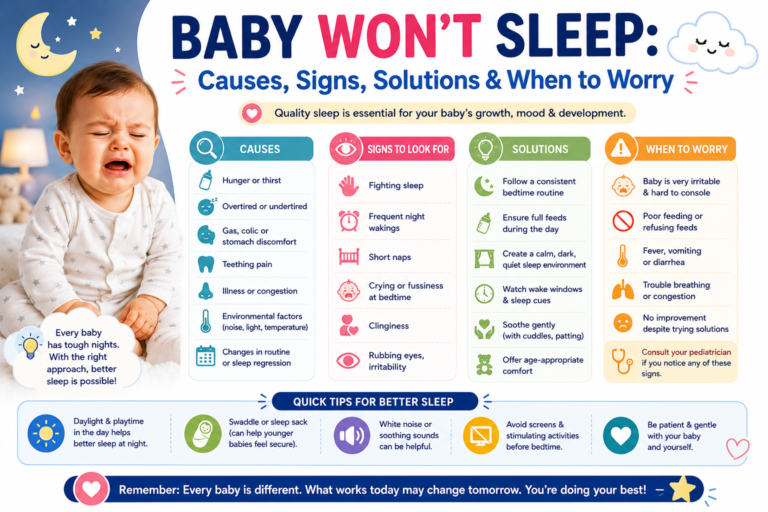
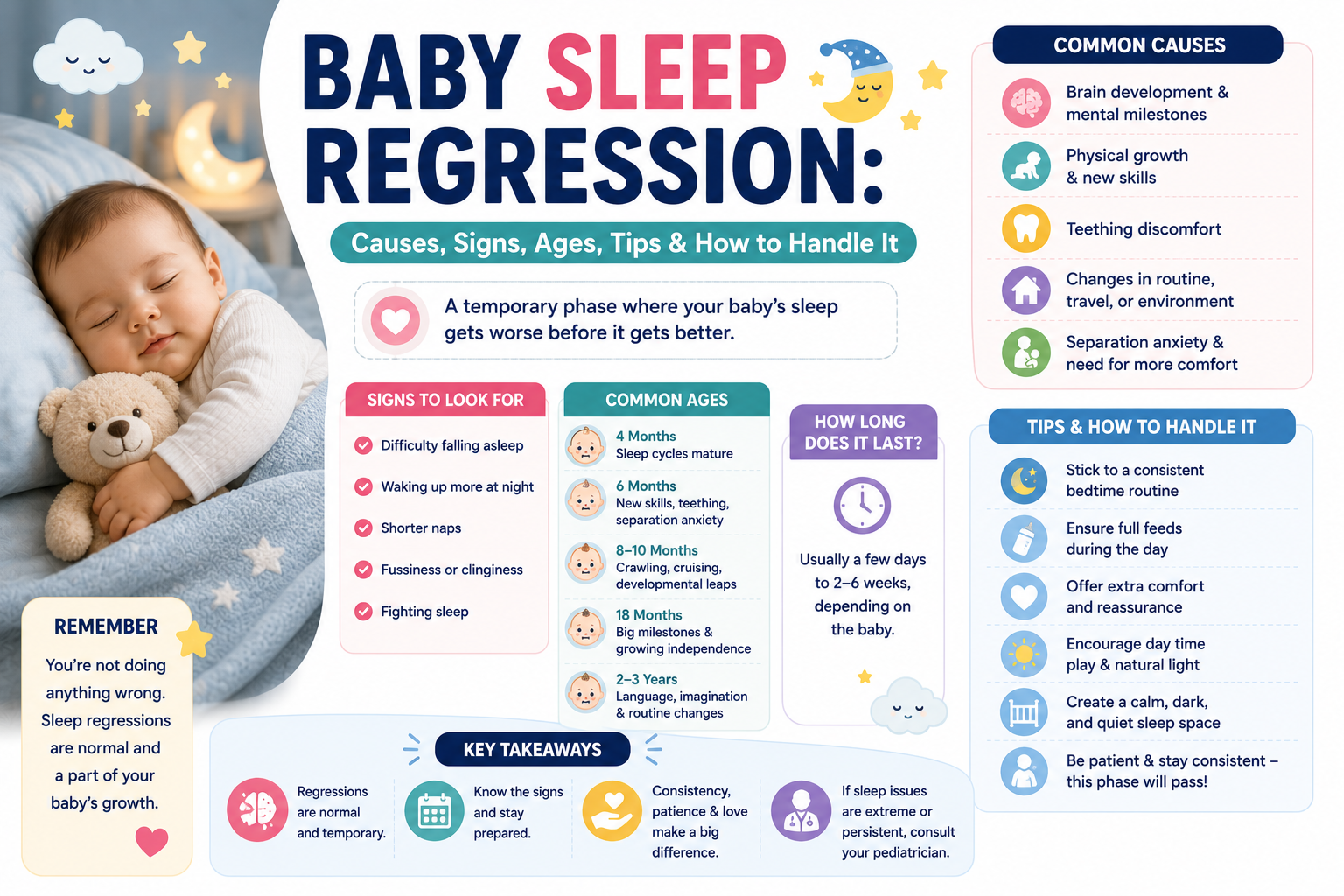

Medical Note: Sleep regression is usually temporary and does not mean you’ve developed “bad sleep habits.” With consistency, patience, and an age-appropriate bedtime routine, most babies return to their regular sleep pattern within a few weeks.
Just when you think your baby has settled into a good sleep routine, they suddenly begin waking up several times a night, resisting naps, or refusing bedtime altogether. This unexpected change can leave parents feeling exhausted and confused. If this sounds familiar, your baby may be experiencing sleep regression.
Baby sleep regression is a temporary period during which a baby who previously slept well begins waking more often or has difficulty falling asleep. Although it can be frustrating, sleep regression is usually a normal part of your baby’s growth and brain development.
Most babies experience sleep regression during key developmental stages, such as 4 months, 6 months, 8–10 months, 12 months, 18 months, and 2 years. These phases often coincide with milestones like rolling over, crawling, standing, walking, talking, or changes in sleep patterns.
This comprehensive guide explains what baby sleep regression is, why it happens, common signs by age, how long it lasts, practical tips to manage it, and when parents should seek medical advice.
If you’re also looking for guidance on newborn sleep schedules, baby growth spurts, or baby feeding and nutrition, explore our related MomSaathi resources for age-specific parenting advice.
What Is Baby Sleep Regression?
Baby sleep regression is a temporary disruption in a baby’s usual sleep pattern, often occurring during periods of rapid physical, cognitive, or emotional development.
During a sleep regression, your baby may:
- Wake more frequently during the night
- Resist naps
- Take shorter naps
- Have difficulty falling asleep
- Wake very early in the morning
- Become fussier than usual
- Want extra comfort or feeding during the night
Sleep regression is not an illness and is generally considered a normal developmental phase.
Is Baby Sleep Regression Normal?
Yes. Sleep regression is common and affects many babies during the first two years of life.
As your baby’s brain develops, they begin learning new skills and processing more information. These developmental changes can temporarily interrupt sleep cycles.
Although every baby is different, most sleep regressions resolve within 2–6 weeks with consistent routines and supportive care.
What Causes Baby Sleep Regression?
Several developmental and environmental factors can contribute to sleep regression.
1. Brain Development
Your baby’s brain is developing rapidly during the first two years.
Learning new skills such as:
- Rolling over
- Sitting
- Crawling
- Standing
- Walking
- Talking
can temporarily make it harder for babies to settle and stay asleep.
2. Changes in Sleep Cycles
Around 4 months, babies begin developing more mature sleep cycles, similar to adults.
This transition can cause:
- More frequent waking
- Lighter sleep
- Difficulty falling back asleep
The 4-month sleep regression is often considered the most noticeable.
3. Growth Spurts
Growth spurts increase your baby’s nutritional needs.
Babies may wake more frequently because they:
- Feel hungrier
- Need additional feeds
- Experience temporary discomfort
Growth spurts commonly occur alongside sleep regressions.
4. Teething
Teething discomfort may disturb sleep.
Signs include:
- Drooling
- Chewing on objects
- Swollen gums
- Fussiness
While teething alone does not always cause sleep regression, it can make existing sleep disruptions worse.
5. Separation Anxiety
Between 8 and 18 months, babies become more aware of their caregivers’ absence.
This may lead to:
- Crying at bedtime
- Night waking
- Difficulty settling without a parent
- Clinginess during the day
6. Illness
Colds, ear infections, fever, and other illnesses can temporarily disrupt sleep.
Most babies return to their usual sleep routine after they recover.
7. Changes in Routine
Travel, moving house, daycare, visitors, or changes in caregivers may temporarily affect sleep patterns.
Maintaining familiar bedtime routines often helps babies adjust.
Signs of Baby Sleep Regression
Common signs include:
- Frequent night waking
- Difficulty falling asleep
- Short naps
- Refusing naps
- Increased crying at bedtime
- Fussiness
- Increased night feeding
- Wanting to be held more often
- Early morning waking
- Separation anxiety
Not every baby experiences all these symptoms.
Baby Sleep Regression by Age
4-Month Sleep Regression
This is often the first major sleep regression.
Common reasons include:
- Mature sleep cycles developing
- Increased awareness
- Brain growth
Signs:
- Frequent waking
- Short naps
- Difficulty settling
Duration:
2–6 weeks
6-Month Sleep Regression
Possible causes include:
- Growth spurts
- Rolling over
- Sitting independently
- Increased hunger
Babies may temporarily wake more often to feed.
8–10 Month Sleep Regression
One of the most common regressions.
Triggers include:
- Crawling
- Pulling to stand
- Separation anxiety
- Increased mobility
Night waking often increases during this period.
12-Month Sleep Regression
Around the first birthday, babies experience:
- Walking
- Talking
- Increased independence
- Transition to fewer naps
These developmental changes may temporarily disrupt sleep.
18-Month Sleep Regression
Common causes include:
- Language development
- Stronger emotions
- Separation anxiety
- Nap transitions
Toddlers may resist bedtime more frequently.
2-Year Sleep Regression
Possible triggers include:
- Imagination
- Nightmares
- Toilet training
- Transition to a toddler bed
- Changes in routine
Many toddlers begin testing bedtime boundaries at this age.
How Long Does Baby Sleep Regression Last?
Most sleep regressions last:
- 2–6 weeks
Some babies recover sooner, while others take slightly longer depending on:
- Age
- Temperament
- Illness
- Developmental milestones
- Sleep routine consistency
Sleep regression is temporary and generally resolves without long-term effects.
Baby Sleep Regression vs Sleep Problems
| Sleep Regression | Sleep Disorder |
|---|---|
| Temporary | Persistent |
| Linked to development | May require medical evaluation |
| Usually lasts 2–6 weeks | May continue for months |
| Improves with routine | May need specialist assessment |
How to Help Your Baby During Sleep Regression
Although sleep regression cannot always be prevented, consistent routines and healthy sleep habits can make this phase easier for both babies and parents.
1. Maintain a Consistent Bedtime Routine
A predictable bedtime routine helps signal to your baby that it’s time to sleep.
Your routine may include:
- A warm bath
- Gentle baby massage
- Changing into comfortable sleepwear
- Reading a short bedtime story
- Singing a lullaby
- Dimming the lights
- Quiet cuddles before putting your baby to bed
Try to keep the bedtime routine consistent every night, even during travel or weekends.
2. Follow Your Baby’s Sleep Cues
Watch for signs that your baby is ready to sleep, such as:
- Rubbing eyes
- Yawning
- Staring into space
- Fussiness
- Pulling ears
- Becoming quieter
Putting your baby to bed when they are sleepy—but not overtired—often helps them fall asleep more easily.
3. Create a Sleep-Friendly Environment
A calm sleep environment can improve sleep quality.
Consider:
- A dark room
- Comfortable room temperature
- White noise (if helpful)
- Minimal distractions
- Safe sleep surface
- Comfortable sleep clothing
Avoid televisions, bright screens, or loud noises before bedtime.
4. Encourage Self-Soothing
If your baby is developmentally ready, allow them a few moments to settle before immediately picking them up.
Some babies naturally learn to:
- Suck their fingers
- Hug a comfort object (only when age-appropriate and safe)
- Roll into a comfortable sleeping position
Always follow safe sleep recommendations for infants.
5. Be Flexible During Growth Spurts
Growth spurts often increase your baby’s hunger.
If your baby genuinely appears hungry during the night, feeding them is appropriate.
Once the growth spurt ends, many babies naturally return to their previous sleep pattern.
Should You Sleep Train During Sleep Regression?
There is no single approach that works for every family.
Some parents choose gentle sleep-training methods after discussing them with their pediatrician, while others prefer to wait until the regression has passed.
Whichever approach you choose:
- Be consistent.
- Use age-appropriate expectations.
- Avoid abrupt changes during illness.
- Never leave a distressed young infant unattended for prolonged periods.
Sleep training is a personal decision and should always prioritize your baby’s safety and emotional well-being.
Feeding During Sleep Regression
Some babies feed more frequently during developmental milestones.
Continue:
- Breastfeeding on demand
- Formula feeding as recommended
- Age-appropriate solid foods
Avoid assuming every night waking is caused by hunger. Babies may also wake because of developmental changes, teething, or a need for comfort.
For more feeding guidance, explore our Baby Feeding & Nutrition and Signs Baby Getting Enough Breast Milk articles.
Sample Sleep Schedule by Age
| Baby’s Age | Total Sleep (24 Hours) | Typical Naps |
|---|---|---|
| Newborn (0–3 Months) | 14–17 hours | No set schedule |
| 4–6 Months | 12–16 hours | 3–4 naps |
| 6–12 Months | 12–15 hours | 2–3 naps |
| 12–18 Months | 11–14 hours | 1–2 naps |
| 18–24 Months | 11–14 hours | 1 nap |
Every baby is different. Some may naturally need slightly more or less sleep than others.
Safe Sleep Recommendations
To reduce the risk of sleep-related accidents:
- Always place your baby on their back to sleep.
- Use a firm, flat mattress.
- Keep pillows, blankets, stuffed toys, and loose bedding out of the crib.
- Share a room (not a bed) with your baby for at least the first six months if possible.
- Avoid overheating your baby during sleep.
- Do not smoke around your baby.
These recommendations are supported by the American Academy of Pediatrics (AAP).
Common Mistakes Parents Should Avoid
During sleep regression, try to avoid:
- Changing bedtime every night
- Skipping naps completely
- Introducing too many new sleep habits at once
- Relying on screens before bedtime
- Assuming every cry means hunger
- Becoming inconsistent with bedtime routines
Temporary flexibility is normal, but consistency usually helps babies return to regular sleep patterns sooner.
Can Baby Sleep Regression Be Prevented?
Sleep regression is a normal developmental stage and cannot always be prevented.
However, healthy sleep habits may reduce its impact:
- Keep a regular bedtime.
- Encourage daytime activity and play.
- Follow age-appropriate nap schedules.
- Create a calm bedtime routine.
- Respond consistently to night waking.
- Ensure your baby receives adequate daytime nutrition.
When Should You See a Pediatrician?
Arrange a medical evaluation if your baby:
- Snores loudly or has pauses in breathing
- Sleeps very little for several weeks
- Has poor weight gain
- Refuses feeds repeatedly
- Seems excessively sleepy during the day
- Has persistent fever or illness
- Shows signs of severe reflux
- Develops sudden sleep changes with other concerning symptoms
Sleep regression alone usually does not require medical treatment, but persistent sleep difficulties should be discussed with your pediatrician.
Emergency Warning Signs
Seek immediate medical care if your baby:
- Has difficulty breathing during sleep
- Turns blue while sleeping
- Is difficult to wake
- Has seizures
- Develops persistent vomiting
- Has a high fever, especially in a young infant
- Shows signs of dehydration
- Stops feeding completely
These symptoms are not typical of sleep regression and require urgent medical evaluation.
Conclusion
Baby sleep regression is a common and temporary part of childhood development. Although frequent night waking, shorter naps, and bedtime resistance can be challenging, these changes often occur as babies reach important physical, emotional, and cognitive milestones.
Maintaining a consistent bedtime routine, following your baby’s sleep cues, and creating a calm sleep environment can help your baby return to healthy sleep patterns. Remember that every child develops at their own pace, and most sleep regressions resolve within 2 to 6 weeks.
If sleep problems persist beyond the expected timeframe or are accompanied by poor feeding, breathing difficulties, or poor growth, seek advice from your pediatrician.
For additional parenting support, explore our Baby Growth Spurts, Baby Feeding & Nutrition, Newborn Sleep Schedule, and Baby Milestones by Month guides on MomSaathi.
Frequently Asked Questions (FAQs)
What is baby sleep regression?
Baby sleep regression is a temporary period when a baby who previously slept well begins waking more often or has difficulty falling asleep due to normal developmental changes.
At what age does sleep regression happen?
Common sleep regressions occur around 4 months, 6 months, 8–10 months, 12 months, 18 months, and 2 years.
How long does sleep regression last?
Most sleep regressions last 2–6 weeks, although the duration varies from baby to baby.
Is the 4-month sleep regression the worst?
Many parents find the 4-month sleep regression the most noticeable because babies transition to more mature sleep cycles.
Does every baby experience sleep regression?
No. Some babies have only mild sleep changes, while others experience more noticeable disruptions.
Can teething cause sleep regression?
Teething discomfort may worsen sleep, but developmental changes are usually the primary cause of sleep regression.
Should I feed my baby during sleep regression?
If your baby is genuinely hungry, continue breastfeeding or formula feeding as needed. Consult your pediatrician if you are unsure.
Is sleep regression a sign something is wrong?
Usually not. Sleep regression is considered a normal developmental phase.
Can sleep regression affect naps?
Yes. Babies may resist naps, take shorter naps, or skip naps during a regression.
Should I change my baby’s bedtime?
It’s usually best to maintain a consistent bedtime rather than making frequent changes.
Is sleep training recommended during sleep regression?
Some families choose gentle sleep-training methods, while others wait until the regression ends. Discuss the best approach with your pediatrician if needed.
Can illness cause sleep regression?
Yes. Colds, ear infections, and other illnesses can temporarily disrupt sleep patterns.
How can I help my baby sleep better?
Maintain a calming bedtime routine, respond consistently, create a sleep-friendly environment, and follow your baby’s sleep cues.
When should I call a doctor?
Consult your pediatrician if sleep problems persist for several weeks, or if your baby has poor feeding, breathing difficulties, poor weight gain, or other concerning symptoms.
Will my baby eventually sleep through the night again?
In most cases, yes. As your baby adjusts to developmental milestones and routines remain consistent, sleep typically improves over time.