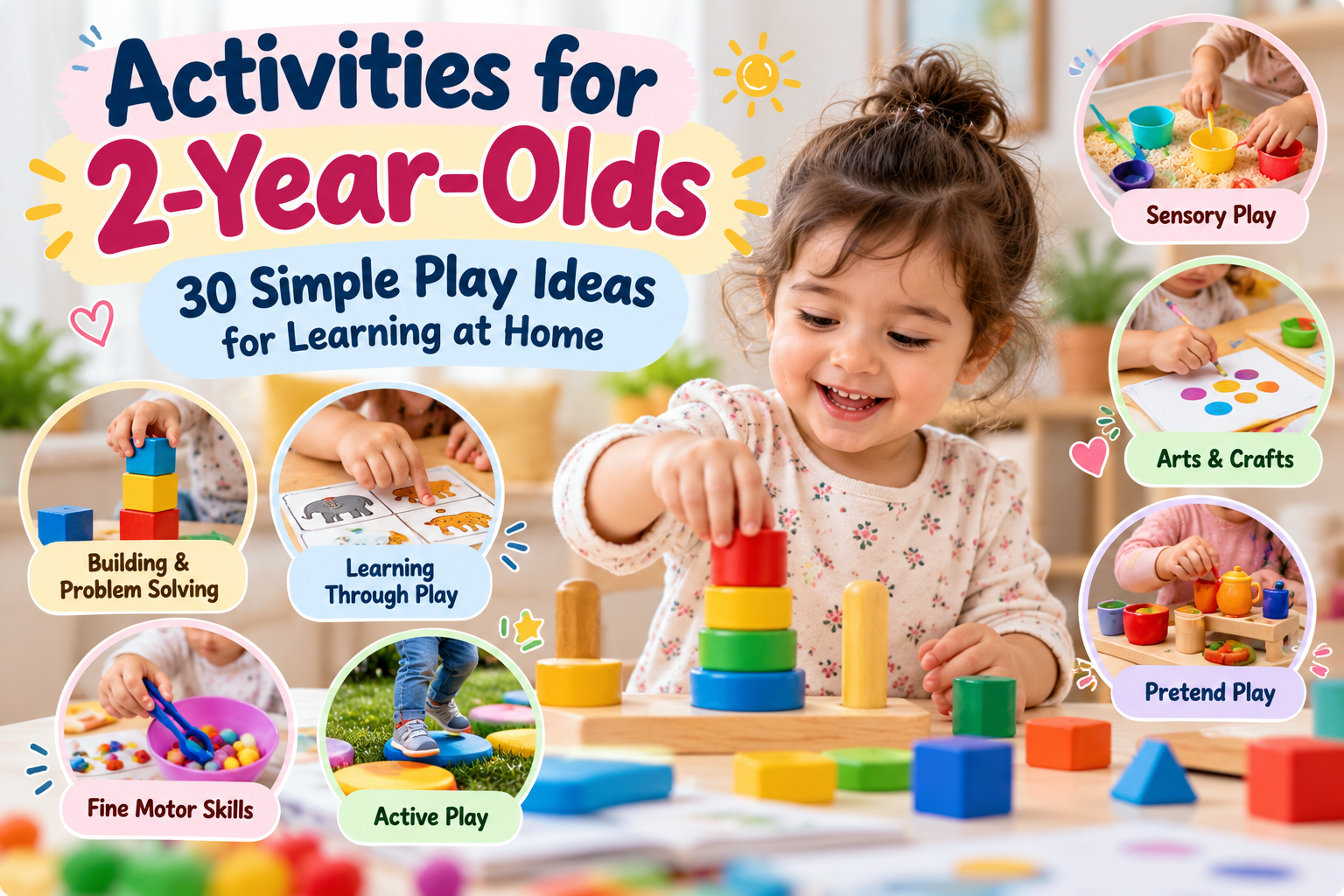

Two-year-olds learn through movement, imitation, conversation, repetition and hands-on discovery. You do not need expensive toys or a packed timetable. These simple, supervised activities use familiar materials to encourage language, coordination, creativity and problem-solving.
Every child develops at a different pace. Keep play enjoyable, follow your toddler’s interests and stop when they lose interest.
Find a play idea in 10 seconds
Choose what your toddler feels like doing right now. Open a section to find a quick activity. Keep the activity child-led and supervise throughout.
My toddler has lots of energy
Try Dance and freeze, Bubble chase or Soft-ball rolling. Clear the floor first and stay close.
My toddler wants a quiet activity
Try Chunky puzzles, Picture-book pointing or Family photo chat. Sit together and follow your child’s attention.
We have only 5 minutes
Try Animal sounds, Colour hunt or Follow the leader. A short burst of shared play is enough.
We want to use things already at home
Try Matching socks, Block transfer or Clean-up game. Use only large, safe objects and supervise closely.
Try the 7-day play challenge
Tick an activity after you try it together. There is no need to complete every day—repeat a favourite or skip a day whenever it suits your family.
Tip: Your ticks are temporary and may reset when you refresh or leave the page. This checklist does not store your child’s information.
Make the activity easier or harder
If my toddler gets frustrated
Make the task simpler, demonstrate one step, offer a choice between two activities or take a break. Avoid turning play into a test.
If my toddler finishes quickly
Repeat the activity in a new way: use a different colour, take turns, add a simple word or invite your toddler to show you what happens next.
If my toddler does not want to join
Play alongside them without pressure. Your child may watch first, join later or choose another activity. Respect their cues.
How to plan play for a 2-year-old
- Offer one simple activity at a time.
- Expect repetition; repeating a game gives toddlers practice.
- Use age-appropriate, non-toxic materials without small parts, button batteries, magnets or sharp edges.
- Supervise water, food, climbing and outdoor play continuously.
- Let your child try first, then demonstrate if needed.
30 fun activities for 2-year-olds
Sensory and discovery play
- Texture basket: Offer a soft cloth, large sponge and silicone spatula. Name each texture together.
- Block transfer: Let your toddler move large blocks between two bowls using their hands.
- Water painting: Give a large brush and a little water to paint an outdoor surface while you supervise.
- Nature observation: Look at large leaves and flowers outdoors. Do not allow tasting or handling unknown plants.
- Sound discovery: Compare gentle sounds made by a wooden spoon tapping a pot and a soft toy being squeezed.
Fine-motor and problem-solving play
- Large-block towers: Build and knock down towers with age-appropriate blocks.
- Posting game: Drop large toddler-safe blocks into a wide container and tip them out.
- Shape sorting: Match large shapes to openings in a toddler toy.
- Big stickers: Place large easy-peel stickers on paper with close supervision.
- Chunky puzzles: Try simple two- to four-piece puzzles with large pieces.
Language and pretend play
- Picture-book pointing: Ask where familiar animals or objects are and name what your child points to.
- Action songs: Sing familiar songs with gestures and repeated words.
- Pretend tea party: Use large toy cups and plates to practise taking turns.
- Animal sounds: Name an animal, make its sound and invite your toddler to copy.
- Everyday helper: Ask your child to put safe clothes in a basket or carry a light napkin.
Movement and coordination
- Soft-ball rolling: Sit opposite each other and roll a large soft ball.
- Follow the leader: Walk, clap, stretch and march together on a clear floor.
- Floor path: Walk along a line made with masking tape placed securely on the floor.
- Dance and freeze: Dance to music, then pause when the music stops.
- Bubble chase: Blow bubbles and encourage your toddler to walk and reach for them outdoors.
Creativity and everyday learning
- Crayon scribbling: Offer large non-toxic toddler crayons and paper; supervise closely.
- Big-paper mural: Tape a large sheet of paper to a low surface and draw together.
- Colour hunt: Find familiar objects of one colour around the room.
- Matching socks: Pair large, clean socks by colour or pattern.
- Toy wash: Wash a few large plastic toys in a shallow basin while an adult stays within arm’s reach.
- Snack helper: Let your toddler place pre-cut soft fruit on a plate. An adult must prepare food safely and supervise eating.
- Shape walk: Find circles and squares in everyday surroundings.
- Family photo chat: Look at familiar photographs and name people and actions.
- Pretend home: Make a simple den with a blanket over a low table, ensuring airflow and stability.
- Clean-up game: Put large toys into a basket together and name each one.
A simple play routine
There is no single ideal activity timetable. Across the day, offer books, active play, creative play and outdoor time alongside meals, naps, free play and family routines. Follow your child’s energy and cues rather than forcing every activity.
Safety tips parents should remember
Stay within arm’s reach around water, including buckets and tubs. Avoid small objects, loose parts, balloons, button batteries, magnets, plastic bags and foods that may cause choking. Keep craft materials non-toxic and age-appropriate. Never leave a toddler unattended near stairs, in a bathroom, on furniture or outdoors.
When to discuss development with a professional
Play ideas are not a developmental test. If you are concerned about communication, movement, hearing, social interaction or loss of a skill your child previously had, discuss it with your child’s paediatrician. They can review development and advise whether screening or support is appropriate.
Frequently asked questions
How long should a 2-year-old do one activity?
There is no fixed duration. Many toddlers move between activities quickly. Follow their interest and offer another option when they are ready.
Do 2-year-olds need educational toys?
No. Books, blocks, pretend play, music, conversation and safe everyday objects can all create useful learning opportunities.
Are screen-based activities a substitute for play?
They should not replace sleep, movement, conversation or hands-on play. Choose age-appropriate content and watch or interact together when screens are used.
Final thoughts
The best activities for 2-year-olds are simple, safe and shared with a responsive adult. Rotate a few ideas, repeat favourites and let curiosity lead. Everyday moments—reading, sorting laundry, singing and helping—can become meaningful play. For more ideas, see our screen-free activities for kids.