
Big feelings are part of growing up. A child may become overwhelmed after a busy day, feel frustrated when a toy does not work, or struggle to explain why they are upset. In these moments, telling a child to “calm down” rarely teaches them what to do next. A calm-down corner offers a small, predictable space where children can pause, feel supported and practise simple ways to regulate emotions.
A calm-down corner is not a punishment area, a place to isolate a child or a way to stop tears quickly. It is a supportive space that a child can use with an adult’s help. You do not need an expensive sensory kit or a separate room. A quiet corner, a few safe objects and a caring response are enough to begin.
What is a calm-down corner?
A calm-down corner is a comfortable, child-friendly spot designed to support emotional regulation. It may include cushions, picture books, feelings cards, soft toys, drawing materials or a simple breathing prompt. Children can use it when they feel angry, worried, disappointed, overstimulated or simply need a quiet break.
The purpose is not to make an emotion disappear. It is to help a child notice what they are feeling, feel safe and gradually learn what may help. Younger children will need an adult nearby; older children may begin choosing tools independently.
Calm-down corner vs. time-out: What is the difference?
| Calm-down corner | Punitive time-out |
|---|---|
| Offers a supportive place to pause | May be used to remove a child for misbehaviour |
| Adult stays available and helps when needed | Can leave a child feeling isolated |
| Focuses on recognising feelings and practising skills | Often focuses on stopping behaviour |
| Child is encouraged, not forced, to use it | May be imposed as a consequence |
| Connection and problem-solving follow the pause | May end without teaching a replacement skill |
A calm-down corner should never be used to shame, threaten or confine a child. If a child does not want to use it, stay close, reduce stimulation where possible and offer comfort in another safe place.
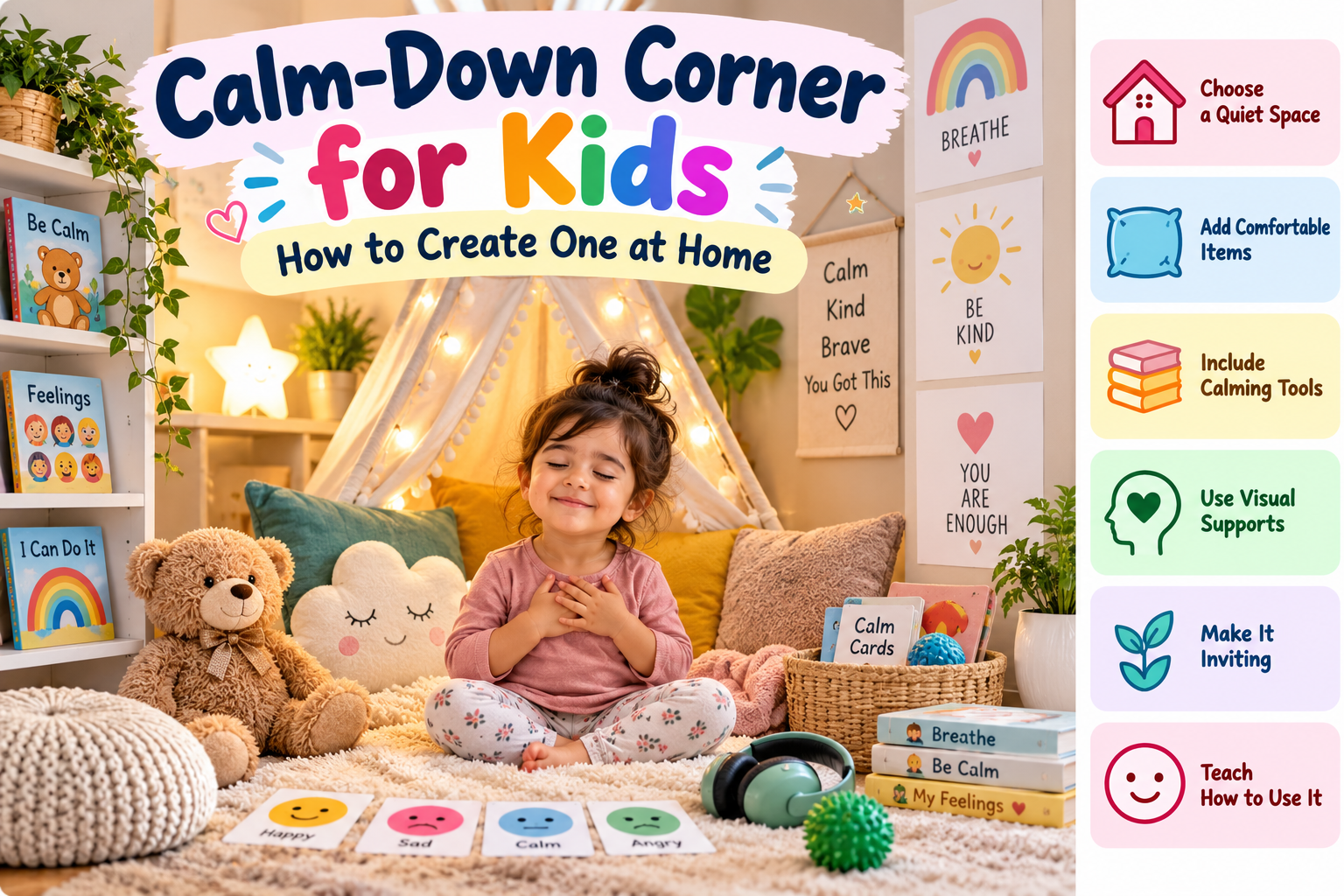
How to create a calm-down corner at home in 7 simple steps
1. Choose a quiet, visible spot
Select a low-traffic corner of a bedroom, living room or play area. It should feel comfortable but not hidden away or locked. Keep it within sight or easy reach of an adult, especially for toddlers and preschoolers. A small floor mat or a space beside a bookshelf can work.
2. Make it comfortable, not overstimulating
Add a washable cushion, a soft mat or a small chair. Choose gentle colours and keep the area uncluttered. Too many toys, flashing lights or noisy gadgets may make the space less calming for some children. Follow your child’s preferences: some like a cosy nook, while others prefer an open space.
3. Add a simple feelings chart
Use pictures or simple words for emotions such as happy, sad, angry, worried, excited and tired. For young children, photographs or clear faces can be easier to understand than written labels. Point to the chart together and say, “I wonder if you are feeling frustrated.” Avoid insisting that your guess is correct.
4. Offer a few safe calming tools
Start with two or three options rather than filling a basket with everything. You might include a soft toy, a sturdy picture book, paper and crayons, or a child-safe sensory item suitable for your child’s age. Check every item for loose parts, choking hazards, sharp edges, allergens and damage. Avoid small objects for children who still mouth items.
5. Display one or two easy calming ideas
Keep instructions short and visual. For example: “Smell the flower, blow the candle” can help a child practise a slow breath through pretend play. You can also suggest squeezing a cushion, asking for a hug, drawing a feeling or listening to a quiet story. Breathing should never be forced or used as a test.
6. Let your child help set it up
Invite your child to choose a cushion, book or drawing pad. Explain that the corner is available whenever they need a break. When children help create the space, they may be more willing to explore it. Do not make access dependent on behaving well.
7. Practise when everyone is calm
Introduce the space during a relaxed moment, not for the first time in the middle of a meltdown. Demonstrate how to choose a book, hold a soft toy or take a gentle breath. Visit together for a minute or two. The aim is familiarity, not a lesson that your child must perform perfectly.
What to put in a calm-down corner: Age-wise ideas
For toddlers (1–3 years)
- A soft mat or cushion placed safely on the floor.
- A familiar soft toy or comfort object without detachable parts.
- Board books showing simple emotions or everyday situations.
- A few large crayons and paper, used with adult supervision.
- A simple feelings picture with two or three clear expressions.
Toddlers need an adult to co-regulate with them. Stay nearby, use a gentle voice and offer simple words such as, “You are upset. I am here.” Do not expect a toddler to go to the corner and manage strong feelings alone.
For preschoolers (3–5 years)
- Feelings cards or a basic emotion wheel.
- Picture books about frustration, worry, friendship and sharing.
- Paper, washable crayons and a feelings drawing prompt.
- A child-safe breathing picture or simple movement cards.
- A soft toy that the child can hold while talking.
Offer two choices: “Would you like to draw or look at a book?” Too many choices can feel overwhelming when a child is already upset.
For school-age children (6–10 years)
- A journal or notepad for writing or drawing.
- A short list of coping ideas the child helped create.
- Age-appropriate books or a puzzle with safe, large pieces.
- Headphones for quiet audio, if appropriate and used with supervision.
- A card that reminds the child how to ask an adult for help.
Older children can help decide what belongs in the space and when they want privacy while still knowing that a trusted adult is available. Keep expectations flexible: some children prefer movement, conversation or time with a parent instead of sitting quietly.
How to use a calm-down corner during a difficult moment
- Regulate yourself first. Pause, lower your voice and make sure the environment is safe. A calm adult response can help a child feel less overwhelmed.
- Connect before correcting. Try, “That was frustrating. I am here with you.” Avoid lectures while the child is highly upset.
- Offer the space as an option. Say, “Would you like to sit here with me, or have a little space while I stay nearby?” Do not drag or force the child into the corner.
- Give time. Some children want a hug; others need fewer words. Watch your child’s cues and respect safe preferences.
- Talk after the intense feeling has passed. Briefly discuss what happened and what might help next time. Keep the conversation age-appropriate.
- Repair and reconnect. If someone was hurt or something was damaged, help your child take a suitable next step, such as checking on the person, helping tidy up or practising a safer way to express frustration.
What parents can say when a child is upset
Simple, reassuring language is often more helpful than long explanations. You can try:
- “I can see this is hard. I am here.”
- “It is okay to feel angry. It is not okay to hit.”
- “Would you like a hug, some space or help?”
- “Let’s take one slow breath together if that feels comfortable.”
- “When you are ready, we can work out what to do next.”
Avoid phrases such as “Stop crying,” “You are being silly,” or “Go there until you behave.” These can make a child feel that emotions themselves are unacceptable. Set clear limits on unsafe behaviour while showing that the child is still cared for.
Common mistakes to avoid
- Using the corner as a punishment: This changes its purpose from support to exclusion.
- Expecting instant calm: Children learn emotional skills through repetition and adult support.
- Forcing a child to sit alone: A child may need connection, movement or a different safe space.
- Adding too many objects: A crowded corner can become distracting and difficult to maintain.
- Using unsafe sensory items: Check age guidance, choking risks, cords, batteries, magnets and small parts.
- Only introducing it during meltdowns: Explore the space together when your child is relaxed.
- Ignoring the reason behind behaviour: Hunger, tiredness, transitions, sensory overload or communication difficulties may contribute to distress.
Does a calm-down corner really work?
A calm-down corner is a practical way to make coping tools accessible, but it is not a guaranteed solution or a treatment for emotional or behavioural difficulties. Its usefulness depends on the child’s age, needs, the adult’s response and whether the space is used supportively. Some children may prefer a walk, a cuddle, quiet music or talking with a trusted adult.
Think of the corner as one tool in a wider approach that includes predictable routines, warm relationships, clear boundaries, enough rest and opportunities for play. If your child’s distress is frequent, intense, affects everyday life or raises concerns about safety, speak with a paediatrician or qualified child mental health professional for individual guidance.
Frequently asked questions
At what age can a child use a calm-down corner?
You can introduce a simple cosy space in toddlerhood, but young children need an adult to stay with them and guide the process. As children grow, they can gradually choose tools and use the space more independently.
How long should a child stay in a calm-down corner?
There is no fixed time limit. It is not a timed punishment. Let the child’s needs guide the pause, stay available and reconnect when they are ready. Do not use a timer to force a child to stop feeling upset.
Should I send my child to the calm-down corner after hitting?
First make sure everyone is safe and calmly stop the hitting. You can offer a supported pause, but do not frame the corner as a punishment. Once your child is calmer, set a clear limit and help them practise a safer response.
What if my child refuses to use the calm-down corner?
Do not force it. Offer comfort or a different safe option, such as sitting beside you, getting a drink of water or moving to a quieter area. The goal is emotional support, not compliance with a particular space.
Can I create a calm-down corner in a small home?
Yes. A cushion beside a bookshelf, a small basket of books and a feelings card can be enough. The quality of the adult’s support matters more than the size or decoration of the space.
Related MomSaathi guides
- Toddler Tantrums Explained: A Parent’s Guide
- Emotional Development by Age: Milestones and Parent Guide
- Gentle Parenting Techniques for Newborns and Toddlers
Further reading
- American Academy of Pediatrics: Helping Children Build Resilience
- UNICEF Parenting: Child Development
Final thoughts
A calm-down corner does not need to look perfect or contain expensive products. It needs to communicate one important message: every feeling can be heard, and your child does not have to handle difficult moments alone. Start small, practise together when things are calm and stay flexible about what helps your child. Over time, these supported moments can give children more chances to recognise emotions, ask for help and practise safer ways to respond.