
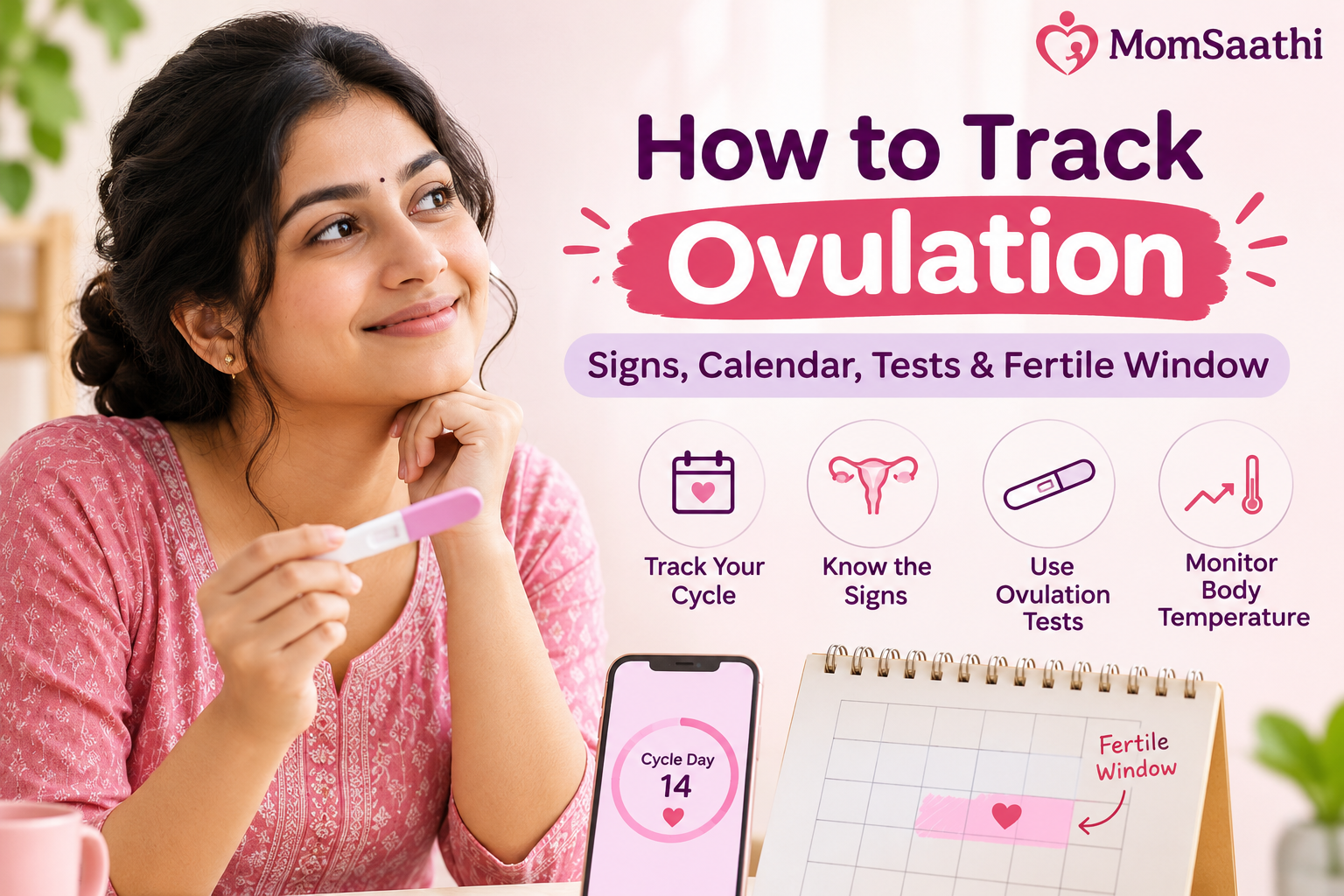
How to Track Ovulation: Signs, Calendar, Tests and Fertile Window

Trying to conceive can make it useful to understand when ovulation happens. Ovulation is the release of an egg from an ovary. It usually occurs once during a menstrual cycle, and the days leading up to ovulation are the most fertile time because sperm can survive in the reproductive tract for several days while the egg remains available for a shorter time after release.
This guide explains practical ways to estimate ovulation, recognise possible signs, use a calendar or app, and know when to seek medical advice. Tracking can help you understand your cycle, but no home method can confirm the exact day of ovulation with complete certainty.
What is ovulation?
Ovulation is part of the menstrual cycle. A developing follicle in an ovary releases an egg. If sperm fertilises the egg, pregnancy may occur. If fertilisation does not happen, hormone levels change and a menstrual period usually follows.
The first day of menstrual bleeding is counted as Day 1 of the cycle. Cycle length is counted from the first day of one period to the day before the next period begins. A 28-day cycle is often used as an example, but cycle length varies between people and can vary from month to month.
When does ovulation happen?
Ovulation does not happen on Day 14 for everyone. It often occurs roughly 12 to 16 days before the next period begins. This is why estimating ovulation by counting 14 days from the start of a period can be inaccurate, particularly if cycles are shorter, longer or irregular.
The fertile window is generally considered to be the five days before ovulation and the day of ovulation. Having sex every one to two days during this window can help improve the chance of conception. If timing intercourse is stressful, regular sex every two to three days throughout the cycle is another practical approach.
How to track ovulation
1. Record your menstrual cycle
Write down the first day of each period and the number of days until the next period starts. Track several cycles rather than relying on one month. A calendar can help you notice patterns, but it estimates rather than proves when ovulation occurs.
2. Observe cervical mucus
As ovulation approaches, cervical mucus may become clearer, wetter, slippery and stretchy, similar to raw egg white. This change can indicate that you are approaching your fertile days. Mucus observations can be affected by infections, semen, lubricants and some medicines, so interpret them alongside other signs.
3. Use an ovulation predictor kit
Urine ovulation predictor kits detect a rise in luteinising hormone (LH), which commonly occurs about 24 to 36 hours before ovulation. Follow the kit instructions carefully, including the recommended testing time and when to begin testing. A positive result suggests ovulation may be approaching; it does not guarantee that an egg was released. Some people with conditions such as polycystic ovary syndrome (PCOS) may have results that are harder to interpret.
4. Track basal body temperature
Basal body temperature (BBT) is your resting temperature immediately after waking. Measure it before getting out of bed, at around the same time each morning, using a suitable thermometer. After ovulation, progesterone often causes a small temperature rise. A sustained rise can help identify that ovulation probably happened, but it usually confirms the pattern after the fertile window rather than predicting it in advance.
5. Use a cycle-tracking app
An app can store period dates, symptoms, mucus observations and test results. Its predicted fertile window is an estimate based on the information entered and previous cycles. Do not treat an app prediction as proof of ovulation or use it as reliable contraception unless the method has been specifically designed and taught for that purpose.
Example: estimating an ovulation window
If your cycles are consistently about 30 days long, ovulation may occur around 14 to 16 days before your next period, often near Day 14 to Day 16. Your fertile window may therefore begin several days earlier. This is only an illustration: your own timing may differ, and tracking several cycles gives a more useful picture.
Possible signs of ovulation
- Clear, slippery or stretchy cervical mucus.
- A positive urine LH test.
- A small, sustained rise in basal body temperature after ovulation.
- Mild one-sided lower abdominal discomfort in some people.
- Breast tenderness, bloating or changes in sexual interest in some people.
Not everyone notices symptoms. Pain, discharge or bleeding should not automatically be assumed to be ovulation-related, especially if symptoms are severe, persistent, unusual or accompanied by fever.
What if your periods are irregular?
Calendar predictions are less reliable when cycle lengths vary. Consider recording period dates and symptoms for several months and discussing the pattern with a gynaecologist. Irregular or absent periods can have several causes, including PCOS, thyroid conditions, significant weight changes, stress, intense exercise and other health factors. A clinician can advise whether tests or treatment are appropriate.
When should you speak to a doctor?
Consider seeking medical advice if your periods are consistently very irregular or absent, you have severe pelvic pain, you suspect a hormonal or reproductive health condition, or you have concerns about fertility. General guidance commonly recommends a fertility evaluation after 12 months of trying to conceive if you are under 35, after 6 months if you are 35 or older, and sooner when you are over 40 or have known reproductive health concerns. Individual circumstances may warrant earlier advice.
Seek urgent medical care for severe abdominal or pelvic pain, fainting, heavy bleeding, fever or pain with a possible pregnancy.
FAQs about ovulation tracking
Can I ovulate on Day 10?
Yes. Ovulation timing varies. A shorter cycle may be associated with earlier ovulation, but cycle length alone cannot confirm the exact day.
Can I get pregnant if I have sex after ovulation?
The chance is generally highest in the days before ovulation and on the day itself. The egg is usually viable for a relatively short time after release, so the chance falls quickly after ovulation.
Does a positive ovulation test mean I will definitely ovulate?
No. It detects an LH rise that often precedes ovulation, but it does not confirm that ovulation occurred. A clinician may use other assessments when confirmation is needed.
Can an app tell me my exact ovulation date?
No. Apps estimate based on cycle information. Combining records with cervical mucus observations or LH tests may provide more useful clues, but no app can guarantee an exact date.
Is basal body temperature useful for predicting ovulation?
It is more useful for recognising a temperature pattern after ovulation than for predicting the fertile window in advance.
Key takeaway
Tracking your period dates, cervical mucus, LH tests and basal body temperature can help you understand your cycle and estimate your fertile window. Use more than one clue where helpful, remember that predictions are not guarantees, and speak with a qualified healthcare professional if your cycles are irregular or you have fertility concerns.
Medical sources to verify during editorial review
- American College of Obstetricians and Gynecologists (ACOG): Fertility awareness-based methods of family planning — https://www.acog.org/womens-health/faqs/fertility-awareness-based-methods-of-family-planning
- National Health Service (NHS): Periods and fertility in the menstrual cycle — https://www.nhs.uk/conditions/periods/fertility-in-the-menstrual-cycle/
- ASRM: Optimizing natural fertility — https://www.asrm.org/practice-guidance/practice-committee-documents/optimizing-natural-fertility-a-committee-opinion-2022/
Editorial note: This is general educational information, not a diagnosis or a substitute for individual medical advice. Verify all medical references and have the article reviewed before publication.