
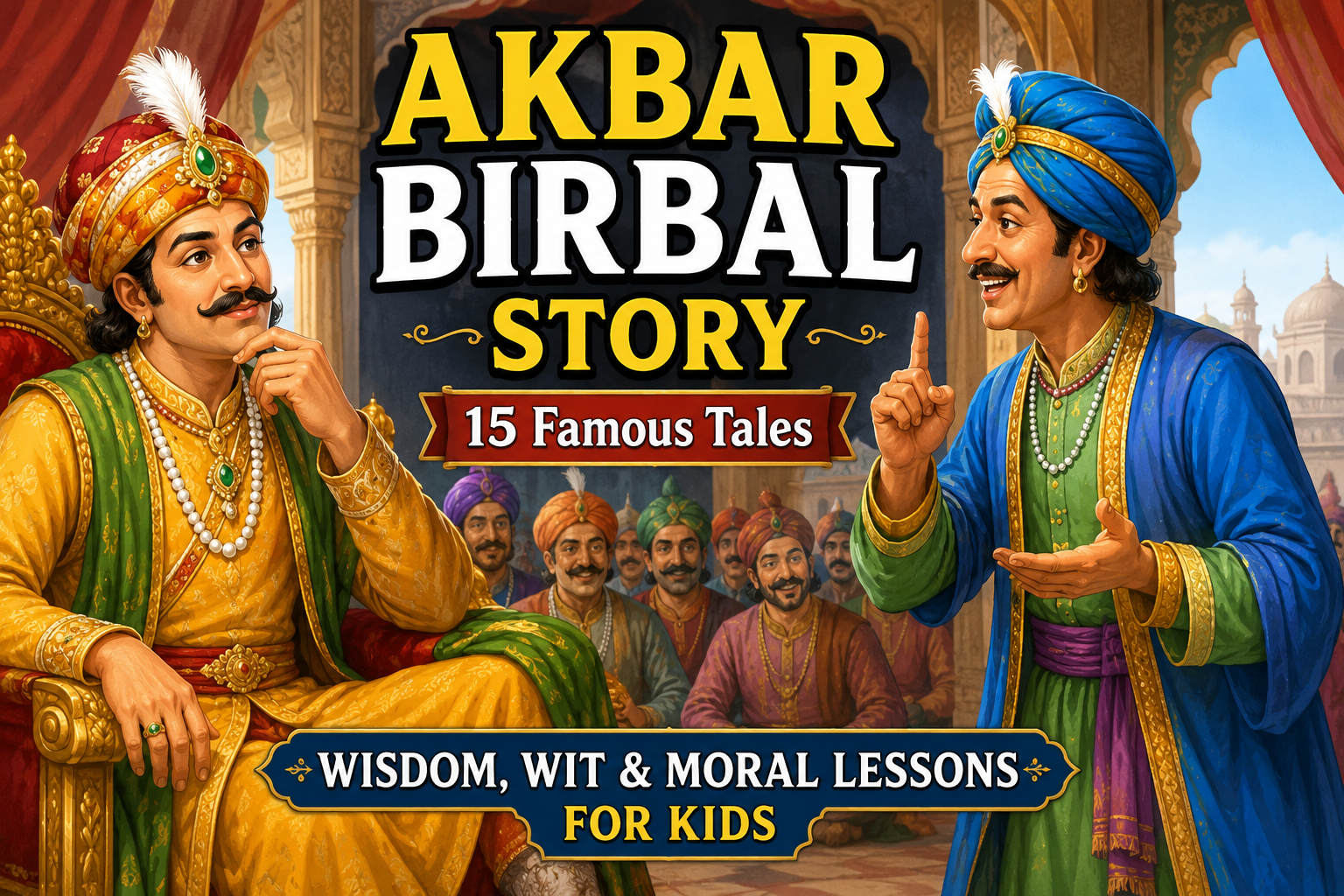

Editorial Note: This collection retells popular Akbar-Birbal tales in child-friendly language for reading and educational purposes. Many stories associated with Akbar and Birbal belong to folklore and oral storytelling traditions, so plot details, dialogue, titles, and moral lessons may vary across books, regions, languages, and retellings. Historical figures and later folk narratives should not be treated as identical.
Introduction
Akbar Birbal stories have entertained generations of children with clever puzzles, humorous situations, and memorable lessons about fairness, intelligence, patience, honesty, and presence of mind.
The stories usually feature Emperor Akbar and Birbal, his famous courtier, in situations where a difficult question, dispute, or unusual challenge must be solved. Birbal often responds with wit rather than force, making these tales especially engaging for children.
In this collection, you can read 15 Akbar Birbal stories for kids, each retold in simple language with a short moral lesson. Because these tales come through folklore and repeated retellings, story titles, dialogue, and details may differ from one version to another.
These stories have been passed down through generations as popular Indian folk tales and remain a favorite choice for bedtime reading and storytelling sessions for children.
Quick Answer: Akbar-Birbal stories are popular Indian tales known for clever questions, witty answers, humour, and problem-solving. In many stories, Emperor Akbar presents a puzzle or difficult situation, and Birbal responds with intelligence and presence of mind. Popular tales include Birbal’s Khichdi, Counting the Crows, The Honest Merchant, The Wise Answer, and other stories whose titles and details may vary across retellings.
Whether it is solving a difficult puzzle, answering a tricky question, or delivering justice with wisdom, Birbal’s intelligence always amazed Emperor Akbar and everyone in his royal court. Through simple yet meaningful narratives, children learn important values such as kindness, patience, fairness, and problem-solving skills.
If you are looking for the best Akbar Birbal stories in English with morals, this collection will take you into a world of clever answers, funny incidents, and unforgettable lessons.
These stories are a part of India’s rich Indian storytelling traditions that preserve wisdom, culture, and values across generations.
Who Were Akbar and Birbal?
Emperor Akbar was one of the most famous rulers of the Mughal Empire in India. His reign was known for administration, cultural growth, and his appreciation for knowledge. Among the many scholars and ministers in his court, Birbal was especially admired for his exceptional intelligence, quick wit, and ability to solve complicated problems with simple ideas.
The historical background of Birbal explains his role as one of Akbar’s most trusted advisors and a respected poet in the Mughal court.
Although Akbar was a real historical ruler and Birbal was his trusted advisor, many famous Akbar Birbal stories are traditional folk tales that have been shared orally over generations. These stories combine historical characters with imagination to teach wisdom and moral values.
You can learn more about Emperor Akbar’s life and reign, including his contributions to administration, culture, and the Mughal Empire.
1. The Crows in the Kingdom
One morning, Emperor Akbar looked out of his palace window and noticed many crows flying around.
He asked Birbal, “Tell me, how many crows are there in our kingdom?”
The courtiers became nervous because they believed it was impossible to answer such a strange question. However, Birbal calmly replied, “Your Majesty, there are exactly eighty thousand four hundred and fifty crows in the kingdom.”
Akbar smiled and asked, “What if there are more crows than your count?”
Birbal quickly replied, “Then some crows must have come to visit their relatives here.”
“And what if there are fewer?” Akbar asked.
“Then some of our kingdom’s crows must have gone to visit their relatives elsewhere,” answered Birbal.
Akbar laughed and praised Birbal’s clever reply.
Moral:
Intelligence and quick thinking can solve even the most difficult situations.
2. Birbal’s Khichdi
During a cold winter evening, Akbar announced that anyone who could stand in the freezing lake throughout the night would receive a great reward.
A poor man accepted the challenge. He stood in the cold water all night and successfully completed the task.
The next day, when he came to claim his reward, Akbar asked him how he managed to survive the freezing night.
The man answered, “I kept looking at a distant lamp and thought about its warmth.”
Some courtiers argued that the lamp had provided him warmth, and therefore he did not deserve the reward.
The poor man left disappointed.
Birbal wanted to teach Akbar a lesson. The next day, he invited the emperor for lunch. When Akbar arrived, he saw a pot of khichdi hanging high above a small fire.
He asked, “Birbal, how can the food cook when the fire is so far away?”
Birbal smiled and replied, “If a distant lamp can provide warmth to a man standing in a lake, then this fire can surely cook the food.”
Akbar realized his mistake and rewarded the poor man.
Moral:
Justice should be fair and compassionate.
3. The Missing Ring
One day, Emperor Akbar lost his precious ring. He suspected that someone in his court had stolen it and asked Birbal to identify the thief.
Birbal looked at all the courtiers and announced, “The person who stole the ring has a piece of straw stuck in his beard.”
Immediately, one court member touched his beard in fear.
Birbal noticed his reaction and identified him as the thief. The guilty man confessed his mistake and returned the ring.
Akbar was impressed by Birbal’s intelligence.
Moral:
A guilty conscience often reveals the truth.
4. The Farmer’s Well
A farmer bought a well from his neighbor. However, when he tried to take water from it, the neighbor stopped him.
The neighbor argued, “I sold you the well, but I never sold you the water inside it.”
The farmer approached Emperor Akbar for justice.
After listening carefully, Birbal gave a clever judgment.
He said, “If the well belongs to the farmer, you have no right to keep your water inside his property. Remove your water immediately, or pay him rent for storing it.”
The neighbor realized his mistake and apologized.
Moral:
True justice requires wisdom and fairness.
5. Birbal’s List of Fools
Once, a merchant promised Emperor Akbar that he would bring rare items from a foreign land. Akbar gave him a large amount of money without any guarantee.
After many days, the merchant did not return.
Akbar asked Birbal to prepare a list of the biggest fools in the kingdom.
To Akbar’s surprise, his own name appeared at the top of the list.
Angrily, Akbar asked, “How dare you call your emperor a fool?”
Birbal respectfully answered, “Your Majesty, you trusted a stranger with your wealth without any proof that he would return.”
Akbar then asked, “What if the merchant comes back?”
Birbal replied, “Then I will remove your name and write his instead.”
Akbar laughed and appreciated Birbal’s honesty and courage.
6. The Clever Answer to the Emperor’s Question
One day, Emperor Akbar asked his courtiers a difficult question, “What is the most powerful thing in the world?”
Many ministers gave different answers. Some said wealth, while others believed it was an army or a king’s authority.
When Birbal’s turn came, he replied, “Your Majesty, the most powerful thing in this world is wisdom.”
Akbar asked him to explain.
Birbal said, “Wealth can disappear, strength can fade, and power can change hands. But wisdom helps a person make the right decisions and overcome any challenge.”
Akbar appreciated Birbal’s thoughtful answer.
Moral:
Wisdom is a person’s greatest strength.
7. Birbal and the Pot of Wisdom
A rich man once asked Birbal if wisdom could be bought with money.
Birbal smiled and handed him an empty pot, saying, “This pot is filled with wisdom.”
The rich man looked confused and asked how an empty pot could contain wisdom.
Birbal replied, “The value of wisdom does not lie in things you can see or touch. It comes from experience, learning, and understanding.”
The man understood that knowledge was more valuable than material possessions.
Moral:
True wisdom cannot be purchased; it is gained through learning and experience.
8. The Mango Tree Dispute
Two neighbors came to Akbar’s court arguing over ownership of a mango tree. Both claimed they had planted and cared for the tree.
Akbar asked Birbal to solve the matter.
Birbal secretly sent a message to both men, saying that thieves were planning to steal the mangoes from the tree that night.
The first man immediately rushed to protect the tree. The second man showed no concern.
The next day, Birbal announced that the first man was the real owner because his actions showed genuine love and responsibility toward the tree.
Akbar praised Birbal’s intelligent judgment.
Moral:
Actions reveal the truth better than words.
9. Birbal’s Dream
One morning, Akbar told Birbal about a strange dream. He said, “I dreamt that I was eating delicious sweets while you were eating mud.”
Birbal smiled and replied, “Your Majesty, I also had a dream. In my dream, after we finished eating, we cleaned each other’s faces.”
The clever response made Akbar laugh and taught him not to make fun of others.
Moral:
Humor and intelligence can overcome insults gracefully.
10. The Foolish Thief
A thief once entered a wealthy man’s house and stole many valuable items. However, while escaping, he accidentally dropped his shoe.
The owner reported the incident to Akbar.
Birbal announced throughout the kingdom that the person whose shoe was found would receive a reward.
The thief, thinking he would get a prize, came to claim the shoe. He was immediately caught.
Everyone was amazed by Birbal’s clever plan.
Moral:
Greed and dishonesty often lead to one’s downfall.
11. The Real Test of Intelligence
Akbar once challenged his courtiers to draw the shortest possible line on the ground without touching or erasing it.
Everyone failed.
Birbal drew a longer line beside the first one.
The original line now appeared shorter without being changed.
Akbar applauded Birbal’s creativity.
Moral:
Problems can be solved by looking at them from a different perspective.
12. Birbal and the Three Questions
A scholar once visited Akbar’s court and challenged everyone with three difficult questions:
- What is the greatest weapon?
- What is the greatest treasure?
- What is the greatest strength?
Birbal answered:
- The greatest weapon is intelligence.
- The greatest treasure is knowledge.
- The greatest strength is patience.
The scholar accepted his defeat and praised Birbal’s wisdom.
Moral:
Intelligence, knowledge, and patience are the keys to success.
Lessons Children Can Learn From Akbar Birbal Stories
Akbar and Birbal stories are more than entertaining tales. Every story contains a valuable lesson that helps children understand life and develop positive qualities.
1. Importance of Intelligence
Birbal teaches children that thinking carefully and using their minds can help solve even the biggest problems.
2. Honesty and Truthfulness
Many stories show that dishonesty eventually gets exposed, while honesty earns respect and trust.
3. Fairness and Justice
Birbal’s judgments remind children to listen carefully, understand every situation, and make fair decisions.
4. Creativity and Problem Solving
The stories encourage children to think beyond ordinary solutions and use creativity when facing challenges.
5. Respect and Humility
Despite his intelligence, Birbal always remained humble and respectful toward others.
Why Are Akbar Birbal Stories Still Popular?
Even after hundreds of years, Akbar Birbal stories continue to be loved because they combine entertainment with meaningful lessons. The characters are memorable, the situations are interesting, and the solutions are often surprising.
Parents and teachers use these stories to improve children’s imagination, critical thinking, and moral understanding. Since the stories are short and easy to understand, they make excellent bedtime stories for kids.
Frequently Asked Questions (FAQs)
1. Who were Akbar and Birbal?
Akbar was a famous Mughal emperor of India, and Birbal was one of his trusted ministers known for his intelligence, wit, and wise judgments.
2. Why are Akbar Birbal stories popular among children?
Akbar Birbal stories are popular because they are entertaining, easy to understand, and teach important values like honesty, intelligence, patience, and fairness.
3. What lessons do Akbar Birbal stories teach?
These stories teach children valuable qualities such as creative thinking, problem-solving, truthfulness, kindness, and making wise decisions.
4. Are Akbar and Birbal stories real?
Akbar and Birbal were real historical personalities, but many of the famous stories associated with them are traditional folk tales created to share wisdom and moral lessons.
5. Which is the most famous Akbar Birbal story?
Some of the most famous stories include Birbal’s Khichdi, The Crows in the Kingdom, The Farmer’s Well, The Missing Ring, and The Mango Tree Dispute.
6. Are Akbar Birbal stories suitable for bedtime reading?
Yes, Akbar Birbal stories are ideal bedtime stories because they are short, engaging, and contain meaningful lessons that children can understand and remember.
Moral:
Trust should always be balanced with wisdom and caution.
Why Do Children Love Akbar Birbal Stories?
Children love Akbar Birbal stories because they are simple, entertaining, and filled with surprising endings. Unlike ordinary stories, these tales encourage children to think differently and understand that intelligence is often more powerful than strength.
They also teach important life values such as honesty, patience, fairness, creativity, and the importance of making thoughtful decisions.
Conclusion
Akbar Birbal stories have remained a precious part of Indian storytelling traditions for generations. The friendship between Emperor Akbar and his intelligent advisor Birbal represents the power of wisdom, honesty, and presence of mind.
Whether it is solving a difficult puzzle, delivering justice, or teaching someone an important lesson, Birbal’s clever answers always leave a lasting impression. These stories remind children that true strength comes not from wealth or power but from intelligence, kindness, and good character.
Reading these famous Akbar Birbal stories with morals can be an enjoyable way for children to learn important life lessons while having fun. The wisdom hidden in these simple tales continues to guide readers of all ages even today.