

Edited by: MomSaathi Editorial Team
Reviewed by: Based on the latest child safety guidelines, educational policies, and expert-backed parenting practices.
The sound of the school bell often brings a mix of excitement and a little bit of anxiety for parents. We spend our mornings packing nutritious dabbas and ensuring bags are packed, but the most important thing we send our children to school with isn’t in their backpack—it’s the knowledge of how to stay safe.
When we talk about safety rules at school, we aren’t just talking about preventing scraped knees on the playground. We are talking about creating an environment where children feel secure enough to learn, grow, and express themselves. In an Indian context, where schools can be crowded and hallways bustling, understanding these rules is non-negotiable.
In this comprehensive guide, we’ll break down everything from the 10 safety rules at school for child development to creating a safety rules at school chart that actually works.
What Are Safety Rules at School?
Simply put, safety rules at school are a set of guidelines designed to protect students from physical harm, emotional distress, and environmental hazards. They act as a “code of conduct” that dictates how a child should move, interact, and react within the school premises.
In many Indian schools, these rules cover everything from how to board the school bus to how to walk in the corridors during lunch break. These aren’t just “restrictions”; they are the foundation of a disciplined and happy school life.
Why Are Safety Rules Important for Children?
Children are naturally curious and often impulsive. Without clear boundaries, their energy can lead to accidents. Here is why prioritizing safety is essential:
-
Physical Protection: Schools have stairs, playgrounds, and laboratories. Rules prevent falls, burns, and collisions.
-
Emotional Security: When children know there are rules against bullying or rough play, they feel emotionally safe to participate in class.
-
Discipline and Habit Building: Learning to follow rules at school prepares children for the responsibilities of adult life.
-
Emergency Readiness: In the rare event of a fire or a medical emergency, knowing the safety protocol can literally be life-saving.
10 Safety Rules at School for Children
If you are a parent or a teacher, these are the top 10 safety rules at school for child safety that every student must memorize and practice.
-
Walk, Don’t Run, in Corridors: Corridors are often slippery or crowded. Running can lead to nasty falls or bumping into others, especially during the hectic “recess” time.
-
Use the “Buddy System”: Never go to the washroom or a secluded part of the school alone. Always take a friend along to ensure someone can call for help if needed.
-
Stay Within School Bounds: Children should never leave the school gates without an authorized adult. This is the most basic rule for preventing kidnapping or accidents on the road.
-
Follow Playground Instructions: Only use the swings and slides as they are intended. No standing on swings or jumping off moving merry-go-rounds!
-
Listen to Your Teacher: Teachers are the primary guardians at school. If they say “stay away from the construction area,” there is a very good reason for it.
-
Do Not Share Personal Information: Teach children never to give their home address or phone number to strangers, even if the person claims to know their parents.
-
Be Careful on the Stairs: Always hold the railing and stay to the left (or right, as per school policy). Avoid playing or pushing on the staircase.
-
Know Emergency Exits: Every child should know where the nearest exit is and what the school’s fire alarm sounds like.
-
Report Bullying Immediately: Safety isn’t just physical. If someone is making a child feel scared or uncomfortable, it must be reported to a teacher at once.
-
Sanitation and Hygiene: Especially post-pandemic, washing hands before eating and after using the restroom is a vital health safety rule.
Safety Rules in the School Classroom
The classroom is where students spend the bulk of their day. Maintaining safety rules in school classroom environments ensures that the focus remains on education.
-
Furniture Safety: Children should avoid leaning back on chairs or climbing on desks. In many Indian classrooms, wooden desks can have sharp edges or splinters if handled roughly.
-
Proper Use of Stationery: Scissors, compasses, and even sharpened pencils can be dangerous. Teach kids to pass these items “handle-first” and never point them at others.
-
Keep Aisles Clear: Bags and water bottles should be kept under the desk, not in the path where someone might trip over them.
-
Interaction with Peers: Respecting personal space is a safety rule. No “play-fighting” or pushing inside the room.
Safety Rules at School Chart (For Kids)
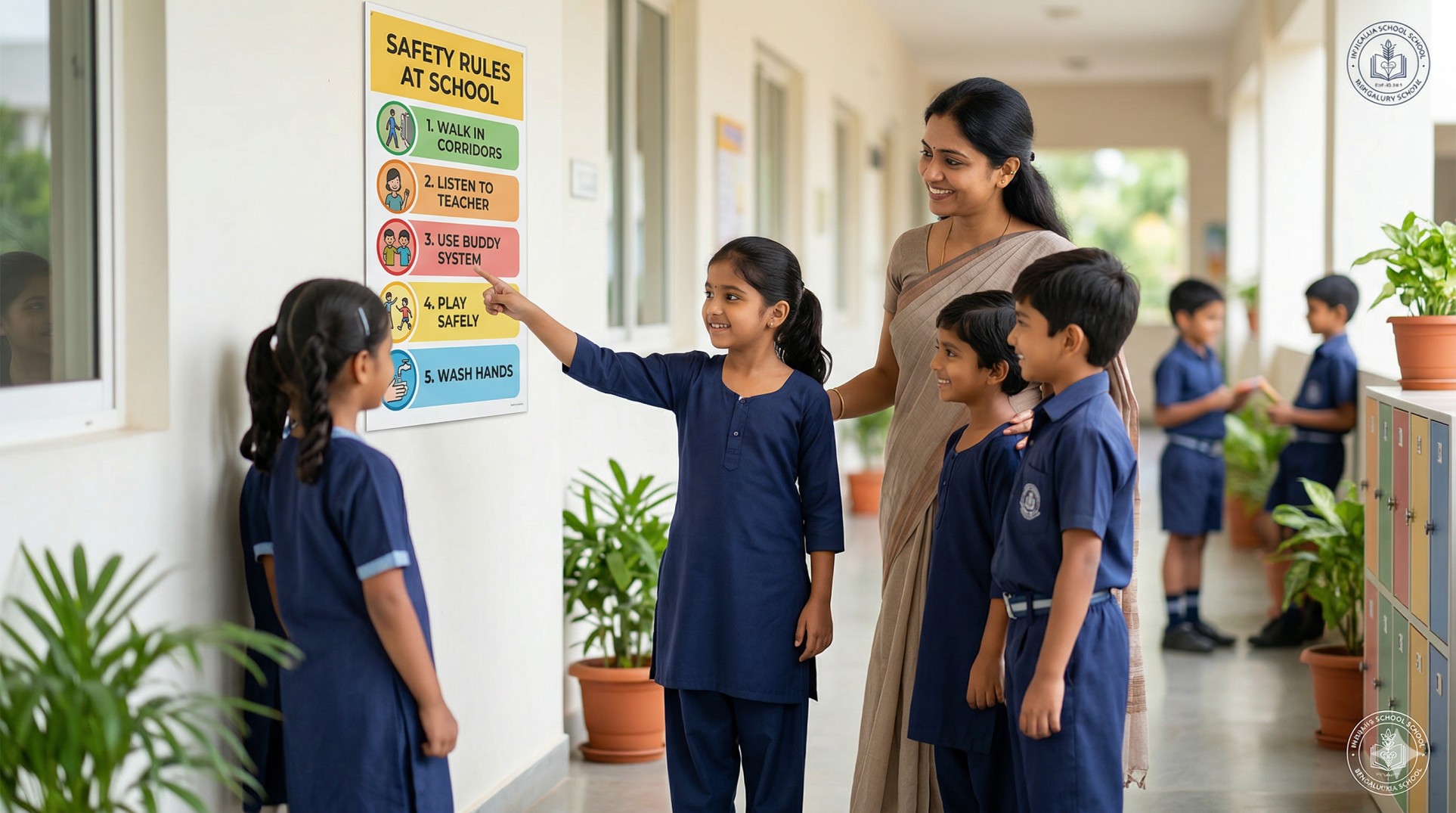
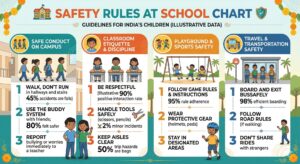
Charts are incredible tools because they act as a constant visual reminder. Well-placed safety rules at school, charted in the hallway or classroom, help children internalize the rules without feeling lectured.
Sample Layout for a School Safety Chart:
| Category | The Rule | The “Why” |
| Movement | Walk in a line | To avoid tripping and falling |
| Play | Wait for your turn on the slide | To keep everyone safe from hits |
| Interaction | Use kind words | To keep our hearts happy |
| Bus | Keep your hands inside the window | To prevent accidents on the road |
| Emergencies | Stay calm and quiet | So you can hear the teacher’s instructions |
Safety Rules at School Pictures (Visual Learning)
Why do we look for safety rules in school pictures? Because children—especially younger ones—are visual learners. An image stays in their mind much longer than a list of words.
Recommended Image Ideas for Your School Projects:
-
The “Yellow Line” Picture: An image of students standing behind a yellow line while waiting for the school bus.
-
The “Helping Hand” Picture: An older student helping a younger one on the stairs.
-
The “Corridor Walk” Picture: A clear illustration of a student walking with their hands to their side, not running.
-
The “Emergency Map”: A bright, colorful map showing the exit routes of the school.
Note: If you are making a project, try to find photos that reflect the local school environment (students in uniforms, Indian school buses) to make it more relatable.
Common Mistakes Children Make at School
Even with the best intentions, kids make mistakes. Identifying them early helps in correction:
-
The Mistake: Hiding an injury because they are afraid they will get in trouble for “playing rough.”
-
The Solution: Encourage an “open-door” policy where kids know that their health is more important than the rules they might have broken.
-
-
The Mistake: Following a stranger because they have a “cool toy” or “sweet.”
-
The Solution: Role-play “stranger danger” scenarios at home so the child knows exactly what to say.
-
-
The Mistake: Running to the gate as soon as the bell rings.
-
The Solution: Teach them that the bell signifies the start of the exit process, not a race to the finish line.
-
Tips for Parents & Teachers to Teach Safety Rules
Teaching safety shouldn’t be about scaring children; it should be about empowering them.
-
For Teachers: Conduct a “Safety Walk” once a month. Walk the kids through the corridors and point out the fire extinguishers, the nurse’s office, and the emergency exits.
-
For Parents: Don’t just tell them the rules—explain the “Why.” Instead of saying “Don’t run,” say “We walk so we don’t fall and hurt our knees before the weekend trip.”
-
Use Positive Reinforcement: When you see a child following a safety rule, praise them. “I love how safely you used the stairs today!” goes a long way.
FAQ Section
Q1: What is the most important safety rule at school?
A: While all are important, “Listening to the Teacher” is the umbrella rule. If a child follows instructions, they are likely to stay safe in almost any situation.
Q2: How can I make a safety rules at school chart at home?
A: Use a large chart paper, divide it into “Dos” and “Don’ts,” and let your child draw safety rules at school pictures for each point. This involvement makes them more likely to follow the rules.
Q3: My child is being bullied; is this a safety issue?
A: Absolutely. Emotional safety is just as vital as physical safety. School safety rules strictly prohibit bullying, and it should be reported to the school administration immediately.
Q4: Are there specific safety rules for the school bus?
A: Yes. Rules include staying seated until the bus stops, keeping hands/heads inside, and never talking loudly to avoid distracting the driver.
Q5: How can visual aids help in teaching school safety?
A: Visual aids like posters and videos help children recognize hazards instantly. They are especially effective for kindergarten students who may not yet be able to read complex rules.
Conclusion
Ensuring safety rules at school are followed is a collective responsibility. It takes a village—parents, teachers, bus drivers, and the students themselves—to create a secure environment.
When children feel safe, their brains move out of “survival mode” and into “learning mode.” By teaching these rules today, you aren’t just preventing an accident; you are giving your child the peace of mind to become the best version of themselves. Let’s make safety a habit, not an afterthought!
Official School Safety Resources
For more detailed safety protocols and official guidelines, please visit the following organizations:
- UNICEF:
Protecting Children from Violence in Schools - Ministry of Education (Govt. of India):
Guidelines on School Safety & Security - World Health Organization (WHO):
Global School Health Framework - NCPCR India:
Manual on Safety and Security of Children in Schools