

Edited by: MomSaathi Editorial Team
Reviewed by: Obstetricians & Gynecologists (OB-GYNs), Certified Nutritionists, and Maternal Health Experts based on evidence-based pregnancy and preconception care guidelines
As soon as I heard whispers about the optimal age to become pregnant, 27 kept cropping up in conversations with friends, doctors, and even random aunties at family events. “Pregnant at 27” seemed oddly specific — like it struck a balance between youth, energy, and readiness without either the early twenties rush or mid-thirties panic.
After doing research into my options and speaking to women who’ve already experienced motherhood while double-checking science’s claims on its practicality, 27 is certainly one of the least hyped yet most practical ages for starting or expanding families — not because everyone will benefit equally, but because it hits that sweet spot most women don’t ever hear about!
If you are 26, 27, or 28 and wondering whether now is the right time for you to have children, you aren’t alone. In India, especially, where discussions of pregnancy often oscillate between “get married early and have children by 22” and “build your career first”, 27 seems like an appropriate middle ground which works both biologically, emotionally, and practically. So let’s break this down without any unnecessary drama or panic-inducing rhetoric.
The Biology of Being Pregnant at 27
Fertility doesn’t suddenly fade with age 30 — according to data from the American Society for Reproductive Medicine and multiple studies, healthy women between 25-27 still have approximately a 20-25% chance of naturally conceiving within any cycle. If actively trying for pregnancy within 12 months (78-85% odds), chances are good.
Compare that to age 35+ when monthly chances drop to below 15% and miscarriage risks significantly rise. At 27, however, chromosomal issues like Down syndrome still fall below 0.3% while miscarriage rates average only 10-12% among confirmed pregnancies; gestational diabetes, hypertension, or preterm birth complications tend to be minimal at this age compared to later ones.
Indian Council of Medical Research has determined 21 to be an ideal biological age for many Indian women based on overall health metrics in their population, but for urban, educated women who juggle careers, higher education, and nuclear families, 27 is often more realistic; your body remains resilient, hormones remain balanced, and recovery from pregnancy usually goes smoothly. One European couple study noted fertility began a gradual decrease starting around 27, but wasn’t noticed until early thirties; getting pregnant at 27 means you’re still riding at the high end of this curve!
At this age, many mothers report conception without needing tracking apps or supplements — just their natural cycles doing their job! No IVF drama and no months of disappointment: that is the power of late 20s fertility!
Energy Levels and Physical Recovery
One thing pregnancy blogs rarely mention: toddlers can be exhausting. At 27, however, you still possess enough stamina to chase a crawling baby around at 2 a.m. or endure another round of “one more story” without feeling like your life has suddenly aged significantly overnight.
Your body also recovers more quickly when giving birth in your twenties than later on, with skin elasticity, muscle recovery, and overall healing occurring more quickly than if given birth later on in life. One mom I spoke to (who had her first at 27 and second at 30) reported being back to pre-pregnancy weight and energy levels within six months without extreme dieting or trainers. However, she gained 12-15 kg, her joints didn’t ache, her hair didn’t thin significantly, and postpartum depression felt manageable since she wasn’t fighting both fatigue and sleep deprivation at once!
Comparatively, friends who waited until 35+ shared stories of joint pain during gestation and prolonged recovery from C-sections, plus chronic fatigue that persists after giving birth. At 27, you’re not “old” per se, but past the reckless twenties when late nights and poor eating habits might have been commonplace; most likely, you have established basic self-care measures for sleep, nutrition, and movement, which make pregnancy and early motherhood sustainable rather than survival mode.
Career, Money, and Life Stability
At 27 you’ve reached an ideal point in your professional journey: beyond entry-level chaos yet not yet locked into senior leadership, where taking maternity leave feels irreparable. Most women at this age already have several years of work experience and savings behind them, giving them enough security in their field that taking time off or switching roles feels manageable without derailing everything they’ve achieved so far.
Financially, being 27 can often put one in an excellent place financially. Salaries should have started increasing, maybe you own or have purchased an EMI home or two-wheeler, and dual-income households are increasingly common across Indian metros like Bengaluru, Mumbai or Delhi, where hospital bills, nanny costs, and baby gear costs add up quickly. You should now know budgeting but your earning potential remains strong.
One working mom shared how her pregnancy at 27 gave her the “second innings” she needed. She took time away from mid-level corporate roles to evaluate what truly motivated her, then returned stronger by starting a side hustle that now supports her family. The time off didn’t feel like punishment; rather, it felt like strategic pausing.
Emotional Readiness and Relationship Glow-Up
By 27, most of us have lived some. We’ve experienced wild nights, questionable decisions, heartache, and quarter-life crises — an experience which should allow for genuine excitement about responsibility instead of any feelings of resentment or regret.
Your relationship can become richer with each passing year, from late-night feeds and first smiles, to those terrifying but hilarious parenting fails that bond you more deeply than date nights ever could. Respect grows; laughter becomes easier. By now, both partners are mature enough to deal with conflict without as much drama — yet still young enough to dream big together!
Indian families tend to view this age as the one where you have navigated some of the “log kya kahenge” pressure and can relax a bit about asking when my beta or shaadi is happening? Instead, they ask when is my wedding happening? — a weird yet welcome change.
The Long Game: When Your Kids Are Grown, You Aren’t “Old”
Imagine this: when your first child turns 18 when you are 45, you still feel energetic enough for college drop-offs, weddings and grandkids without missing your own life completely. Travel plans, career pivots or even that long-postponed MBA suddenly become viable again — life doesn’t end at 40; it opens up!
Moms who had children at 27 often say they feel as if they have “regained their youth” in their forties — this perspective shift can be profound.
But Pregnancy at 27 Isn’t All Rainbows
Let’s be real here — pregnancy at 27 can present real challenges. Society may treat you like you’re “too young,” especially if you don’t hold down a corporate job or carry debt. Postpartum body changes can be hard-hitting when comparing yourself with filtered Instagram lives, and joint families often provide unsolicited advice that flows like water down the Ganges River.
Fertility isn’t guaranteed for everyone; PCOS, stress, and lifestyle factors all can play a part no matter your age. Even women as old as 27 still face conception delays and need medical assistance — which is perfectly normal; what matters more than perfection is having the odds stacked more heavily in your favor now than later on.
Real Stories from Women Who Were Pregnant at 27
I have heard different versions of this across cities: from Bengaluru software engineers who conceived on their second cycle after marriage and now manage the workload associated with being pregnant at 27; to Mumbai content creators documenting their pregnancy journeys to become late-20s mom communities; and Delhi teachers citing how their energy levels allowed them to be the “fun moms” their kids still speak highly of.
One woman shared with me: “At 27, I was worried I was rushing life. However, looking back it gave me the best of both worlds — not being overwhelmed at 22 and exhausted at 35; 27 worked perfectly!”
Practical Tips If You Plan to Conceive at 27 (or Soon After)
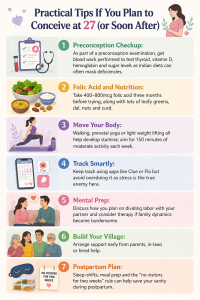
- Preconception Checkup: As part of a preconception examination, get blood work performed to test thyroid, vitamin D, hemoglobin and sugar levels as Indian diets can often mask deficiencies.
- Folic Acid and Nutrition: Take 400-800mcg folic acid three months before trying, along with lots of leafy greens, dal, nuts and curd.
- Move Your Body: Walking, prenatal yoga, or light weight lifting all help develop stamina; aim for 150 minutes of moderate activity each week.
- Track Smartly: Keep track using apps like Clue or Flo, but avoid overdoing it as stress is the true enemy here.
- Mental Prep: Discuss how you plan on dividing labor with your partner and consider therapy if family dynamics become burdensome.
- Build Your Village: Arrange support early from parents, in-laws, or hired help.
- Postpartum Plan: Sleep shifts, meal prep, and the “no visitors for two weeks” rule can help save your sanity during postpartum.
Final Thoughts: Your Body, Your Timeline
Pregnancies often happen at 27. While some women get pregnant as early as 22, others require medical support in their late 30s before going into gestation. But if you are in your late twenties and feeling ready to try for a baby — if biology and life are in sync — then science, real moms, and common sense point to yes!
Are You Late, Rushing or on Time for Motherhood? No one said anything like that — rather, there’s never been a better time or place to embrace motherhood that allows for you to remain present, energetic and fully yourself!
If this post strikes a chord with you, share your experiences in the comments. And if you’re actively trying or just considering it, visit a good gynecologist who listens carefully to you, not just age; as ultimately the ideal age is dependent upon personal choice.
Official Government of India Resources
- → Maternity Benefit (Amendment) Act, 2017
(26 weeks paid leave – Ministry of Labour) - → High-Risk Conditions in Pregnancy Guidelines
(MoHFW / PMSMA) - → Antenatal & Pregnancy Care Guidelines
(National Health Mission) - → ICMR Guidelines on Infertility & Reproductive Health
(Indian Council of Medical Research)
All links are official Government of India sources • Verified & trustworthy
Faq About Being Pregnant at 27
Is 27 really the best age to get pregnant?
It’s not “the best” for every woman, but it’s often one of the smartest. Biologically, fertility and egg quality are still at their peak while your body has the resilience of youth. Life-wise, you’re usually stable enough in your career and relationship to handle the changes without feeling completely overwhelmed. Doctors call it the “Goldilocks age” — not too young, not too old.
What are the risks of pregnancy at 27 compared to other ages?
Risks are actually very low. The miscarriage rate is around 10-12%, chromosomal abnormalities are under 0.3%, and complications like gestational diabetes or high blood pressure are far less common than after 35. The biggest “risk” is usually lifestyle-related (stress, poor diet) rather than age itself. Compared to 22, you’re more mature; compared to 35, your body recovers faster.
Will I have trouble conceiving if I wait until 27?
Most women don’t. Natural conception rates at 27 are excellent — about 78-85% within one year of trying. If you have conditions like PCOS, thyroid issues, or irregular cycles, you might need help regardless of age, but 27 gives you better odds than later. Start tracking cycles and see a gynecologist early if periods are irregular.
How does pregnancy at 27 affect my career?
It usually gives you more flexibility than later. You’ve had time to build some experience and savings, but you’re not yet in a senior role where maternity leave feels like a bigger setback. Many women return stronger — with better negotiation power or even a career pivot. In India, the Maternity Benefit Amendment Act gives you 26 weeks of paid leave, which feels more manageable when you’re still climbing the ladder.
What should I do before trying to get pregnant at 27?
Book a preconception check-up at least 3 months ahead. Get basic blood tests, start folic acid, eat balanced home-cooked meals, exercise regularly, cut down on caffeine and alcohol, and make sure your partner gets a basic semen analysis if needed. Mental health prep is just as important — talk openly with your partner and family.
Is it harder to lose baby weight after pregnancy at 27?
Not usually. Most women in their late twenties find it easier to get back in shape because metabolism is still high and hormones bounce back quicker. Combine breastfeeding, light walks, and realistic nutrition (not crash diets), and most moms are comfortable in their old clothes within 8-12 months. It’s more about consistency than age.