
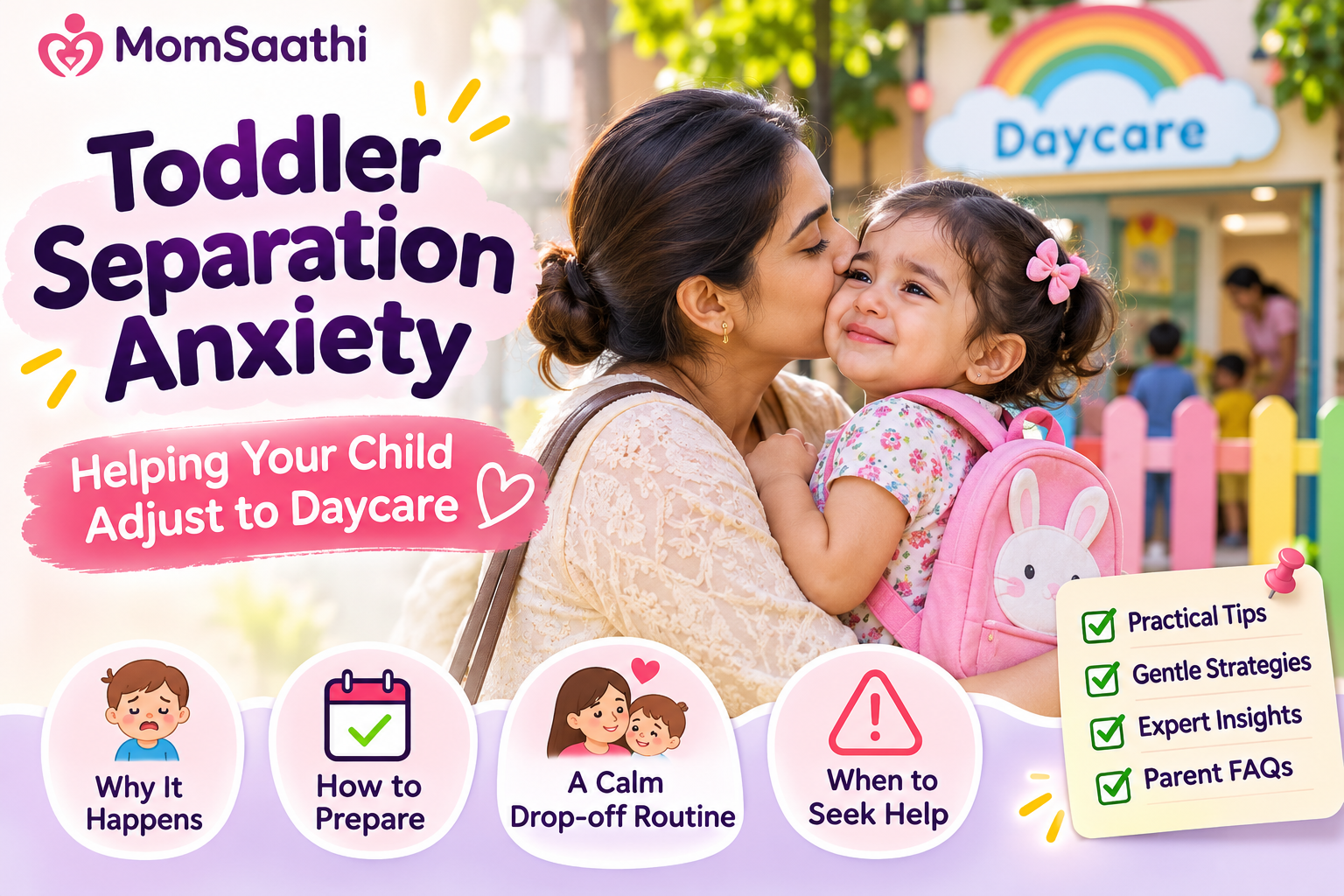
Toddler Separation Anxiety: Helping Your Child Adjust to Daycare

Starting daycare or preschool is a major change for a toddler. A child who was previously happy to explore may suddenly cling to a parent, cry at the classroom door, refuse to let go, or become unsettled at bedtime. These reactions can be upsetting, but they are often a normal response to separation and a new environment.
Toddler separation anxiety is not a sign that you have spoiled your child or that daycare is necessarily the wrong choice. It is part of how young children develop close relationships and learn that a trusted adult can leave and return. With a predictable goodbye routine, a warm partnership with caregivers, and gradual practice, most children become more comfortable over time.
This guide explains what separation anxiety can look like, why it happens, how to prepare your toddler for daycare, what to do during drop-off, and when to seek extra support.
What is toddler separation anxiety?
Separation anxiety is the worry or distress a young child experiences when a familiar caregiver leaves or is out of sight. It commonly appears during infancy and toddlerhood, although its timing and intensity vary. It may become noticeable again during transitions such as starting daycare, moving house, changing caregivers, returning after a holiday, or welcoming a new sibling.
For a toddler, a parent leaving can feel difficult because the child is still learning about time, routines, emotional regulation, and the fact that people continue to exist when they cannot be seen. A toddler may understand that you are leaving without yet being able to feel confident about when you will return.
Separation anxiety is a developmental pattern, not a diagnosis by itself. The important questions are how intense the distress is, whether it gradually eases, and whether it is affecting the child’s daily functioning.
Common signs of separation anxiety at daycare
Every child expresses worry differently. You may notice one or several of these behaviours:
- Crying or clinging: Your toddler holds your hand, leg, or clothing and cries when you approach the classroom.
- Refusing to enter: Your child may stop at the gate, hide behind you, or say, “No school.”
- Repeated reassurance-seeking: Your toddler asks where you are going or when you will come back.
- Changes in sleep: Your child may resist bedtime, wake more often, or ask for extra comfort.
- Changes in appetite or toileting: Some children temporarily eat less or have toileting setbacks during a transition.
- Big emotions after pickup: A child may be tearful, irritable, unusually quiet, or very clingy after holding it together during the day.
- Physical complaints: A toddler may say their tummy hurts or seem unsettled before drop-off. Persistent or significant symptoms should be discussed with a healthcare professional rather than automatically attributed to anxiety.
A difficult goodbye does not tell the whole story. Ask the daycare team how your child settles after you leave, whether they play or eat, and how they respond to familiar caregivers. Some toddlers cry at drop-off and then engage in activities a short time later.
Why does starting daycare trigger separation anxiety?
1. A new place and unfamiliar people
Daycare introduces new rooms, sounds, faces, routines, and expectations. Even a confident toddler may need time to understand what happens there and which adults can help.
2. A stronger awareness of separation
As toddlers grow, they become more aware that a caregiver can leave. Their language and understanding are still developing, so they may struggle to explain the worry they feel.
3. Limited sense of time
“I will be back at 4 pm” may not mean much to a young child. Linking your return to a familiar event, such as after snack time or after the afternoon play session, can be easier to understand.
4. Changes in routine
A new wake-up time, commute, meal schedule, nap time, or caregiver can make the transition feel bigger. Tiredness and hunger can make emotional regulation harder.
5. Temperament and previous experiences
Some children take longer to warm up to new people or places. A recent illness, family change, move, or break from daycare may also make returning more challenging. This does not mean a child will always struggle with separation.
How to prepare your toddler before daycare starts
Talk about daycare in simple, positive language
Explain what your child will do: play, listen to stories, have a snack, meet a teacher, and come home. Keep the explanation honest and age-appropriate. Avoid promising that your child will never feel sad. Instead say, “You might miss me. Your teacher will help you, and I will come back after your afternoon snack.”
Read books and use pretend play
Read picture books about starting preschool or being away from a parent. At home, use dolls or soft toys to act out a simple routine: arrive, say goodbye, play, eat, and reunite. Let your toddler take the role of the parent or teacher too.
Visit the centre if possible
Ask whether you can visit the classroom with your child before the first day. Meet the main caregiver, explore the play area, and learn where meals and naps happen. A familiar face or room can make the first drop-off less overwhelming.
Practise short separations
If appropriate for your family, practise brief separations with a trusted relative or caregiver. Tell your child where you are going and when you will return, then come back as promised. Increase the time gradually. Do not disappear secretly; predictable departures help build trust.
Keep the home routine steady
In the days before daycare begins, aim for reasonably consistent sleep, meals, and wake-up times. Avoid making several major changes at once if you can. Prepare the school bag, clothes, and lunch the night before to reduce morning pressure.
A simple daycare drop-off routine that works
A short, warm, predictable routine is usually more helpful than a long goodbye that changes every morning. Try this sequence:
- Arrive calmly: Give yourselves enough time so you are not rushing through the entrance.
- Connect first: Crouch to your child’s eye level, offer a hug, and acknowledge the feeling: “You want me to stay. Saying goodbye is hard.”
- Tell your child what happens next: “I am going to work. You will play with your teacher, have lunch, and I will come after your afternoon snack.”
- Use the same goodbye each day: A hug, a phrase, and a wave can become a reassuring ritual.
- Hand over to the caregiver: Let the teacher help your child move towards a familiar activity or comfort item, if the centre permits one.
- Leave after saying goodbye: Do not repeatedly return to the doorway. A clear departure helps the child understand that the goodbye has happened.
You might use a phrase such as: “I love you. You are safe with your teacher. I will come back after playtime and snack. See you soon.” Keep it brief and consistent.
What parents should avoid during drop-off
- Do not sneak away. Your child may become more watchful or worried about losing sight of you unexpectedly.
- Do not make promises you cannot keep. Avoid saying you will return in five minutes if you will be away for the full session.
- Do not shame the tears. Phrases such as “Big children don’t cry” can make a child feel that sadness is wrong.
- Do not prolong the goodbye indefinitely. Repeatedly leaving and returning can make the separation harder to understand.
- Do not compare your child with classmates or siblings. Children adjust at different speeds.
- Do not use threats or punishment. Anxiety is not deliberate misbehaviour.
How daycare teachers can help your toddler settle
Adjustment works best when parents and caregivers follow a shared plan. Talk to the centre before the first day and ask:
- Will one familiar caregiver greet my child each morning?
- Can the settling-in period be gradual, where the centre’s policy allows?
- What do staff do when a child cries after a parent leaves?
- Can my child bring a small comfort object, family photo, or familiar item?
- How will the centre update me about eating, naps, play, and distress?
- Who should I contact if my child remains very upset during the session?
Ask for specific observations rather than only “fine” or “not fine.” For example: How long did the crying last? What helped? Did the child accept comfort? Did they participate in play or eat? This information helps you understand whether the transition is progressing.
A supportive caregiver should respond warmly, keep your child safe, and help them join an activity without dismissing their feelings. If the centre cannot explain its settling-in approach or you have concerns about how your child is treated, arrange a conversation with the supervisor.
How long does toddler separation anxiety last?
There is no fixed adjustment timetable. Some toddlers become comfortable within days; others need several weeks or longer, particularly if they are new to group care or have experienced several changes. Progress is not always linear. A child may settle well for a few days and then become upset after a weekend, illness, holiday, or change in routine.
Look for gradual signs of progress: your toddler accepts comfort from a teacher, begins playing after drop-off, recognises the routine, talks about daycare, or recovers more quickly after a difficult morning. The goal is not necessarily a tear-free goodbye every day. The goal is that your child feels safe, supported, and increasingly able to participate.
Practical tips for the first two weeks
Before the first day
- Confirm timings, transport, food rules, nap arrangements, and the centre’s settling-in policy.
- Label your child’s belongings and pack only permitted comfort items.
- Explain the routine using the same simple words each time.
- Keep the first morning as calm and unhurried as possible.
During the first few days
- Follow the agreed drop-off routine rather than changing it based on each day’s tears.
- Ask the teacher for a short update at an agreed time, rather than repeatedly calling during class.
- Offer extra connection at home: play together, listen, cuddle, and allow time to decompress.
- Keep evenings predictable and protect your toddler’s sleep opportunity.
After the first week
- Review the teacher’s observations and your child’s behaviour at home.
- Notice small improvements, even if drop-off is still emotional.
- Discuss any continuing difficulties with the caregiver and agree on one consistent plan.
- Avoid adding unnecessary pressure or comparing progress with another child.
What to do if your toddler cries every morning
First, find out what happens after you leave. If your child settles with a caregiver, plays, eats, and participates for much of the day, the tears at separation may be one part of an otherwise manageable adjustment. Continue the predictable goodbye routine and coordinate with the teacher.
If your child remains distressed for a large part of the day, cannot be comforted, stops participating in usual activities, or shows a sustained change in sleep, eating, or behaviour, arrange a detailed discussion with the centre. Consider whether the schedule, length of the day, caregiver match, or transition pace needs to be reviewed.
Do not assume that every problem is separation anxiety. Ask about possible practical causes such as illness, tiredness, hunger, sensory overwhelm, conflict with another child, or an activity your toddler finds frightening. A calm, factual conversation with staff can help identify what is happening.
When should you seek professional advice?
Consider speaking with your child’s paediatrician or a qualified child mental-health professional if the anxiety is intense, persists without improvement, or significantly interferes with daycare, sleep, family life, or other everyday activities. Seek advice sooner if your child has repeated physical symptoms, severe distress, regression that concerns you, or a sudden marked change in behaviour.
If your child reports being hurt, frightened, threatened, or unsafe at the centre, take the concern seriously. Listen without leading questions, document what your child says in their own words, and contact the centre’s leadership and appropriate child-protection or local authorities when safety may be at risk. Do not send a child back into a situation you reasonably believe is unsafe while the concern is being addressed.
A professional can help distinguish a typical transition from anxiety that needs additional support. This article is general parenting information and cannot assess an individual child or replace medical advice.
Frequently asked questions
Is separation anxiety normal when a toddler starts daycare?
Yes. Many toddlers show some distress when separating from a familiar caregiver or entering a new setting. The intensity varies. A consistent routine and supportive caregivers often help children adjust.
Should I stay at daycare until my child stops crying?
Follow the centre’s settling-in policy and agree on a plan with the teacher. A brief, predictable goodbye is often more helpful than waiting indefinitely at the door. If the centre recommends gradual settling, make the steps clear and consistent.
Is it okay if my toddler cries after I leave?
Crying at goodbye can happen during adjustment. Ask the caregiver how long it lasts and whether your child can be comforted and engage in the day. Persistent distress throughout the session needs a closer conversation with the centre.
Should I pick my toddler up early if they cry?
Not automatically. First understand what happens after drop-off and follow the plan agreed with the centre. If your child remains highly distressed, is unwell, or the staff cannot keep them safe and supported, discuss an appropriate response with the centre.
Can a comfort toy help with daycare separation anxiety?
It may help some children, provided the daycare allows it and the item is safe for the setting. A small soft toy, family photo, or other familiar object can act as a reminder of home.
Why does my toddler cry again after a weekend or holiday?
A break changes the routine, so your child may need a little time to get used to daycare again. Return to the usual sleep and morning routine and use the same goodbye ritual.
Does separation anxiety mean my toddler is not ready for daycare?
Not necessarily. Tears alone do not establish whether a child is ready. Consider the whole picture: whether the child accepts comfort, gradually participates, and is supported by responsive caregivers. If distress remains severe or daily functioning is affected, seek individual advice.
Final thoughts
Starting daycare is a transition for the whole family. Your toddler may need reassurance, repetition, and time before the new routine feels familiar. Keep goodbyes loving and predictable, work closely with the caregivers, and notice gradual progress rather than expecting an immediate change.
Most importantly, let your child know that missing you is okay and that you will return. A calm, dependable response helps build the trust and confidence your toddler needs to explore the world beyond home.