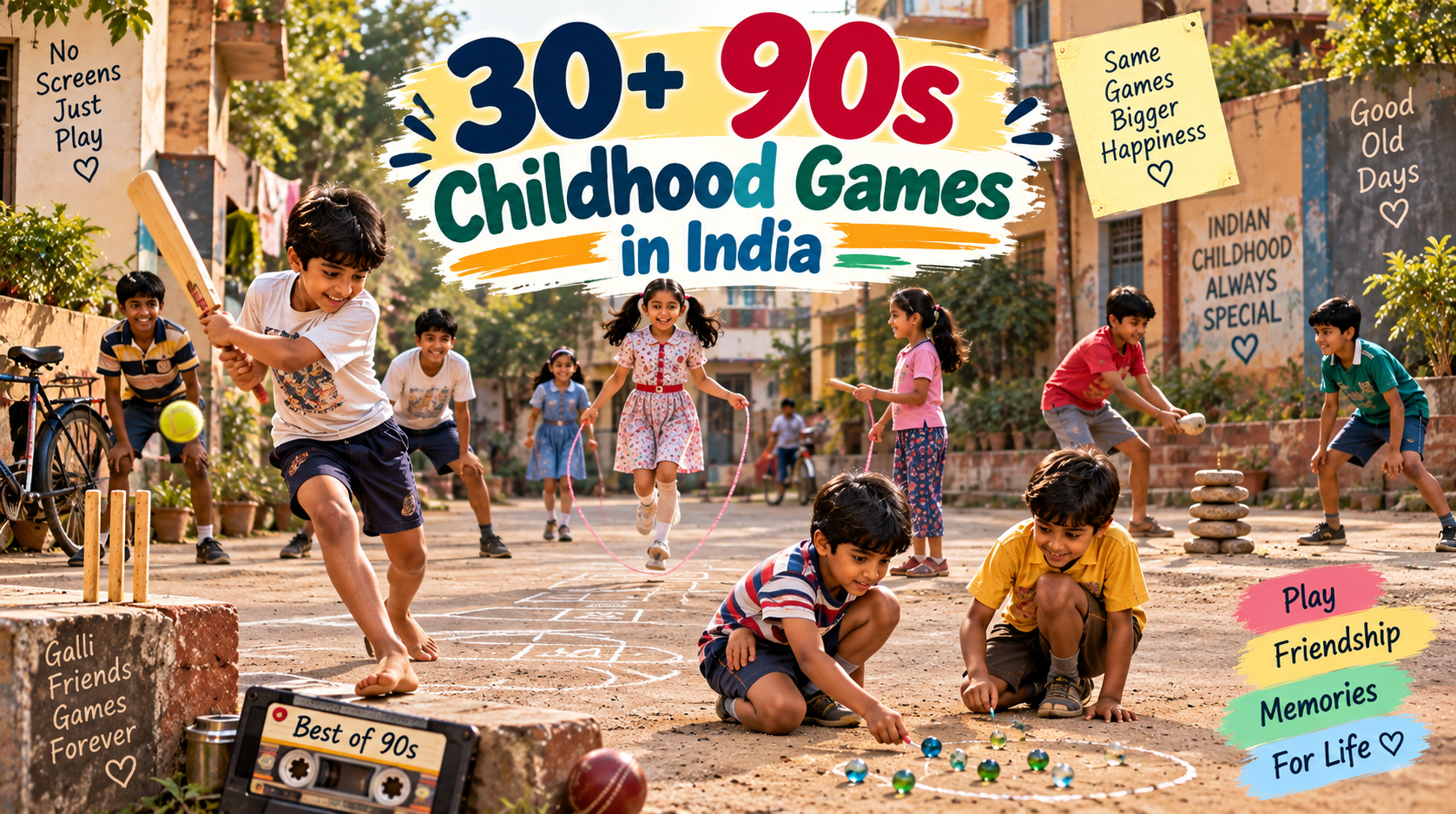

Do you remember rushing outside after school, dropping your school bag at home and hearing your friends call your name from downstairs?
For many Indian children growing up in the 1990s, entertainment did not come with a remote control, smartphone or Wi-Fi connection. We had open playgrounds, apartment courtyards, school grounds, rooftops, streets and plenty of imagination.
A tennis ball could become the centre of an entire afternoon. A few stones could turn into a game of Lagori. A piece of chalk could create a hopscotch grid. And sometimes, all you needed was a group of friends and someone shouting, “Chal, khelte hain!”
The 90s gave Indian children a special kind of childhood filled with outdoor games, traditional Indian games, neighbourhood competitions and simple indoor games.
Here are 30+ 90s childhood games in India that many children played at school, in their neighbourhoods or with siblings and friends.
Quick-Reference: 30+ 90s Childhood Games in India
| # | Game | Type | Best For |
|---|---|---|---|
| 1 | Lagori | Outdoor | Groups |
| 2 | Kho-Kho | Outdoor | Groups |
| 3 | Kabaddi | Outdoor | Groups |
| 4 | Gilli Danda | Outdoor | Older Kids |
| 5 | Kancha | Outdoor | Small Groups |
| 6 | Hide-and-Seek | Outdoor/Indoor | All Ages |
| 7 | Pakdam Pakdai | Outdoor | Younger Kids |
| 8 | Vish Amrit | Outdoor | Groups |
| 9 | Poshampa | Outdoor | Younger Kids |
| 10 | Aankh Micholi | Indoor/Outdoor | Groups |
| 11 | Stapoo | Outdoor | Younger Kids |
| 12 | Dog and the Bone | Outdoor | Groups |
| 13 | Chain-Chair | Outdoor | Groups |
| 14 | Four Corners | Indoor/Outdoor | Small Groups |
| 15 | Catch-Catch | Outdoor | Groups |
| 16 | Cricket | Outdoor | Groups |
| 17 | Football | Outdoor | Groups |
| 18 | Cycling Races | Outdoor | Older Kids |
| 19 | Skipping Rope | Indoor/Outdoor | All Ages |
| 20 | Seven Tiles | Outdoor | Groups |
| 21 | Carrom | Indoor | Family |
| 22 | Ludo | Indoor | Family |
| 23 | Snakes and Ladders | Indoor | Younger Kids |
| 24 | Playing Cards | Indoor | Family |
| 25 | Business | Indoor | Family |
| 26 | Antakshari | Indoor | Family/Groups |
| 27 | Name, Place, Animal, Thing | Indoor | Older Kids |
| 28 | Dumb Charades | Indoor | Family/Groups |
| 29 | Dots and Boxes | Indoor | 2 Players |
| 30 | Tic-Tac-Toe | Indoor | 2 Players |
| 31 | Paper Games | Indoor | All Ages |
30+ 90s Childhood Games in India
1. Lagori
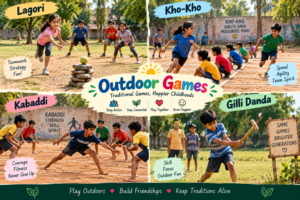
Lagori, also called Seven Stones or Pithu, was one of the most exciting outdoor games for many 90s kids.
A small pile of stones was arranged one on top of another. One team knocked the pile down with a ball and then tried to rebuild it while the other team attempted to stop them.
It was simple, energetic and usually became very competitive.
2. Kho-Kho
Kho-Kho was a familiar sight on Indian school grounds.
Players chased members of the opposite team while using speed, strategy and quick changes of direction to avoid being tagged.
It was one of those games where knowing when to run—and when to stop—mattered just as much as speed.
3. Kabaddi
Kabaddi needed very little equipment but plenty of courage and strategy.
One player entered the opponent’s area, tried to tag someone and return safely while maintaining the traditional rhythm of the game.
It was particularly popular in schools, local playgrounds and community competitions.
4. Gilli Danda
Gilli Danda is one of India’s traditional games and was played long before the 1990s.
The game uses a small wooden stick called the gilli and a longer stick called the danda.
For many children, it was a creative alternative to organised sports because all you needed was a couple of sticks and enough space to play.
5. Kancha
Kancha, or marbles, was another favourite among children.
Players used small glass marbles and tried to hit or collect their opponents’ marbles according to the rules they followed.
Different neighbourhoods often had their own variations.
6. Hide-and-Seek
No list of childhood games would be complete without hide-and-seek.
One child closed their eyes and counted while everyone else rushed to find a hiding place.
Staircases, behind doors, under tables and around trees could suddenly become the perfect hiding spot.
7. Pakdam Pakdai
Pakdam Pakdai was one of the simplest games to organise.
One child became “it” and chased the others. The challenge was to avoid getting caught.
No equipment. No complicated rules. Just running, laughing and trying not to be tagged.
8. Vish Amrit
Vish Amrit was another popular chasing game played by groups of children.
Depending on the local rules, children could be tagged, frozen or freed by teammates.
Like many traditional games, the rules could vary from one neighbourhood to another.
9. Poshampa
Poshampa was often played by younger children and involved two players forming a gate with their arms while others passed underneath.
A traditional rhyme accompanied the game, making it as much a social activity as a physical one.
10. Aankh Micholi
Aankh Micholi was essentially a variation of blindfolded chase.
One player was blindfolded and tried to locate the other players using sound and movement.
It could quickly turn into a hilarious game when everyone tried to stay quiet while avoiding being caught.
More Outdoor Games 90s Kids Loved
11. Stapoo
Stapoo, also known as hopscotch in many places, was commonly drawn on the ground using chalk.
Children hopped from one numbered section to another while trying not to step on the lines.
Some neighbourhoods used stones or small markers as part of the game.
12. Dog and the Bone
Two teams stood opposite each other with numbers assigned to players.
When a number was called, the corresponding players raced towards the object placed in the middle and tried to take it back to their side without being tagged.
13. Chain-Chair
In this chasing game, one tagged player joined hands with another to form a chain.
The chain gradually grew as more players were caught.
The larger the chain became, the harder it was for the remaining players to escape.
14. Four Corners
Four players or groups occupied four corners while another player tried to reach or occupy an empty corner.
The game was particularly easy to play in an open room or outdoor area.
15. Catch-Catch
Sometimes the simplest games were the most popular.
Catch-catch involved one or more players trying to tag others.
Rules often changed depending on the group, but the basic idea was always the same: run fast and don’t get caught.
16. Cricket With a Tennis Ball
You didn’t need a proper cricket kit to play cricket in the 90s.
A tennis ball, a plastic bat or even a piece of wood could be enough.
The rules depended entirely on where you were playing:
“One-tip-one-hand.”
“Last man batting.”
“Window out.”
“Direct hit.”
Every neighbourhood seemed to have its own cricket rulebook.
17. Football in the Street
A small open space could become a football ground.
Two bags, shoes or bricks could serve as goalposts, and the game could continue until someone was called home.
18. Cycling Races
For many children, getting a bicycle meant gaining a whole new sense of freedom.
Friends would race around the colony, practise turns and sometimes organise informal competitions.
Of course, safe riding areas and adult supervision were important.
19. Skipping Rope
Skipping was both a game and a physical activity.
Children could skip individually or turn it into a group game with two people holding the rope and one person jumping in the middle.
20. Seven Tiles
Seven Tiles is another name sometimes used for games similar to Lagori.
Players knocked down a stack of tiles or flat objects and attempted to rebuild them before being tagged by the opposing team.
Indoor Games 90s Kids Played
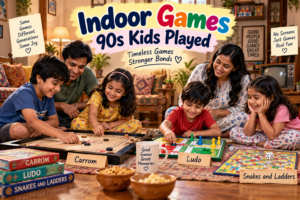
Not every childhood game required a playground.
On rainy afternoons, during school holidays or when parents said, “Bahut dhoop hai, bahar mat jao,” indoor games came to the rescue.
21. Carrom
Carrom was a classic family game.
Many Indian homes had a carrom board, and children learned to aim, strike and pocket coins while competing with siblings, parents or friends.
22. Ludo
Ludo was a staple in many households.
The excitement of waiting for a six, sending another player’s token back home and trying to get all four tokens safely to the centre could keep children occupied for hours.
23. Snakes and Ladders
Snakes and Ladders introduced children to numbers, counting and a little bit of luck.
One moment you could be climbing a huge ladder; the next, a snake could send you almost all the way back.
24. Playing Cards
Simple card games were common family entertainment.
Children learned games from parents, grandparents or older siblings, often adapting rules as they went.
25. Business
The board game Business introduced children to buying, selling, money and property in a playful way.
For many families, it became a long weekend game that could continue for hours.
26. Antakshari
Antakshari did not need a board or playing equipment.
All you needed were two teams, a good memory and plenty of songs.
Families often played it during gatherings, road trips and holidays.
27. Name, Place, Animal, Thing
Give everyone a letter and start filling categories such as:
- Name
- Place
- Animal
- Thing
The person who completed the list first would usually shout, “Stop!”
It was a fun way to test vocabulary and general knowledge.
28. Dumb Charades
One person acted out a word, movie or phrase without speaking while everyone else tried to guess it.
It was especially entertaining during family gatherings and birthday parties.
29. Dots and Boxes
All you needed was paper and a pen.
Players joined dots to create boxes, with the person completing the most boxes eventually winning.
30. Tic-Tac-Toe
Known to many Indian children as noughts and crosses, this simple pen-and-paper game could be played almost anywhere.
A notebook, school desk or scrap of paper was enough.
31. Paper Games
From paper boats and paper planes to simple drawing games, children could turn an ordinary sheet of paper into hours of entertainment.
Traditional Indian Games From the 90s
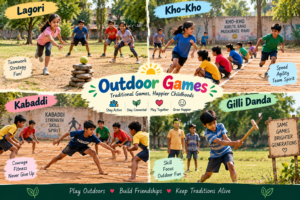
One of the most memorable things about 90s childhood was the popularity of games that required very little equipment.
Some were passed from grandparents to parents and then to children. Others were learned from school friends or neighbourhood groups.
Traditional games such as Kho-Kho, Kabaddi, Gilli Danda, Lagori, Kancha and Stapoo were often inexpensive, social and easy to adapt to the space available.
The exact rules could vary from one state, city or neighbourhood to another. That was part of the fun.
A game played in Delhi might not have had exactly the same rules as one played in Mumbai, Kolkata, Bengaluru or Chennai.
90s School Games Every Indian Kid Remembers
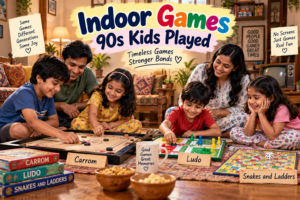
School wasn’t just about classrooms and homework.
For many children, the playground was where some of the best memories were made.
Popular school and playground games included:
- Kho-Kho
- Kabaddi
- Cricket
- Football
- Lagori
- Stapoo
- Skipping
- Dog and the Bone
- Hide-and-seek
- Catch-catch
- Lemon and spoon races
- Relay races
Annual sports days added another layer of excitement, with children competing in races, long jumps, relay events and team games.
Why 90s Childhood Games Still Feel Special
What made these games memorable wasn’t necessarily the game itself.
It was the experience around it.
There were no notifications telling us to come inside.
There were no online leaderboards.
There was no need to charge a device before going outside.
Instead, children negotiated rules, formed teams, argued about whether someone was “out”, solved disagreements and started playing again five minutes later.
These games also gave children opportunities to run, communicate, cooperate, compete and use their imagination.
And perhaps most importantly, they created shared childhood memories.
90s Games vs Today’s Screen-Based Entertainment
Children today have access to entertainment that 90s kids could hardly imagine.
Online games, streaming platforms, educational apps and social media can all be part of modern childhood.
But that doesn’t mean traditional games have to disappear.
Parents can introduce children to simple games from their own childhood and let them experience the fun of playing together.
A weekend game of Lagori, Carrom, Kho-Kho, Ludo or Antakshari can become a family activity rather than simply a lesson about the past.
For more ideas around balancing modern childhood with offline experiences, see our guide to modern parenting in India.
How Parents Can Introduce 90s Games to Kids Today
You don’t need to recreate the entire 1990s.
Start with one game.
If you have enough outdoor space, try Lagori, Kho-Kho, cricket or Stapoo.
For indoor family time, try Carrom, Ludo, Name Place Animal Thing or Antakshari.
You can also ask grandparents to teach children a game they played when they were young.
This can turn a simple game into a conversation about family memories.
Try a “90s Family Game Night”
Choose three games:
Game 1: Ludo or Carrom
Game 2: Antakshari
Game 3: Name Place Animal Thing
Keep phones away for an hour and let everyone participate.
The goal isn’t competition.
It’s creating a memory your children may talk about years from now.
90s Childhood Games and Screen-Free Play
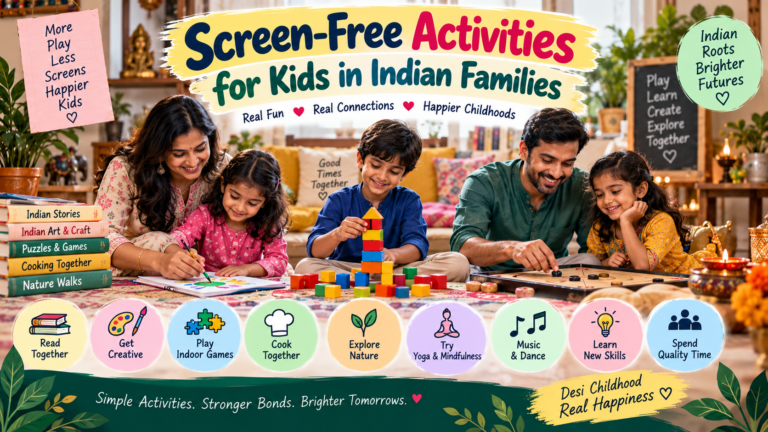
Many of these games are also excellent options when parents are looking for ways to encourage children to spend some time away from screens.
You can explore more ideas in our guide to screen-free activities for kids.
For younger children, activities should always be adapted to their age and abilities, with appropriate supervision.
Games involving small objects, sticks, balls, outdoor roads or physical contact need particular attention to safety.
90s Childhood Memories Go Beyond Games
Games were only one part of growing up in the 90s.
There were also school picnics, summer holidays, birthday parties, cartoon shows, pocket money, handwritten birthday cards, neighbourhood cricket matches and snacks bought from the local shop.
If you remember those days, you may also enjoy our article on 90s kids snacks in India.
Together, these small memories tell a bigger story about childhood before smartphones became part of everyday life.
Frequently Asked Questions
What games did children play in India in the 90s?
Popular games included Lagori, Kho-Kho, Kabaddi, Gilli Danda, Kancha, Hide-and-Seek, Pakdam Pakdai, Stapoo, cricket, football, Carrom, Ludo and Antakshari. The popularity and rules varied between regions and communities.
What were the most popular outdoor games in the 90s?
Some commonly played outdoor games included Kho-Kho, Kabaddi, Lagori, Gilli Danda, Kancha, Stapoo, cricket, football, hide-and-seek and Pakdam Pakdai.
Which traditional Indian games did 90s kids play?
Traditional games played by many children included Gilli Danda, Lagori, Kho-Kho, Kabaddi, Kancha, Stapoo and Poshampa. Different regions often had different names or variations of the same game.
What indoor games did 90s kids play in India?
Popular indoor games included Carrom, Ludo, Snakes and Ladders, playing cards, Business, Antakshari, Dumb Charades, Name Place Animal Thing, Dots and Boxes and Tic-Tac-Toe.
Are 90s childhood games suitable for children today?
Many traditional games can still be enjoyed today when they are adapted to the child’s age, abilities and playing environment. Parents should supervise activities where there is a risk of falls, traffic, physical injury or use of small objects.
Why were 90s childhood games so popular?
Most games were inexpensive, easy to organise and could be played with friends or family. Many also required little or no equipment, making them accessible to children in different communities.
Final Thoughts
The best thing about many 90s childhood games was their simplicity.
A few stones could become Lagori.
A piece of chalk could become Stapoo.
A notebook could become Name Place Animal Thing.
A carrom board could bring the entire family together.
And a group of children could turn almost any open space into a playground.
Technology has changed childhood in many wonderful ways, but there is still something special about children running around with friends, making up rules, laughing loudly and coming home only when someone finally calls them for dinner.
Maybe the best way to keep these games alive isn’t simply to remember them.
It’s to play them again—and introduce them to the next generation.