
Medical note: This article is intended for educational and informational purposes only and should not replace professional medical advice, diagnosis or treatment. Every pregnancy, baby and child develops differently. Always consult your obstetrician, paediatrician or another qualified healthcare professional regarding any questions about your health or your child’s development. Never ignore professional medical advice or delay seeking care because of information you have read online.
Finding out your baby’s gender is one of the most exciting moments during pregnancy.
Many parents begin wondering as soon as they see a positive pregnancy test:
When can I find out if I’m having a boy or a girl?
The answer depends on which test is used.
Some prenatal tests can identify the baby’s sex as early as 10 weeks, while others are performed later in pregnancy.
However, if you live in India, it’s important to know that revealing a baby’s sex before birth is prohibited by law under the PCPNDT Act.
In this guide, we’ll explain when gender can be identified, how accurate different methods are, and what every parent should know.
While you’re waiting to learn more about your baby, you can also explore our Child Development Milestones Birth to 5 Years guide to understand how your little one will grow after birth.
Quick Answer
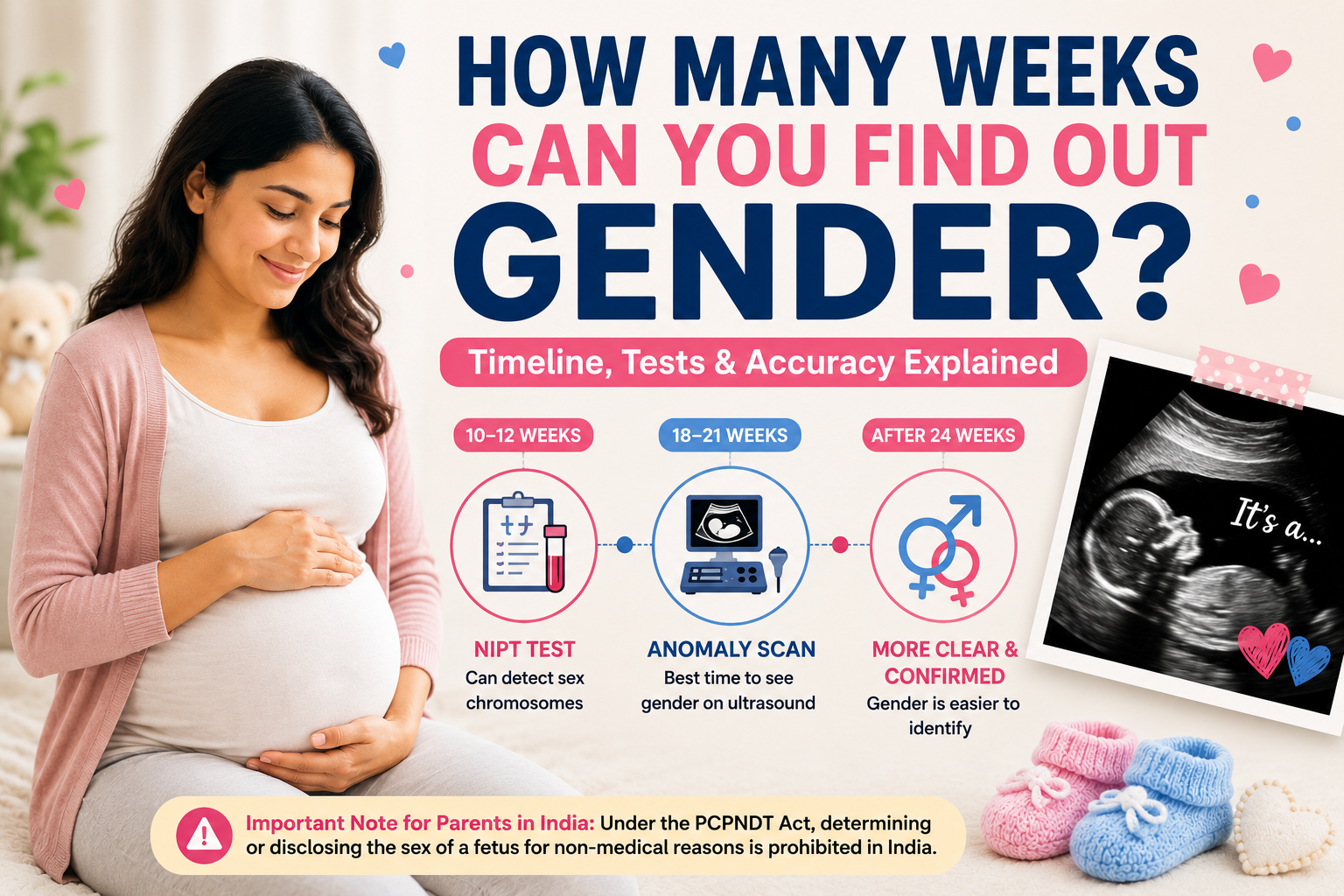
Most parents can find out their baby’s sex from around 10 weeks of pregnancy through a Non-Invasive Prenatal Test (NIPT).
If NIPT is not performed, the baby’s sex is usually visible during the detailed anatomy ultrasound performed between 18 and 22 weeks, depending on the baby’s position and local laws.
At What Week Can You Find Out the Baby’s Gender?
Here’s a quick overview.
| Pregnancy Week | Method | Can Gender Be Determined? |
|---|---|---|
| 6–9 weeks | Ultrasound | ❌ No |
| 10 weeks | NIPT Blood Test | ✅ Yes |
| 11–13 weeks | CVS (Medical Reasons) | ✅ Yes |
| 15–20 weeks | Amniocentesis | ✅ Yes |
| 18–22 weeks | Anatomy Ultrasound | ✅ Usually Yes |
How Does Gender Develop During Pregnancy?
Every baby begins developing from the same basic structures during early pregnancy.
Around the 7th week of pregnancy, genes on the baby’s chromosomes begin directing the development of reproductive organs.
However, the external genitalia are still too small to be identified accurately on an ultrasound.
This is why routine ultrasound cannot reliably determine gender during the first trimester.
Can You Find Out Gender at 6 Weeks?
No.
At 6 weeks:
- the embryo is extremely small
- external genital organs haven’t developed enough
- ultrasound cannot accurately identify fetal sex
Some online myths claim otherwise, but there is no scientific evidence supporting accurate gender determination this early.
Can You Find Out Gender at 7 Weeks?
No.
Although genetic sex has already been determined at conception, the baby’s reproductive organs have not developed enough to be identified during an ultrasound.
Can You Find Out Gender at 8 Weeks?
Not reliably.
Some commercial blood tests claim early gender prediction.
However, most healthcare providers recommend waiting until 10 weeks because there is more fetal DNA circulating in the mother’s bloodstream.
Testing too early increases the possibility of inaccurate results.
Can You Find Out Gender at 9 Weeks?
Possibly, but accuracy is lower than testing from 10 weeks onward.
Most laboratories recommend waiting until at least 10 weeks for reliable NIPT results.
Can You Find Out Gender at 10 Weeks?
Yes.
This is usually the earliest time parents can accurately determine fetal sex.
Non-Invasive Prenatal Testing (NIPT) analyses tiny fragments of fetal DNA present in the mother’s blood.
Besides screening for certain chromosomal conditions, the test can also identify whether Y chromosome DNA is present.
If Y chromosome DNA is detected, the baby is likely male.
If it isn’t detected, the baby is likely female.
NIPT is considered more than 99% accurate for fetal sex determination.
Can an Ultrasound Tell Gender at 12 Weeks?
Sometimes.
However, accuracy depends on:
- baby’s position
- sonographer’s experience
- quality of ultrasound equipment
- gestational age
At 12 weeks, mistakes are still possible because the baby’s external genitalia continue developing.
Many healthcare providers prefer confirming the baby’s sex during the detailed anatomy scan later in pregnancy.
When Does an Ultrasound Usually Show the Baby’s Gender?
Most parents who don’t have NIPT find out during the 18–22 week anatomy scan.
At this stage:
- reproductive organs are more developed
- baby’s anatomy is examined carefully
- visibility is usually much better
However, gender cannot always be confirmed if:
- baby is facing away
- legs remain crossed
- visibility is poor
- maternal body habitus affects imaging
According to the American College of Obstetricians and Gynecologists (ACOG), non-invasive prenatal testing (NIPT) can be performed from around 10 weeks of pregnancy and is primarily used to screen for certain chromosomal conditions.
Which Test Finds Out Gender Earliest?
1. Non-Invasive Prenatal Testing (NIPT)
Earliest: 10 weeks
Accuracy:
More than 99%
Benefits:
- simple blood test
- no risk to baby
- screens for certain chromosome conditions
- earliest reliable gender determination
For more information about prenatal screening and diagnostic tests, visit MedlinePlus, a trusted resource from the U.S. National Library of Medicine.
2. Chorionic Villus Sampling (CVS)
Performed between:
10–13 weeks
CVS analyses placental tissue.
Since chromosomes are examined directly, fetal sex can also be determined.
However, CVS is not performed simply to identify gender.
It is offered only when medically indicated.
3. Amniocentesis
Usually performed:
15–20 weeks
Like CVS, amniocentesis studies fetal chromosomes.
It can identify fetal sex with extremely high accuracy but is recommended only for specific medical reasons.
4. Anatomy Ultrasound
Performed:
18–22 weeks
This remains the most common method used worldwide for parents who don’t undergo genetic screening.
Which Test Is the Most Accurate?
| Test | Accuracy for Gender |
|---|---|
| NIPT | More than 99% |
| CVS | Nearly 100% |
| Amniocentesis | Nearly 100% |
| Anatomy Ultrasound | Usually 95–99% |
Remember that ultrasound accuracy depends on fetal position.
Why Can’t Doctors Always Tell Earlier?
During early pregnancy:
- reproductive organs are tiny
- ultrasound resolution is limited
- babies frequently change position
Even if the baby’s chromosomes are already male or female, visible anatomy develops gradually.
Is NIPT 100% Accurate?
No medical test is completely perfect.
Although NIPT is extremely accurate for fetal sex determination, rare errors can occur because of:
- low fetal DNA fraction
- laboratory issues
- vanishing twin pregnancy
- rare chromosomal variations
Parents should discuss results with their healthcare provider.
Can Gender Ever Be Wrong on Ultrasound?
Yes.
Occasionally ultrasound predictions are incorrect because:
- baby keeps legs closed
- umbilical cord resembles genitalia
- scanning occurs too early
- image quality is poor
This is why some parents discover a different sex at birth than expected.
Although uncommon, it does happen.
The NHS explains that the routine anomaly scan is usually performed between 18 and 21 weeks of pregnancy and may reveal your baby’s sex if it is visible during the scan.
Boy or Girl: Does Pregnancy Symptoms Predict Gender?
Many popular myths claim you can predict gender based on:
- morning sickness
- baby’s heartbeat
- belly shape
- food cravings
- skin changes
However, scientific research has not confirmed these methods.
Pregnancy symptoms cannot reliably determine fetal sex.
Can You Choose Your Baby’s Gender?
Naturally conceived pregnancies cannot be controlled to produce a specific sex.
Certain assisted reproductive technologies may allow embryo selection in limited medical situations in some countries.
However, laws vary widely.
Is It Legal to Find Out the Baby’s Gender in India?
This is one of the most important questions for Indian parents.
Under the Pre-Conception and Pre-Natal Diagnostic Techniques (PCPNDT) Act, determining or revealing the sex of the fetus is illegal except for specific medical purposes.
Healthcare providers are prohibited from informing parents whether they are expecting a boy or a girl.
The law was introduced to prevent sex-selective practices and promote gender equality.
Parents should respect these legal requirements and avoid unverified or illegal methods of fetal sex determination.
Why Do Some Countries Allow Gender Disclosure?
Many countries permit parents to learn the baby’s sex if they choose.
Reasons include:
- preparing the nursery
- choosing baby names
- planning family celebrations
- personal preference
However, regulations differ across countries, and parents should follow the laws where they receive prenatal care.
What If I Don’t Want to Know the Gender?
Many parents choose to keep it a surprise.
If you prefer not to know:
- tell your sonographer before the scan begins
- remind your healthcare provider during appointments
- ask that the baby’s sex not be included in printed reports if possible
This allows you to enjoy the surprise on your baby’s birthday.
Common Myths About Finding Out Baby’s Gender
| Myth | Fact |
|---|---|
| Heartbeat predicts gender | No scientific evidence |
| Belly shape shows boy or girl | Myth |
| Morning sickness always means girl | Not reliable |
| Chinese Gender Chart is accurate | Not scientifically proven |
| Ultrasound at 8 weeks shows gender | Too early |
| NIPT can determine sex before 10 weeks | Usually not recommended |
| Every anatomy scan reveals gender | Baby’s position may prevent it |
When Should Parents Consider Genetic Testing?
Genetic tests such as NIPT, CVS and amniocentesis are primarily performed for medical reasons, including screening or diagnosing certain chromosomal conditions.
The decision to undergo these tests should always be discussed with a qualified healthcare provider.
Frequently Asked Questions
How many weeks can you find out gender?
Most parents can learn the baby’s sex from around 10 weeks through NIPT or during the 18–22 week anatomy ultrasound.
Can you tell gender at 8 weeks?
No. Eight weeks is generally too early for reliable fetal sex determination.
Is NIPT accurate for gender?
Yes. NIPT is considered more than 99% accurate for determining fetal sex.
Can ultrasound be wrong about gender?
Yes. Ultrasound predictions can occasionally be incorrect because of fetal position or technical limitations.
Can I know my baby’s gender at 12 weeks?
Sometimes, but confirmation is usually more reliable during the detailed anatomy scan between 18 and 22 weeks.
Is gender testing legal in India?
No. Under the PCPNDT Act, revealing or determining fetal sex for non-medical reasons is illegal in India.
Does baby’s heartbeat predict gender?
No. There is no scientific evidence that fetal heart rate predicts whether the baby is a boy or a girl.
Can morning sickness predict a girl’s pregnancy?
Morning sickness varies widely between pregnancies and cannot reliably predict fetal sex.
Final Thoughts
Finding out your baby’s gender is an exciting milestone, but the timing depends on the type of prenatal test used.
While NIPT can determine fetal sex from around 10 weeks, many parents learn the baby’s sex during the 18–22 week anatomy scan. Remember that no method is completely perfect, and ultrasound accuracy can depend on the baby’s position.
For parents in India, it’s essential to understand that revealing or determining the baby’s sex before birth is prohibited under the PCPNDT Act. Prenatal tests should always be used for appropriate medical care rather than sex selection. Once your baby arrives, our When Can Babies Sit Up? guide explains one of the first exciting developmental milestones parents look forward to during the first year.
Instead of focusing on whether you’re expecting a boy or a girl, use your pregnancy journey to learn about your baby’s growth, attend regular prenatal check-ups, and prepare for a healthy birth. The most important news at every appointment is that your baby is growing well and both parent and child remain healthy.
Continue Reading on MomSaathi
As you prepare for your baby’s arrival, you may also find these guides helpful:
👉 Child Development Milestones Birth to 5 Years
👉 When Can Babies Sit Up?
👉 15 Screen-Free Activities for Toddlers