
Everything Parents Need to Know About Artificial Intelligence, Safety, Learning & Smart Usage
Artificial Intelligence (AI) is no longer a futuristic concept—it has become a part of everyday life. From voice assistants like Siri and Alexa to educational apps, homework helpers, and creative tools, children are interacting with AI more often than many parents realize.
As AI continues to transform education, entertainment, and communication, many parents have important questions:
- Is AI safe for children?
- At what age should kids start using AI?
- Can ChatGPT help with homework?
- Will AI make children smarter or more dependent on technology?
- How can parents ensure responsible AI use?
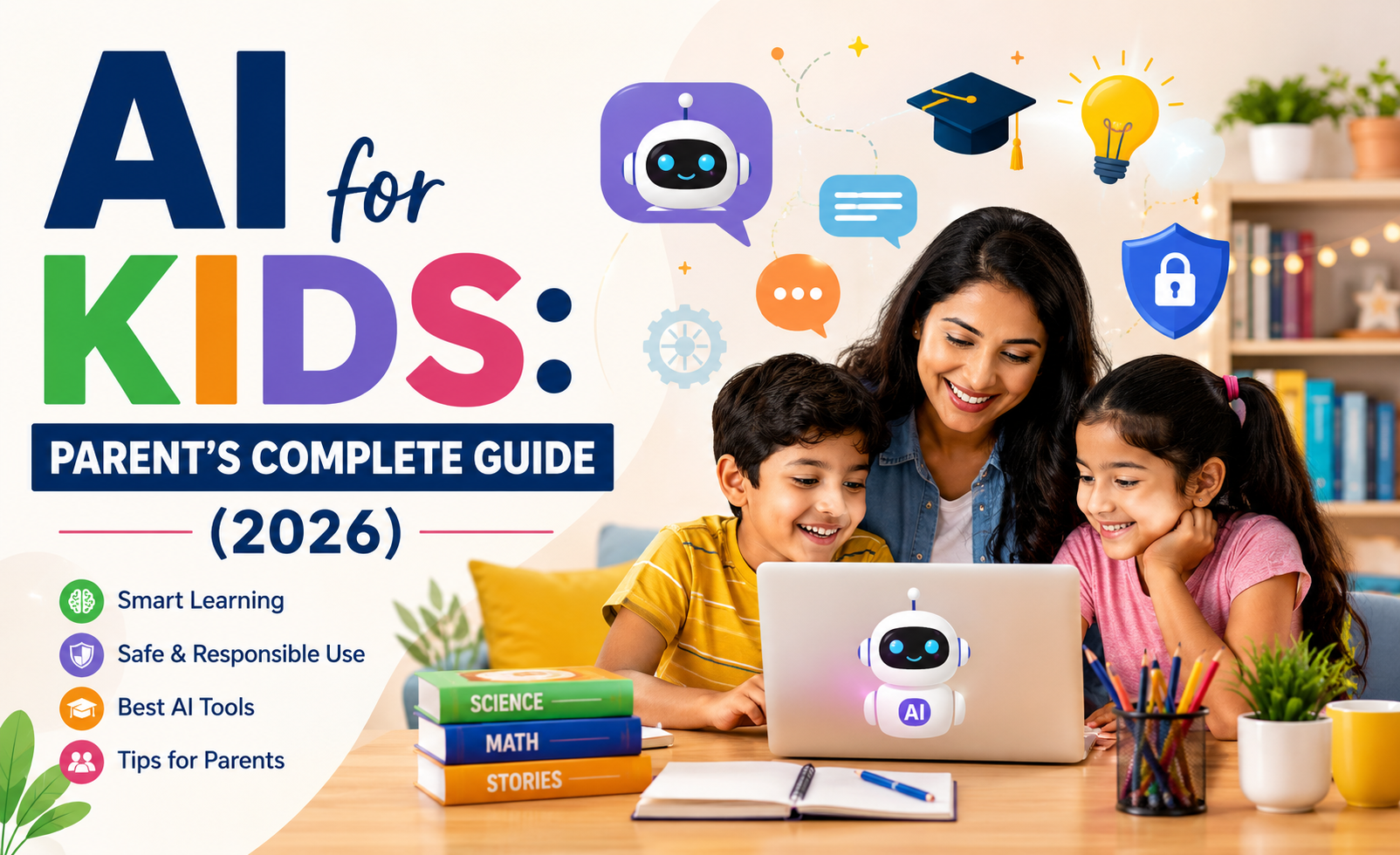
This comprehensive guide answers these questions and provides practical tips to help parents introduce AI to their children safely and confidently.
Related: Parenting in the digital age is all about balance. Explore our 5 Gentle Parenting Tips Every Mom Should Know to build trust and healthy technology habits at home.
What Is Artificial Intelligence (AI)?
Artificial Intelligence, commonly known as AI, refers to computer systems designed to perform tasks that typically require human intelligence. These tasks include learning, problem-solving, understanding language, recognizing images, answering questions, and even creating stories, music, or artwork.
Many AI-powered tools are already part of children’s daily lives, such as:
- Voice assistants (Alexa, Siri, Google Assistant)
- AI chatbots like ChatGPT
- Educational learning apps
- Language learning platforms
- Smart toys
- Personalized learning systems
- AI-powered search engines
Unlike traditional software, AI can analyze information, learn from patterns, and provide personalized responses.
Why Are Kids Using AI Today?
Today’s children are growing up in an AI-driven world. Schools, educational platforms, and even search engines increasingly incorporate AI to enhance learning experiences.
Some common reasons children use AI include:
- Completing homework
- Learning new concepts
- Solving math problems
- Practicing languages
- Writing essays
- Creating presentations
- Generating images
- Coding assistance
- Brainstorming creative ideas
- Studying for competitive exams
When used correctly, AI can act as a learning assistant rather than a replacement for critical thinking.
Expecting a Baby? Follow your baby’s growth week by week with our detailed Pregnancy Week 27 Guide.
Benefits of AI for Kids
AI offers several educational and developmental advantages when used responsibly.
1. Personalized Learning
Every child learns differently. AI-powered educational tools can adapt lessons according to a child’s learning speed, strengths, and areas that need improvement.
For example:
- Faster learners receive advanced challenges.
- Struggling learners receive additional explanations and practice.
This personalized approach helps children stay engaged and motivated..
🎯 Parents Also Read: AI should support learning—not replace real-life play. Discover fun offline activities in our guide to The Ultimate Guide to the Best Board Games for Families.
2. Instant Homework Support
Children often get stuck while solving assignments. AI can explain difficult concepts step by step instead of simply providing answers.
For instance, a child struggling with fractions can ask an AI assistant for an explanation using simple language and real-life examples.
Parents should encourage children to understand solutions rather than copy answers.
3. Encourages Creativity
AI isn’t just for academics.
Children can use AI to:
- Write stories
- Create poems
- Generate artwork
- Build comics
- Design games
- Brainstorm science projects
- Practice speeches
These activities encourage imagination while improving communication skills.
4. Improves Language Skills
Many AI tools can help children:
- Learn new vocabulary
- Practice pronunciation
- Improve grammar
- Translate languages
- Develop writing skills
This is especially useful for bilingual families and children learning additional languages.
5. Builds Future-Ready Skills
According to education experts, AI literacy will become as important as computer literacy over the coming years.
Children who learn how AI works develop skills such as:
- Critical thinking
- Problem-solving
- Digital literacy
- Logical reasoning
- Creativity
- Responsible technology use
These skills are increasingly valuable in future careers.
Is AI Safe for Children?
The answer depends on how AI is used.
AI itself is neither good nor bad. Like the internet, it is a powerful tool that requires parental guidance.
Children using AI without supervision may encounter:
- Incorrect information
- Biased responses
- Inappropriate content
- Privacy risks
- Overdependence on AI
- Reduced independent thinking
However, with proper guidance, AI can become a safe educational companion.
🍽️ Related: Good learning starts with good nutrition. If your child refuses healthy food, don’t miss our guide on Solutions for Picky Eaters.
Potential Risks of AI for Kids
Parents should understand the possible challenges before allowing unrestricted AI access.
1. Misinformation
AI sometimes generates inaccurate or outdated information.
Children may assume every answer is correct.
Teach kids to verify important facts using trusted educational sources or by asking teachers.
2. Privacy Concerns
Some AI tools collect user data.
Children should never share:
- Home address
- School name
- Phone numbers
- Passwords
- Personal photographs
- Family financial information
Parents should review privacy settings before allowing children to use any AI application.
3. Overdependence
If children rely entirely on AI for homework, they may stop thinking independently.
Instead of asking AI to complete assignments, encourage prompts like:
“Explain this concept in simple words.”
or
“Help me understand how to solve this problem.”
4. Exposure to Inappropriate Content
Although most AI tools include safety filters, no system is perfect.
Parents should:
- Enable parental controls
- Use child-friendly AI platforms
- Monitor conversations
- Discuss responsible AI use
At What Age Can Children Start Using AI?
There is no universal age, but experts generally recommend different levels of supervision depending on maturity.
Ages 3–6 Years
Recommended use:
- AI-powered storytelling
- Interactive educational games
- Language learning apps
- Voice assistants
Parental supervision should always be present.
Ages 7–10 Years
Children may begin using AI for:
- Homework explanations
- Reading assistance
- Fun quizzes
- Educational videos
- Creative writing
Parents should review AI responses together.
Ages 11–13 Years
Older children can learn:
- Research skills
- Coding basics
- Presentation ideas
- Science experiments
- Debate preparation
This is also the right age to teach digital responsibility.
Ages 14+
Teenagers can use AI for:
- Career exploration
- Competitive exam preparation
- Resume building
- Programming
- Research projects
- Entrepreneurship ideas
However, they should understand ethical AI use and academic honesty.
❤️ Also Read: Parenting isn’t just about technology—it’s about building stronger family relationships. Read Motherhood vs Wifehood: Finding Harmony, Not Competition.
Can AI Replace Teachers?
No.
AI is designed to support learning—not replace teachers.
Teachers provide:
- Emotional support
- Classroom discussions
- Critical thinking activities
- Real-life experiences
- Social learning
- Personalized mentorship
AI works best as an educational assistant that complements classroom learning.
Can AI Help with Homework?
Yes—but it should be used wisely.
Good examples include:
✅ Explain difficult concepts
✅ Generate practice questions
✅ Check grammar
✅ Solve math step by step
✅ Summarize chapters
Poor examples include:
❌ Copying essays
❌ Completing assignments without understanding
❌ Cheating during exams
Parents should emphasize learning rather than shortcuts.
How Parents Can Introduce AI to Children
If your child is new to AI, follow these simple steps:
Step 1: Start Together
Explore AI tools as a family instead of allowing independent use immediately.
Step 2: Explain That AI Can Make Mistakes
Teach children that AI is helpful but not always accurate.
Encourage them to ask:
- Is this information correct?
- Can I verify this elsewhere?
- Does this make sense?
Step 3: Set Clear Rules
Create family guidelines such as:
- No sharing personal information
- AI only after homework attempts
- Ask permission before using new AI apps
- Use AI for learning—not cheating
Step 4: Encourage Curiosity
Ask children to use AI for:
- Science questions
- Story writing
- Nature facts
- Coding practice
- Art ideas
- History quizzes
This builds curiosity while promoting responsible technology use.
Best AI Tools for Kids (2026)
Not every AI tool is designed for children. Parents should choose age-appropriate platforms that prioritize privacy, learning, and safe interactions.
| AI Tool | Best For | Recommended Age |
|---|---|---|
| ChatGPT | Homework help, explanations, creative writing | 13+ (or younger with parental supervision) |
| Khanmigo | Personalized tutoring | 8+ |
| Google Gemini | Research and learning | Teenagers with guidance |
| Duolingo AI | Language learning | 6+ |
| Scratch with AI Extensions | Coding and creativity | 8+ |
| Canva Magic Write | School projects and presentations | 10+ |
| Photomath | Step-by-step math solutions | 10+ |
| Microsoft Copilot | Research and productivity | Teenagers |
Parent Tip: Always explore a new AI tool yourself before introducing it to your child.
How to Teach Kids to Use AI Responsibly
AI should be treated like a calculator or encyclopedia—it helps with learning but should not do all the thinking.
Teach your child these five golden rules:
1. Think First, Ask AI Second
Encourage children to attempt solving problems independently before seeking AI assistance.
2. Verify Important Information
AI can occasionally provide incorrect or incomplete answers. Teach children to cross-check facts using trusted books, teachers, or reputable educational websites.
3. Never Share Personal Information
Children should never enter:
- Full name
- Home address
- School name
- Phone number
- Passwords
- Family financial details
- Personal photographs
4. Use AI to Learn, Not Cheat
AI should explain concepts rather than complete homework without understanding.
Instead of asking:
“Write my science assignment.”
Encourage prompts like:
“Explain photosynthesis in simple words suitable for Class 6.”
5. Discuss AI Conversations
Parents should occasionally ask:
- What did you ask AI today?
- Did you learn something new?
- Was anything confusing?
- Did the answer seem trustworthy?
These conversations help children develop digital literacy.
Signs Your Child Is Overusing AI
Like any technology, AI should be used in moderation.
Watch for these warning signs:
- Completing homework unusually quickly
- Copying AI-generated answers without reading
- Reduced creativity
- Less interest in solving problems independently
- Spending excessive time chatting with AI
- Avoiding books or classroom resources
If you notice these behaviors, set healthier digital boundaries and encourage offline learning activities.
Family AI Rules Every Home Should Have
Creating a family AI agreement can help children develop healthy technology habits.
Recommended House Rules
✔ AI is a learning assistant—not a replacement for thinking.
✔ Homework should be attempted before asking AI for help.
✔ No personal information should ever be shared with AI tools.
✔ Parents should know which AI apps are installed.
✔ AI use should happen in shared family spaces whenever possible.
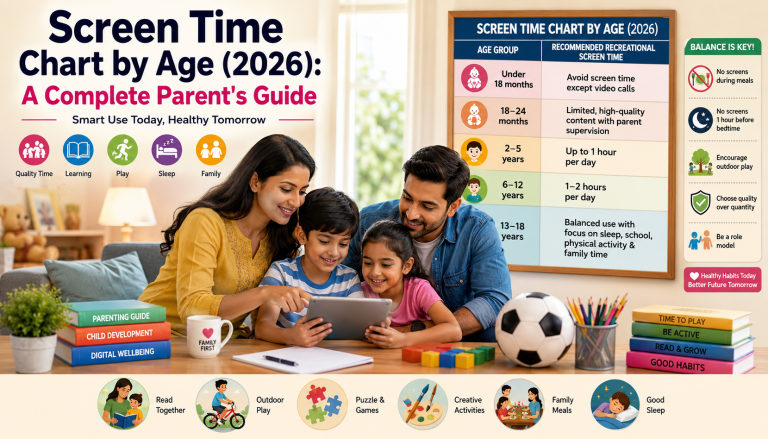
✔ Screen time limits should still apply to AI-based apps.
✔ Important school projects should include your child’s original ideas.
Posting these rules near the study area can serve as a helpful reminder.
Healthy Moms, Happy Families: A parent’s wellbeing directly impacts a child’s development. Explore our Fitness for Mothers in India guide.
AI Activities Parents Can Do with Kids
Instead of fearing AI, families can use it together in fun and educational ways.
Creative Storytelling
Ask AI to begin a story, then let your child write the ending.
Science Exploration
Children can ask questions like:
- Why is the sky blue?
- How do volcanoes erupt?
- Why do leaves change color?
Then discuss the answers together.
Quiz Time
Generate quizzes on:
- Animals
- Space
- History
- Mathematics
- Geography
- General knowledge
Vocabulary Builder
Ask AI to explain difficult words using child-friendly examples.
Coding Practice
Older children can use AI to:
- Learn programming basics
- Understand coding errors
- Build simple games
- Explore robotics concepts
AI Myths vs Facts
| Myth | Fact |
|---|---|
| AI knows everything. | AI can make mistakes and provide outdated information. |
| AI will replace teachers. | AI supports teachers but cannot replace human guidance. |
| Kids should never use AI. | Responsible AI use can improve learning and creativity. |
| AI completes homework better than children. | Learning happens when children understand concepts themselves. |
| AI is dangerous for everyone. | Safe use with parental supervision can be highly beneficial. |
Frequently Asked Questions
Is ChatGPT safe for children?
With parental supervision and age-appropriate use, ChatGPT can be a valuable educational tool. Parents should monitor conversations and teach children not to share personal information.
Can AI improve learning?
Yes. AI can personalize learning, explain difficult concepts, generate practice questions, and encourage creativity when used responsibly.
Should children use AI every day?
Moderate use is acceptable if balanced with reading, outdoor play, social interaction, and independent problem-solving.
Will AI reduce creativity?
Not necessarily. AI can actually inspire creative writing, storytelling, coding, and art. However, children should create original work rather than rely entirely on AI-generated content.
Can AI help children with special learning needs?
Many AI-powered educational tools provide personalized learning experiences, speech support, reading assistance, and adaptive lessons that may benefit children with diverse learning styles. Parents should consult teachers or specialists when choosing tools.
Printable AI Safety Checklist for Parents
Before allowing your child to use AI, ask yourself:
- Have I explained what AI is?
- Does my child know not to share personal information?
- Have we discussed that AI can make mistakes?
- Are parental controls enabled where available?
- Have I selected age-appropriate AI tools?
- Do we have screen time rules?
- Will I review AI-generated content with my child?
- Does my child understand that AI is for learning, not cheating?
Completing this checklist can help create a safer and more positive AI experience.
Expert Tips for Parents
Technology experts and educators recommend focusing on AI literacy rather than avoiding AI altogether.
Help children develop these lifelong skills:
- Ask thoughtful questions.
- Think critically about answers.
- Verify facts from multiple sources.
- Respect digital privacy.
- Use AI ethically.
- Balance online learning with real-world experiences.
- Stay curious and keep learning together.
Children who understand how AI works—not just how to use it—will be better prepared for the future.
Final Thoughts
Artificial Intelligence is becoming an essential part of education and everyday life. Instead of viewing it as something to fear, parents can treat AI as a powerful learning companion.
The goal isn’t to let AI think for children—it is to help children think better.
By setting clear boundaries, encouraging curiosity, and promoting responsible use, families can enjoy the benefits of AI while protecting children’s privacy, creativity, and critical thinking.
Remember, the most valuable skill your child can develop isn’t simply knowing how to use AI—it’s knowing when to question it, when to trust it, and when to think independently.
Trusted Resources & Further Reading
To learn more about Artificial Intelligence, online safety, and responsible technology use for children, explore these trusted resources from leading global organizations:
- UNICEF’s Guidance on AI and Children
- UNICEF – Keeping Children Safe Online
- Common Sense Media – AI Research on Tweens & Teens
- Children and Screens – Youth & Generative AI: A Guide for Parents and Educators
- Protecting Children in the Age of AI – UNICEF USA
Editorial Note: This article is based on guidance and research from trusted organizations, including UNICEF and Common Sense Media, to help parents understand how children can use Artificial Intelligence safely and responsibly. While AI offers exciting learning opportunities, parental supervision, digital literacy, and age-appropriate usage remain essential for protecting children’s privacy, wellbeing, and healthy development.