
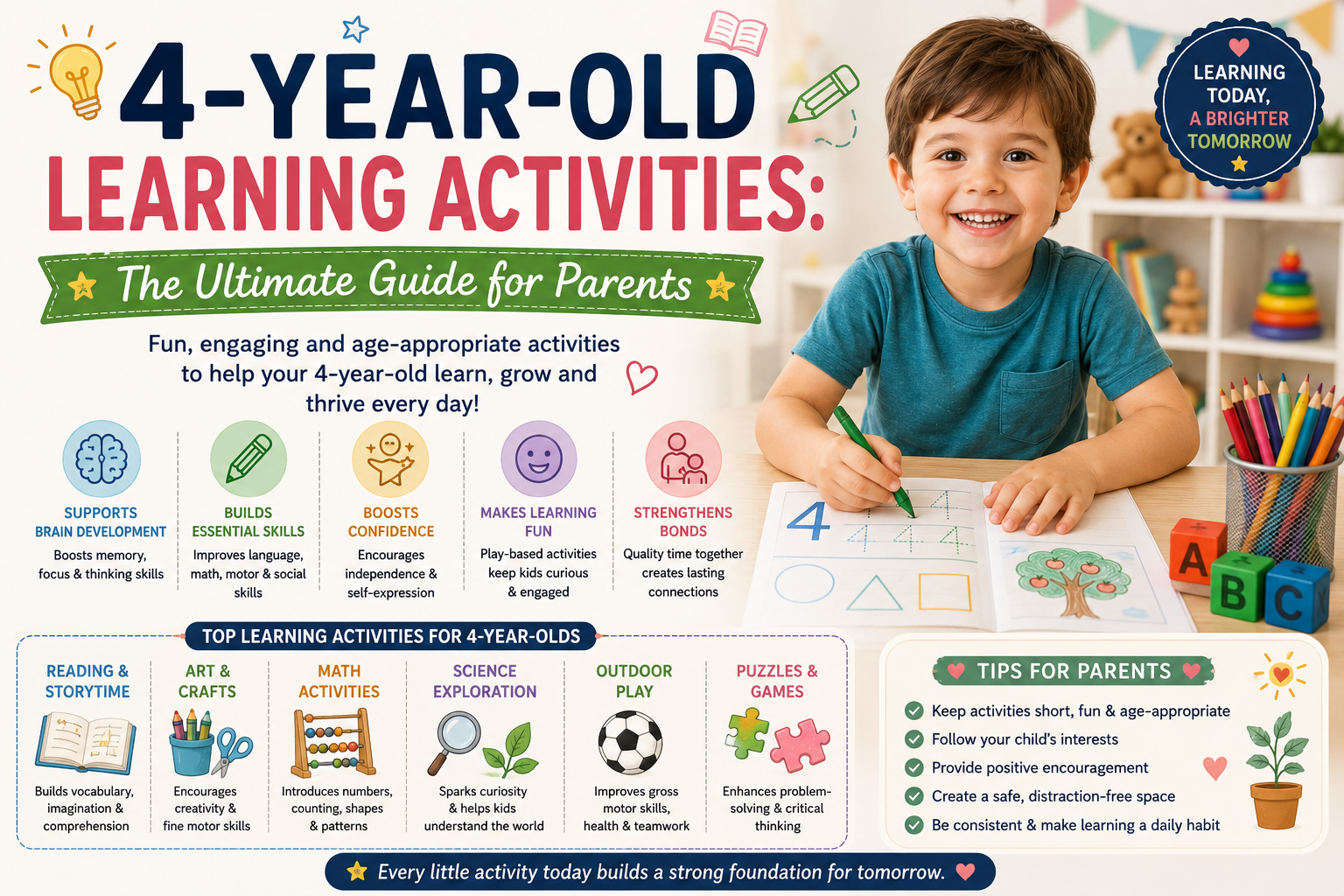

At four years old, children are naturally curious and eager to explore the world around them. They ask questions, enjoy imaginative play, and develop important skills through hands-on experiences. The best 4-year-old learning activities combine fun with education, helping preschoolers build confidence while preparing them for kindergarten.
Learning at this age doesn’t have to feel like formal lessons. Everyday activities such as reading books, counting toys, drawing pictures, and exploring nature provide valuable opportunities to develop language, math, social, and motor skills.
Whether you’re a parent, grandparent, or preschool teacher, this guide offers engaging activities that encourage learning through play.
If you’re looking for more parenting tips, explore our guides on 3-Year-Old Daily Routine, Baby Food Chart (0–24 Months), and Baby Sleep Schedule.
Why Learning Activities Matter for 4-Year-Olds
At age four, children experience rapid growth in language, thinking, movement, and emotional development. Engaging in age-appropriate learning activities helps strengthen these skills while making learning enjoyable.
Benefits include:
- Improves language and vocabulary
- Builds early math skills
- Develops fine and gross motor skills
- Encourages creativity
- Strengthens memory and attention
- Boosts confidence and independence
- Supports kindergarten readiness
- Promotes social and emotional development
According to the Centers for Disease Control and Prevention (CDC), preschoolers learn best through play, daily routines, and positive interactions with caregivers.
Skills Most 4-Year-Olds Are Developing
Children may begin learning to:
- Recognize letters
- Identify numbers
- Count objects
- Follow multi-step instructions
- Draw recognizable shapes
- Write some letters
- Tell simple stories
- Sort by color and size
- Solve simple puzzles
- Play cooperatively with friends
Every child develops at their own pace, so focus on progress rather than perfection.
Literacy Activities
1. Read Together Every Day
Reading remains one of the best learning activities for preschoolers.
Choose books with:
- Rhyming words
- Repetitive phrases
- Colorful illustrations
- Simple stories
- Interactive questions
Reading together helps improve vocabulary, listening skills, and imagination.
2. Letter Hunt
Hide alphabet letters around the room.
Ask your child to:
- Find the letters
- Name them
- Match uppercase with lowercase
- Say words beginning with each letter
3. Name Writing Practice
Encourage your child to practice writing their own name.
Start with:
- Tracing
- Copying
- Independent writing
Celebrate effort instead of focusing on perfect handwriting.
4. Storytelling
Show your child a picture and ask:
“What do you think is happening?”
Storytelling encourages:
- Creativity
- Sentence formation
- Confidence
- Communication
5. Rhyming Games
Examples:
- Cat – Hat
- Ball – Tall
- Sun – Fun
Rhyming helps children hear sound patterns needed for early reading.
Math Activities
6. Counting Objects
Count everyday items such as:
- Blocks
- Apples
- Toys
- Cars
- Crayons
Use opportunities throughout the day to practice counting naturally.
7. Number Matching
Write numbers on paper and match them with the correct number of objects.
Example:
5 → ⭐⭐⭐⭐⭐
8. Shape Hunt
Look around your home for:
- Circles
- Squares
- Rectangles
- Triangles
- Ovals
Turn it into a fun scavenger hunt.
9. Sorting Games
Sort by:
- Color
- Shape
- Size
- Texture
Sorting develops early math and problem-solving skills.
10. Simple Patterns
Create patterns using:
🔴🔵🔴🔵
Or
🚗🚙🚗🚙
Ask your child to continue the sequence.
Fine Motor Activities
Fine motor skills prepare children for writing and self-care tasks.
11. Playdough Fun
Roll, squeeze, flatten, and shape playdough into:
- Animals
- Letters
- Numbers
- Food
12. Cutting Practice
Using child-safe scissors, let children cut:
- Straight lines
- Curved lines
- Shapes
Always supervise this activity.
13. Bead Threading
Threading beads helps improve:
- Hand-eye coordination
- Finger strength
- Concentration
Use large beads suitable for preschoolers.
14. Sticker Art
Children can decorate pictures using colorful stickers while improving finger control.
15. Coloring
Provide:
- Crayons
- Colored pencils
- Washable markers
Coloring develops pencil grip and creativity.
Science Activities
16. Nature Walk
Take a walk and collect:
- Leaves
- Flowers
- Rocks
- Feathers
Talk about colors, textures, and shapes.
17. Sink or Float
Fill a container with water.
Test objects like:
- Spoon
- Leaf
- Toy
- Rock
- Ball
Ask:
“What do you think will happen?”
18. Growing Plants
Plant beans or flowers in a small pot.
Children can:
- Water plants
- Observe growth
- Measure height
This teaches patience and responsibility.
19. Color Mixing
Mix:
- Red + Yellow
- Blue + Yellow
- Red + Blue
Ask your child to predict the new color.
20. Weather Chart
Track daily weather.
Discuss:
- Sunny
- Rainy
- Windy
- Cloudy
This builds observation skills.
Creative Activities
21. Finger Painting
Messy play encourages creativity and sensory exploration.
22. Building Blocks
Create:
- Towers
- Bridges
- Houses
- Castles
Building develops engineering thinking and problem-solving.
23. Dress-Up Play
Pretend to be:
- Doctor
- Teacher
- Chef
- Firefighter
- Astronaut
Role-playing improves language and social skills.
24. Puppet Shows
Create simple puppets using socks or paper bags and tell stories together.
25. Music and Dance
Sing songs and dance to improve rhythm, balance, and coordination.
Outdoor Learning Activities
Outdoor play supports physical health while providing endless learning opportunities.
Ideas include:
- Nature scavenger hunts
- Chalk alphabet games
- Hopscotch with numbers
- Obstacle courses
- Ball games
- Bubble play
- Gardening
- Bird watching
The American Academy of Pediatrics (AAP) encourages regular active play to support healthy development and reduce sedentary behavior.
Tips for Successful Learning
To keep learning enjoyable:
- Keep activities short (10–20 minutes)
- Follow your child’s interests
- Offer praise and encouragement
- Allow plenty of free play
- Limit distractions
- Make learning part of everyday life
Remember, preschoolers learn best when they’re engaged and having fun.
For more parenting resources, visit:
Baby Haircut
Contact Naps
Baby Hair Growth Oil
Four-year-olds learn best through play, exploration, and everyday experiences. The goal isn’t to teach like a classroom—it’s to create opportunities for your child to discover, ask questions, solve problems, and build confidence. These activities help prepare children for kindergarten while keeping learning enjoyable.
If you’re building a complete learning routine, also explore our guides on 3-Year-Old Daily Routine, Baby Sleep Schedule, and Baby Food Chart (0–24 Months).
Montessori Learning Activities for 4-Year-Olds
Montessori-inspired activities encourage independence, concentration, and hands-on learning.
26. Pouring Water
Let your child pour water between cups using a small jug.
Benefits:
- Hand-eye coordination
- Fine motor skills
- Concentration
27. Folding Clothes
Teach your child to fold small towels or clothes.
This builds:
- Independence
- Organization
- Responsibility
28. Matching Everyday Objects
Match:
- Socks
- Kitchen utensils
- Toy animals
- Leaves
- Buttons
Matching activities strengthen observation and classification skills.
29. Practical Life Tasks
Invite your child to help with:
- Watering plants
- Setting the table
- Wiping surfaces
- Organizing toys
- Feeding pets
These activities build confidence and life skills.
30. Sensory Bins
Fill a container with:
- Rice
- Beans
- Sand
- Cotton balls
Hide letters, numbers, or small toys for your child to find.
STEM Activities
STEM (Science, Technology, Engineering, and Math) introduces problem-solving through play.
31. Build a Paper Bridge
Challenge your child to build a bridge using paper and blocks.
Ask:
“How can we make it stronger?”
32. Balloon Rocket
Thread a straw onto string, tape a balloon to the straw, and release it.
Children learn about movement and air pressure while having fun.
33. Tower Challenge
Build the tallest tower using:
- Blocks
- Cups
- LEGO® bricks
Encourage experimentation rather than perfection.
34. Ice Melting Experiment
Freeze small toys inside ice cubes.
Use:
- Warm water
- Salt
- Plastic spoons
Observe which method melts the ice fastest.
35. Magnet Exploration
Test household items.
Ask:
“Does it stick to the magnet?”
This introduces basic scientific observation.
Indoor Learning Activities
Perfect for rainy days.
36. Alphabet Treasure Hunt
Hide letters around the house.
Ask your child to:
- Find each letter
- Say its name
- Think of a word beginning with it
37. Puzzle Time
Choose puzzles with:
- Animals
- Vehicles
- Numbers
- Maps
- Alphabet
Puzzles improve logical thinking and patience.
38. Memory Matching Game
Use picture cards and encourage children to find matching pairs.
Memory games strengthen concentration and recall.
39. DIY Obstacle Course
Create an indoor course using:
- Pillows
- Chairs
- Tape lines
- Soft toys
Children can crawl, jump, balance, and climb safely.
40. Cooking Together
Simple recipes teach:
- Counting
- Measuring
- Following directions
- Healthy eating habits
Let your child stir, pour, or wash fruits under supervision.
Social and Emotional Learning Activities
Help your child understand emotions and relationships.
Emotion Cards
Ask:
“How is this person feeling?”
Discuss emotions like:
- Happy
- Sad
- Angry
- Excited
- Nervous
Kindness Challenge
Encourage one kind act each day, such as:
- Sharing toys
- Helping a sibling
- Saying thank you
- Giving compliments
Family Conversations
Ask open-ended questions:
- What made you smile today?
- What was your favorite activity?
- Did anything make you feel upset?
These conversations build emotional awareness and communication.
Screen-Free Learning Ideas
Instead of relying on digital devices, encourage:
- Reading books
- Board games
- Building blocks
- Drawing
- Singing songs
- Gardening
- Nature walks
- Pretend play
- Treasure hunts
- Craft projects
The American Academy of Pediatrics recommends balancing any screen use with active play, sleep, reading, and family interaction.
Weekly Learning Plan
| Day | Main Activity |
|---|---|
| Monday | Alphabet and reading |
| Tuesday | Math and counting games |
| Wednesday | Science experiment |
| Thursday | Arts and crafts |
| Friday | Nature exploration |
| Saturday | Cooking and practical life skills |
| Sunday | Family games and storytelling |
Rotating activities keeps learning exciting and helps children build a wide range of skills.
Common Mistakes Parents Should Avoid
Avoid these common pitfalls:
- Expecting long attention spans
- Comparing your child with others
- Turning every activity into a lesson
- Overscheduling the day
- Focusing only on worksheets
- Ignoring free play
- Correcting every small mistake
Learning should be enjoyable and child-led whenever possible.
Expert Tips for Parents
- Read together every day.
- Encourage curiosity by answering questions patiently.
- Praise effort rather than outcomes.
- Let children solve simple problems independently.
- Spend time outdoors every day.
- Keep learning playful and pressure-free.
- Celebrate small achievements.
Frequently Asked Questions
What should a 4-year-old be learning?
Most children begin developing early literacy, counting, problem-solving, creativity, communication, and social skills through play.
How long should learning activities last?
Around 10–20 minutes per activity is generally appropriate, depending on your child’s interest and attention span.
Should my 4-year-old know the alphabet?
Many preschoolers begin recognizing letters and sounds by age four, though development varies from child to child.
Can a 4-year-old start writing?
Many children begin tracing and writing some letters, especially those in their own name.
How much screen time is appropriate?
Choose high-quality educational content and balance it with active play, reading, and family interaction.
What are the best indoor learning activities?
Puzzles, storytelling, alphabet games, crafts, building blocks, pretend play, and science experiments are excellent indoor options.
How much outdoor play does a preschooler need?
Daily outdoor play supports physical health, creativity, and emotional well-being.
Should learning be structured?
A balance of structured activities and free play works best for preschool-aged children.
Are worksheets necessary?
No. Hands-on, play-based learning is generally more engaging and developmentally appropriate for most 4-year-olds.
How can I encourage my child to love learning?
Follow your child’s interests, make activities fun, offer praise, and create a positive environment where mistakes are seen as part of learning.
Final Thoughts
The best 4-year-old learning activities are those that inspire curiosity, creativity, and confidence. Everyday experiences—reading together, exploring nature, building with blocks, cooking, counting, and imaginative play—can all become meaningful learning opportunities.
Remember that every child develops at their own pace. Focus on creating a supportive environment where your preschooler feels safe to ask questions, experiment, and enjoy the learning process. Consistency, encouragement, and play are the foundations of lifelong learning.
For more preschool and parenting resources, explore these MomSaathi guides:
3-Year-Old Daily Routine
Baby Food Chart (0–24 Months)
Baby Sleep Schedule
Contact Naps
Baby Haircut
Baby Hair Growth Oil
Authoritative Resources
For evidence-based guidance on preschool learning and development, refer to:
- Centers for Disease Control and Prevention (CDC) – Developmental Milestones: https://www.cdc.gov/ncbddd/actearly/milestones/
- HealthyChildren.org (American Academy of Pediatrics): https://www.healthychildren.org/
- NAEYC (National Association for the Education of Young Children): https://www.naeyc.org/
- PBS Parents – Learning Through Play: https://www.pbs.org/parents/
These trusted resources provide practical advice on child development, early learning, play-based education, and school readiness.
[…] 4-Year-Old Learning Activities: 50+ Fun Preschool Ideas […]