
Medical note: This article is for educational purposes only and should not replace professional medical advice. If your baby’s birthmark changes rapidly, develops swelling, bleeding or is associated with other concerning symptoms, consult your paediatrician or a dermatologist.
Noticing a pink or reddish mark on your newborn’s forehead, eyelids or the back of the neck can be surprising for new parents. These marks are often called stork bite birthmarks, and they are one of the most common and harmless birthmarks seen in babies.
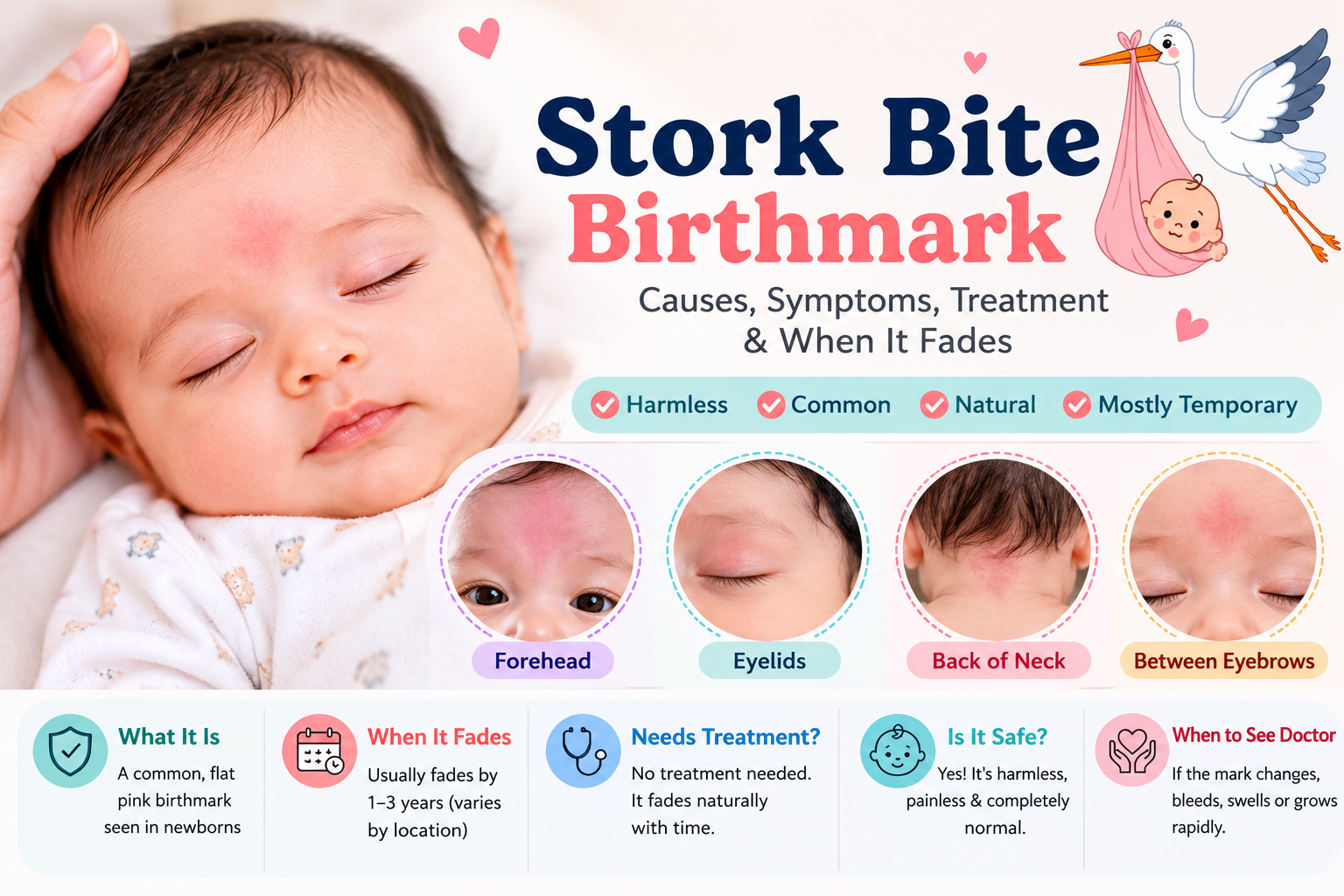
A stork bite is present at birth and is caused by tiny blood vessels just beneath the skin. It usually fades naturally during infancy or early childhood without any treatment. While the name may sound unusual, a stork bite is simply a normal variation in skin appearance and is not a sign of illness.
In this guide, we’ll explain what a stork bite birthmark is, why it develops, how to tell it apart from other birthmarks, when it fades and when medical advice may be needed.
What Is a Stork Bite Birthmark?
A stork bite birthmark, medically known as nevus simplex or a salmon patch, is a flat, pink or light red birthmark caused by tiny dilated blood vessels (capillaries) close to the surface of the skin.
It is one of the most common vascular birthmarks in newborns and is completely benign (non-cancerous).
The colour often becomes more noticeable when a baby:
- Cries
- Is upset
- Has a fever
- Is warm after a bath
As blood flow increases, the mark may temporarily appear brighter. According to the American Academy of Pediatrics (HealthyChildren.org), vascular birthmarks such as salmon patches (stork bites) are common in newborns and are usually harmless.
Why Is It Called a Stork Bite?
The name comes from an old folklore story that babies were delivered by storks carrying them by the back of the neck. Because these birthmarks frequently appear on the back of the neck, they became known as stork bites.
When similar marks appear on the forehead or between the eyebrows, they are sometimes called angel kisses.
Both names describe the same type of birthmark.
What Causes a Stork Bite Birthmark?
A stork bite develops because some tiny blood vessels remain slightly widened beneath the skin during fetal development.
Doctors do not know exactly why this occurs, but it is considered a normal variation in newborn skin.
Importantly:
- It is not caused by anything the mother ate during pregnancy.
- It is not linked to medications.
- It is not caused by injuries during childbirth.
- It is not hereditary in most cases.
- It is not contagious.
How Common Are Stork Bite Birthmarks?
Stork bites are extremely common.
Research suggests that 30–50% of newborns have a nevus simplex birthmark, making it one of the most frequently seen birthmarks in infants.
Both boys and girls are equally likely to have them. The NHS explains that many birthmarks, including salmon patches, often fade naturally during early childhood and usually do not require treatment.
Where Do Stork Bite Birthmarks Usually Appear?
Common locations include:
- Back of the neck (most common)
- Forehead
- Between the eyebrows
- Eyelids
- Nose
- Upper lip
- Scalp (occasionally)
Some babies may have more than one salmon patch.
What Does a Stork Bite Birthmark Look Like?
A typical stork bite birthmark is:
- Flat
- Pink, peach or light red
- Smooth
- Not raised
- Irregular in shape
- Painless
- Soft to touch
Unlike bruises, it does not hurt your baby.
Symptoms
A stork bite generally causes no symptoms.
Your baby will not experience:
- Pain
- Itching
- Burning
- Tenderness
- Swelling
The birthmark is simply a change in skin colour.
Does a Stork Bite Change Colour?
Yes.
Many parents notice that the birthmark becomes darker when the baby:
- Cries
- Laughs
- Strains
- Gets excited
- Feels hot
Once the baby calms down, the colour usually becomes lighter again.
How Is a Stork Bite Diagnosed?
Doctors usually diagnose a stork bite through a simple physical examination.
In most cases, no blood tests, scans or biopsies are needed.
A paediatrician can usually identify it based on its:
- Appearance
- Location
- Colour
- Flat texture
Does a Stork Bite Need Treatment?
No.
Most stork bites do not require any treatment because they fade naturally over time.
The birthmark does not affect your baby’s health, growth or development.
Parents should simply observe the mark during routine baby check-ups.
As your baby grows, you may also find our guide on Child Development Milestones: Birth to 5 Years helpful for understanding other normal developmental changes during infancy.
Stork Bite vs Angel Kiss
Although the names differ, both are nevus simplex birthmarks.
| Stork Bite | Angel Kiss |
|---|---|
| Usually on the back of the neck | Usually on the forehead, eyelids or between the eyebrows |
| Often persists into adulthood | Usually fades during early childhood |
| Harmless | Harmless |
| No treatment needed | No treatment needed |
Stork Bite vs Port-Wine Stain
Many parents confuse these two birthmarks.
| Stork Bite | Port-Wine Stain |
|---|---|
| Light pink | Dark red or purple |
| Usually fades | Usually permanent |
| Flat | Flat but may thicken over time |
| Common | Less common |
| Usually no treatment | May require laser therapy |
A paediatrician can easily distinguish between the two during an examination.
Does a Stork Bite Birthmark Fade?
Yes. Most stork bite birthmarks (nevus simplex) fade naturally as a child grows.
The rate at which they disappear depends on their location.
- Forehead: Often fades by 1–2 years of age.
- Eyelids: Usually disappears during infancy.
- Between the eyebrows: Commonly fades before school age.
- Back of the neck: May remain visible into adulthood but is usually hidden by hair.
Even if a stork bite persists on the neck, it is harmless and does not require treatment unless there are cosmetic concerns.
Can Adults Have a Stork Bite Birthmark?
Yes.
While facial stork bites often fade during childhood, those on the back of the neck may remain throughout life.
Adult stork bites:
- Are flat
- Do not become cancerous
- Rarely change in appearance
- Usually remain hidden beneath the hairline
Many adults are unaware they have one unless someone points it out. MedlinePlus, a service of the U.S. National Library of Medicine, notes that most birthmarks are harmless and only require medical evaluation if they change in appearance or cause symptoms.
Can a Stork Bite Become Dangerous?
No.
A typical stork bite is a benign vascular birthmark and does not increase the risk of:
- Skin cancer
- Infection
- Developmental problems
- Brain disorders
- Vision problems
However, if a birthmark changes rapidly or looks different from a typical salmon patch, it should be evaluated by a healthcare professional.
When Should Parents See a Doctor?
Although stork bites are usually harmless, seek medical advice if:
- The birthmark becomes raised or swollen.
- It starts bleeding or develops sores.
- The colour changes dramatically over a short period.
- The mark is dark purple rather than light pink.
- The birthmark grows rapidly.
- Your baby develops multiple unusual vascular birthmarks.
- You are unsure whether it is a stork bite or another type of birthmark.
A paediatrician or dermatologist can confirm the diagnosis and determine whether further evaluation is needed.
Can You Prevent a Stork Bite?
No.
Stork bites develop before birth and cannot be prevented.
They are not caused by:
- Diet during pregnancy
- Sleeping position
- Stress
- Exercise
- Medications (in most cases)
- Normal labour or delivery
There is nothing parents could have done differently to prevent them.
Common Myths vs Facts
| Myth | Fact |
|---|---|
| A stork bite means the baby had a difficult delivery. | ❌ False. It develops before birth. |
| It is caused by something the mother ate during pregnancy. | ❌ False. There is no evidence linking diet to stork bites. |
| A stork bite is painful. | ❌ False. It does not cause pain or discomfort. |
| All stork bites are permanent. | ❌ False. Most facial stork bites fade naturally in early childhood. |
| Stork bites require surgery. | ❌ False. Treatment is rarely needed. |
| A stork bite can become skin cancer. | ❌ False. It is a benign birthmark. |
Caring for a Baby with a Stork Bite
A stork bite does not require special treatment, but good skincare is always beneficial.
- Clean your baby’s skin with lukewarm water and a mild baby cleanser.
- Avoid harsh scrubbing or rubbing the birthmark.
- Protect your baby’s skin from excessive sun exposure as they grow older.
- Attend routine well-baby check-ups so your paediatrician can monitor overall health.
As your baby grows, you may also enjoy our guide on When Can Babies Sit Up?, which explains one of the first major developmental milestones during infancy.
Conclusion
A stork bite birthmark is one of the most common and harmless birthmarks seen in newborns. Caused by tiny dilated blood vessels beneath the skin, these flat pink or red patches often appear on the forehead, eyelids or back of the neck.
Most facial stork bites fade naturally during infancy or early childhood, while those on the neck may persist into adulthood without causing any health problems.
Although they can become more noticeable when a baby cries or gets warm, stork bites are not painful, contagious or dangerous. If you notice unusual changes in the birthmark or are unsure whether it is a stork bite, consult your paediatrician for reassurance and guidance.
Frequently Asked Questions
What is a stork bite birthmark?
A stork bite is a common, harmless vascular birthmark caused by tiny dilated blood vessels beneath the skin.
Is a stork bite the same as a salmon patch?
Yes. “Stork bite,” “salmon patch” and “nevus simplex” all refer to the same type of birthmark.
Why is it called a stork bite?
The name comes from folklore suggesting that storks delivered babies, leaving a “bite” on the back of the neck.
Are stork bites common?
Yes. They affect approximately 30–50% of newborns.
Do stork bites hurt?
No. They are painless and do not cause itching or discomfort.
When do stork bites fade?
Most facial stork bites fade by 1–3 years of age, while neck patches may last much longer.
Can adults still have a stork bite?
Yes. Stork bites on the back of the neck may remain visible into adulthood.
Is a stork bite contagious?
No. It cannot spread from one person to another.
Does a stork bite require treatment?
No. Most cases do not require any treatment.
Can laser treatment remove a stork bite?
Laser treatment is rarely necessary but may be considered for persistent facial birthmarks if there are cosmetic concerns. A dermatologist can advise on suitability.
Can a stork bite become cancer?
No. It is a benign birthmark and does not increase the risk of skin cancer.
Is a stork bite hereditary?
Most cases occur randomly and are not inherited.
Can a stork bite appear after birth?
No. It is present at birth, although it may become more noticeable during the first few weeks.
Is a stork bite related to teething?
No. Teething does not cause a stork bite, though increased crying may make it appear darker temporarily.
When should I see a doctor about a stork bite?
Consult your doctor if the birthmark changes rapidly, becomes raised, bleeds, develops sores or if you are uncertain about the diagnosis.