
Safety note: Match every activity to your child’s age and abilities. Clear slippery floors and sharp furniture edges before active play, supervise young children closely, and avoid balloons, small objects or improvised equipment when they could create choking or injury risks.
Rainy afternoons, extreme heat, poor air quality, school holidays or simply a long evening at home can leave parents asking the same question: How do I keep my child busy indoors without handing over a screen?
The answer does not have to involve expensive toys or complicated craft supplies. Many of the best indoor games for kids use things already available at home: socks, paper cups, pillows, masking tape, balloons, spoons or simply imagination.
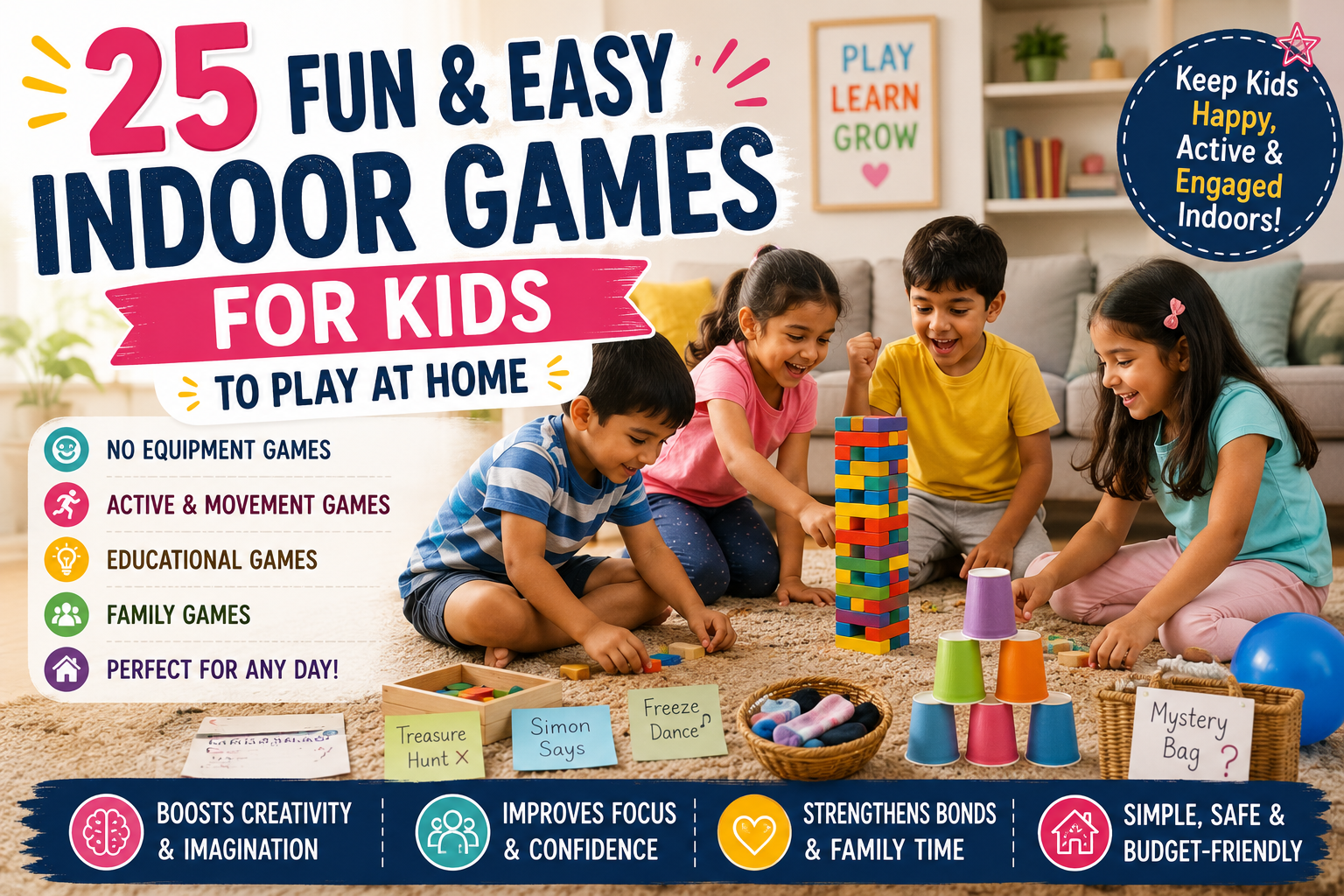
This guide brings together 25 fun indoor games for kids, including no-equipment games, active challenges, educational activities, toddler-friendly ideas and family games. Most can be adapted for apartments and small spaces.
If you are building a bigger list of screen-free ideas, explore MomSaathi’s Kids Activities collection for more family-friendly play inspiration.
Quick answer: Easy indoor games for kids include Simon Says, Freeze Dance, Balloon Keep-Up, Indoor Treasure Hunt, Sock Basketball, Memory Tray, Charades, The Floor Is Lava, Cup Bowling and Story Chain.
Indoor Games for Kids at a Glance
| Indoor Game | Best For | Players | Equipment |
|---|---|---|---|
| Simon Says | Ages 3+ | 2+ | None |
| Freeze Dance | Ages 3+ | 2+ | Music optional |
| The Floor Is Lava | Ages 4+ | 1+ | Cushions |
| Balloon Keep-Up | Ages 4+ | 1+ | Balloon |
| Indoor Treasure Hunt | Ages 4+ | 1+ | Clues |
| Sock Basketball | Ages 4+ | 1+ | Socks, basket |
| Tape Maze | Ages 4+ | 1+ | Painter’s tape |
| Memory Tray | Ages 5+ | 1+ | Household objects |
| Mystery Bag | Ages 3+ | 1+ | Bag, safe objects |
| Cup Bowling | Ages 4+ | 1+ | Cups, soft ball |
| Animal Walk Race | Ages 3+ | 2+ | None |
| Indoor Obstacle Course | Ages 4+ | 1+ | Safe household items |
| Charades | Ages 5+ | 2+ | None |
| Story Chain | Ages 5+ | 2+ | None |
| Shadow Guessing | Ages 5+ | 2+ | Light source |
| Hot and Cold | Ages 4+ | 2+ | Safe object |
| Mirror Game | Ages 3+ | 2 | None |
| Paper Dance | Ages 5+ | 2+ | Paper |
| What Changed? | Ages 5+ | 2+ | None |
| Cup Stack Challenge | Ages 5+ | 1+ | Cups |
| Alphabet Hunt | Ages 4+ | 1+ | None |
| Silent Line-Up | Ages 6+ | 3+ | None |
| Spoon Balance Walk | Ages 5+ | 1+ | Spoon, safe object |
| Indoor Mini Olympics | Ages 6+ | 2+ | Varies |
| Family Quiz Night | Ages 6+ | 2+ | Questions |
1. Play Simon Says
Simon Says is one of the easiest indoor games for children because it requires no equipment.
One person becomes “Simon” and gives instructions.
Examples:
- “Simon says touch your nose.”
- “Simon says clap twice.”
- “Simon says stand on one foot.”
- “Jump three times.”
The trick is simple: players should follow the instruction only when it begins with “Simon says.”
If the leader says:
“Touch your head!”
without saying “Simon says,” players should stay still.
Make it more interesting
Try themed rounds:
- animal actions;
- yoga-inspired poses;
- funny faces;
- slow-motion movements;
- school vocabulary.
For younger children
Do not focus heavily on elimination. Let everyone keep playing.
That keeps the activity fun instead of turning a small mistake into frustration.
2. Try Freeze Dance
Freeze Dance is ideal when children need to move.
How to play
- Play music.
- Let children dance.
- Pause the music unexpectedly.
- Everyone freezes.
- Restart the music.
Anyone who moves during the freeze can:
- do a funny pose;
- become the next music controller;
- continue playing without elimination.
Fun variations
Ask children to freeze like:
- a dinosaur;
- a superhero;
- a tree;
- a robot;
- an astronaut.
For more offline play inspiration for younger children, MomSaathi’s 15 Screen-Free Activities for Toddlers includes simple ideas designed around hands-on play rather than passive screen use.
3. Play The Floor Is Lava
This imaginative movement game can turn an ordinary room into an adventure.
How to play
Create a safe route using suitable items such as:
- cushions;
- mats;
- marked floor spots.
Children move from one safe point to another without touching the “lava.”
Add a story
Say:
“The volcano has erupted! Can you reach the rescue island?”
Safety first
Avoid:
- jumping from furniture;
- unstable chairs;
- slippery cushions;
- staircases;
- sharp-edged areas.
The goal is imaginative movement, not risky climbing.
4. Balloon Keep-Up
The challenge is simple:
Keep the balloon from touching the floor.
Children can tap it using:
- hands;
- elbows;
- knees, if safe;
- alternating hands.
Challenge ideas
Try:
- 10 taps;
- 20 taps;
- only one hand;
- partner mode;
- count aloud with every tap.
Important safety note
Balloons and broken balloon pieces can pose a serious choking risk, particularly for young children. This activity requires close adult supervision and is not appropriate where balloon fragments could be accessed by babies or toddlers.
For younger children, consider a larger lightweight soft ball instead.
5. Organise an Indoor Treasure Hunt
An indoor treasure hunt can be adapted for almost any age.
Simple clue examples
“Look where your shoes go to sleep.”
“Find the place where we keep things cold.”
“Your next clue is near something you read.”
“Look under something soft.”
For preschoolers
Use:
- pictures;
- colours;
- simple directions.
For older children
Try:
- riddles;
- number clues;
- word puzzles;
- coded messages.
Educational variation
Make every clue solve a small challenge:
“What is 5 + 3? Find clue number 8.”
This turns the hunt into a playful learning activity.
6. Play Sock Basketball
Roll clean socks into soft balls and use a:
- laundry basket;
- cardboard box;
- suitable wide container
as the target.
Create scoring zones
For example:
- close line = 1 point;
- middle line = 2 points;
- far line = 3 points.
Add maths
Ask children to calculate their own score.
Example:
Two 3-point shots + one 1-point shot = ?
This makes Sock Basketball one of the easiest educational indoor games for kids.
7. Build a Tape Maze
Use painter’s tape or another surface-appropriate removable tape to create lines on the floor.
Children can:
- follow a path;
- avoid certain zones;
- walk heel-to-toe;
- solve a maze;
- carry an object to the finish.
Add symbols
Mark:
- ★ = jump once
- ○ = turn around
- △ = clap twice
- ♥ = freeze
Important
Test tape on a small hidden area first. Some adhesives may damage flooring or leave residue.
8. Play the Memory Tray Game
This is a simple observation challenge.
You will need
A tray with safe household objects such as:
- spoon;
- pencil;
- toy car;
- comb;
- block;
- cup;
- eraser.
How to play
- Show the objects for 20–30 seconds.
- Cover the tray.
- Ask children to remember as many items as possible.
Harder version
Remove one object secretly and ask:
“What is missing?”
Important
Avoid coins, batteries, magnets, medication, sharp objects and other hazardous small items.
9. Create a Mystery Bag
Place safe familiar objects inside a cloth bag.
Possible objects:
- soft toy;
- spoon;
- large block;
- brush;
- ball;
- cup.
Without looking, the child touches one object and guesses what it is.
Ask questions
- Is it hard or soft?
- Is it smooth or rough?
- Is it round?
- Is it heavy or light?
This turns a guessing game into a vocabulary activity.
10. Set Up Cup Bowling
Arrange lightweight cups like bowling pins.
Use a soft ball to knock them down.
Simple scoring
- 1 cup = 1 point
- all cups = bonus points
Add numbers
Write numbers on reusable labels attached to the cups.
Children add the numbers they knock down.
Example:
Cups 2 + 4 + 5 = 11 points
This is an easy way to combine play with simple arithmetic.
11. Try an Animal Walk Race
Children move across a safe area while pretending to be animals.
Try:
- bear walk;
- penguin walk;
- frog-inspired jumps;
- crab-style movement, if age-appropriate;
- slow elephant steps.
Make it imaginative
Call out:
“Cross the jungle like a tiger!”
“Move slowly like a sleepy turtle!”
“Waddle to the finish like a penguin!”
Keep movements suitable for the child and available space.
12. Build an Indoor Obstacle Course
Use safe household items to create a simple route.
Possible stations:
- Walk around a cushion.
- Crawl through an open safe space.
- Step over a low marked line.
- Toss a sock into a basket.
- Balance briefly on one foot.
- Reach the finish.
Apartment-friendly version
You do not need a large room.
Create five small stations instead of one long course.
Active indoor play can contribute to a child’s overall movement across the day. The CDC child physical activity overview says children ages 3–5 should be active throughout the day, while ages 6–17 should get at least 60 minutes of physical activity daily.
13. Play Charades
One person silently acts out a word while everyone else guesses.
Easy categories for kids
- animals;
- jobs;
- sports;
- story characters;
- household activities;
- emotions.
Example prompts
Act like:
- a cat;
- a teacher;
- someone brushing teeth;
- a person swimming;
- a monkey;
- someone opening a giant gift.
For younger children
Let them choose from picture cards rather than written words.
14. Create a Story Chain
One person begins:
“Once there was a tiny elephant who lived inside a library…”
The next person adds one sentence.
Then the next player continues.
Example
Player 1:
“One day, Mira found a golden key.”
Player 2:
“The key opened a tiny door behind her bookshelf.”
Player 3:
“Inside the door was a city of talking cats.”
Continue until the story reaches an ending.
Educational extension
Ask older children to include:
- a problem;
- a character;
- a setting;
- a solution.
This encourages storytelling without making it feel like a formal writing exercise.
15. Play Shadow Guessing
Use a safe light setup to create shadows on a wall.
Children can make shapes with:
- hands;
- toys;
- safe household objects.
Everyone guesses the object.
Ask questions
- Why does the shadow get larger?
- What happens when the object moves?
- Can two objects make similar shadows?
Safety
Adults should control lamps and electrical equipment. Keep children away from hot bulbs, cords and unstable light fixtures.
16. Play Hot and Cold
Hide a safe object somewhere in the room.
As the seeker moves:
- say “warmer” when they get closer;
- say “colder” when they move away.
Variations
Use:
- “freezing”;
- “cool”;
- “warm”;
- “hot”;
- “boiling.”
Never hide objects in unsafe places such as:
- electrical areas;
- medicine storage;
- kitchens near hot appliances;
- high shelves;
- staircases.
17. Try the Mirror Game
Two players face each other.
One becomes the leader.
The other copies every movement like a mirror.
Try:
- raising one arm;
- smiling;
- turning the head;
- slow clapping;
- funny expressions.
Challenge version
The leader moves very slowly while the “mirror” tries to match perfectly.
Then switch roles.
This is a good quiet indoor game when you do not want running or jumping.
18. Play Paper Dance
Give each player a large sheet of paper or another clearly marked safe standing area.
Play music while children move nearby. When the music stops, they return to their marked spot.
Traditional variation
The standing area becomes smaller over time.
My safer recommendation
For younger children, do not force them to balance on tiny folded paper. Instead:
- change the pose;
- ask them to touch the marker with one foot;
- ask two teammates to reach the same larger zone.
This reduces unnecessary slipping and crowding.
19. Play “What Changed?”
One child studies another player or a small room setup.
Then they close their eyes.
Change one thing.
Examples:
- roll up one sleeve;
- remove a hair clip;
- move a cushion;
- turn a book around;
- swap two safe objects.
Ask:
“What changed?”
Harder version
Make two changes.
This works particularly well as a calm game before dinner or bedtime.
20. Try a Cup Stack Challenge
Give children lightweight reusable cups.
Challenge them to build:
- the tallest tower;
- a pyramid;
- a wall;
- a pattern.
Add a timer
Try:
“How many cups can you stack in 60 seconds?”
Add maths
Ask:
- How many cups are on the bottom row?
- How many altogether?
- Which tower is taller?
- What happens if the base is narrower?
Avoid glass or other breakable containers.
21. Go on an Alphabet Hunt
Ask children to find objects beginning with different letters.
Examples:
- A = apple
- B = book
- C = cup
- D = doll
For younger children
Choose only five letters.
For older children
Try:
“Find one safe object for every letter you can.”
Variation
Play a colour hunt:
- something red;
- something blue;
- something green.
This is especially useful for children who prefer searching and sorting to active movement games.
22. Try Silent Line-Up
This game works best with three or more children.
The challenge:
Line up without speaking.
Possible rules:
- shortest to tallest;
- birthday month order;
- alphabetical order by first name;
- shoe-size order.
Players can use:
- gestures;
- fingers;
- facial expressions.
This encourages teamwork and non-verbal problem-solving.
23. Set Up a Spoon Balance Walk
Give each child a spoon and a lightweight, non-hazardous object that is too large to be a choking risk.
Children walk from start to finish without dropping it.
Variations
Try:
- straight line;
- slow-motion round;
- around a marker;
- partner relay.
Safety
Do not use small hard items for young children. Avoid running, slippery floors and putting spoons in the mouth.
24. Organise Indoor Mini Olympics
Create several simple stations.
For example:
- Sock Toss
- Cup Stack
- One-Foot Balance
- Balloon Tap
- Paper Ball Target Throw
Scorecard
| Event | Score |
|---|---|
| Sock Toss | ___ |
| Cup Stack | ___ |
| Balance | ___ |
| Target Throw | ___ |
Better than “winner takes all”
Give playful awards such as:
- Best Team Spirit
- Most Creative Technique
- Biggest Improvement
- Funniest Moment
- Best Encourager
This keeps the focus broader than winning.
25. Host a Family Quiz Night
Create questions based on age and interests.
Categories
- animals;
- space;
- cartoons;
- family memories;
- school topics;
- India;
- food;
- riddles.
Example questions
Which planet is known as the Red Planet?
How many legs does a spider have?
What is the capital of India?
Which family member makes the funniest dance move?
Mix knowledge questions with silly family questions.
If your family enjoys sitting together for game time, MomSaathi also has a guide to board games for families with options for different ages and play styles.
Best Indoor Games for Kids Without Equipment
No toys available? Try these:
- Simon Says
- Charades
- Story Chain
- Mirror Game
- What Changed?
- Hot and Cold
- Animal Walks
- Silent Line-Up
- 20 Questions
- I Spy
These are useful during:
- travel delays;
- power cuts where conditions are safe;
- waiting periods;
- visits to relatives;
- rainy afternoons.
Active Indoor Games for Kids
When children have energy to use, try:
- Freeze Dance
- The Floor Is Lava
- Balloon Keep-Up
- Animal Walk Race
- Indoor Obstacle Course
- Sock Basketball
- Mini Olympics
- Tape Maze
Active indoor play can be one part of a child’s overall daily movement. For school-age children, the CDC recommends 60 minutes or more of moderate-to-vigorous physical activity each day, with age-appropriate variety.
That does not mean every indoor game counts as moderate-to-vigorous activity. Intensity depends on what the child is actually doing.
Educational Indoor Games for Kids
Want play with a learning element? Try:
- Memory Tray
- Alphabet Hunt
- Treasure Hunt
- Story Chain
- Cup Bowling Maths
- Mystery Bag
- Family Quiz
- What Changed?
- Cup Stack Challenge
Match games to interests
A child who dislikes worksheets may enjoy:
- counting points;
- solving clues;
- building towers;
- finding letters;
- inventing stories.
Learning through play does not need to look like a classroom lesson.
Parents looking for more guidance around digital and offline learning can explore MomSaathi’s Screen Time and Learning resources.
Indoor Games for Toddlers
For toddlers, choose simple games with short instructions.
Good options include:
- Simon Says with one-step actions;
- Mirror Game;
- gentle Freeze Dance;
- colour hunt;
- animal movements;
- large-object Mystery Bag.
Keep expectations realistic
A toddler may play for only a few minutes before switching activities.
That is fine.
Focus on:
- participation;
- movement;
- interaction;
- simple language;
- enjoyment.
For more age-specific ideas, see MomSaathi’s screen-free toddler activities guide.
The WHO guidelines for children under 5 address physical activity, sedentary behaviour and sleep together, reflecting the importance of considering a young child’s whole day rather than treating one game as a complete solution.
Indoor Games for 5-Year-Olds
Many 5-year-olds may enjoy:
- Treasure Hunt
- Freeze Dance
- Cup Bowling
- Alphabet Hunt
- Simon Says
- Sock Basketball
- What Changed?
- Mystery Bag
Keep rules:
- short;
- visible;
- easy to repeat.
If your child struggles with a rule, simplify it rather than immediately ending the game.
Indoor Games for Kids Ages 6–8
Try:
- Charades
- Memory Tray
- Indoor Olympics
- Tape Maze
- Treasure Hunt
- Story Chain
- Cup Stack Challenge
- Alphabet Hunt
Children in this age range may enjoy:
- points;
- teams;
- timed rounds;
- riddles;
- simple strategy.
But not every child likes competition, so cooperative versions can work just as well.
Indoor Games for Kids Ages 9–12
Older children may prefer games with more complexity.
Try:
- advanced Charades;
- coded Treasure Hunts;
- Family Quiz Night;
- Silent Line-Up;
- Story Challenges;
- Memory Tray;
- Indoor Mini Olympics;
- puzzle races.
Make a treasure hunt harder
Instead of:
“Look under the table.”
try:
“I have four legs but never walk. Your next clue waits beneath me.”
Two-Player Indoor Games for Kids
Only two children available?
Try:
- Mirror Game
- Charades
- Hot and Cold
- Cup Bowling
- Sock Basketball
- Story Chain
- What Changed?
- Memory Tray
- Cup Stack Race
- Shadow Guessing
Many group games can be adapted for two players by:
- taking turns;
- comparing scores;
- working cooperatively.
Indoor Games for the Whole Family
Family-friendly options include:
- Charades
- Quiz Night
- Treasure Hunt
- Story Chain
- Mini Olympics
- What Changed?
- Simon Says
- Cup Bowling
One useful rule:
Let children lead sometimes.
A child who creates the quiz questions or treasure-hunt clues becomes an active organiser rather than only a participant.
Rainy-Day Indoor Games
When outdoor plans are cancelled, try combining different types of play.
Sample 90-minute rainy-day plan
| Time | Activity |
|---|---|
| 15 min | Freeze Dance |
| 20 min | Treasure Hunt |
| 15 min | Snack break |
| 20 min | Cup Stack Challenge |
| 20 min | Story Chain |
This alternates:
- movement;
- thinking;
- rest;
- creativity.
Indoor Games for Small Apartments
You do not need a large room.
Good small-space options include:
- Memory Tray
- Mystery Bag
- Charades
- Story Chain
- Mirror Game
- What Changed?
- Family Quiz
- Alphabet Hunt
- Cup Stack Challenge
Avoid turning a cramped room into a running course.
Choose games that fit the actual space.
How Indoor Games Can Support Active, Screen-Free Time
Indoor games can provide opportunities for:
- movement;
- conversation;
- imagination;
- problem-solving;
- turn-taking;
- family interaction.
For children ages 3–5, the CDC says activity should be encouraged throughout the day; for ages 6–17, its guidance calls for at least 60 minutes of physical activity daily.
For families trying to balance digital habits with real-world play, MomSaathi’s Screen Time Chart by Age offers an age-based guide to consider alongside your family routine.
The key point is not that every indoor game automatically satisfies physical-activity recommendations. A quiet memory game and an energetic dance game are clearly different. Variety matters.
How to Choose the Right Indoor Game
Before starting, consider:
Your child’s age
A 3-year-old and a 10-year-old may need very different rules.
Available space
Do not choose running games for a cramped room.
Energy level
Ask:
Does my child need movement or calm?
Number of players
Some games work alone. Others need partners.
Time available
A good game can last:
- 5 minutes;
- 15 minutes;
- an hour.
Longer is not automatically better.
Your child’s interests
A child may prefer:
- movement;
- stories;
- puzzles;
- competition;
- building;
- pretending.
The best game is often the one that fits the child, not the one trending online.
Essential Indoor Play Safety Tips
Before starting active indoor games:
- clear the floor;
- remove sharp or breakable objects;
- secure unstable furniture;
- keep stairs out of the play zone;
- avoid throwing hard objects;
- supervise younger children;
- choose age-appropriate materials;
- watch for choking hazards;
- stop if the floor becomes slippery;
- give children enough personal space.
For active games, keep the challenge appropriate to the child’s abilities. The CDC’s guidance emphasizes age-appropriate and enjoyable physical activity for children and adolescents.
Frequently Asked Questions
What are the best indoor games for kids?
Popular options include Simon Says, Freeze Dance, Indoor Treasure Hunt, Sock Basketball, Charades, Memory Tray, Cup Bowling and The Floor Is Lava.
What indoor games can kids play without equipment?
Try Simon Says, Charades, Mirror Game, Story Chain, What Changed?, Hot and Cold, I Spy and animal movements.
What are good indoor games for toddlers?
Toddler-friendly options include simple Simon Says, gentle Freeze Dance, Mirror Game, colour hunts and supervised animal movements.
What are active indoor games for children?
Active options include Freeze Dance, Balloon Keep-Up, Animal Walk Race, Sock Basketball, Tape Maze and a safe indoor obstacle course.
What are educational indoor games for kids?
Try Memory Tray, Alphabet Hunt, Treasure Hunt, Story Chain, Cup Bowling Maths and Family Quiz Night.
What indoor games work in small apartments?
Memory Tray, Mystery Bag, Charades, Story Chain, Mirror Game, What Changed? and Cup Stacking need relatively little space.
What are good indoor games for 5-year-olds?
Treasure Hunt, Simon Says, Freeze Dance, Cup Bowling, Alphabet Hunt and What Changed? are easy to adapt for many 5-year-olds.
What indoor games are suitable for ages 6–12?
Try Charades, Mini Olympics, coded Treasure Hunts, Memory Tray, Quiz Night, Story Chain and Cup Stack Challenges.
How can I keep kids busy indoors without screens?
Rotate between movement, creativity and thinking games. For example, combine Freeze Dance, a Treasure Hunt and Story Chain rather than expecting one activity to fill the entire afternoon.
Can indoor games count as physical activity?
Some energetic indoor games can contribute to overall movement, but whether an activity reaches light, moderate or vigorous intensity depends on how it is performed. A quiet guessing game is not equivalent to energetic active play.
Final Thoughts
The best indoor games for kids do not require a room full of expensive toys.
A pair of rolled socks can become a basketball game. A few clues can create a treasure hunt. Cups can become bowling pins or a building challenge. A simple story prompt can keep an entire family laughing.
Start with the game that fits your child’s:
- age;
- interests;
- energy level;
- available space.
For more screen-free inspiration, continue with MomSaathi’s Kids Activities collection or explore 15 Screen-Free Activities for Toddlers for younger children.
The goal is not to keep children constantly entertained. A good indoor game simply creates an opportunity to move, think, imagine or connect.