
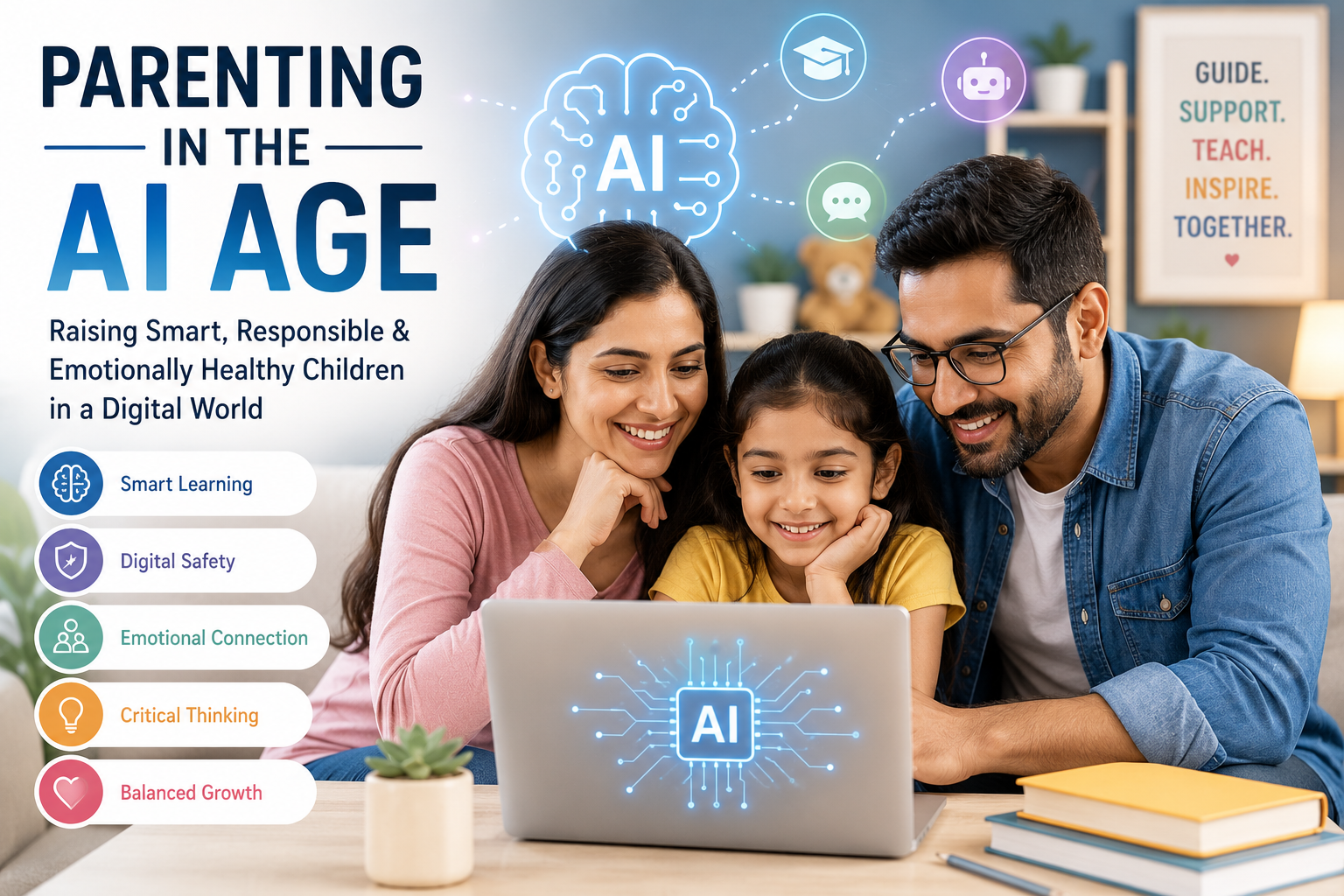

Parenting’s never been easy. The parents of each generation have their own challenges, whether it’s television, video games, smartphones or social media. But families today are facing something very different – Artificial Intelligence (AI).
Artificial intelligence is becoming a regular part of everyday life with AI-powered learning apps, smart speakers, chatbots and personalized educational platforms. Kids are growing up in a world where technology can answer questions in an instant, write stories, solve math problems, and even pretend to be your virtual friend.
This poses important questions for many parents.
- Is AI safe for children?
- What is a good dose of AI?
- Can AI help learning?
- What are the dangers?
- How do parents raise responsible, emotionally healthy children in an AI-impacted world?
In this guide, we explore the effects of AI on parenting today, the opportunities it offers, the challenges it creates, and concrete ways parents can help their children thrive in the age of AI.
What is AI and Why Should Parents Be Concerned?
Artificial intelligence is the ability of a computer system to perform tasks that normally require human intelligence.
These tasks require:
- Learning
- Problem solving
- Language understanding
- Decision making
- Pattern recognition
Today, AI is one of many tool families we use every day:
- Voice assistant
- Learning apps
- Home automation devices
- Recommended videos
- Language learning platforms
- Online tutoring tools
- Chat bots
- Tools for content creation
Many children are exposed to AI without knowing it.
As AI continues to weave its way into daily life, parents need to understand how it affects learning, communication, creativity and behavior.
How Artificial Intelligence Is Changing Childhood
Today’s children are often called “digital natives” because they have grown up in a world full of technology.
Children have access to:
- Immediate information
- Customized learning experiences
- Interactive learning tools
- Entertainment powered by AI
- Virtual support
A child can ask a smart speaker a science question, use an AI app to learn math or receive personalized reading recommendations in seconds.
These advances have great benefits, but they should also be under the guidance of parents.
Advantages of AI for Kids
When used responsibly, AI can be a valuable tool for learning and development.
1. Personalized Learning
One of the biggest benefits of AI is the ability to personalize learning experiences to individual people’s needs.
AI-powered educational platforms can:
- Identify gaps in learning
- Configure difficulty levels
- Timely feedback
- Suggest personalized lessons
It allows children to learn at their own pace.
2. Increased Accessibility
AI tools can help children with different learning needs.
Examples include:
- Text-to-speech software
- Software for speech recognition
- Help with translations
- Applications for reading support
Such technologies help create more inclusive learning environments.
3. Increasing Curiosity
Children are naturally inquisitive.
AI tools can assist with answering questions about:
- Science
- Nature
- Space
- History
- Languages
This ready access to information can drive exploration and self-directed learning.
4. Developing Creativity
Many AI tools enable children to:
- Write stories
- Make art
- Write music
- Learn to program
- Design projects
When used properly, AI can be a creative partner, not a replacement for imagination.
5. Improved Educational Support
Parents are often busy juggling work, family and household duties.
Additionally, AI-powered learning platforms can provide children with additional academic support by helping them practice skills and reinforcing learning outside of school hours.
Parenting in the Age of AI: Challenges
There are many benefits of AI, but there are also new concerns that parents need to be aware of.
1. More Time on Screen
Many of the AI tools need digital devices.
Children may spend too much time without clear limits:
- On tablets
- On mobile phones
- On computers
Excessive screen time can impact:
- Sleep
- Exercise
- Socialising
- Psychological health
2. Overreliance on Technology
Children’s overdependence on AI for answers may rob them of opportunities to develop:
- Critical thinking
- Problem solving skills
- Inventiveness
- Independent thinking
Parents should help their children learn how to think instead of looking for quick answers.
3. Data Security & Privacy
A lot of AI applications collect information about users.
Things parents need to know:
- Policies for collecting data
- Privacy settings
- Online safety dangers
Teaching children about digital privacy is becoming as important as teaching them about road safety.
4. Misinformation Exposure
AI systems sometimes provide wrong or misleading answers.
Sometimes children don’t know they are being deceived.
This highlights the importance of parental guidance when using AI-based tools.
5. Reduced Human Interaction
Real human relationships can never be replaced by technology.
Children still require:
- In-person conversation
- Time with family
- Emotional support
- Social interaction
Healthy emotional development still requires human connection.
Growing Up Responsible in the Digital Age
The goal is not to do away with technology, but to teach children how to use it responsibly.
Establish Healthy Boundaries
Establish clear rules about:
- Screen time
- Gadget-free meals
- Technology use before sleep
- Online activities
Children learn good habits through repetition.
Develop Critical Thinking
Encourage kids to:
- Pose questions
- Check facts
- Compare sources
- Use original thinking
AI should be a learning tool, not a substitute for thinking.
Stay Engaged
Parents do not have to become tech experts.
Even just getting involved can make a difference.
Ask questions such as:
- What do you find out?
- What programs are you using?
- What does this tool do for you?
Trust and awareness are built through open communication.
Focus on Digital Literacy
Digital literacy is more than using devices.
Children should be taught:
- Internet safety
- Protection of privacy
- Responsible sharing of content
- Media literacy
- Ethical use of technology
These are the skills the future demands.
Emotional Intelligence Has Never Been More Important
As technology gets smarter, human skills become that much more valuable.
It is important to give children opportunities to develop:
- Empathy
- Communication
- Perseverance
- Controlling emotions
- Relationship building skills
Technology cannot teach these qualities fully.
Parents can help children learn about feelings, solve problems, and build relationships that are important.
AI and Education: Collaborate, Don’t Replace
Some parents fear AI could replace teachers.
AI is most useful when it is used to support teachers, not to replace them.
Teachers provide:
- Emotional guidance
- Motivation
- Group learning
- Human understanding
AI can help learning, but it can’t replace the importance of good teacher-student relationships.
The best way is to combine technology with human instruction.
Real Life Parenting Advice for the AI Age
Let’s Go Offline
Balance technology with:
- Playing outside
- Reading books
- Sports
- Family games
- Creative hobbies
Be a Role Model for Healthy Tech Use
Children often imitate the behavior of adults.
If parents are always on their devices, children may develop similar habits.
Set healthy boundaries with technology.
Discuss AI Freely
Make AI simple.
Teach children to understand:
- What AI is
- How it operates
- Its advantages
- Its restrictions
Knowledge decreases confusion and encourages responsible use.
Make Human Connection a Priority
Have quality time together.
Simple activities such as:
- Family meals
- Storytelling
- Walks
- Conversations
Help establish relationships.
Learning Never Stops
Technology changes quickly.
It makes parents more aware so they can better prepare their children for what’s coming down the road.
The Future of Parenthood in an AI-Driven World
Artificial intelligence will continue to influence education, communication, entertainment and daily life.
Children growing up today will most probably do their work, learn and interact in ways that previous generations never dreamed of.
Parents should not fear technology; they should focus on helping children use technology wisely.
The children of the future who will be most successful may not be those who only know how to use AI, but those who combine technological skills with creativity, empathy, critical thinking and emotional intelligence.
Conclusion
Parenting in the age of AI is a balancing act. Artificial Intelligence presents huge opportunities for learning, creativity, and growth, but it also creates challenges that need careful navigation.
Kids need more than tech to flourish. Children need positive relationships, strong values, emotional resilience and opportunities to develop real world skills.
Through awareness, healthy boundaries, and responsible use of technology, parents can help their children confidently move forward into the digital future while remaining rooted in the qualities that make us human.
Frequently Asked Questions (FAQs)
Is AI safe for children?
AI can be safe when used under the supervision of parents and through age-appropriate platforms.
Can AI improve kids’ learning?
Yes. AI can offer personalized learning experiences and additional educational support.
Should kids use AI tools for homework?
AI can be helpful in learning, but children need to be able to think independently and understand concepts on their own.
How much screen time is okay?
The right amount depends on age but balance and quality of use is more important than total time alone.
Will AI Take Over Parenting?
No. Technology can be a help to families, but emotional guidance, values and relationships are still the parents’ job.