

Edited by: MomSaathi Editorial Team
Reviewed by: Based on women’s reproductive health and anatomical guidelines from WHO & trusted medical
You might have heard the term “anteverted uterus” if you’ve had a pelvic scan or seen a gynaecologist recently. This word can be confusing or even scary for a lot of women.
But here’s the good news: an anteverted uterus is perfectly normal and is actually the most common position for the uterus.
👉 Medical information from trusted sources like the Cleveland Clinic confirms this is a normal anatomical variation.
It gives you power to know your body. This guide will help you understand everything about an anteverted uterus in a simple, clear, and human way, whether you’re planning to get pregnant, have symptoms, or just want to know more.
What Is a Uterus That Is Anteverted?
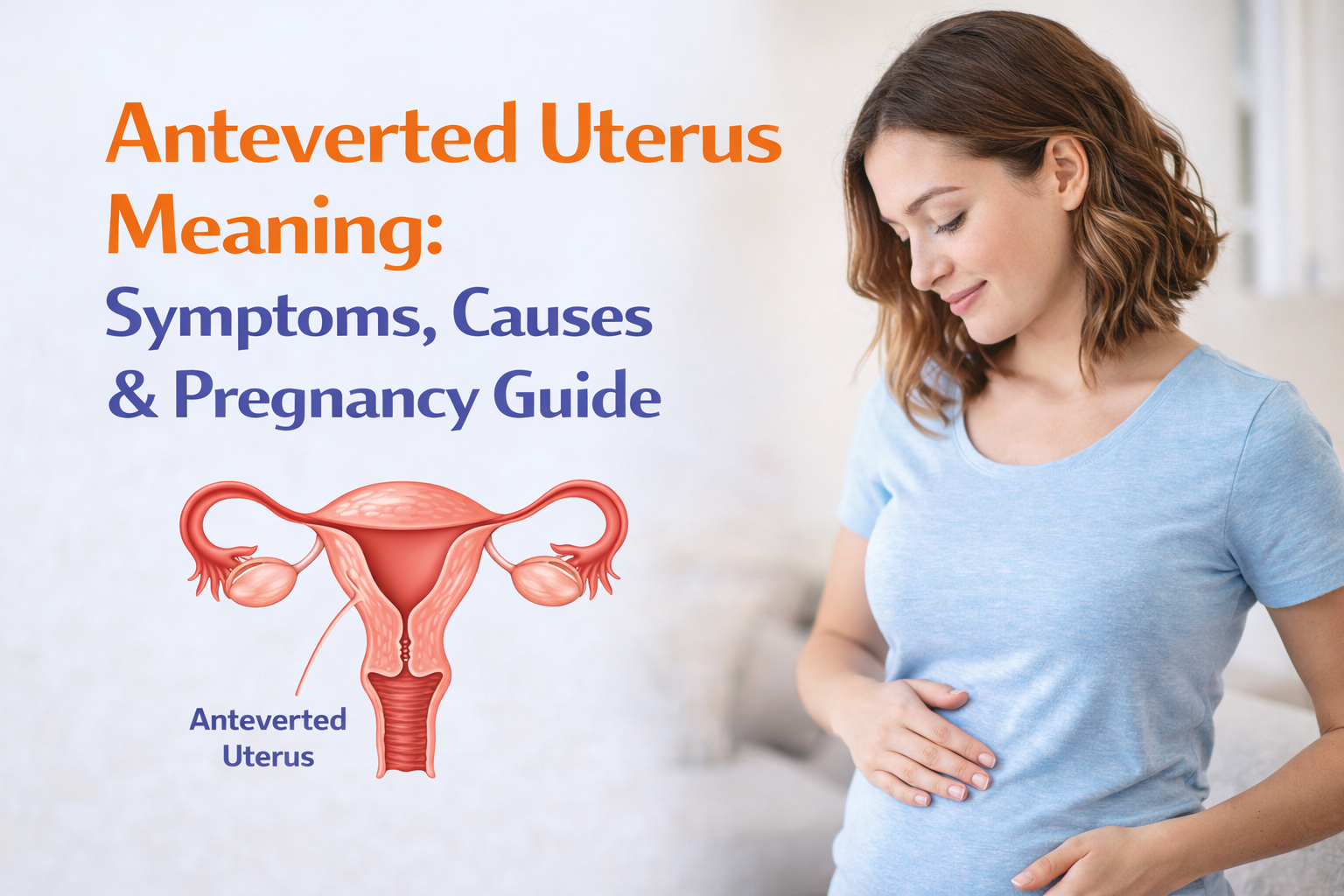
When a uterus is anteverted, it tilts forward toward the abdomen or bladder instead of backward.
Your uterus is like a small pear-shaped organ. It naturally leans forward in most women.
👉 According to Cleveland Clinic, this forward tilt is the most common and normal position for the uterus.
Key Facts:
- About 70–75% of women have a uterus that is tilted forward
- It is regarded as a typical anatomical variation rather than a medical condition
👉 Additional reproductive health insights can be explored via World Health Organization.
Where the Uterus Is (Simple Explanation)
The uterus is located in the pelvis, positioned between:
- The bladder (in the front)
- The back of the rectum
When the uterus is anteverted:
- The uterus leans forward toward the bladder
- The cervix is angled a little bit backward
This position helps support natural reproductive processes such as menstruation and pregnancy.
Uterus That Is Anteverted vs Retroverted
To get a better idea, let’s compare:
| Feature | Anteverted Uterus | Retroverted Uterus |
|---|---|---|
| Direction | Leans forward | Leans back |
| Common | Very common | Less common |
| Symptoms | Usually none | Sometimes pain |
| Health Risk | No health risk | Not often a problem |
👉 A retroverted uterus leans toward the spine, and an anteverted uterus leans toward the abdomen.
Signs of an Anteverted Uterus
Most women with an anteverted uterus don’t have any symptoms at all.
That’s why a lot of women only find out about it during a routine check-up or ultrasound.
In rare cases, you might notice:
- Some mild pain in the pelvic area
- Pain during sex
- Cramps during your period
👉 Most of the time, these symptoms are caused by something else, not the position of the uterus itself.
👉 You can explore related gynecological health topics via the National Health Service.
Why an Anteverted Uterus Happens
The main reason is simple: you were born with it.
Some common reasons are:
1. Natural Anatomy
From birth, most women have a uterus that is tilted forward.
2. Changes During Pregnancy
The uterus gets bigger and may move on its own during pregnancy.
3. Problems with the Pelvis
Things like:
- Endometriosis
- Tissue that has been damaged
- Fibroids
👉 These conditions are explained in detail by organisations like Mayo Clinic.
👉 But these things don’t cause anteversion itself; they might change the position.
Does an Anteverted Uterus Affect Pregnancy?
This is one of the most common worries, and the answer is good news:
👉 No, an anteverted uterus does NOT affect pregnancy.
- You can get pregnant normally
- Pregnancy goes as planned
- Delivery is not affected
👉 Experts at Cleveland Clinic confirm it does not impact fertility or childbirth.
Does It Change How You Look When You’re Pregnant?
Some women think that having an anteverted uterus makes the baby bump show up sooner. This can happen, but it’s not a sure thing.
Things that affect how early you show up:
- Type of body
- Tone of muscles
- First pregnancy compared to the second
- The baby’s position
👉 The position of the uterus is only a small part of it.
Is an Anteverted Uterus Good or Bad?
The short answer is:
👉 It’s not good or bad; it’s just normal.
Doctors are very clear when they say that:
- It doesn’t hurt your health
- It doesn’t change daily life
- It does not need treatment
How Do You Know If You Have an Anteverted Uterus?
You probably won’t feel or see it yourself.
Doctors figure out what it is by using:
1. Exam of the Pelvis
A regular check-up can tell where the uterus is.
2. Scan with Ultrasound
The tilt of the uterus is very clear on a transvaginal ultrasound.
👉 Diagnostic methods are also explained by Johns Hopkins Medicine.
When Should You Go to the Doctor?
An anteverted uterus is not dangerous, but you should see a doctor if you have:
- Very bad pain in the pelvis
- Sex hurts
- Periods that are heavy or not regular
- Strange discharge
👉 These signs could mean that you have another health problem.
Does It Need to Be Treated?
There is no need for treatment.
Because it is a normal position in the body:
- No drugs
- No surgery
- No changes to your way of life
👉 Unless the symptoms are caused by something else.
Can the Position of the Uterus Change Over Time?
Yes, in some cases:
- Pregnancy may change your position for a short time
- As you get older, your pelvic muscles may change
- Tilt may be affected by medical conditions
👉 But most of the time, your uterus stays in the same place throughout your life.
Common Myths About an Anteverted Uterus
Let’s clear up some things:
❌ Myth 1: It makes you unable to have children
✔ Fact: It doesn’t affect fertility
❌ Myth 2: It makes periods hurt
✔ Fact: Pain is usually caused by something else
❌ Myth 3: It needs to be treated
✔ Truth: It’s perfectly normal
Emotional Support for Women
It can be hard to hear medical terms about your body.
But keep in mind:
👉 There is no disease called an anteverted uterus
👉 There is no problem
👉 That’s just how your body is made to work
A lot of women have it and are perfectly healthy.
Tips for a Healthy Lifestyle
Even though you don’t need treatment, it’s still important to keep your reproductive health in good shape:
- Regular visits to the gynaecologist
- A healthy diet
- Keep moving
- Take care of stress
- Track your menstrual cycles
👉 You can also explore women’s health guidance via UNICEF resources.
FAQ: Anteverted Uterus
What does “anteverted uterus” mean?
It means that your uterus is tilted forward toward your stomach, which is the most common and normal position.
Is it normal for a uterus to be anteverted?
Yes, it’s perfectly normal and happens to most women.
Is it possible for me to get pregnant with an anteverted uterus?
Yes, it doesn’t affect pregnancy or fertility.
Does it hurt?
Not usually. Pain usually comes from other problems.
Does it need to be treated?
No, it doesn’t need any treatment.