
Hey mama! 👋If you’re watching your 6-month-old stare at your plate with those big curious eyes, you’re probably asking: “Is it time to start solids? How do I transition from breastfeeding without losing my milk supply or stressing my baby?”
You’re in the perfect place. At Momsaathi, we know this transition can feel exciting yet overwhelming. This complete 6-month baby led weaning guide walks you through everything — from the right signs to start, safe first foods, feeding schedules, common mistakes, and how to keep breastfeeding strong while introducing solids.
Baby-led weaning (BLW) puts your baby in charge — they self-feed soft finger foods instead of purees. It encourages independence, better oral motor skills, and a healthy relationship with food. Ready? Let’s make this transition smooth, joyful, and mess-free(ish)! 🍓
When to Start Solids: Signs Your 6-Month-Old Is Ready
The World Health Organization and AAP recommend exclusive breastfeeding for the first 6 months, then introducing solids while continuing breast milk as the main nutrition.
Your baby is ready for solids when they show most of these signs:
- Can sit with minimal support (or in a high chair)
- Has good head and neck control
- Shows interest in food (reaches for your plate, watches you eat)
- Lost the tongue-thrust reflex (no longer automatically pushes food out with tongue)
- Can bring objects to mouth and chew on them
Most babies hit these milestones around 6 months, but some may be ready a little earlier or later. Never start before 4 months.
For tracking overall development, see our guide: Baby Milestones by Month: What to Expect 0-12 Months (With Red Flags).
Why Baby-Led Weaning? Benefits for Breastfed Babies
Baby-led weaning offers many advantages over traditional spoon-feeding:
- Develops fine motor skills and hand-eye coordination
- Reduces risk of picky eating later by letting baby explore textures and tastes
- Helps with self-regulation of appetite (babies stop when full)
- Encourages family mealtimes and confident eaters
Studies show BLW babies often accept a wider variety of foods and have better chewing skills.
How to Transition from Breastfeeding to Solids: Step-by-Step 6-Month Plan
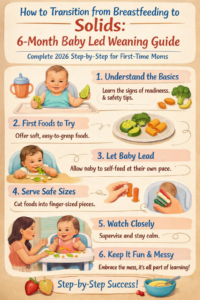
Week 1–2: First Tastes (Exploration Phase)
- Offer solids after breastfeeding (so baby isn’t overly hungry or frustrated).
- Start with 1 meal per day, 10–15 minutes long.
- Begin with soft, stick-shaped foods that baby can easily grasp (about the size of your pinky finger).
- Let baby self-feed. Expect more playing than eating at first — that’s normal!
Week 3–4: Building Confidence
- Increase to 2 meals per day.
- Introduce new single-ingredient foods every 2–3 days to watch for allergies.
- Continue breastfeeding on demand (usually 6–8 times in 24 hours).
Month 2 (Around 7–8 Months)
- Move to 3 meals per day + 1–2 snacks.
- Add more textures: mashed foods, soft lumps.
- Breast milk still provides most calories and nutrition.
Month 3–6 (8–12 Months)
- 3 meals + 2 snacks.
- Offer family foods (modified for safety).
- By 12 months, solids become the main source of nutrition, with breast milk or formula as a supplement.
Sample Daily Schedule at 6–7 Months (Breastfeeding + BLW)
- 7:00 AM – Breastfeed
- 8:00 AM – Breakfast solids (e.g., avocado strips)
- 10:30 AM – Breastfeed
- 12:30 PM – Lunch solids
- 3:00 PM – Breastfeed + snack
- 5:30 PM – Breastfeed
- 7:00 PM – Breastfeed before bed
Adjust based on your baby’s cues. For sleep support during this transition, read: Best Newborn Sleep Schedule 0-3 Months for First-Time Moms (many tips still apply at 6 months).
Best First Foods for Baby-Led Weaning (Safe & Nutritious)
Focus on iron-rich foods since breast milk iron stores start dropping around 6 months.
Top 10 Safe Starter Foods:
- Avocado slices (soft, healthy fats)
- Banana strips (ripe, mashable)
- Steamed broccoli florets or carrot sticks (soft enough to squish)
- Sweet potato wedges (roasted soft)
- Apple slices (steamed or grated)
- Iron-fortified baby oatmeal (mixed thick)
- Scrambled egg yolks (well-cooked)
- Soft pear pieces
- Well-cooked chicken or salmon flakes
- Full-fat plain yogurt (if no dairy allergy)
Foods to Avoid at 6 Months:
- Honey (botulism risk)
- Whole nuts, grapes, raw carrots (choking hazards)
- Added salt or sugar
- Cow’s milk as a drink (wait until 12 months)
External Resource: For the latest choking prevention guidelines, see the American Academy of Pediatrics safe feeding advice: https://www.healthychildren.org/English/ages-stages/baby/feeding-nutrition/Pages/Starting-Solid-Foods.aspx
Safe Feeding Practices & Choking Prevention in Baby-Led Weaning
- Always supervise meals 100% — never leave baby alone while eating.
- Offer foods in safe shapes: long strips or soft sticks that baby can hold and gnaw on.
- Cut round foods (like grapes or cherry tomatoes) lengthwise into quarters.
- Learn infant CPR — every parent should know it.
- Sit baby upright in a high chair with good support.
If you notice frequent spit-up during this transition, our guide Why Does My Baby Spit Up After Every Feeding? Safe Remedies can help.
How to Protect Your Breast Milk Supply During Weaning
Many moms worry about supply dropping. Here’s how to keep it strong:
- Continue breastfeeding before every solid meal.
- Offer breastfeeds on demand, especially at night and during growth spurts.
- Pump or hand-express if baby skips a feed.
- Stay hydrated and eat calorie-rich foods (oats, fenugreek, lactation cookies if needed).
Most moms successfully continue breastfeeding until 12 months or longer while introducing solids.
For postpartum support while juggling feeding changes, check: Postpartum Recovery Tips Week by Week for New Moms.
Common Challenges & Gentle Solutions in Baby-Led Weaning
- Baby refuses solids or gags a lot → Normal at first. Gagging is different from choking (baby will make noise). Keep offering calmly.
- Messy eating → Embrace it! Put a mat under the high chair. It’s how they learn.
- Constipation → Increase water intake and offer high-fiber fruits/veggies.
- Allergic reactions → Introduce one new food at a time. Watch for rash, vomiting, or swelling — seek medical help if severe.
Use gentle parenting approaches during mealtimes: Gentle Parenting Techniques for Newborns and Toddlers (No Cry Methods).
External Resource: Detailed baby-led weaning safety and recipes from Solid Starts (highly recommended by many pediatric feeding experts): https://solidstarts.com/
12 FAQs About Transitioning from Breastfeeding to Solids at 6 Months
- Can I start baby-led weaning before 6 months? Not recommended. Wait for developmental readiness and pediatrician’s green light.
- How much solids should my 6-month-old eat? Start with 1–2 tablespoons per meal. Breast milk remains the main nutrition.
- Will starting solids reduce my milk supply? Usually not if you continue breastfeeding on demand before solids.
- What if my baby only plays with food and doesn’t eat? Totally normal in the first weeks. Exploration is learning!
- Is pureeing better than baby-led weaning? Both work. Many families do a mix (BLW + some spoon-feeding).
- How do I know if my baby is allergic to a food? Introduce one new food every 2–3 days and watch for symptoms.
- When can my baby have water or juice? Offer small sips of water with meals after 6 months. No juice until 12 months.
- My baby gags a lot — is that choking? Gagging is loud and baby can cough. Choking is silent — learn the difference and act fast.
- Should I use baby rice cereal? It’s optional. Many BLW parents skip it and go straight to whole foods.
- When do babies usually self-feed well? Most improve dramatically between 7–9 months.
- Can I combine baby-led weaning with purees? Yes — a blended approach works great for many families.
- What if my baby has low iron levels? Prioritize iron-rich foods and discuss supplements with your pediatrician.
You’ve Got This, Mama — Enjoy the Journey!
Transitioning from breastfeeding to solids at 6 months with baby-led weaning is a beautiful milestone. It’s messy, fun, and full of firsts. Trust your baby’s cues, keep breastfeeding strong, and celebrate every new taste they try.
Save this 6-month baby led weaning guide and come back as your little one grows. The meals will get easier, the giggles louder, and the memories sweeter.
Drop your biggest question or your baby’s favorite first food in the comments below — our Momsaathi community loves sharing tips and cheering each other on!
Share this guide with any breastfeeding mama who’s about to start solids. You’re doing an incredible job nourishing your baby. 💕
This article was medically reviewed by our in-house pediatric consultant and last updated March 2026. Always consult your pediatrician for personalized advice.