
Choosing a baby girl haircut can be exciting, whether you are planning your little one’s first trim or looking for a fresh hairstyle for your toddler. From classic short bobs and pixie cuts to soft layers, natural curls and adorable ponytails, there are plenty of styles to consider.
The best haircut for a baby girl depends on her hair texture, length, comfort and how much time you want to spend on daily grooming. Some parents prefer short, easy-to-manage hair, while others love longer hairstyles that can be tied into ponytails or braids.
In this guide, you will find 20 baby girl haircut and hairstyle ideas, age-based suggestions, first haircut tips, hair care advice and answers to common questions parents ask.
Quick answer: There is no medically required age for a baby girl’s first haircut. You can trim your child’s hair when it becomes difficult to manage or when you prefer a different style. Cutting or shaving hair does not make it grow thicker or faster.
20 Cute Baby Girl Haircut and Hairstyle Ideas
Here are 20 hairstyle ideas for babies, toddlers and young girls. Each style has different grooming needs, so choose one that suits your child’s hair type and everyday routine.
1. Short Bob Haircut for Baby Girls
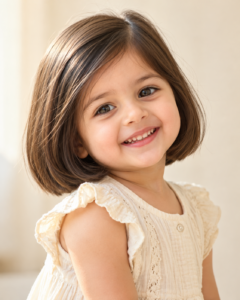
A short bob is a popular option for parents who prefer a neat, simple haircut. The hair is generally cut around the chin or jawline, although the exact length can vary.
A bob can work well for straight, wavy and some curly hair textures. It is also a practical choice when you want to reduce tangling and make everyday grooming easier.
Best for: Babies and toddlers with enough hair for a defined cut.
Maintenance: Low to moderate, depending on the length and hair texture.
2. Shoulder-Length Haircut for Baby Girls
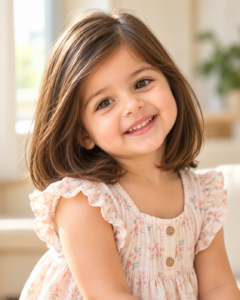
A shoulder-length haircut offers flexibility without requiring very long hair. You can leave the hair open, create a simple side part or tie it into a loose ponytail when it is long enough.
This style can suit families who want to keep their child’s hair long while making it easier to manage than very long hair.
Best for: Toddlers with straight, wavy or loosely curly hair.
Maintenance: Moderate, particularly if the hair tangles easily.
3. Pixie Haircut for Baby Girls
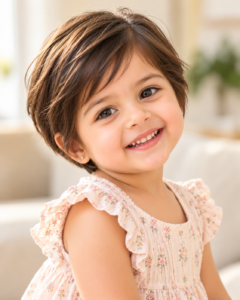
A pixie haircut keeps the hair short around the sides and back, with a little more length on top if desired. It is a good option for parents who prefer a short style that requires little daily styling.
The shape can be adjusted to suit the child’s hair texture and facial proportions.
Best for: Families who prefer very short hair.
Maintenance: Low for everyday grooming, although occasional trims may be needed to maintain the shape.
4. Layered Haircut for Baby Girls
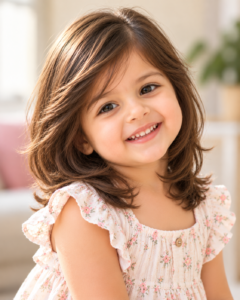
A layered haircut uses sections of different lengths to create shape and movement. It can work well for longer or thicker hair, depending on the child’s texture.
For fine hair, heavy layers may make the ends appear thinner. Ask a child-friendly hairstylist whether soft layers are suitable for your child’s hair.
Best for: Toddlers with medium-length or longer hair.
Maintenance: Moderate.
5. Baby Girl Haircut with Bangs
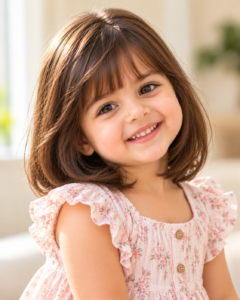
Bangs, also called a fringe, can change the appearance of a bob or longer haircut. They may be cut straight across or styled to one side.
The fringe must not obstruct your child’s vision. Because babies move unexpectedly, leave trimming near the eyes to an experienced hairstylist.
Best for: Children whose parents prefer a fringe and can maintain it safely.
Maintenance: Moderate, because the fringe may need regular trimming.
6. Curly Haircut for Baby Girls
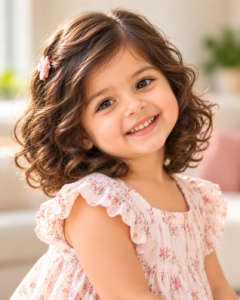
Curly hair has its own shape and may appear shorter when dry than when wet. A haircut that respects the natural curl pattern can help the hair sit comfortably without excessive styling.
Use a gentle combing routine and avoid pulling curls into tight hairstyles. A stylist experienced with curly hair can help choose a suitable length.
Best for: Babies and toddlers with naturally curly hair.
Maintenance: Depends on curl pattern and how easily the hair tangles.
7. Blunt Haircut for Baby Girls
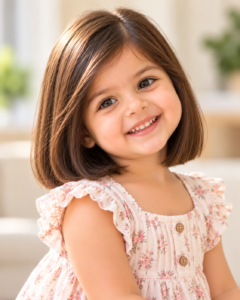
A blunt haircut has ends cut to a similar length, creating a clean outline. It can be suitable for straight or wavy hair and may give fine hair a fuller-looking edge.
This style is simple and versatile, although the ends may need trimming to maintain the shape.
Best for: Straight or gently wavy hair.
Maintenance: Low to moderate.
8. Side-Parted Hairstyle for Baby Girls
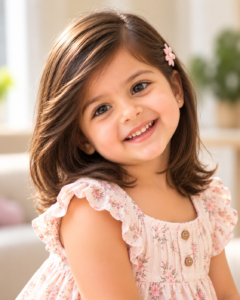
A side part is an easy way to style short or medium-length hair without changing its overall length. It can create a neat appearance for everyday activities or family photographs.
Use your fingers or a soft brush rather than pulling the hair tightly into place.
Best for: Most hair lengths that can naturally hold a side part.
Maintenance: Low.
9. Baby Girl Hairstyle with a Tiny Ponytail
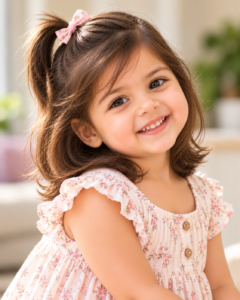
A tiny ponytail keeps longer hair away from the face and works well for everyday activities. Use a soft hair tie that does not snag or pull the hair.
Avoid tying the ponytail tightly, as repeated tension can damage hair and irritate the scalp.
Best for: Toddlers with enough hair to gather safely.
Maintenance: Low.
10. Pigtails for Baby Girls
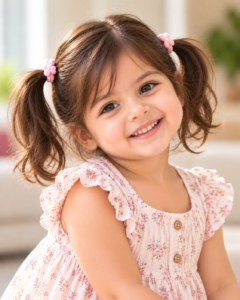
Pigtails divide the hair into two sections, one on each side of the head. They can be worn high or low depending on the child’s hair length.
Keep the sections loose and comfortable. Remove hair ties and accessories before sleep.
Best for: Toddlers with medium-length or longer hair.
Maintenance: Low to moderate.
11. Simple Braids for Little Girls
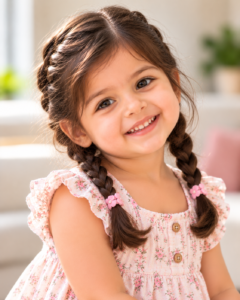
Braids help organise longer hair and can be useful for outings, playtime and special occasions. Simple three-strand braids are often easier to create than more complicated styles.
Keep braids loose and stop if the child experiences discomfort or scalp pulling.
Best for: Toddlers and young girls with longer hair.
Maintenance: Moderate.
12. Half-Up Hairstyle for Baby Girls
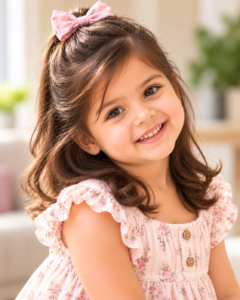
A half-up hairstyle gathers the upper section of the hair while leaving the rest loose. It is a versatile option for longer hair and can keep some strands away from the face.
Use a soft, age-appropriate hair tie and avoid small decorative pieces that could come loose.
Best for: Medium-length or long hair.
Maintenance: Low to moderate.
13. Natural Open Hairstyle
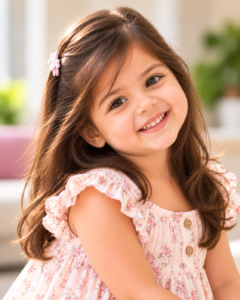
Not every hairstyle needs accessories or styling. Natural open hair can be a simple choice for everyday wear, especially when the hair is short or does not tangle easily.
Gentle brushing, suitable washing and careful detangling are usually enough for basic hair care.
Best for: All hair textures, provided the hair remains comfortable and manageable.
Maintenance: Depends on hair length and texture.
14. Baby Girl Hairstyle with Side Clips
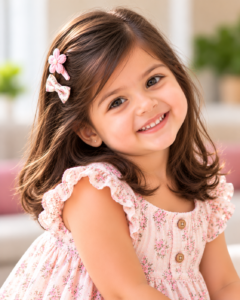
A side clip can keep a small section of hair away from the face. Choose accessories appropriate for the child’s age and make sure they are secure and do not have detachable parts.
Hair clips and small accessories can pose choking risks. Keep them under close supervision and remove them during sleep.
Best for: Older babies and toddlers under adult supervision.
Maintenance: Low.
15. Short Haircut for Fine Baby Hair
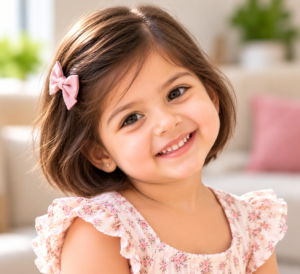
Some babies have fine or sparse hair for several months or longer. A simple trim can tidy uneven ends, but there is no need to cut the hair to make it thicker.
Hair density and texture can change naturally as children grow.
Best for: Children with fine or sparse hair.
Maintenance: Low.
16. Long Haircut for Toddler Girls
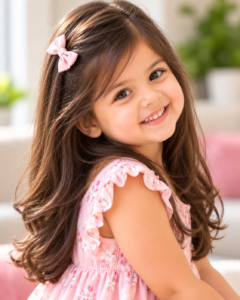
Long hair offers many styling options, including ponytails, braids and half-up hairstyles. However, longer strands may require more detangling, especially if the hair is curly or fine.
Trim the ends when needed rather than following a fixed schedule.
Best for: Families who prefer longer hair and can manage its grooming needs.
Maintenance: Moderate to high, depending on hair texture.
17. Wavy Haircut for Baby Girls
Image placement: Insert an image of a toddler girl with natural, soft waves in a medium-length haircut.
Image alt text: Baby girl with a soft wavy haircut.
Wavy hair can look lovely in a bob or shoulder-length cut. A natural shape can help the waves fall comfortably without requiring heat styling.
Avoid straightening tools and harsh chemical treatments on young children’s hair.
Best for: Babies and toddlers with naturally wavy hair.
Maintenance: Low to moderate.
18. Coily Haircare and Hairstyle Ideas
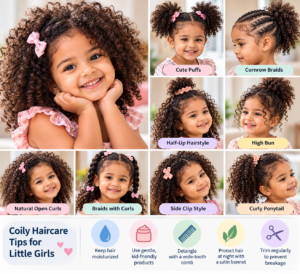
Coily hair can be delicate and may be more prone to tangling and breakage during rough brushing. A gentle routine, suitable conditioning products and careful detangling can help reduce friction.
Choose a natural style that does not place excessive tension on the hairline. Seek advice from a stylist experienced with coily hair if you are unsure which cut would work best.
Best for: Children with naturally coily hair.
Maintenance: Depends on the hair’s needs and the products used.
19. Face-Framing Haircut for Little Girls
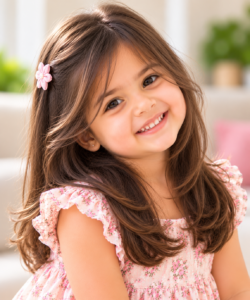
Face-framing sections can give medium or long hair a softer outline. The length should be chosen carefully so that strands do not fall into the eyes or interfere with play.
Ask a hairstylist to adapt the cut to the child’s hair texture and daily grooming routine.
Best for: Older toddlers and young girls with medium or long hair.
Maintenance: Moderate.
20. Simple Occasion Hairstyle for Baby Girls
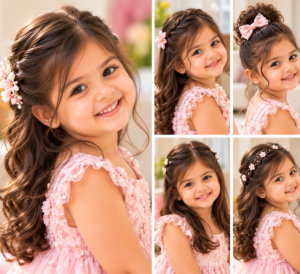
A birthday, family gathering or photograph may be a reason to try a different hairstyle. A loose half-up style, gentle side part or simple braid can create a polished look without excessive styling.
Avoid tight pulling, heat styling and products that irritate the scalp. Comfort should come before appearance.
Best for: Family events and special occasions.
Maintenance: Depends on the hairstyle.
Which Baby Girl Haircut Is Best for Each Age?
There is no fixed age for a first haircut. These suggestions are general guidance, not milestones that every child needs to follow.
Newborn to 3 Months
Newborn hair can be fine, sparse or uneven. Most newborns do not need a haircut. If hair repeatedly falls into the eyes, ask a qualified professional about a safe trim.
6 Months
Some six-month-old babies have very little hair, while others have thicker growth. A small trim is optional if the hair becomes difficult to manage.
1 Year
A simple bob or even trim may be suitable if the hair has grown enough to shape. There is no need to cut the hair just because your baby is celebrating a first birthday.
2–3 Years
Toddlers may have enough hair for bobs, shoulder-length cuts, soft layers or simple ponytails. Choose a style that can be maintained without pulling or frequent styling.
4–5 Years and Older
Older children may enjoy expressing their preferences. You can consider longer bobs, layers, fringes or longer hairstyles, depending on the child’s comfort and grooming routine.
For everyday grooming, explore our baby hair care tips to learn about gentle brushing and caring for your little one’s hair.
If your little one is still a newborn, read our newborn care tips for more guidance on everyday baby care.
As your child grows, our toddler care tips can help you navigate everyday routines and changing needs.
For more information about caring for your baby’s scalp, visit our baby scalp care guide.
You can also learn more about baby hair growth and the natural changes that happen during infancy.
How to Choose the Best Haircut for Your Baby Girl
The right haircut depends on three main factors: hair texture, length and how easily the hair can be maintained.
- Fine hair: A simple, even trim may give the ends a neat appearance.
- Straight hair: Bobs and blunt trims are often straightforward to maintain.
- Wavy hair: A natural, softly shaped cut can preserve the waves.
- Curly hair: Choose a style that accounts for how the curls sit when dry.
- Coily hair: Gentle handling and a stylist familiar with coily hair can help reduce breakage.
- Long hair: Consider whether you have time for regular detangling and comfortable hairstyles.
No haircut is required for healthy hair growth. Choose a style that fits your child’s needs rather than following a trend.
When Should You Give Your Baby Her First Haircut?
Parents can arrange a baby’s first haircut whenever they feel it is appropriate. There is no medically required age.
Consider a trim if the hair becomes difficult to manage, repeatedly falls into the eyes or develops tangles that are hard to remove gently.
Before the appointment:
- Choose a time when your child is rested and comfortable.
- Find a hairstylist experienced with babies and toddlers.
- Keep the first haircut simple and brief.
- Bring a familiar toy or book for an older baby or toddler.
- Make sure your child is safely supported throughout the haircut.
- Pause if your child becomes distressed or cannot remain safely positioned.
Babies can move suddenly, so avoid sharp scissors near the face, ears and scalp. For young infants, a professional experienced with infant haircuts is generally preferable to attempting a complicated haircut at home.
For additional guidance, consult the American Academy of Dermatology’s hair and scalp care resources
Parents can also find general child-health guidance at HealthyChildren.org, published by the American Academy of Pediatrics:
For general health information and family advice, visit the UK National Health Service
Does Shaving a Baby Girl’s Head Make Her Hair Grow Thicker?
No. Shaving or cutting a baby’s hair does not make it grow thicker, faster or darker.
Hair growth and texture are influenced by genetics, age and normal development. Newly cut hair can feel coarser because the ends are blunt, but shaving does not change the hair follicles beneath the scalp.
Parents do not need to shave their baby’s head to encourage healthy hair growth. Gentle hair care and appropriate nutrition support general health.
If your child develops sudden hair loss, bald patches, persistent scalp redness or scaling, consult a qualified healthcare professional.
What Is the Mundan Ceremony?
Mundan, also called the first-hair ceremony in some Hindu traditions, involves shaving or removing a child’s hair according to family custom. The timing and practices vary across communities and families.
Some families observe Mundan for girls, while others do not. The ceremony is a cultural or religious choice, not a medical requirement for healthy hair growth.
Families who choose to observe Mundan should prioritise clean equipment, careful handling and protection against scalp cuts or irritation.
Baby Girl Haircut Safety Tips
A baby’s scalp and skin need gentle care. Follow these precautions during a haircut:
- Choose a child-friendly salon with clean equipment.
- Keep sharp tools away from the child’s face and ears.
- Never leave a baby unattended with grooming tools.
- Do not force a haircut if your child is struggling.
- Avoid harsh chemical treatments, dyes and straightening products.
- Remove small hair accessories during sleep.
- Check the scalp for cuts or irritation after the haircut.
For babies who cannot sit safely, postpone the haircut or seek a professional who is experienced with infants.
How to Care for Your Baby Girl’s Hair After a Haircut
Use a mild shampoo suitable for your child’s age and wash the hair as needed. A soft brush or comb can help with gentle grooming.
For longer or curly hair, detangle carefully instead of pulling knots. Avoid tight hairstyles that repeatedly pull at the roots.
Hair oils may help lubricate hair and reduce friction, but they have not been shown to make a baby’s hair grow faster. Stop using a product if it causes irritation. If the scalp has been shaved, protect it from excessive sun exposure.
Frequently Asked Questions About Baby Girl Haircuts
1. What is the best age for a baby girl’s first haircut?
There is no fixed age. Parents can arrange a trim when the hair becomes difficult to manage or when they prefer a different style.
2. Which haircut is best for a one-year-old girl?
A simple bob or even trim can be practical for a one-year-old. The best choice depends on the child’s hair texture, length and comfort.
3. Can I cut my baby girl’s hair at home?
A minor trim may be possible for an older, calm child with suitable precautions. For infants and children who move unpredictably, a professional experienced with young children is generally preferable.
4. Does cutting baby hair make it thicker?
No. Cutting hair does not change the follicles or make hair grow thicker or faster.
5. Is shaving a baby girl’s head necessary?
No. Shaving is not medically necessary. Whether to observe a first-hair ceremony is a personal and cultural decision.
6. Which hairstyle is easiest to maintain for a baby girl?
A simple bob, natural short hair or an even trim can be easy to manage. The best choice depends on the child’s hair texture and how easily it tangles.
7. How often should a baby girl’s hair be cut?
There is no required haircut schedule. Trim the hair when needed to maintain the preferred length or shape.
8. Can baby girls have bangs?
Yes, bangs can be an option, but the hair should not obstruct the child’s vision. Have the fringe trimmed carefully by an experienced hairstylist.
9. How can I help my baby girl’s hair stay healthy?
Use gentle washing and brushing, avoid tight hairstyles and choose age-appropriate hair products. Seek medical advice if you notice persistent scalp irritation or unusual hair loss.
10. Should I use hair oil to make my baby’s hair grow faster?
Hair oil may reduce friction, but it has not been shown to accelerate hair growth. Use products suitable for your child’s age and stop if irritation occurs.
Final Thoughts
The best baby girl haircut is one that suits your child’s hair texture, comfort and everyday routine. A short bob, shoulder-length cut, natural curls or simple ponytail can all be good choices.
There is no need to rush the first haircut or shave your baby’s head to improve hair growth. Choose a style that makes grooming easier and keeps your little one comfortable.
At MomSaathi, our goal is to help parents find practical, easy-to-understand information about baby care, child development and everyday parenting.