


Edited by: MomSaathi Editorial Team
Reviewed by: Board-certified Obstetricians and prenatal screening experts
The moment you see that positive pregnancy test, your mind starts racing. You wonder about nurseries, tiny outfits, and names. But the biggest question of all usually is: “Is it a boy or a girl?”
Waiting for the big reveal is one of the most exciting (and sometimes impatient) parts of the journey. While old wives’ tales might suggest your cravings or the shape of your “bump” hold the secret, science has a much more reliable timeline.
If you are wondering when can I know the sex of the baby, you aren’t alone. In this guide, we’ll walk through the medical milestones, the different types of tests available, and the earliest dates you can circle on your calendar.
When Can You Actually Find Out?
While the baby’s sex is determined the very second the sperm meets the egg, it takes time for the physical characteristics to develop enough for us to see them.
Generally, most parents find out the sex during the mid-pregnancy ultrasound, which typically happens between 18 and 22 weeks. However, with modern technology, there are ways to find out much earlier.
The Timeline of Discovery
1. Noninvasive Prenatal Testing (NIPT) – 10+ Weeks
This is currently the earliest way to know the sex through a medical screen. The NIPT is a simple blood test that looks for tiny fragments of the baby’s DNA in your bloodstream.
-
Reliability: Over 99% accurate for sex determination.
-
Primary Purpose: To screen for chromosomal conditions like Down syndrome.
2. Nuchal Translucency (NT) Scan – 11 to 13 Weeks
During this first-trimester ultrasound, some technicians may look at the “nub” (the early genital development). While it’s fun to guess, it is far less reliable than later scans.
3. Mid-Pregnancy Anatomy Scan – 18 to 22 Weeks
This is the “gold standard” for most families. By this stage, the external genitalia are fully formed.
-
The “Wait” Factor: Sometimes, a shy baby might be curled up or crossing their legs, making it impossible for the sonographer to see clearly!
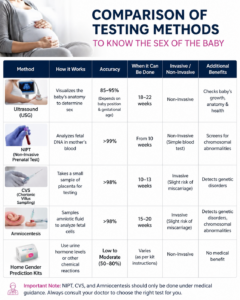
Comparison of Testing Methods
| Method | Earliest Timing | Accuracy | Type of Test |
| NIPT Blood Test | 10 Weeks | Very High | Blood Draw |
| NT Ultrasound | 11-13 Weeks | Moderate | Ultrasound |
| Anatomy Scan | 18-22 Weeks | High | Ultrasound |
| Amniocentesis | 15-20 Weeks | 100% | Invasive Procedure |
Why Timing Matters
Knowing the sex isn’t just about the “reveal.” For many parents, it helps with:
-
Bonding: Giving the baby a name or a gendered pronoun can make the pregnancy feel more tangible.
-
Planning: From choosing a theme for the nursery to sorting through hand-me-downs.
-
Medical Preparedness: Some genetic conditions are linked to biological sex, so knowing early can help doctors prepare for specialized care.
Common Myths vs. Reality
In India and across the globe, there are endless myths about predicting sex. Let’s clear the air:
-
Heart Rate: Some say a fast heart rate means a girl. Reality: There is no scientific link between heart rate and sex.
-
Cravings: Sweets for a girl, spicy for a boy? Reality: Cravings are hormonal and nutritional, not gender-based.
-
The “Belly” Test: Carrying high or low. Reality: This depends on your muscle tone, body type, and the baby’s position.
A Note on Legal Regulations in India
It is important to remember that in India, the PCPNDT Act (Pre-Conception and Pre-Natal Diagnostic Techniques Act) strictly prohibits the detection or disclosure of the baby’s sex before birth.
While parents in many other countries can choose to find out, healthcare providers in India are legally bound to keep this information confidential to prevent gender-biased sex selection. The focus of every ultrasound in India remains strictly on the health and development of the baby.
Tips for the Waiting Game
If you are in a region where you are waiting for the birth to find out, or if you’ve chosen to keep it a surprise:
-
Focus on the Milestones: Celebrate the first kick, the first heartbeat, and every clear health report.
-
Gender-Neutral Prep: Earth tones, greens, and yellows make for beautiful, modern nurseries.
-
The Ultimate Surprise: There is nothing quite like the moment a doctor says “It’s a…” in the delivery room!
Conclusion
The question of when can I know the sex of the baby depends largely on the type of testing you choose and the legal guidelines of your country. Whether you find out at 10 weeks, 20 weeks, or on the day of delivery, the most important part of the journey is a healthy pregnancy and a happy arrival.
📚 Trusted Medical Resources
For deeper clinical insights on prenatal testing and fetal development, we recommend these global health authorities:
FAQs About Knowing Your Baby’s Gender During Pregnancy
Is an ultrasound at 12 weeks accurate for sex?
It is about 70-80% accurate. Because the “nub” looks very similar for both boys and girls at this stage, most doctors recommend waiting until 18-20 weeks for a visual confirmation.
Can the NIPT test be wrong?
While extremely rare, errors can happen due to low fetal DNA in the mother’s blood or if there was a recent vanished twin. It is generally 99% accurate.
Why didn’t the sonographer tell me the sex at 20 weeks?
This usually happens if the baby is in a “breech” position or has their legs tightly tucked, blocking the view of the genitals.
Are home “gender prediction” kits reliable?
Most over-the-counter kits that use urine are not scientifically proven and are considered for “entertainment purposes only.”
Does the mother’s diet affect the baby’s sex?
No. The sex is determined solely by the chromosome carried by the father’s sperm (X or Y) at the moment of conception.