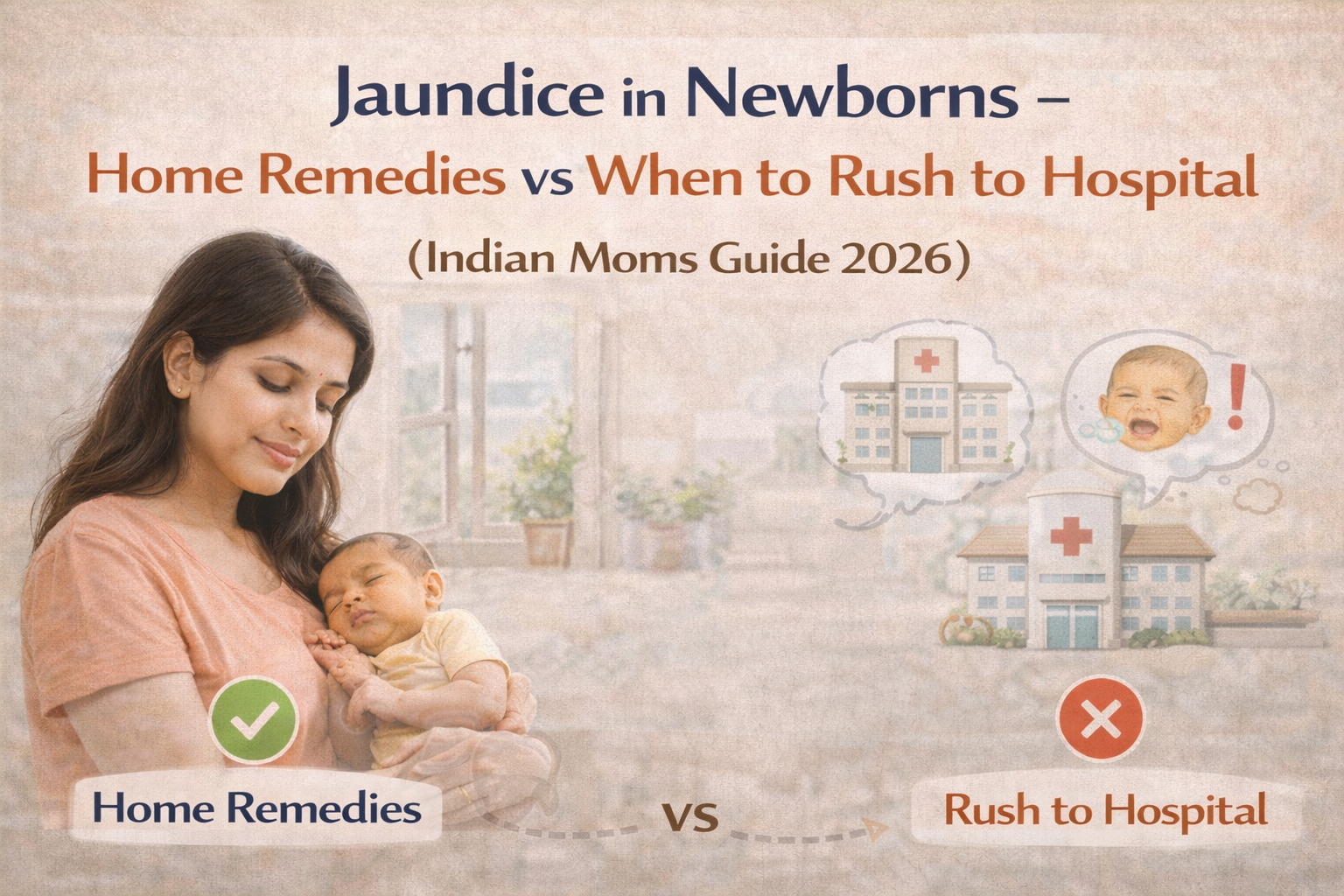

Newborn jaundice spikes every summer and monsoon in India due to heat, dehydration risks, and infections. Many moms notice yellow skin/eyes in their baby and wonder: Can I manage with home remedies, or is it time for hospital?
Most cases are physiological (harmless) and resolve in 1–2 weeks, but high bilirubin can lead to serious issues like kernicterus if ignored. This guide explains symptoms, safe home care (focusing on breastfeeding), common myths (like direct sunlight), phototherapy truth, bilirubin levels chart, and clear signs to rush to hospital.
What Is Newborn Jaundice & Common Symptoms in Indian Babies
Jaundice happens when excess bilirubin (yellow pigment from red blood cell breakdown) builds up because the newborn liver is immature. It affects 60% of term and 80% of preterm babies in India.
Key Symptoms:
- Yellow skin (starts on face, spreads to chest, belly, legs)
- Yellow whites of eyes
- Drowsiness or poor feeding
- Dark urine (should be pale) or pale stools
- In severe cases: lethargy, high-pitched cry, arching back (emergency!)
Physiological jaundice peaks at 3–5 days and fades by 2 weeks. Pathological (serious) starts early (<24 hours) or lasts longer.
(Alt text suggestion for image: “newborn jaundice symptoms yellow skin eyes Indian baby”)
Safe Home Care & Remedies for Mild Newborn Jaundice in India
For physiological jaundice (most cases), focus on supporting the baby’s natural elimination of bilirubin:
- Frequent Breastfeeding – The #1 “remedy” per IAP and pediatricians. Feed every 2–3 hours (8–12 times/day). Breast milk helps flush bilirubin via stools. Avoid stopping breastfeeding – it worsens jaundice.
- Ensure Good Hydration & Feeding – Watch for wet diapers (6+ daily) and stools. Poor intake causes “breastfeeding jaundice” from dehydration.
- Gentle Sun Exposure Myth Bust – Direct sunlight is NOT recommended! UV rays risk burns/dehydration; it’s a myth in India. Filtered/indirect morning light (near window, not direct) may help mildly but is NOT a substitute for treatment. AAP/IAP say no to sunbathing.
- Monitor & Comfort – Keep baby cool in summer/monsoon; avoid overheating.
Important: No turmeric, papaya leaves, or herbal mixes for newborns – they can be harmful. Always consult pediatrician before any remedy.
(Alt text suggestion: “frequent breastfeeding newborn jaundice home care India”)
Bilirubin Levels Chart: When It’s Normal vs Dangerous (India Guidelines)
Use age-specific total serum bilirubin (TSB) levels (from IAP/AAP-aligned Indian protocols for term babies ≥35 weeks):
| Age (hours/days) | Normal/Physiological Range (mg/dL) | Phototherapy Threshold (approx.) | High Risk/Exchange Transfusion |
|---|---|---|---|
| 24 hours | <8–10 | >12–15 | >19–20 |
| 48 hours | <12–15 | >15–18 | >22 |
| 72 hours | Peak <15–18 | >18–20 | >24 |
| >1 week | Declining <12–15 | >20+ or persistent | >25 |
- Low risk: Term baby, no hemolysis.
- Medium/High risk: Preterm, dehydration, hemolysis, G6PD (common in India).
Get TSB test if yellowing spreads fast or baby seems unwell. Home TcB devices help monitor but confirm with blood test.
(Alt text suggestion: “newborn jaundice bilirubin levels chart India 2026 guidelines”)
Phototherapy Truth: The Main Hospital Treatment
Phototherapy (blue light) breaks down bilirubin safely in skin – gold standard in India.
- Baby placed under special lights (eyes masked, diaper only).
- Intensive for high levels; home phototherapy possible in mild cases.
- Duration: 1–2 days usually; monitor rebound. No proven risks like bronze baby in most cases.
Avoid myths – phototherapy is evidence-based, not “harsh”.
When to Rush to Hospital Immediately (Red Flags for Indian Moms)
Rush to pediatrician/NICU if:
- Jaundice appears in first 24 hours
- Yellowing spreads to arms/legs/palms/soles
- Bilirubin rising fast (>5 mg/dL/day) or >15–18 mg/dL (check test)
- Baby lethargic, refuses feeds, high-pitched cry, arching
- Fever, poor weight gain, dark urine/pale stools
- Family history of G6PD, Rh incompatibility
In summer/monsoon, dehydration worsens it – hospital for IV fluids/phototherapy if needed. Early checks prevent complications.
Final Thoughts for Indian Moms
Newborn jaundice is common and often harmless with good feeding and monitoring. Frequent breastfeeding is your best “home remedy” – myths like direct sunlight can harm more than help. Watch bilirubin levels and rush for tests/treatment if red flags appear. Most babies recover fully with timely care.
Momsaathi.com provides content for informational and educational purposes only. It is not intended to serve as a substitute for professional medical advice, diagnosis, or treatment. If your newborn shows jaundice signs (yellow skin/eyes, poor feeding, lethargy), consult a pediatrician immediately for bilirubin test and guidance.
Frequently Asked Questions (FAQs)
Is sunlight safe for newborn jaundice in India?
No – direct sunlight risks burns/dehydration; it’s a myth. Filtered window light may help mildly, but phototherapy is the proven treatment.
What home remedies work for newborn jaundice?
Only frequent breastfeeding/hydration. Avoid herbs/turmeric – consult doctor first.
When does newborn jaundice need hospital treatment in India?
If bilirubin >15–20 mg/dL (age-dependent), appears early, or baby unwell – phototherapy often needed.
Does breastfeeding cause jaundice?
Not usually – “breastfeeding jaundice” from poor intake; feed more often to help.
What bilirubin level is dangerous for newborns?
20–25 mg/dL risks kernicterus; monitor closely with tests.
Related Articles on Momsaathi.com:
- Newborn Care Basics India 2026 – First Month Guide
- Breastfeeding Tips for Indian Moms – Overcoming Challenges
- Common Newborn Health Issues Summer Monsoon India
External Resources: